Qtenboard Interactive Panel Kiosk Digital Signage Manufacture_Factory Video_Video_Qtenboard

Your Position >  Home  >  Video  > Factory Video  > 

Qtenboard Interactive Panel Kiosk Digital Signage Manufacture

Factory Tour · Qtenboard Manufacturing · Shenzhen, China · Updated 2026

When a distributor asks "can you actually deliver 500 units by Q3?" the honest answer lives on the factory floor — not in a sales deck. This page shows you what Qtenboard's manufacturing facility actually looks like, what it can do, and why full vertical integration matters when you're sourcing interactive whiteboards, digital signage, or kiosks at scale.


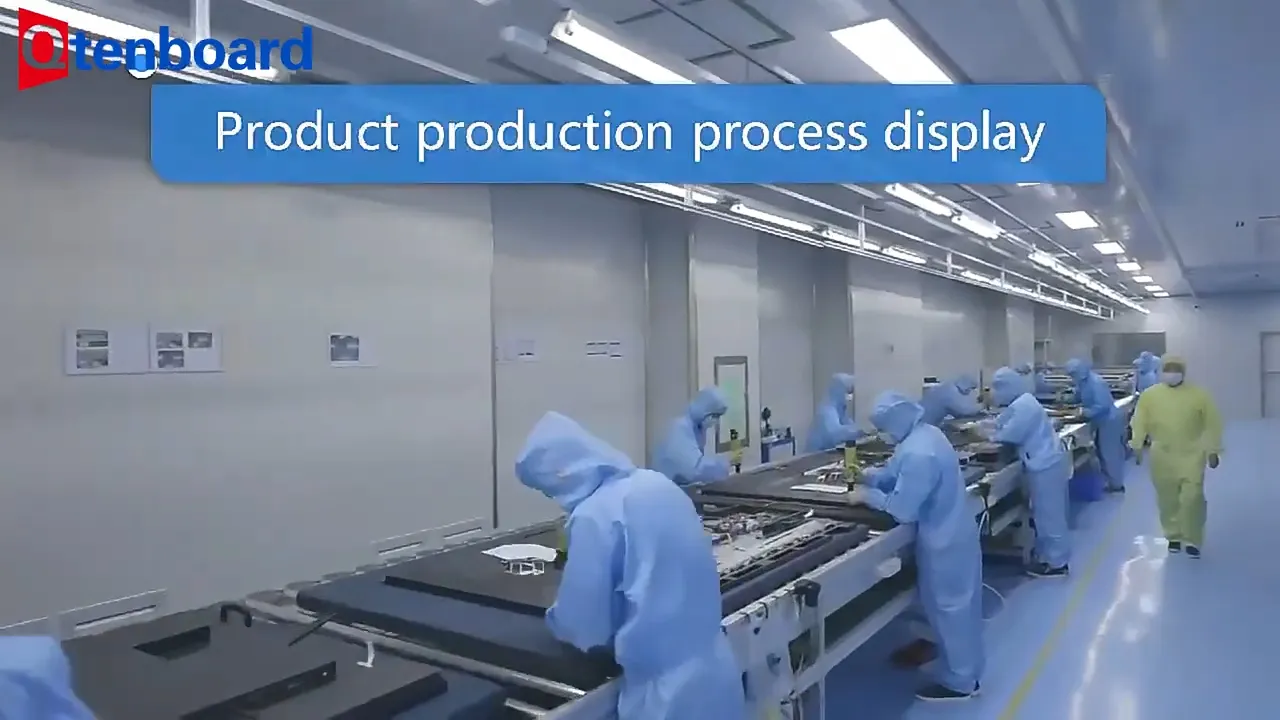
Qtenboard factory tour — interactive whiteboard, digital signage, kiosk, and LCD video wall manufacturing lines, Shenzhen, China


A Factory Built for Commercial Display Manufacturing at Scale

Qtenboard operates from a purpose-built industrial park in Shenzhen, China — one of three manufacturing sites the company operates. The Shenzhen facility is the primary production hub for interactive flat panels and digital signage, with end-to-end in-house capability covering PCB assembly, structural fabrication, touch panel bonding, firmware loading, aging tests, and final quality inspection before shipment.

What this means in practice: a customer placing an OEM interactive whiteboard order does not depend on sub-contractors for the parts that determine product reliability. Mainboard assembly, metal chassis fabrication, glass panel cutting, and plastic injection molding all happen under the same roof — under the same quality management system.

330,000
m² manufacturing area
1,000+
skilled workers
200+
units per day output
20+
years in operation


What the Factory Actually Manufactures In-House

Most display manufacturers in China are assembly operations: they buy panels, buy mainboards, buy chassis from separate suppliers, and bolt them together. Qtenboard's vertical integration model is different. The factory produces or controls the following processes internally:

  • 🔧
    SMT (Surface Mount Technology) Lines — PCB Assembly Automated SMT lines handle mainboard and sub-board PCB assembly. Components are placed and soldered under controlled temperature profiles. This process covers the 9679, 3576, V100, and Genio 520 mainboards used across Qtenboard's interactive whiteboard product range.
  • 🪟
    Touch Panel Fabrication & Bonding IR touch frames are manufactured and bonded to display panels in-house. Touch accuracy, multi-point response time, and linearity are tested at this stage — before the panel enters final assembly.
  • 🏗️
    Metal Processing — Chassis & Frame Fabrication Sheet metal cutting, bending, and powder coating for interactive whiteboard enclosures and wall-mount frames. In-house metal processing enables dimensional control that matters for flush wall installations and custom OEM enclosure designs.
  • 💉
    Plastic Injection Molding Plastic components — bezels, corner pieces, port covers — are injection-molded on-site. OEM partners specifying custom colors, textures, or branding features on exterior plastic parts get those changes manufactured without involving a third-party plastics supplier.
  • 💾
    Firmware Loading & Software Pre-Configuration Android OS, OEM launcher, pre-installed applications, device management agent, and regional settings are flashed and validated on every unit before it enters aging test. This step is where OEM software customization — branded UI, kiosk mode, restricted access profiles — gets applied.
  • 📦
    Smart Warehousing & Component Buffer Stock Upgraded smart warehousing with ESD-safe storage and material tracking covers key components including mainboards, touch frames, and panels. Buffer stock is maintained against the production schedule — a factor that directly affects lead time reliability for large orders.


How Every Panel Is Tested Before It Ships

Interactive whiteboards operate 6–10 hours per day in schools and conference rooms. A panel that passes a five-minute bench test and then fails three months into a school year creates a warranty claim, a logistics problem, and a credibility problem for the distributor who sold it. Qtenboard's quality control process is designed to catch those failures before the unit leaves the factory.

Step 01
Incoming Component Inspection
Display panels, mainboards, and touch frames are inspected on arrival before entering production. Panels are tested for pixel uniformity, backlight consistency, and dead pixels. Mainboards are spot-tested for power stability before PCB assembly begins.
Step 02
Post-Assembly Functional Test
Every assembled unit is powered on and tested for touch accuracy across all 20 touch points, display color calibration, speaker output, camera function, port connectivity (HDMI, USB, Type-C, OPS), and wireless module registration.
Step 03
Aging Test — 24-Hour Burn-In
Units run continuously in an aging chamber at elevated temperature for a minimum of 24 hours. Thermal stability, fan-free passive cooling behavior, and sustained display brightness are monitored. Units that show any thermal throttling or instability are flagged and returned for investigation before proceeding.
Step 04
Structural & Drop Integrity Check
Enclosure integrity, port alignment, bezel fit, and stand/mount bracket connection points are inspected. For OEM orders with custom enclosures, dimensional tolerances are verified against the approved engineering drawings before bulk production proceeds.
Step 05
Software & Firmware Validation
OEM firmware, pre-installed applications, DMS agent registration, and access control profiles are validated on a random sample from each production batch. Boot animation, launcher behavior, and restricted settings menus are confirmed against the customer's approved configuration specification.
Step 06
Final Inspection & Packaging
Panel surface, ports, accessories, and packaging integrity are inspected before the unit is sealed. OEM orders are packaged with customer-branded outer cartons where required. Shipping marks, country-of-origin labeling, and certification documentation are verified against the purchase order before dispatch.
What this means for an OEM partner

A unit that leaves Qtenboard's factory has been powered on, aged, tested for touch and display, validated for software configuration, and inspected structurally — before it enters the shipping carton. Your warranty claim rate is determined largely by what happens in those six steps, not by the spec sheet.


What "Factory-Direct" Actually Means for an OEM Buyer

Working directly with a manufacturer rather than through a trading company changes what customization is possible and how quickly it happens. At Qtenboard, OEM and ODM customization is handled by the same engineering team that designs the base product — not outsourced to a separate contract manufacturer who has to relay information back.

Customization Area What Is Configurable
Hardware Branding Logo on front bezel and rear panel, custom color options for plastic components, branded packaging (outer carton, foam insert printing, accessory labels)
Software & UI Boot animation, launcher theme, pre-installed app set, restricted settings menus, kiosk mode configuration, DMS agent setup, language packs
Panel Size 55″, 65″, 75″, 86″, 98″, 105″, 110″ standard. Custom sizes available under ODM arrangement
Connectivity OPS slot (Windows module), USB 2.0 / 3.0 port count, HDMI in/out configuration, Type-C with or without power delivery, front-facing camera selection
Export Format Fully built unit (CBU), CKD for local assembly in Brazil / India / Indonesia, SKD for partial local assembly. Includes assembly documentation and technical support
Certifications CE, FCC, RoHS standard. UKCA, BIS, SASO, EAC, NOM on request — specify target markets at quotation stage
MOQ Evaluation samples available for qualified partners. Production runs from 100 units for standard configurations
Lead Time Standard: 25–35 working days. ODM / custom enclosure: 45–60 working days. Sample units: 7–10 working days


Questions Distributors & Buyers Ask When Evaluating a Factory

Q Can we visit the factory before placing a bulk order?
Yes. Factory visits are welcome for qualified partners evaluating Qtenboard as a supplier. The facility is located in Longhua District, Shenzhen, and tours can be arranged with advance scheduling. If an in-person visit is not practical, our team can conduct a live video walkthrough of the production lines, QC chambers, and R&D lab on request. Contact our commercial team to arrange either.
Q What is the realistic daily production capacity for interactive whiteboards?
Standard daily output is 200+ units across the interactive whiteboard product lines. For large orders requiring dedicated production runs — school district deployments, government tenders, or enterprise campus rollouts — production scheduling is confirmed at the purchase order stage. Buffer stock of key components (mainboards, panels, touch frames) is maintained to reduce scheduling risk.
Q How does Qtenboard handle quality control for OEM orders with custom configurations?
OEM orders with custom software, firmware, or hardware configurations go through the same six-stage QC process as standard products — with an additional validation step specific to the OEM configuration. Before bulk production begins, a pre-production sample (typically 3–5 units) is produced and approved by the partner against the agreed specification. Bulk production proceeds only after written sign-off on the sample. This prevents configuration errors from propagating through an entire production run.
Q What makes Qtenboard different from a trading company selling display products?
A trading company sources products from third-party factories and resells them. They cannot modify the product, cannot respond to custom requirements at the engineering level, and cannot give you a meaningful answer about why a quality issue occurred. Qtenboard manufactures the products it sells — the engineers who can modify the mainboard firmware, adjust the chassis dimensions, or change the touch sensitivity profile are on-site. For an OEM partner, that means custom requests take days rather than weeks, and quality problems have a traceable root cause rather than a shrug.
Q Does Qtenboard support CKD/SKD export for local assembly in our market?
Yes. Complete Knock-Down (CKD) and Semi-Knock-Down (SKD) export is supported for markets where local assembly reduces import duties or satisfies local content requirements — including Brazil, India, Indonesia, and other markets with preferential tariff schemes for locally assembled electronics. Qtenboard provides the component kits, assembly documentation, and technical support. If you are building a local assembly operation and need to understand what that partnership looks like structurally, contact our team with your target market and intended volume.
Q Which product lines does this factory produce?
The Shenzhen facility produces interactive flat panels (55″–110″, education and enterprise configurations), digital signage displays (indoor and outdoor, multiple brightness tiers), payment kiosks, queue management kiosks, information kiosks, LCD video walls (standard and narrow-bezel configurations), and Stand By Me portable TV units. All product lines share the same SMT, assembly, aging test, and QC infrastructure — so capacity can be allocated across product lines based on order mix.

Ready to source from the factory directly?

Request a factory sample, arrange a visit, or speak with our OEM team about your project. We reply within 24 hours.

Recommended videos