Выбіраючы Тэкст Чадка вызначыць ад кіноду. Уласцівасці, дистриблівальнікі і сістэмныя інтегратары сапраўды выбраць шматгоду прароднагах: Кантакт і паказаць якасць, глыбіня, кантрольны прыродак, сертыфікаты, дакладны час, і падтрымка запрадываць ці будзе абарзець лінію продукту або спакойна змену. Маленькі паходна магчыма можа быць стаць найраго лінія на табліцы, калі раз раз працыцца, затрымоўваць паведамленні, Працоўныя сертыфікацыі і не падтрымліваецца формер
Яшчэ дзве пасткі хаваюцца за параўнаннем цэн. Першы, OEM, ODM, белы тэкст, CKD, і SKD не змяніць сервіс - яны яны трэба вельмі розныя глыбокы адпавядаць глыбоку, прылад, MOQ, і час да маркету. Другі, прапаўвальнік, які могуць хутка звучаць, не трэба выкарыстання. Адрозненне між выконструювання ўдомы, частковую вывадрування і трэўная кампанія змяняе усё аб кантэлінацыі, хуткасць настаўленняў, і адпраўкі.
Гэтая наставіць напісаны для ўласнікамі бентару, расп'ютэраў і універатары, сістэмныя інтэрвалентаў, кантактаў праекту AV, Сярэдзіці і адукацца, і локальныя асбіральныя партнеры. Яна стварае ўрэзку выканання выканавальнік: тое, што трэба параўляць, што выглядаць, як узровень настаўленняў працуе, і якое выглядае працэс праекту. Qtenboard праўляе інтэрактыўны панель OEM, ODM, CKD і SKD праграмы, які пакладае праграмы, выгляд, структуры, Уласцівасці і поўны наладзіць для глабальных праектаў B2B.
| Аб' екта | Пытанні, якія трэба задаць | Чаму гэта важна. |
|---|---|---|
| Партфель прадуктаў | 55-110", 4K, сэнсарныя опцыі, выбар аперацыйнай сістэмы | Ахоплівае розныя рынкі і патрэбы праектаў |
| Глыбіня налады | Праграмнае забеспячэнне, знешні выгляд, канструкцыя, індывідуальная форма | Вызначае дыферэнцыяцыю брэнда і тэрміны вывядзення на рынак. |
| Кантроль праграмаў | Інтэрфейс у домі, супутацыі, SMT, тэст для старэйх | Выкарыстоўваць якасьцівасці і дакладнасць |
| Кіраўніца | QC, IPQC, OQC, старэчкі, патрахавіць | Памяншае рызыку ў партыі і выдаткі на пасляпродажны сэрвіс |
| Сертыфікаты | CE, FCC, RoHS, REACH, EDLA, энергетычныя | Вырашае пытанні доступу на рынак |
| Дастаўка | Мінімальны аб’ём замовы, тэрмін выканання, магутнасць, CKD/SKD | Уплывае на запасы і планы мясцовай зборкі |
| Падтрымка | Паштовыя часткі, фірмэры, тэхнічныя дакументы, RMA | Усталяваць доўгігага працу і стабільність праекту |
| Камерцыйныя ўмовы | Уласнасць на інструменты, праграмныя аўтарскія правы, гарантыя | Абараняе брэндавыя актывы і прыбытак |
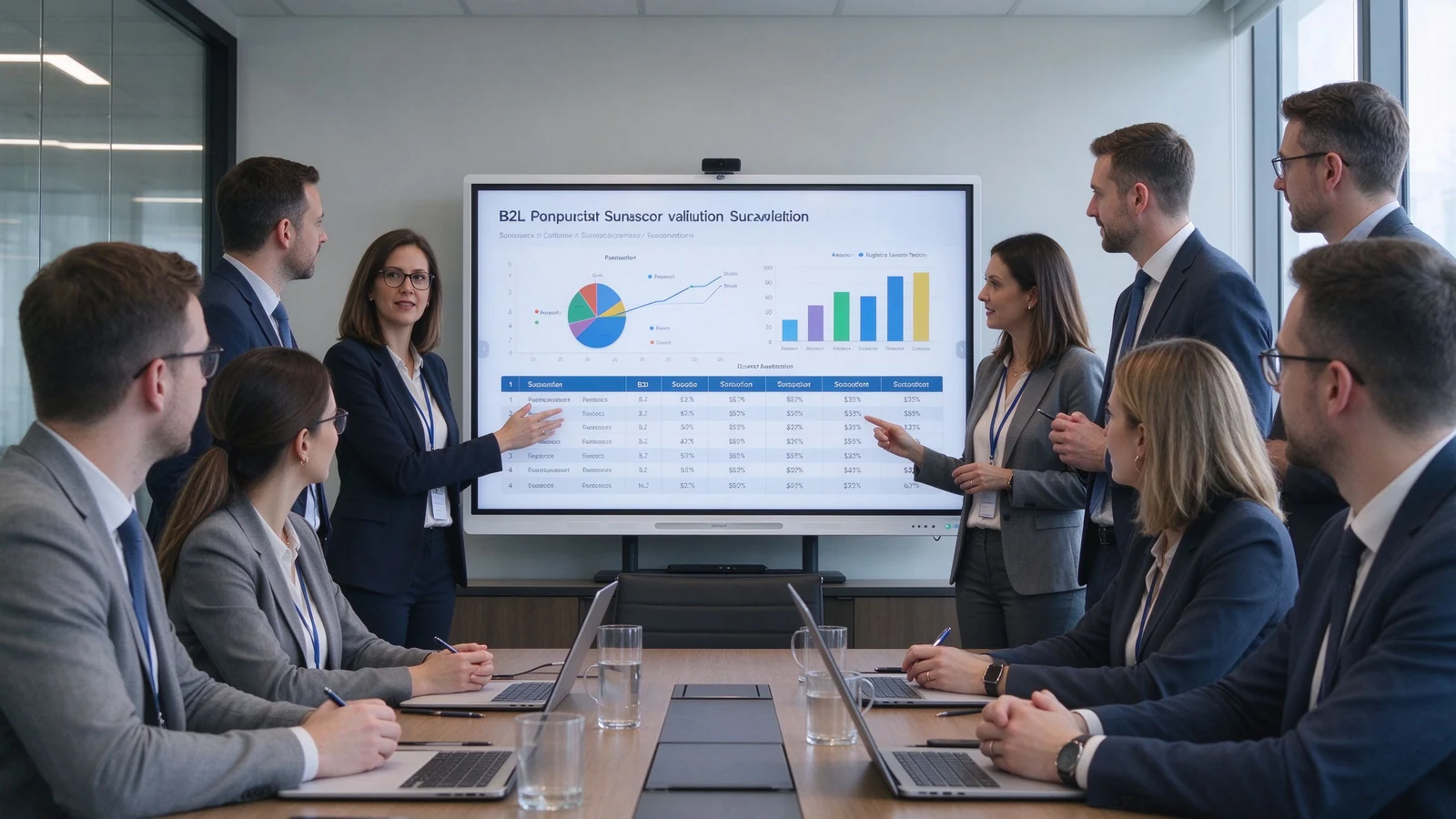
In an OEM relationship, the buyer supplies the brand or product specification and the manufacturer builds to that agreed specification. The product ships under the buyer’s brand, packaging, and sales channels, with hardware, software, and appearance adjusted to the project. This suits established brands with mature specifications, distributors expanding a product line quickly, companies selling under their own brand, and volume project integrators who know exactly what they need.
In an ODM relationship, the manufacturer provides an existing platform or product design, and the buyer selects from it and requests adjustments — appearance, system, ports, logo, packaging, and software. This suits companies without a full in-house R&D team that still need a branded product of their own. The boundary between OEM and ODM is not legal or technical so much as commercial: who owns the design, who pays for tooling, and what can be changed.
| Моделы | Buyer provides | Manufacturer provides | Найлепшае | Qtenboard support |
|---|---|---|---|---|
| White label | Brand name and basic requirements | Existing product, limited changes | Fast market entry | Boot logo, packaging, pre-installed apps |
| OEM | Detailed product specification | Manufacturing to agreed spec | Established brands | Full hardware and software customization |
| ОДМ | Product concept or market need | Product platform, engineering, manufacturing | Brands needing tailored products | Public mold, structural, private mold options |
| CKD | Product and assembly requirements | Disassembled components and technical support | Local assembly projects | Disassembled components and technical support |
| SKD | Product and regional delivery plan | Semi-knocked-down kits | Small-batch local production | Semi-knocked-down kits for local assembly |
Which model fits depends on your team. If engineering capacity is thin, ODM plus careful branding gets you to market fastest. If brand protection matters and volume justifies it, OEM with private mold builds an asset competitors cannot copy in one season. CKD/SKD is a logistics and regulatory decision, not a product decision — choose it when shipping volume, duty, or local-content rules make local assembly cheaper than importing finished units.
Every buyer in this list has a different failure mode. The profiles below translate each one into what should be tested, documented, and negotiated before a PO — so you are not comparing against a generic spec sheet.
Need 55–110 inch interactive whiteboards, education software and cloud platforms, boot-screen logos, education-market certification, batch delivery, local after-sales, and installation support. They also need a supplier who will not disappear between cohorts.
Need meeting-room interactive displays, 4K, video conferencing, wireless casting, Teams / Zoom / Google Meet compatibility, camera-microphone-speaker combinations, and enterprise device management — often alongside existing product lines they distribute.
Care about purchasing price, product range, MOQ, stock and lead time, packaging, territory protection, spares, after-sales, and market differentiation. Their margin lives on supplier consistency and responsiveness, not on one-off discounts.
Need ports, OPS modules, network and control systems, camera and audio integration, device compatibility, project configuration, technical documentation, and batch deployment support. A product that cannot integrate is a project that fails on site.
Need certification, data security, supplier stability, project consistency, phased delivery, warranty and maintenance, long-term spares, project documentation, and acceptance criteria. Their risk is not a defective unit — it is a supplier who cannot stand behind thousands of units over five years.
Need reduced shipping volume, local assembly, compliance with local policy or tax rules, and a local service and production capability. CKD/SKD exists exactly for this group, but only with a supplier who will ship the right kit, not just a box of loose parts.
A range of 55, 65, 75, 86, 98, and 110 inches — plus interactive tables and, where relevant, special sizes — matters for a concrete reason: distributors need price tiers across rooms, enterprise projects need one brand across different spaces, integrators need one supplier for mixed rooms, and large buyers reduce vendor count. Ask whether the same configuration family is available across sizes, and whether touch technology can differ by size.
Understand the LCD panel source, 4K resolution, brightness, anti-glare, and viewing angles. On touch, distinguish infrared from PCAP, touch points, latency, palm rejection, finger/stylus/eraser recognition, and simultaneous writing. Do not stop at “how many points”: test accuracy, fast writing, multi-user operation, and identical behavior under Android and Windows, plus compatibility with the touch software you plan to ship.
Mainboard, CPU and RAM, storage, operating system, OPS module, camera, microphone, speaker, port combination, Wi-Fi/Bluetooth, structure, power system, stand and mounting. Useful questions:
Boot logo, boot animation, UI, pre-installed apps, whiteboard software, casting app, enterprise apps, language packs, device lock, OTA updates, remote device management, AI transcription and meeting summaries, enterprise cloud integration. Confirm who maintains the software, whether updates are charged, whether custom features carry an MOQ, whether source or SDK is available, whether API integration is supported, whether localized language development is possible, and whether technical support continues after the project.
Bezel width, rear cover design, logo position, button layout, camera position, wall-mount structure, thermal design, material and color, packaging and shipping protection, and private mold development. A supplier that molds its own housings can change bezel, venting, and camera placement without buying from a third-party casing vendor — which means faster, cheaper, more reliable customization.
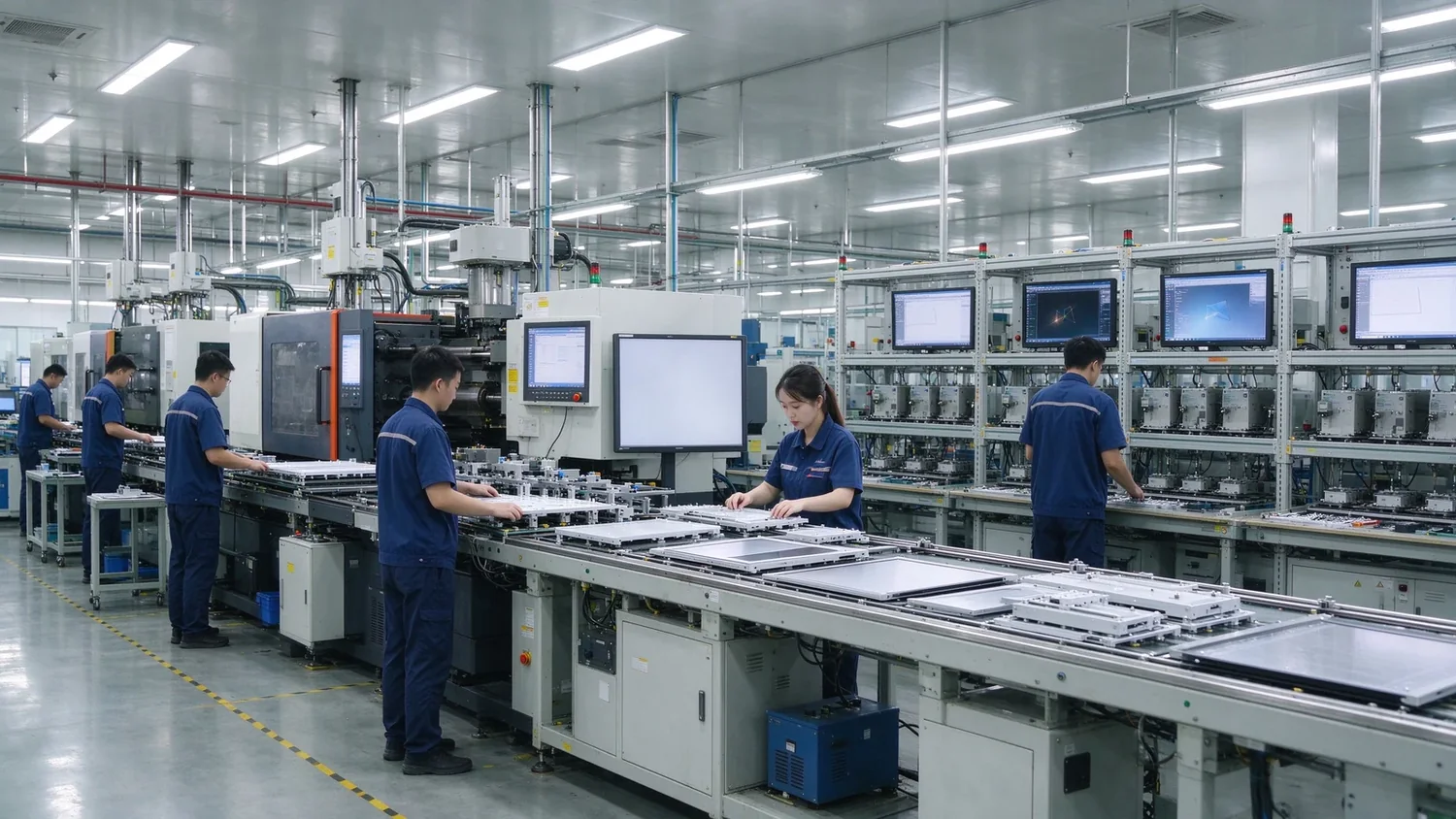
Classify the supplier honestly: true manufacturer, partial in-house with outsourcing, pure trading company, or rebranding agent. Ask how LCD and touch components are procured, whether injection lines are owned, whether assembly and SMT capability exist, whether an aging-test line and reliability lab exist, whether key components are controlled, whether production batches are tracked, and whether batch-to-batch consistency is guaranteed. Answers that cannot be followed by a video audit or sample comparison are answers to discount.
A usable QC picture has four layers. Incoming quality control inspects LCD panels, touch frames, mainboards, power, camera, microphone, speaker, glass, housing, cables, and connectors. In-process control checks screen assembly, touch calibration, mainboard fitting, power safety, firmware burning, port testing, and audio-video testing. Finished-product testing covers brightness and uniformity, touch accuracy, multi-touch, wireless casting, audio and camera, Wi-Fi/Bluetooth/LAN, long-run aging, and packaging drop protection. Batch-delivery control includes first-article approval, sample-vs-mass-production comparison, pre-shipment sampling, defect logging, serial-number and batch traceability, inspection reports, and RMA and replacement processes.
Expect CE, FCC, RoHS, REACH, Energy Star, Google EDLA, Microsoft Teams / Zoom certification where relevant, regional plug and voltage, rules of origin, and data-security compliance. Ask for target-market certification files, test reports, packaging and labeling rules, and product-liability and recall processes. A product that cannot enter your market on paper is not a cheaper product — it is a blocked shipment.
Ask which of these tests are routine and which are one-off certifications. Routine aging — running every unit for a fixed period before packing — is the single strongest signal of a supplier serious about reliability, and the easiest to fake in a marketing deck. Ask to see the actual aging room during a factory visit or video audit.
Customization has a second layer that pricing never shows: who owns what after the project ends. Three commercial points deserve a written answer, not a verbal one.
When you pay for a private mold, confirm whether the tooling belongs to you, to the supplier, or jointly — and where it physically lives. If it stays at the factory and you later switch suppliers, you may pay for the same mold twice. If it ships to you, plan storage and future production runs.
Custom boot screens, pre-installed apps, whiteboard skins, and integrations with your cloud platform: who owns the code, who maintains it, can it be transferred, and what happens if the relationship ends? Suppliers who retain all software IP can legally continue shipping products that carry your own customization, while owning none of it for you.
Is your market protected? Can the supplier sell the same customized product to a competitor in your territory? How long will this configuration stay in production, and what migration path exists when components are discontinued? These clauses cost nothing to write and are expensive to discover missing.
| Аб' екта | Пытанні, якія трэба задаць |
|---|---|
| Праграм | Does the supplier offer the sizes and configurations required? |
| Настаўленне | Can it customize software, appearance, structure, and hardware? |
| Праграмаў | Is production controlled in-house or outsourced? |
| Quality | What inspections and aging tests are performed? |
| Сертыфікаты | Can the supplier provide market-specific documents? |
| Дастаўка | What are MOQ, lead time, capacity, and shipment options? |
| Падтрымка | Are spare parts, firmware updates, and technical support available? |
| Камерцыйныя ўмовы | Are pricing, tooling, ownership, and warranty clearly defined? |
| Supplier type | Advantages | Risks or limitations |
|---|---|---|
| Factory-direct manufacturer | Better control of cost, production, customization, lead time | Buyer must manage technical evaluation |
| Trading company | May offer multiple brands and easier communication | Weaker control over product changes and quality |
| OEM integrator | Can bundle product and service | Some core components may be outsourced |
| Local distributor | Local support and stock | Higher price, limited customization |
Do not over-generalize. A trading company is not automatically bad. The real tests are transparency about the factory, consistent technical documentation, willingness to take after-sales responsibility, a stable supply chain, and credible project experience.
A practical shortlist is three to five: one factory-direct candidate matching your core configuration, one offering deeper customization or better volume pricing, and one backup for risk. Request samples from the top two — samples cost far less than a wrong first container. Evaluate them on the same test script: same drawing, same person, same room, same duration. Judgment made from showroom demos is unreliable; judgment made from a week of internal use is not.
Qtenboard produces interactive whiteboards, LCD video walls, digital signage, kiosks, totem displays, and CMS/DMS software. For distributors and integrators who need more than one commercial display line, one supplier simplifies specification, procurement, certification, and spares.
The customization program runs in four tiers: (1) software and firmware customization, (2) public-mold appearance customization, (3) public-mold structural customization, and (4) private mold or full customization. Software customization can start from lower quantities; structural and private-mold work is confirmed by quantity, tooling, and development investment.
Own-brand logo, boot screen, pre-installed apps, system language, hardware ports, camera and audio, touch points, size and appearance, packaging and manuals, and local assembly options.
For partners needing local assembly, projects needing reduced shipping volume, companies with local factories or service networks, and markets with local-production policy requirements. Before signing, confirm how the kit is packed, which components ship loose versus pre-assembled, and what local-assembly instructions and after-sales documentation are included — a CKD project fails when the kit arrives missing something no one listed.
Samples, specification confirmation, OEM branding, packaging design, batch delivery, technical documentation, certification files, after-sales and spares, and multi-market project coordination.
Typical OEM/ODM programs buyers configure:
| Buyer priority | Qtenboard value proposition |
|---|---|
| Партфель прадуктаў | Interactive whiteboards, video walls, signage, kiosks |
| Глыбіня налады | Software, public mold, structural, private mold |
| Кантроль праграмаў | In-house injection, assembly, aging test |
| Global support | Samples, certifications, spare parts, project coordination |
| Local assembly | CKD/SKD options |
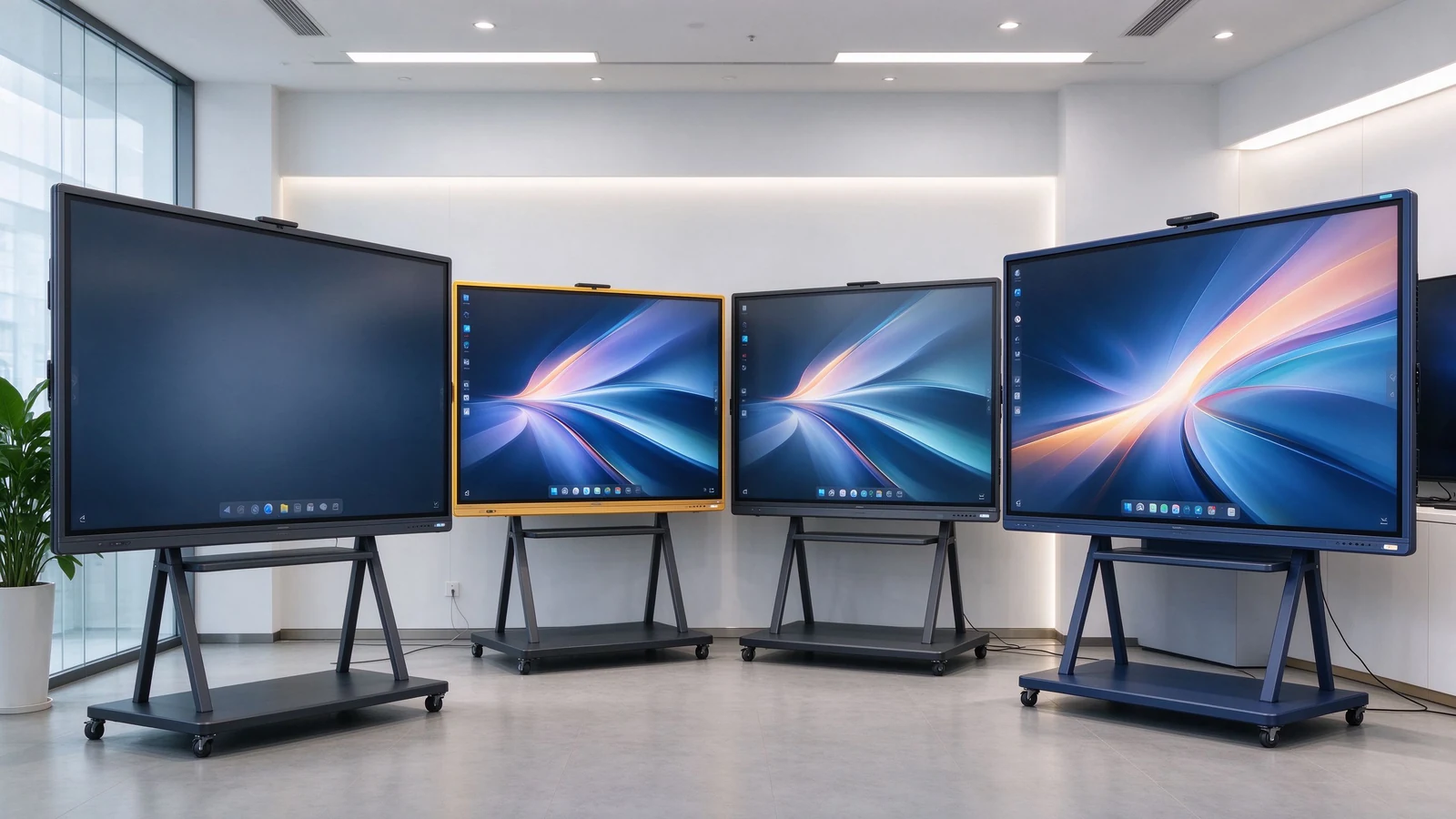

No fixed number should be quoted without a project scope. The cost stack is: screen size, display panel grade, touch technology and points, mainboard and system, camera/microphone/speaker, appearance and structural development, tooling, software customization, packaging, certification, MOQ, shipping and local assembly, and after-sales spares. Compare suppliers on this complete picture, not on an ex-works panel price.
| Customization type | Typical cost impact |
|---|---|
| Boot logo and pre-installed apps | Ніжні |
| Packaging and label customization | Low to moderate |
| Public-mold appearance changes | Памылка |
| Structural changes | Moderate to high |
| Private mold and full product design | High initial investment |
TCO = tooling + software customization + certification + unit cost + packaging + shipping + duty + after-sales spares + software maintenance.
Volume tiers move unit price, but they also move what a supplier will invest in. At low quantities, expect a standard product with logo and packaging changes; the supplier protects margin by limiting engineering. At mid volume, structural changes and dedicated firmware become realistic. At high volume, private mold, dedicated software, and territory agreements come to the table — and the supplier becomes more invested in your success, because your failure costs them too.
Negotiation levers beyond unit price: tooling amortization across batches, sample cost credited at PO, warranty extension, spare-part pricing for years one and two, and a price-freeze clause for the first reorder. Ask for these in writing; they are normal B2B terms, not special favors.
Before any PO, ask for a complete data room. A supplier who cannot produce these documents quickly is telling you something about their processes:
This package also makes comparison honest: five quotes become comparable only when they carry the same documentation behind them.
OEM usually builds to the buyer’s specification; ODM provides the product platform, engineering, and manufacturing, after which the buyer brands or customizes functions. The difference is who owns the design and who pays for its development.
Evaluate product and size range, touch and display technology, software and hardware customization, factory production capability, quality control, certification, MOQ and lead time, after-sales, spares, and lifecycle support.
Some suppliers offer Android, Windows, or dual-system configurations with pre-installed apps, logo, UI, language, and device management. Exact development scope, compatibility, and cost are project-confirmed.
MOQ depends on customization tier. Logo, pre-installed apps, or packaging may work at lower quantities; structural, private-mold, and full product development usually require higher quantities or a long-term commitment.
Prefer suppliers who allow sample testing and golden-sample approval. The sample should be tested for touch, display, software, casting, audio and video, ports, and long-run operation.
Qtenboard offers OEM, ODM, CKD, and SKD programs across brand, software, appearance, structure, hardware, and local assembly tiers, confirmed per project.
Qtenboard supports boot logo, pre-installed apps, packaging, and hardware configuration customization for distributors, system integrators, and brand owners running private-label programs.
Qtenboard operates injection-molding capability and produces housings for interactive whiteboards, digital signage, and kiosks — relevant when custom appearance or structural changes are on the project list.
Request: full specification sheet, certification files, test reports, packaging dimensions, installation guide, user manual, software version information, warranty terms, spares list, and inspection standard.
Software-level customization — boot logo, packaging, pre-installed apps — can move within weeks after golden-sample approval. Structural changes typically add several weeks beyond sample. Private mold and full product design run on tooling and development cycles measured in months, confirmed per project. Ask for a written timeline at quotation, not a verbal estimate.
Different partners take different next steps:
| Role | Recommended next step |
|---|---|
| Brand owner | Request an OEM/ODM consultation |
| Раслікувач | Request a private-label catalog and sample |
| System integrator | Request project configuration support |
| Урад / адукацыя | Download the supplier audit checklist |
| Local assembly | Discuss a CKD/SKD project |
Tell us your target market, screen sizes, required touch points, operating system, customization needs, estimated quantity, and delivery plan. Qtenboard can recommend an OEM, ODM, CKD, or SKD solution for your brand or project. Start through the contact page or explore the OEM/ODM program.
Required: name, company, email, country, business type, product type, estimated quantity, message.
Дадаткова: preferred screen sizes, required touch points, operating system, hardware requirements, software requirements, branding needs, packaging requirements, need for CKD/SKD, expected delivery date.
Request an OEM/ODM Consultation Get a Smart Board Supplier Quote Ask for a Sample Discuss a Private-Label Project
Эксперт вылучэнне
Я загалоўка Qtenboard, і прынесуць над 17 год у тэкставацыі у індустрія. Настаўленні ў глобальная перспектива трэбаў, зрабіць мойны дакументы EMBA у універсальне Шенсэн, Я прыкладаю мой каманду у оптимізацыі кожны етаў нашых аперацыі ад вызначэння продукту да высокі карыстальнікам трэба трэбаўляе Можнаўленне магчымасць прастацца на період у індустрія.
Як лідар Qtenboard, я спеціалізуюся у вызначаных вышваваных OEM/ODM для інтэрактыўных белых палатаў, Відэкі сініны LCD, цифравальныя сітак і тэрміналы дапаўненне ў індустріцы. Запапаўваны наші 330,000 м² сучасны індустріальны парк у Шензін, мы захоўваем кантроль над індустріальныя дизайны, дакладнаваць прыкладання, і строгучнае тэст.
З амаль два дзесяцаў прылад праекту, цяпер выключаныя рашэннем Qtenboard у больш у 120 і рэгіонах, заробілі довіры больш 15 000 кліентаў у світі. Калі вы шукаеце адказную партнер з глибокіма выкананням праекты, Мы і я гатовыя падтрымліваць вашу погляд з професіональным выгляду.

 bel
bel
 EN
EN  pt
pt  spa
spa  th
th  vie
vie  aze
aze  est
est  lav
lav  ukr
ukr  ru
ru