การเลือก A ผู้ผลิตไวท์บอร์ด OEM อัจฉริยะ ไม่ค่อยตัดสินใจโดยราคาต่อหน่วยเพียงอย่างเดียวเจ้าของแบรนด์ผู้จัดจำหน่ายและผู้รวมระบบเลือกพันธมิตรด้านการผลิตหลายปี: หนึ่งที่มีวิศวกรรมผลิตภัณฑ์สัมผัสและแสดงคุณภาพความลึกในการปรับแต่งการควบคุมการผลิตการรับรองเวลานำและการสนับสนุนหลังการขายจะปกป้องสายผลิตภัณฑ์หรือระบายน้ำอย่างเงียบๆราคาซื้อต่ำอาจกลายเป็นเส้นที่แพงที่สุดในสเปรดชีตเมื่อทำงานใหม่การจัดส่งล่าช้าช่องว่างการรับรองและเฟิร์มแวร์ที่ไม่รองรับปรากฏขึ้น
กับดักอีกสองตัวนั่งอยู่หลังการเปรียบเทียบราคาประการแรก OEM, ODM, ฉลากสีขาว, CKD และ skd ไม่สามารถใช้แทนกันได้-พวกเขามีความลึกในการปรับแต่งที่แตกต่างกันมากต้นทุนเครื่องมือ MOQ และเวลาในการออกสู่ตลาดประการที่สองซัพพลายเออร์ที่สามารถเสนอราคาได้อย่างรวดเร็วไม่จำเป็นต้องเป็นผู้ผลิตความแตกต่างระหว่างการผลิตในบ้านการจัดหาบางส่วนและบริษัทการค้าเปลี่ยนแปลงทุกอย่างเกี่ยวกับความสอดคล้องของคุณภาพความเร็วในการปรับแต่งและความรับผิดชอบ
คู่มือนี้เขียนขึ้นสำหรับเจ้าของแบรนด์ผู้จัดจำหน่ายและผู้ค้าส่งผู้รวมระบบผู้รับเหมาโครงการ AV ผู้ซื้อของรัฐบาลและการศึกษาและคู่ค้าการประกอบในท้องถิ่นมันสร้างกรอบการประเมินซัพพลายเออร์ที่ดำเนินการ: สิ่งที่จะเปรียบเทียบสิ่งที่จะตรวจสอบระดับการปรับแต่งจริงทำงานอย่างไรและสิ่งที่กระบวนการโครงการ defensible ดูเหมือน OEM, ODM, CKD และโปรแกรม skd ครอบคลุมซอฟต์แวร์ลักษณะโครงสร้างฮาร์ดแวร์และการปรับแต่งเต็มรูปแบบสำหรับโครงการ B2B ทั่วโลก
| พื้นที่ทดสอบ | คำถามที่จะถาม | ทำไมมันสำคัญ |
|---|---|---|
| กลุ่มผลิตภัณฑ์ผลิตภัณฑ์ | 55-110 ", 4K, ตัวเลือกการสัมผัส, ตัวเลือก OS | ครอบคลุมตลาดและความต้องการของโครงการต่างๆ |
| ความลึกของการปรับแต่ง | ซอฟต์แวร์ลักษณะโครงสร้างแม่พิมพ์ส่วนตัว | ตัดสินใจความแตกต่างของแบรนด์และเวลาในตลาด |
| การควบคุมการผลิต | การฉีดในบ้านการประกอบ SMT การทดสอบอายุ | ส่งผลต่อความสม่ำเสมอของคุณภาพและเวลานำ |
| การควบคุมคุณภาพ | QC, ipqc, oqc, อายุ, การติดตามแบทช์ | ลดความเสี่ยงของแบทช์และต้นทุนหลังการขาย |
| การรับรอง | CE, FCC, ROHS, REACH, edla, พลังงาน | ตัดสินใจเข้าตลาด |
| การจัดส่ง | MOQ, เวลานำ, ความจุ, ckd/skd | ส่งผลกระทบต่อสินค้าคงคลังและแผนการประกอบท้องถิ่น |
| สนับสนุนการสนับสนุน | อะไหล่เฟิร์มแวร์เทคนิค Docs RMA | ส่งผลกระทบต่อความร่วมมือระยะยาวและเสถียรภาพของโครงการ |
| เงื่อนไขเชิงพาณิชย์ | Tooling ownership, Software IP, Warranty | ปกป้องทรัพย์สินแบรนด์และอัตรากำไรขั้นต้น |
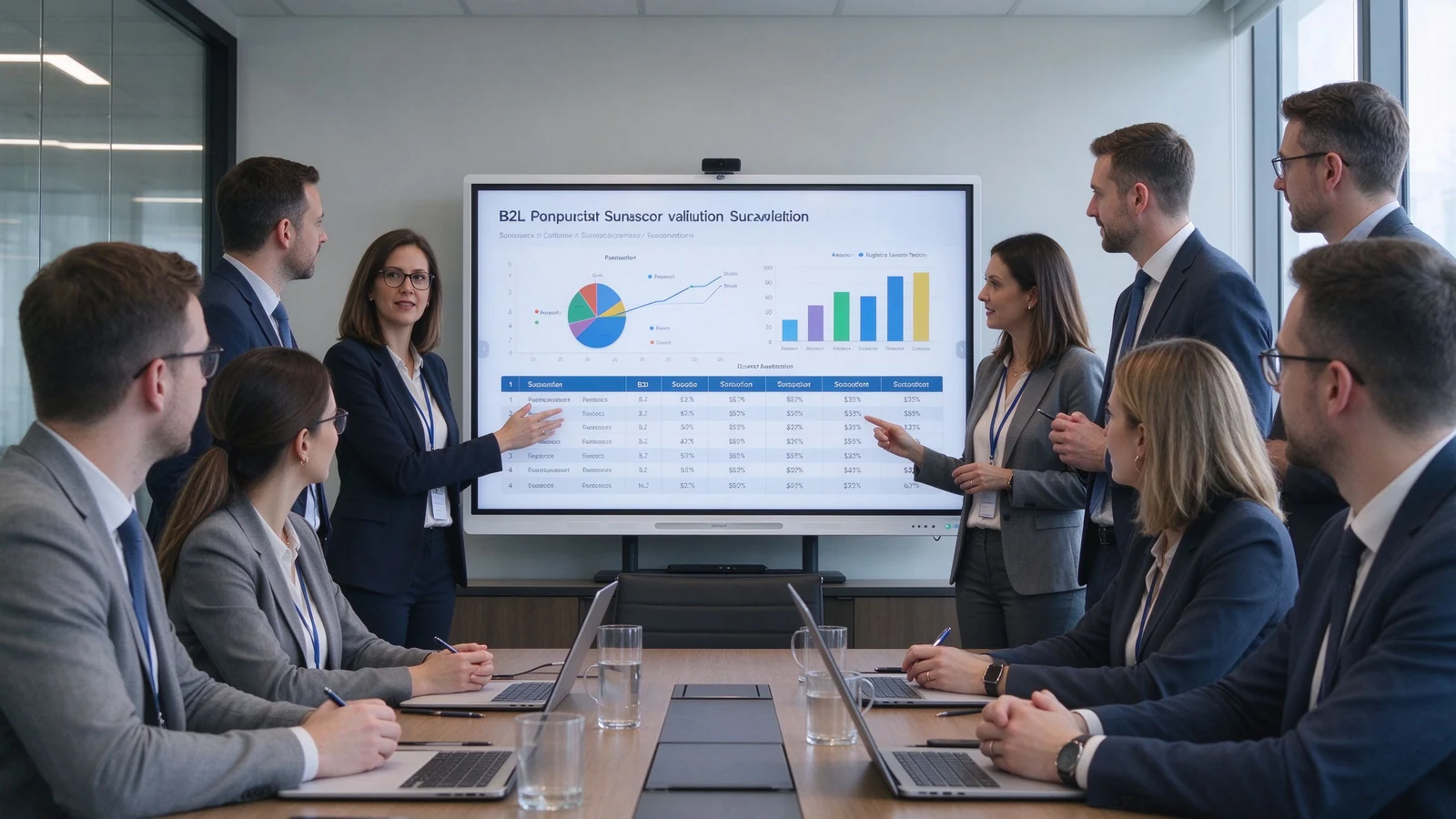
In an OEM relationship, the buyer supplies the brand or product specification and the manufacturer builds to that agreed specification. The product ships under the buyer’s brand, packaging, and sales channels, with hardware, software, and appearance adjusted to the project. This suits established brands with mature specifications, distributors expanding a product line quickly, companies selling under their own brand, and volume project integrators who know exactly what they need.
In an ODM relationship, the manufacturer provides an existing platform or product design, and the buyer selects from it and requests adjustments — appearance, system, ports, logo, packaging, and software. This suits companies without a full in-house R&D team that still need a branded product of their own. The boundary between OEM and ODM is not legal or technical so much as commercial: who owns the design, who pays for tooling, and what can be changed.
| โมเดลโมเดลจำลอง | Buyer provides | Manufacturer provides | ดีที่สุดสำหรับ | Qtenboard support |
|---|---|---|---|---|
| White label | Brand name and basic requirements | Existing product, limited changes | Fast market entry | Boot logo, packaging, pre-installed apps |
| ของ OEM OEM | Detailed product specification | Manufacturing to agreed spec | Established brands | Full hardware and software customization |
| ODM อุปกรณ์เสริม | Product concept or market need | Product platform, engineering, manufacturing | Brands needing tailored products | Public mold, structural, private mold options |
| โรคไตเรื้อรัง | Product and assembly requirements | Disassembled components and technical support | Local assembly projects | Disassembled components and technical support |
| สกั๊ด | Product and regional delivery plan | Semi-knocked-down kits | Small-batch local production | Semi-knocked-down kits for local assembly |
รุ่นไหนที่เหมาะกับขึ้นอยู่กับทีมของคุณหากความจุทางวิศวกรรมบาง ODM บวกการสร้างแบรนด์อย่างระมัดระวังทำให้คุณออกสู่ตลาดได้เร็วที่สุดหากเรื่องการป้องกันแบรนด์และปริมาณเหมาะสม OEM ด้วยแม่พิมพ์ส่วนตัวจะสร้างคู่แข่งสินทรัพย์ไม่สามารถคัดลอกได้ในฤดูกาลเดียว Ckd/skd เป็นการตัดสินใจด้านลอจิสติกส์และการกำกับดูแลไม่ใช่การตัดสินใจของผลิตภัณฑ์-เลือกเมื่อปริมาณการจัดส่งหน้าที่หรือกฎของเนื้อหาในท้องถิ่นทำให้การประกอบในพื้นที่ถูกกว่าการนำเข้าหน่วยสำเร็จรูป
Every buyer in this list has a different failure mode. The profiles below translate each one into what should be tested, documented, and negotiated before a PO — so you are not comparing against a generic spec sheet.
ต้องการกระดานไวท์บอร์ดแบบโต้ตอบขนาด55-110นิ้วซอฟต์แวร์การศึกษาและแพลตฟอร์มคลาวด์โลโก้หน้าจอบูตการรับรองการศึกษาตลาดการจัดส่งแบบแบทช์หลังการขายในท้องถิ่นและการสนับสนุนการติดตั้งพวกเขายังต้องการซัพพลายเออร์ที่จะไม่หายไประหว่าง cohorts
ต้องการการแสดงแบบโต้ตอบในห้องประชุม, 4K, การประชุมทางวิดีโอ, การหล่อแบบไร้สาย, ทีม/ซูม/google ตอบสนองความเข้ากันได้, กล้อง-ไมโครโฟน-ชุดลำโพง, และการจัดการอุปกรณ์ขององค์กร-มักจะควบคู่ไปกับสายผลิตภัณฑ์ที่มีอยู่ที่พวกเขาแจกจ่าย
ดูแลเกี่ยวกับราคาซื้อช่วงผลิตภัณฑ์ MOQ เวลาสต็อกและตะกั่วบรรจุภัณฑ์การป้องกันดินแดนอะไหล่หลังการขายและความแตกต่างของตลาดอัตรากำไรขั้นต้นของพวกเขาเป็นไปตามความสอดคล้องของซัพพลายเออร์และการตอบสนองไม่ใช่ส่วนลดเพียงครั้งเดียว
ต้องการพอร์ตโมดูล OPS ระบบเครือข่ายและการควบคุมการรวมกล้องและเสียงความเข้ากันได้ของอุปกรณ์การกำหนดค่าโครงการเอกสารทางเทคนิคและการสนับสนุนการปรับใช้แบทช์ผลิตภัณฑ์ที่ไม่สามารถรวมเข้าด้วยกันได้เป็นโครงการที่ล้มเหลวในเว็บไซต์
ต้องการการรับรองความปลอดภัยของข้อมูลความเสถียรของซัพพลายเออร์ความสม่ำเสมอของโครงการการจัดส่งแบบแบ่งระยะเวลาการรับประกันและการบำรุงรักษาอะไหล่ระยะยาวเอกสารประกอบโครงการและเกณฑ์การยอมรับความเสี่ยงของพวกเขาไม่ใช่หน่วยที่มีข้อบกพร่อง-เป็นซัพพลายเออร์ที่ไม่สามารถยืนอยู่เบื้องหลังหลายพันหน่วยกว่าห้าปี
Need reduced shipping volume, local assembly, compliance with local policy or tax rules, and a local service and production capability. CKD/SKD exists exactly for this group, but only with a supplier who will ship the right kit, not just a box of loose parts.
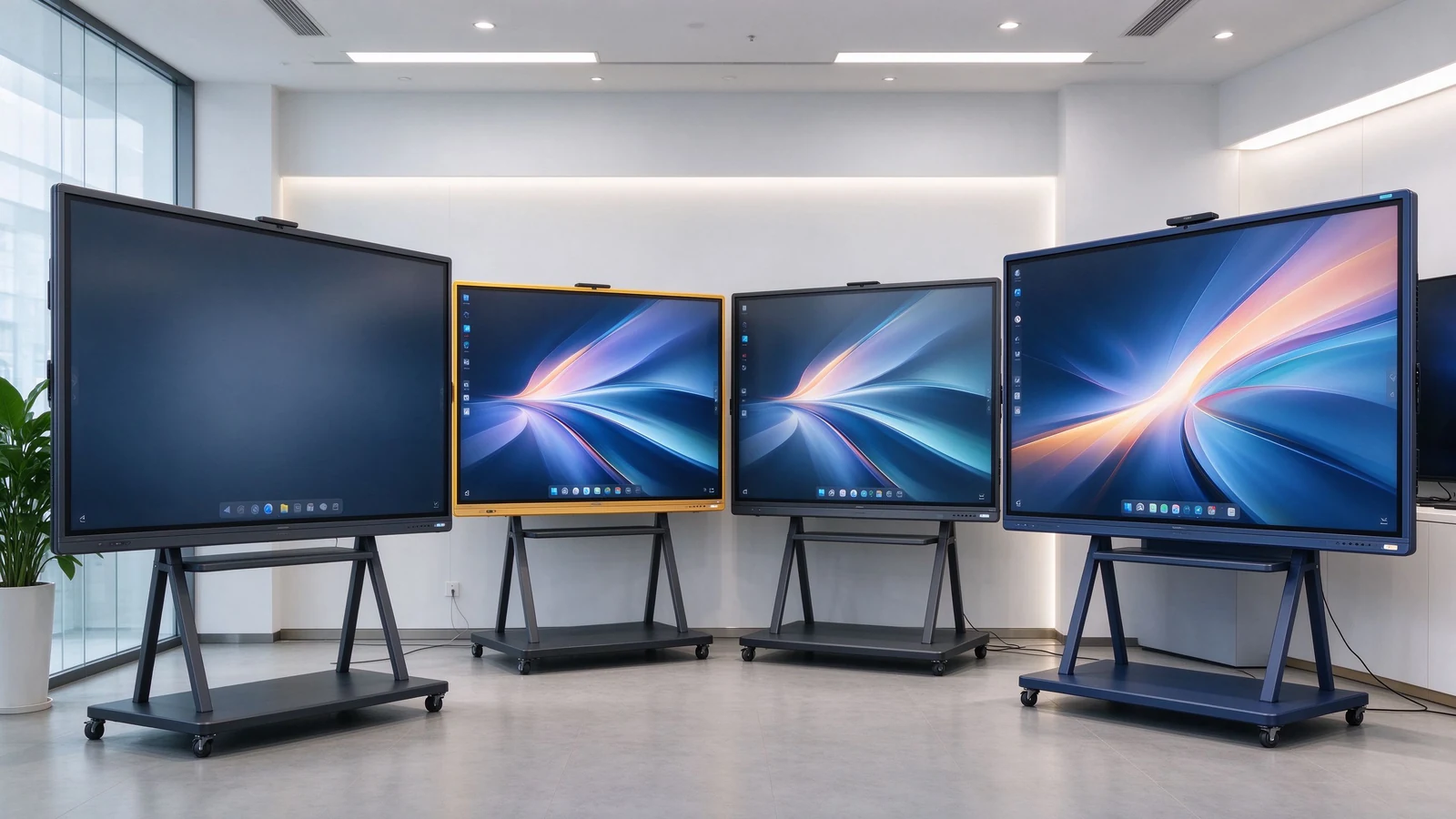
A range of 55, 65, 75, 86, 98, and 110 inches — plus interactive tables and, where relevant, special sizes — matters for a concrete reason: distributors need price tiers across rooms, enterprise projects need one brand across different spaces, integrators need one supplier for mixed rooms, and large buyers reduce vendor count. Ask whether the same configuration family is available across sizes, and whether touch technology can differ by size.
Understand the LCD panel source, 4K resolution, brightness, anti-glare, and viewing angles. On touch, distinguish infrared from PCAP, touch points, latency, palm rejection, finger/stylus/eraser recognition, and simultaneous writing. Do not stop at “how many points”: test accuracy, fast writing, multi-user operation, and identical behavior under Android and Windows, plus compatibility with the touch software you plan to ship.
Mainboard, CPU and RAM, storage, operating system, OPS module, camera, microphone, speaker, port combination, Wi-Fi/Bluetooth, structure, power system, stand and mounting. Useful questions:
Boot logo, boot animation, UI, pre-installed apps, whiteboard software, casting app, enterprise apps, language packs, device lock, OTA updates, remote device management, AI transcription and meeting summaries, enterprise cloud integration. Confirm who maintains the software, whether updates are charged, whether custom features carry an MOQ, whether source or SDK is available, whether API integration is supported, whether localized language development is possible, and whether technical support continues after the project.
Bezel width, rear cover design, logo position, button layout, camera position, wall-mount structure, thermal design, material and color, packaging and shipping protection, and private mold development. A supplier that molds its own housings can change bezel, venting, and camera placement without buying from a third-party casing vendor — which means faster, cheaper, more reliable customization.
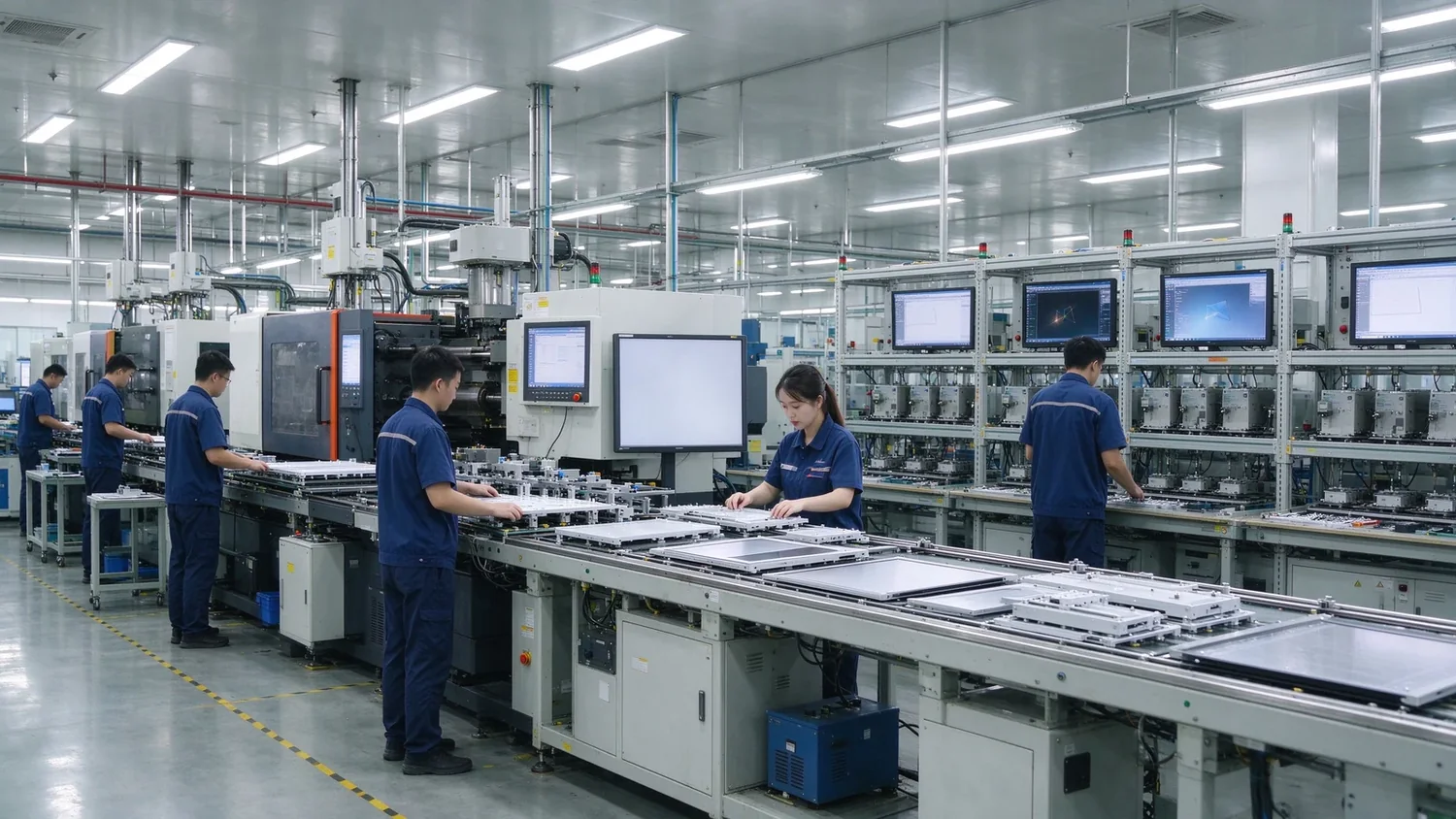
Classify the supplier honestly: true manufacturer, partial in-house with outsourcing, pure trading company, or rebranding agent. Ask how LCD and touch components are procured, whether injection lines are owned, whether assembly and SMT capability exist, whether an aging-test line and reliability lab exist, whether key components are controlled, whether production batches are tracked, and whether batch-to-batch consistency is guaranteed. Answers that cannot be followed by a video audit or sample comparison are answers to discount.
A usable QC picture has four layers. Incoming quality control inspects LCD panels, touch frames, mainboards, power, camera, microphone, speaker, glass, housing, cables, and connectors. In-process control checks screen assembly, touch calibration, mainboard fitting, power safety, firmware burning, port testing, and audio-video testing. Finished-product testing covers brightness and uniformity, touch accuracy, multi-touch, wireless casting, audio and camera, Wi-Fi/Bluetooth/LAN, long-run aging, and packaging drop protection. Batch-delivery control includes first-article approval, sample-vs-mass-production comparison, pre-shipment sampling, defect logging, serial-number and batch traceability, inspection reports, and RMA and replacement processes.
Expect CE, FCC, RoHS, REACH, Energy Star, Google EDLA, Microsoft Teams / Zoom certification where relevant, regional plug and voltage, rules of origin, and data-security compliance. Ask for target-market certification files, test reports, packaging and labeling rules, and product-liability and recall processes. A product that cannot enter your market on paper is not a cheaper product — it is a blocked shipment.
Ask which of these tests are routine and which are one-off certifications. Routine aging — running every unit for a fixed period before packing — is the single strongest signal of a supplier serious about reliability, and the easiest to fake in a marketing deck. Ask to see the actual aging room during a factory visit or video audit.
Customization has a second layer that pricing never shows: who owns what after the project ends. Three commercial points deserve a written answer, not a verbal one.
When you pay for a private mold, confirm whether the tooling belongs to you, to the supplier, or jointly — and where it physically lives. If it stays at the factory and you later switch suppliers, you may pay for the same mold twice. If it ships to you, plan storage and future production runs.
Custom boot screens, pre-installed apps, whiteboard skins, and integrations with your cloud platform: who owns the code, who maintains it, can it be transferred, and what happens if the relationship ends? Suppliers who retain all software IP can legally continue shipping products that carry your own customization, while owning none of it for you.
Is your market protected? Can the supplier sell the same customized product to a competitor in your territory? How long will this configuration stay in production, and what migration path exists when components are discontinued? These clauses cost nothing to write and are expensive to discover missing.
| พื้นที่ทดสอบ | คำถามที่จะถาม |
|---|---|
| สินค้าที่ได้รับความนิยม | Does the supplier offer the sizes and configurations required? |
| การปรับแต่ง | Can it customize software, appearance, structure, and hardware? |
| การผลิต | Is production controlled in-house or outsourced? |
| Quality | What inspections and aging tests are performed? |
| การรับรอง | Can the supplier provide market-specific documents? |
| การจัดส่ง | What are MOQ, lead time, capacity, and shipment options? |
| สนับสนุนการสนับสนุน | Are spare parts, firmware updates, and technical support available? |
| เงื่อนไขเชิงพาณิชย์ | Are pricing, tooling, ownership, and warranty clearly defined? |
| Supplier type | ข้อดี | Risks or limitations |
|---|---|---|
| Factory-direct manufacturer | Better control of cost, production, customization, lead time | Buyer must manage technical evaluation |
| Trading company | May offer multiple brands and easier communication | Weaker control over product changes and quality |
| OEM integrator | Can bundle product and service | Some core components may be outsourced |
| Local distributor | Local support and stock | Higher price, limited customization |
Do not over-generalize. A trading company is not automatically bad. The real tests are transparency about the factory, consistent technical documentation, willingness to take after-sales responsibility, a stable supply chain, and credible project experience.
A practical shortlist is three to five: one factory-direct candidate matching your core configuration, one offering deeper customization or better volume pricing, and one backup for risk. Request samples from the top two — samples cost far less than a wrong first container. Evaluate them on the same test script: same drawing, same person, same room, same duration. Judgment made from showroom demos is unreliable; judgment made from a week of internal use is not.
Qtenboard produces interactive whiteboards, LCD video walls, digital signage, kiosks, totem displays, and CMS/DMS software. For distributors and integrators who need more than one commercial display line, one supplier simplifies specification, procurement, certification, and spares.
The customization program runs in four tiers: (1) software and firmware customization, (2) public-mold appearance customization, (3) public-mold structural customization, and (4) private mold or full customization. Software customization can start from lower quantities; structural and private-mold work is confirmed by quantity, tooling, and development investment.
Own-brand logo, boot screen, pre-installed apps, system language, hardware ports, camera and audio, touch points, size and appearance, packaging and manuals, and local assembly options.
For partners needing local assembly, projects needing reduced shipping volume, companies with local factories or service networks, and markets with local-production policy requirements. Before signing, confirm how the kit is packed, which components ship loose versus pre-assembled, and what local-assembly instructions and after-sales documentation are included — a CKD project fails when the kit arrives missing something no one listed.
Samples, specification confirmation, OEM branding, packaging design, batch delivery, technical documentation, certification files, after-sales and spares, and multi-market project coordination.
Typical OEM/ODM programs buyers configure:
| Buyer priority | Qtenboard value proposition |
|---|---|
| กลุ่มผลิตภัณฑ์ผลิตภัณฑ์ | Interactive whiteboards, video walls, signage, kiosks |
| ความลึกของการปรับแต่ง | Software, public mold, structural, private mold |
| การควบคุมการผลิต | In-house injection, assembly, aging test |
| Global support | Samples, certifications, spare parts, project coordination |
| Local assembly | CKD/SKD options |

No fixed number should be quoted without a project scope. The cost stack is: screen size, display panel grade, touch technology and points, mainboard and system, camera/microphone/speaker, appearance and structural development, tooling, software customization, packaging, certification, MOQ, shipping and local assembly, and after-sales spares. Compare suppliers on this complete picture, not on an ex-works panel price.
| Customization type | Typical cost impact |
|---|---|
| Boot logo and pre-installed apps | ต่ำ |
| Packaging and label customization | Low to moderate |
| Public-mold appearance changes | ปานกลาง |
| Structural changes | Moderate to high |
| Private mold and full product design | High initial investment |
TCO = tooling + software customization + certification + unit cost + packaging + shipping + duty + after-sales spares + software maintenance.
Volume tiers move unit price, but they also move what a supplier will invest in. At low quantities, expect a standard product with logo and packaging changes; the supplier protects margin by limiting engineering. At mid volume, structural changes and dedicated firmware become realistic. At high volume, private mold, dedicated software, and territory agreements come to the table — and the supplier becomes more invested in your success, because your failure costs them too.
Negotiation levers beyond unit price: tooling amortization across batches, sample cost credited at PO, warranty extension, spare-part pricing for years one and two, and a price-freeze clause for the first reorder. Ask for these in writing; they are normal B2B terms, not special favors.
Before any PO, ask for a complete data room. A supplier who cannot produce these documents quickly is telling you something about their processes:
This package also makes comparison honest: five quotes become comparable only when they carry the same documentation behind them.
OEM usually builds to the buyer’s specification; ODM provides the product platform, engineering, and manufacturing, after which the buyer brands or customizes functions. The difference is who owns the design and who pays for its development.
Evaluate product and size range, touch and display technology, software and hardware customization, factory production capability, quality control, certification, MOQ and lead time, after-sales, spares, and lifecycle support.
Some suppliers offer Android, Windows, or dual-system configurations with pre-installed apps, logo, UI, language, and device management. Exact development scope, compatibility, and cost are project-confirmed.
MOQ depends on customization tier. Logo, pre-installed apps, or packaging may work at lower quantities; structural, private-mold, and full product development usually require higher quantities or a long-term commitment.
Prefer suppliers who allow sample testing and golden-sample approval. The sample should be tested for touch, display, software, casting, audio and video, ports, and long-run operation.
Qtenboard offers OEM, ODM, CKD, and SKD programs across brand, software, appearance, structure, hardware, and local assembly tiers, confirmed per project.
Qtenboard supports boot logo, pre-installed apps, packaging, and hardware configuration customization for distributors, system integrators, and brand owners running private-label programs.
Qtenboard operates injection-molding capability and produces housings for interactive whiteboards, digital signage, and kiosks — relevant when custom appearance or structural changes are on the project list.
Request: full specification sheet, certification files, test reports, packaging dimensions, installation guide, user manual, software version information, warranty terms, spares list, and inspection standard.
Software-level customization — boot logo, packaging, pre-installed apps — can move within weeks after golden-sample approval. Structural changes typically add several weeks beyond sample. Private mold and full product design run on tooling and development cycles measured in months, confirmed per project. Ask for a written timeline at quotation, not a verbal estimate.
Different partners take different next steps:
| Role | Recommended next step |
|---|---|
| Brand owner | Request an OEM/ODM consultation |
| จำหน่ายโดยตัวแทนจำหน่าย | Request a private-label catalog and sample |
| System integrator | Request project configuration support |
| รัฐบาล/การศึกษา | Download the supplier audit checklist |
| Local assembly | Discuss a CKD/SKD project |
Tell us your target market, screen sizes, required touch points, operating system, customization needs, estimated quantity, and delivery plan. Qtenboard can recommend an OEM, ODM, CKD, or SKD solution for your brand or project. Start through the contact page or explore the OEM/ODM program.
Required: name, company, email, country, business type, product type, estimated quantity, message.
อุปกรณ์เสริม: preferred screen sizes, required touch points, operating system, hardware requirements, software requirements, branding needs, packaging requirements, need for CKD/SKD, expected delivery date.
Request an OEM/ODM Consultation Get a Smart Board Supplier Quote Ask for a Sample Discuss a Private-Label Project
ซีอีโอ | ผู้เชี่ยวชาญด้านโซลูชันการแสดงผลแบบโต้ตอบและการทำงานร่วมกัน
ฉันเป็นผู้ก่อตั้ง qtenboard นำความเชี่ยวชาญด้านการลงมือปฏิบัติมากกว่า17ปีมาสู่อุตสาหกรรมการแสดงผลแบบสัมผัสจากมุมมองการจัดการทั่วโลกที่ได้รับจากการศึกษา EMBA ของฉันที่มหาวิทยาลัยเซินเจิ้นฉันนำทีมของฉันในการเพิ่มประสิทธิภาพทุกขั้นตอนของการดำเนินงานของเรา-จากความละเอียดของผลิตภัณฑ์ที่มีประสิทธิภาพสูงการจัดการห่วงโซ่อุปทาน-มั่นใจความสามารถในการผลิตของเรายังคงอยู่ในระดับแนวหน้าของอุตสาหกรรม
ในฐานะผู้นำของ qtenboard ฉันเชี่ยวชาญในการให้บริการโซลูชั่น oem/odm ที่ปรับแต่งสำหรับกระดานไวท์บอร์ดแบบโต้ตอบผนังวิดีโอ LCD ป้ายดิจิตอลและเทอร์มินัลสัมผัสระดับอุตสาหกรรมสนับสนุนโดย330,000ตารางเมตรสวนอุตสาหกรรมที่ทันสมัยของเราในเซินเจิ้น, เรารักษาเต็ม Lifecycle ควบคุมการออกแบบอุตสาหกรรม, การผลิตที่มีความแม่นยำ, และการทดสอบประสิทธิภาพที่เข้มงวด.
ด้วยประสบการณ์โครงการเกือบสองทศวรรษโซลูชันการแสดงผลของ qtenboard จึงถูกนำไปใช้ในกว่า120ประเทศและภูมิภาคได้รับความไว้วางใจจากลูกค้าระดับองค์กรมากกว่า15,000รายทั่วโลกหากคุณกำลังมองหาพันธมิตรที่ตอบสนองต่อการผลิตที่ลึกซึ้งสำหรับโครงการแสดงผลแบบสัมผัสที่กำหนดเองของคุณทีมของฉันและฉันพร้อมที่จะสนับสนุนวิสัยทัศน์ของคุณด้วยความเป็นเลิศระดับมืออาชีพ

 th
th
 EN
EN  pt
pt  spa
spa  vie
vie  aze
aze  bel
bel  est
est  lav
lav  ukr
ukr  ru
ru