Same 4K, same size, up to 30–50% apart in price. The difference is usually a component most spec sheets never mention.
LCD panel grade is the single most common explanation for a 30–50% price gap between two interactive flat panels with identical headline specs. Panel grade (A+/A/B) is determined at the factory sorting stage — based on defect count, defect location, and color/brightness uniformity — and almost never appears on a spec sheet. It does not affect whether a panel powers on. It determines whether the panel still looks and performs the way it did on day one, three years into a deployment.
An MTBF figure without a stated panel grade is only half a data point. MTBF is a statistical average from population testing — useful for ranking suppliers relative to each other, not for predicting the service date of any single unit. Original vs refurbished panel sourcing is a separate, quieter risk: refurbished panels enter the supply chain with undocumented prior usage, and panel-component warranty coverage is frequently voided or sharply limited.
Two interactive flat panels can sit side by side in a comparison, both advertised as an 86" 4K interactive whiteboard, both quoting similar brightness and touch response — and still carry a 30% to 50% price gap. Ask the supplier why, and the answer is almost always the same: "we use original A-grade panels." Without a shared vocabulary for what that claim actually means, procurement teams are left evaluating on price alone.
This is a distinctly B2B problem. An interactive flat panel deployed in a classroom or boardroom is not used the way a household television is used. It runs six to ten hours a day, sometimes back-to-back across multiple sessions, for years, in front of end users who never see — and never should have to think about — what is happening inside the display. The component that quietly decides whether that promise holds is the LCD panel itself: its grade, its MTBF rating, its sourcing history, and increasingly, its eye-comfort engineering.
This article walks through four things a procurement or IT buyer should be able to evaluate before signing a purchase order for an interactive whiteboard or IFPD fleet: how panel grading (A+/A/B) actually works, how to read an MTBF figure without over- or under-trusting it, why "Original Panel" and "Refurbished Panel" are not interchangeable at an identical spec sheet, and why panel-level features like low blue light emission belong in a commercial RFP, not just a consumer TV brochure.
Keep these two tables on hand the next time you're comparing supplier quotes for an interactive flat panel — they cover the two variables that most often explain a price gap between two units with identical headline specs.
| Criteria | A+ Grade | A Grade | B Grade |
|---|---|---|---|
| Defect tolerance (bright/dark dots) | Near-zero; tightest bin in the sorting process | Very low; within standard commercial tolerance | Higher tolerance; defects possible, especially near edges |
| Color consistency (Delta E) | ΔE ≤ 3, tight batch-to-batch matching | ΔE ≤ 5, acceptable for most commercial use | ΔE can exceed 5; visible drift across multi-unit installs |
| Brightness uniformity | Typically ≥ 85% across the panel | Typically 75–85% | Can fall below 75%; visible hot spots |
| Brightness decay over rated life | Slower, more linear decay curve | Moderate decay, within spec for rated hours | Faster early-life decay is common |
| Typical MTBF positioning | Highest tier for the panel size/technology | Mid tier; still meets commercial thresholds | Lower tier; often close to consumer-grade figures |
| Typical application | Flagship commercial IFPD, control rooms, high-visibility spaces | Standard commercial classrooms and meeting rooms | Budget/entry-level devices, short replacement cycles |
Grades reflect how a panel is sorted at the factory, not whether it powers on — a B-grade panel will display an image on day one just as reliably as an A+ panel does.
| Criteria | Original Panel | Refurbished / Recycled Panel |
|---|---|---|
| Backlight life remaining | Full rated lifespan from first use | Unknown; prior usage hours typically undocumented |
| Touch layer bonding | Factory-calibrated lamination, consistent parallax | Often re-bonded; higher risk of touch offset or delamination over time |
| Hidden defect rate | Controlled by grading + factory QC | Higher; prior-use defects may not surface immediately |
| Traceability | Full batch and factory traceability | Frequently sourced from open-market channels with no batch history |
| Warranty coverage | Full manufacturer warranty on the panel | Often excluded or heavily limited on the panel component |
| Total cost of ownership | Predictable, aligned with rated MTBF | Higher risk of early failure, service calls, and replacement |
An interactive flat panel's headline spec sheet is built around resolution, touch points, brightness, and processor — the things that are easy to line up across brands in a quote comparison. Panel grade almost never appears on that sheet, yet it is the single component most responsible for whether the unit still looks and performs the way it did on day one, three years into a deployment.
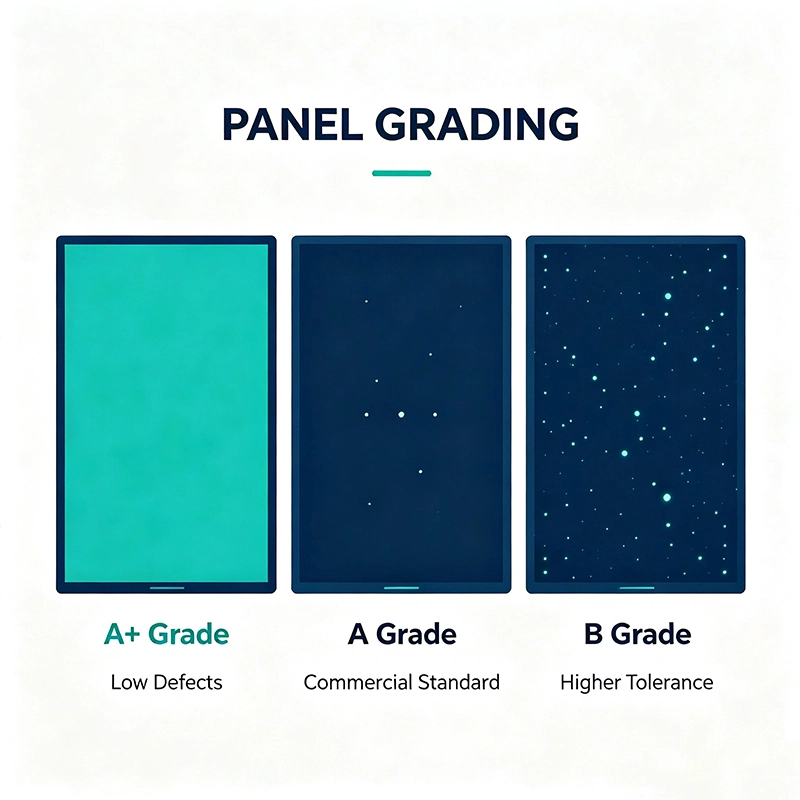
Panel fabs produce large "mother glass" sheets that are cut into individual panels. Every panel is then inspected for bright dots (a sub-pixel stuck permanently on), dark dots (a dead sub-pixel), color uniformity across the surface, and edge light leakage. Panels are sorted — "binned" — into grades based on how many defects are found and where they fall: a dot near the center of the screen is scored far more harshly than one tucked near the bezel, because it's what a viewer actually notices during real use.
A+ represents the tightest bin: the fewest tolerated defects and the strictest uniformity threshold. A grade allows a wider, but still commercially acceptable, defect tolerance. B grade allows visibly more defects, or places them closer to the edge of what's considered acceptable. None of this determines whether the panel powers on — a B-grade panel lights up and displays an image just as reliably as an A+ panel on the first day. The difference is not whether it works. It's how consistently it keeps working, and how gracefully it ages, over the years an interactive flat panel is actually expected to serve a classroom or meeting room.
Panel brand tells you about upstream fabrication capability — it sets a floor, not the final verdict on quality. BOE is one of the largest LCD producers globally, shipping a broad range of sizes and grades. LG Display has a long-standing reputation for color performance and commercial-grade panel lines. AUO and Innolux, both based in Taiwan, are well established in industrial and commercial display segments, including panels commonly used in mid-to-large format interactive flat panels.
The detail buyers frequently miss: every one of these fabs ships multiple grades from the same production lines. Asking "which brand" without asking "which grade, which batch" only gives you half the picture. A more useful procurement question is: "Which fab, which grade, and can you provide the batch code?" — because a brand name alone doesn't guarantee the panel behind it is A+ rather than B.
4K describes pixel count (3840 × 2160) — nothing more. It says nothing about color gamut, contrast ratio, or brightness uniformity, which is why two "4K interactive whiteboards" can look noticeably different side by side. Color gamut (typically expressed as NTSC or sRGB coverage) determines how accurately on-screen colors match the source content — relevant whenever a meeting room is reviewing brand assets, design mockups, or color-coded data. Contrast ratio and uniformity affect how crisp whiteboard ink strokes and small text appear across the full surface, not just at the center.
Viewing angle matters more in commercial deployment than almost anywhere else, because most viewers in a classroom or boardroom are not sitting directly in front of the panel — they're 30 to 45 degrees off-axis, sometimes more, from the third row or the side of a conference table. A panel with narrow viewing-angle performance shows color shift and brightness fall-off at these angles, meaning "the same 4K image" can look meaningfully different to a student in the back row than to one in the front. This is where panel grade and panel technology intersect: wide-angle panel technologies paired with a higher grade hold color and brightness consistency much further off-axis than a lower-grade standard panel.
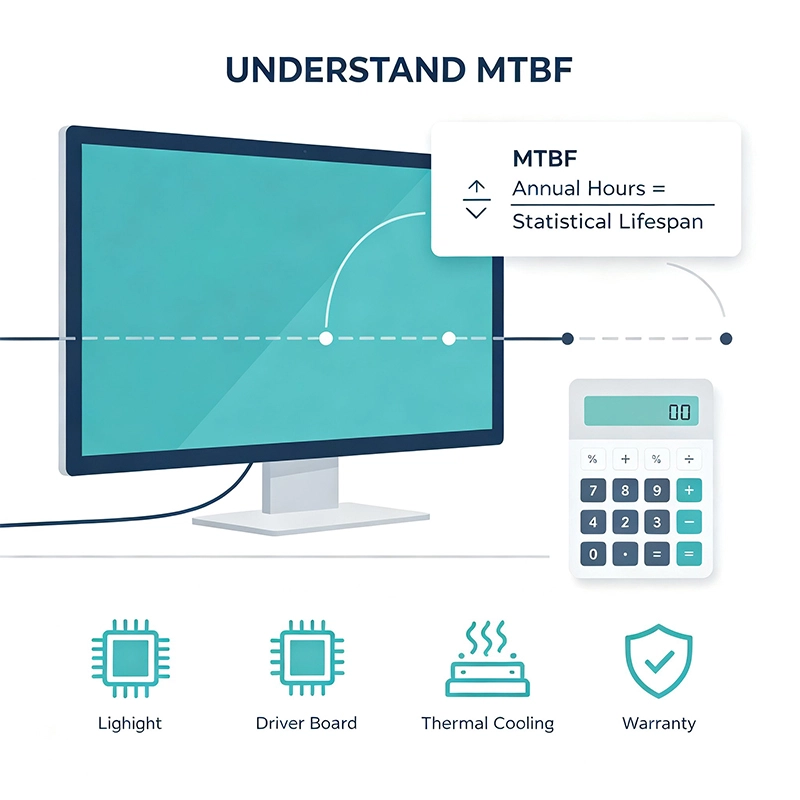
MTBF (Mean Time Between Failures) is a statistical average drawn from testing a population of units under standardized conditions — it is not a guarantee for any single unit. Treating it correctly means using it as a relative tool for comparing suppliers, not as a countdown clock for one specific display.
Example: a facility running an interactive flat panel 8 hours/day, 5 days/week logs roughly 2,080 operating hours per year. Dividing a supplier's stated MTBF figure by that annual usage gives a rough, comparable sense of where a panel sits relative to a competing quote — useful for ranking suppliers, not for predicting the exact day a specific unit will need service.
MTBF is not produced by the panel alone — it reflects the combined effect of panel grade, backlight quality, driver-board design, and thermal/heat-dissipation engineering. A high MTBF claim attached to an unspecified panel grade is only half a data point; ask for both together.
In classrooms running 6–8 hours a day, or control rooms operating near-continuously, fixed cold color temperature and standard blue light emission contribute to visual fatigue over a full school day or shift. A warm light interactive flat panel lets the display shift toward a warmer color temperature for lower-intensity use, such as reading-heavy lessons or long review sessions, reducing strain on the eyes over extended sessions.
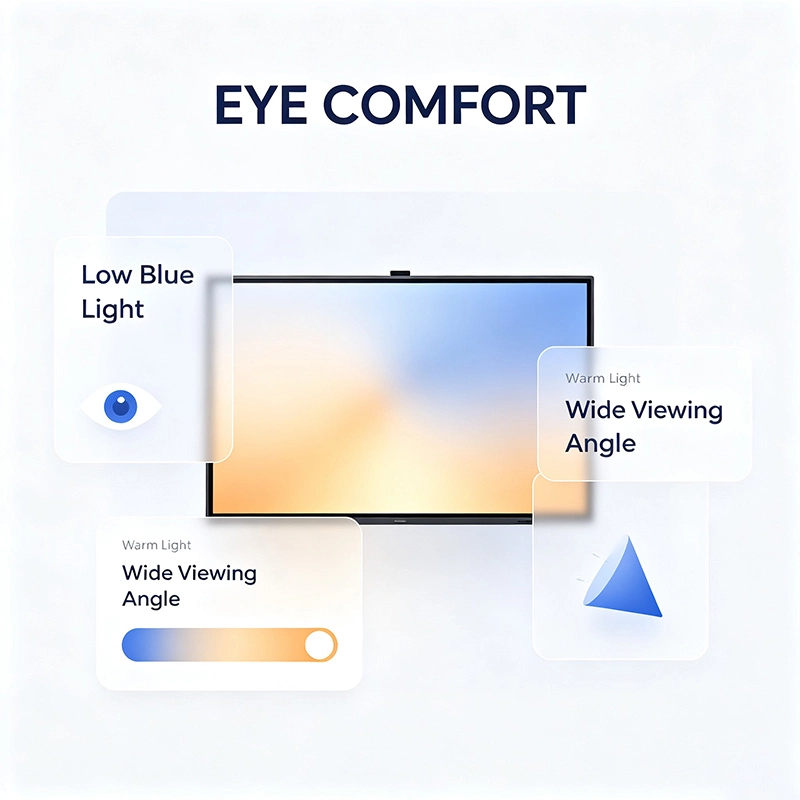
The distinction worth asking suppliers about: a genuine low blue light interactive whiteboard reduces blue-wavelength emission at the backlight/panel level, while a software-only "night mode" filter simply shifts on-screen color rendering — it changes what the image looks like without changing the actual light being emitted. Only a hardware-level implementation reduces real blue light exposure. This is also why eye comfort IFPD features are increasingly written into education and government tender specifications rather than treated as a nice-to-have, and why the topic connects back to panel grade: lower-grade panels with weaker brightness uniformity often need higher backlight output to compensate for dim regions, which can raise overall light and blue light exposure across the room.
A meaningful price gap between two similarly specified interactive flat panels usually traces back to one or more of: a lower, unspecified panel grade; refurbished panel stock instead of original; reduced-spec driver ICs; or a thinner thermal/heat-dissipation design that cuts material cost but shortens component life under sustained use.
The purchase price is only one line in the real cost equation. Total cost of ownership (TCO) also includes service call frequency, replacement panel cost, downtime during repair, and — for education and enterprise buyers — the cost of a screen visibly underperforming in front of the very students, trainees, or clients the room was built to impress. As a directional illustration: if a bulk-purchased fleet requires panel-related service on a noticeably higher share of units within the first 18 months than the low single-digit rate typically expected of properly graded A/A+ panels under normal warranty claims, the labor and replacement cost alone can offset the entire discount gained at purchase — before counting the value of the instructional or meeting time lost to downtime.
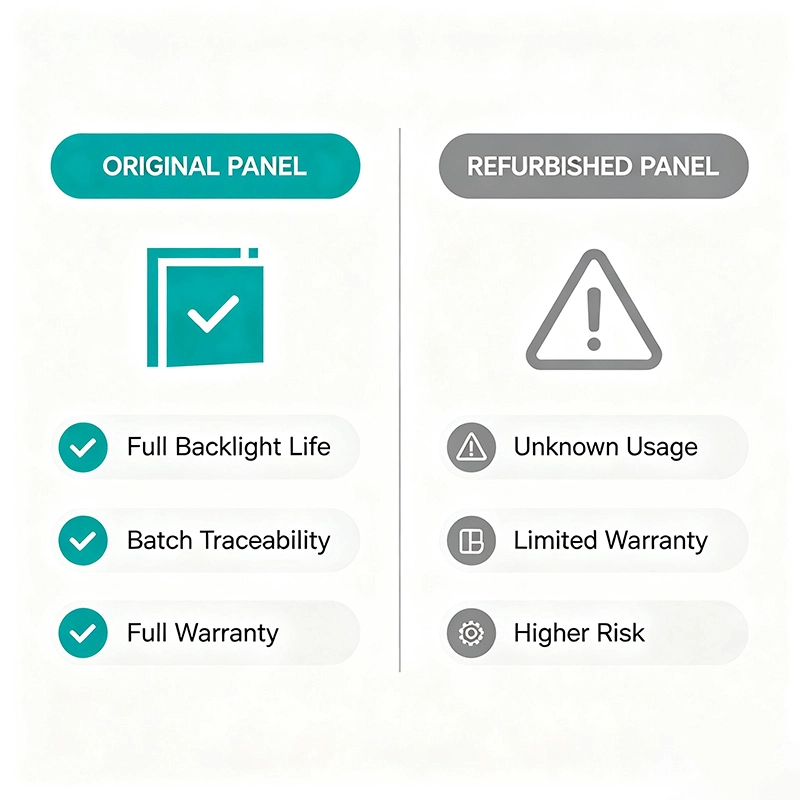
Refurbished panels typically enter the supply chain through decommissioned units, unsold inventory sitting in unofficial channels, or components pulled from returned stock and relabeled. The risks compound quietly: backlight hours already consumed before the panel reaches the buyer, touch-layer realignment issues that surface months after installation rather than at unboxing, and color drift from mismatched batches assembled into the same order. Warranty coverage on the panel component itself is frequently voided or sharply limited in these cases, even when the rest of the unit carries a standard warranty.
The practical safeguard is procedural, not visual: request a panel grade certificate, factory and batch traceability, and warranty terms that explicitly name the panel component — not just the assembled unit — before signing off on a quote that looks unusually attractive for the spec.
Consumer panels are engineered around a household TV usage pattern: a few hours a day, frequent full power-offs, casual viewing distances and angles. Commercial-grade panels built for interactive flat panel applications are engineered for extended, often near-continuous daily run time, more robust thermal management to prevent heat-related pixel degradation, and anti-aging coatings that resist brightness and color drift under sustained illumination. When an education or government procurement standard specifies a minimum daily operating-hour requirement, confirming that a "commercial grade" claim is backed by documentation — rather than a relabeled consumer panel — is a legitimate, specific line item to request from any supplier.
The pattern below shows up across very different buyer types — a training institution and a corporate campus — but the root cause and the fix are the same in both cases.
A vocational training center in Kenya equipped more than 40 classrooms with interactive flat panels as part of a government-supported digital education initiative. During procurement, the evaluation focused mainly on purchase price and core specifications, including 4K resolution, multi-touch capability, and brightness. However, the tender documents did not specify LCD panel grade, panel sourcing, or batch consistency requirements.
After approximately 18 months of regular classroom use, maintenance staff observed noticeable differences between displays. Several units developed uneven backlight brightness and slight color variation around the panel edges, while others continued to perform normally under similar operating conditions.
During the warranty review, the supplier was unable to provide complete documentation confirming that all units had been manufactured using the same commercial-grade LCD panels. Although the products shared the same model number, panel sourcing had varied between production batches, making it difficult to maintain consistent visual performance across the deployment.
The project highlighted an important procurement lesson: identical specifications do not always guarantee identical long-term performance. For education projects involving dozens or hundreds of displays, defining panel grade, batch consistency, and quality traceability in the procurement specification can significantly reduce future maintenance risks.
The second procurement round wrote a documented panel grade and batch traceability directly into the purchase contract. Brightness- and color-related service tickets dropped to a small fraction of the original rate in the following deployment year — reinforcing that the gap in the specification, not the underlying panel technology, had been the root cause.
A regional financial services company in the UAE upgraded more than 60 meeting rooms with large-format smart displays. To reduce upfront procurement costs, the project selected consumer-oriented displays whose specifications—including 4K resolution, touch capability, and screen size—appeared comparable to commercial alternatives.
During normal operation, however, the busiest meeting areas regularly kept displays running for 10 to 12 hours per day, with consecutive meetings and minimal idle time. This operating pattern exceeded the typical daily usage profile for which consumer displays are generally designed.
By the second year of deployment, the IT support team observed a clear difference in maintenance records between high-utilization meeting rooms and those used less frequently. Displays in heavily booked rooms were more likely to exhibit reduced backlight uniformity, gradual brightness degradation, and noticeable color inconsistency during extended operation, while lower-usage rooms remained comparatively stable.
A subsequent technical review indicated that the issue was not the display specifications themselves, but rather the mismatch between the deployment environment and the product's intended duty cycle. Although the consumer and commercial displays shared similar headline specifications, they were designed for different operating conditions, thermal management requirements, and long-term reliability expectations.
The procurement team revised its standards for future deployments, requiring commercial-grade LCD panels and products specifically designed for extended daily operation rather than evaluating displays solely on purchase price and specification sheets.
Replacing the high-usage wing with commercial-grade interactive flat panels — rated for extended daily operation rather than a household duty cycle — brought that wing's ticket rate back in line with the rest of the floor. The lesson mirrors the first case from a different angle: the visible spec sheet looked comparable at purchase time, but the panel's underlying grade and duty-cycle rating were what actually determined whether it held up under the room's real usage pattern.
Panel sourcing is the first quality gate in our production process, not an afterthought handled at final assembly. Every interactive flat panel we build is specified against a documented panel grade, sourced from traceable batches, and inspected against defined uniformity and dead-pixel thresholds before it ever reaches the assembly line.
At Qtenboard, we believe that a commercial display should be judged not only by how it performs when it leaves the factory, but by how reliably it serves customers years after installation.
That's why we focus on commercial-grade LCD panels, stable component sourcing, rigorous quality inspection, and long-term product consistency. Our goal is not simply to build displays with impressive specifications, but to help our partners deliver dependable projects with lower maintenance costs, fewer service calls, and greater confidence throughout the product lifecycle.
In practice, that standard shows up in specific, checkable decisions rather than a marketing claim:
A structured verification list for procurement officers, IT leads and project managers evaluating an interactive flat panel supplier. Each item should be confirmed pre-contract, not after delivery — because the failure modes described throughout this article are almost always invisible at the demo stage.
Bottom line for procurement: the two most common failure modes in interactive flat panel fleet deployments — mixed-batch color and brightness drift, and consumer-grade panel duty-cycle mismatch — are both detectable from documentation before the purchase order is signed. Request the panel grade certificate, batch traceability records, MTBF with stated panel grade, and panel-component warranty terms as a standard documentation pack. If a shortlisted supplier cannot produce all four, treat the quote as unverifiable on long-term performance regardless of how attractive the headline price looks.
Q1What does "A-grade panel" actually mean, and how is it different from A+?
Both grades come from the same factory sorting process based on defect count, defect location, and color/brightness uniformity. A+ sits in the tightest bin with the strictest thresholds; A grade allows a wider but still commercially acceptable tolerance. Neither affects whether the panel powers on — the difference shows up in long-term consistency.
Q2Does panel grade typically affect warranty coverage?
In general, yes — panel-specific warranty terms are usually tied to the grade and sourcing of the component. It's worth asking any supplier to spell out panel warranty terms separately from the overall unit warranty before placing an order, since the two don't always match.
Failure signal: if the supplier's warranty document covers "the unit" without separately naming the panel component, assume the panel is not covered until proven otherwise — especially on quotes priced below the A-grade market average.Q3How should I interpret an MTBF number on a supplier's quote?
Treat it as a statistical average from population testing, not a guarantee for one unit. It's most useful for comparing suppliers relative to each other, alongside the panel grade and thermal design behind the number — an MTBF figure without a stated panel grade is only half the picture.
Failure signal: an MTBF figure presented without a corresponding panel grade or duty-cycle assumption is not a comparable specification. Ask for both together, or treat the number as marketing language.Q4For a large multi-room order, what should I ask suppliers to reduce the risk of inconsistent units?
Ask whether the order will be sourced from a single documented batch or grade specification, and whether that specification can be written into the purchase contract. This is the single most effective safeguard against visible color or brightness differences appearing across a large rollout.
Q5What's the practical difference between an original panel and a refurbished one?
An original panel has its full rated backlight life ahead of it and comes with standard factory traceability. A refurbished panel's prior usage is typically undocumented, which is why defects like touch misalignment or backlight unevenness can surface only after months of use rather than at installation.
Failure signal: a quote that is 20%+ below the market average for the stated panel grade — with no batch documentation — is the most common sign of refurbished stock. The discount is not a negotiation win; it is a signal that the panel component may not be covered under warranty.Q6Is a "low blue light" feature always implemented in hardware?
Not necessarily — some products only apply a software color filter, which changes how the image looks without reducing the actual light emitted. It's a fair question to ask any supplier directly, since the two approaches aren't interchangeable in terms of real eye-comfort benefit.
Q7What operating-hour rating should I look for in a "commercial-grade" panel?
Look for a panel rated for extended daily use that matches your actual deployment pattern — a shared classroom or all-day meeting room runs very differently from a personal office display. Ask the supplier to confirm the rated daily operating hours in writing rather than relying on the word "commercial" alone.
Failure signal: "commercial-grade" claimed without a documented daily operating-hour rating is a relabeled consumer panel until proven otherwise. Ask for the rated duty cycle in hours/day, in writing.Q8What information should I have ready when reporting a panel-related issue?
Having the unit's serial number, purchase batch, and a description of when the issue appears (e.g., only at certain angles, only after long runtime) helps a supplier diagnose whether it's a panel-grade issue, a one-off unit defect, or an installation/environment factor — and speeds up whatever the resolution process turns out to be.
Q9Between A+ and A grade, how should a budget-conscious buyer decide?
For high-visibility, long-hours environments — main auditoriums, control rooms, flagship meeting rooms — A+ pays for itself in consistency. For standard classrooms and meeting rooms, A grade meets commercial thresholds reliably at a lower cost. What we'd caution against, at either budget level, is an undocumented or unspecified grade, which is where most long-term risk actually sits.
Q10What documentation should buyers require from a panel supplier before signing a contract?
Require four documents before signing: (1) a panel grade certificate showing the exact A+/A/B bin and test thresholds applied; (2) factory and batch traceability records for the exact production run; (3) an MTBF figure paired with a stated panel grade and thermal design description — not MTBF alone; and (4) warranty terms that explicitly name the panel component separately from the assembled unit. A quote that cannot produce all four is structurally unverifiable on long-term performance.
Q11How does a refurbished panel enter the supply chain?
Refurbished panels typically enter the supply chain through three channels: decommissioned units from prior deployments, unsold inventory sitting in unofficial channels, and components pulled from returned stock and relabeled. In all three cases, prior usage hours are typically undocumented, touch-layer realignment issues can surface months after installation rather than at unboxing, and panel-component warranty coverage is frequently voided or sharply limited — even when the rest of the unit carries a standard warranty.
Resolution and touch response are easy to compare because they're printed on every quote. Panel grade, MTBF derivation, sourcing traceability, and blue light implementation rarely are — which is exactly why they're where most of the long-term cost, and most of the long-term risk, actually lives in an interactive flat panel purchase. As eye comfort IFPD requirements become more common in education and government tenders, panel-level engineering is quickly moving from a technical footnote to a line item buyers are expected to specify by name.
A-grade panel with documented sourcing is typically sufficient. Avoid unspecified grades and refurbished stock regardless of budget.
A-grade panel, wide viewing angle, and hardware-level eye comfort features are the practical baseline for daily multi-hour use.
A+ grade, top-tier MTBF, and commercial-grade thermal design are worth the premium where downtime or visible defects are not an option.
Explore Qtenboard's education-grade interactive whiteboard line, download the full product catalogue, or talk to our team about panel grade and sourcing documentation for your project.

CEO | Interactive Display & Collaboration Solution Expert
I am the founder of Qtenboard, bringing over 17 years of hands-on expertise to the touch display industry. Drawing on the global management perspective gained through my EMBA studies at ShenZhen University, I lead my team in optimizing every stage of our operations—from product definition to high-efficiency supply chain management—ensuring our manufacturing capabilities remain at the forefront of the industry.
As the leader of Qtenboard, I specialize in providing tailored OEM/ODM solutions for interactive whiteboards, LCD video walls, digital signage, and industrial-grade touch terminals. Backed by our 330,000 m² modern industrial park in Shenzhen, we maintain full-lifecycle control over industrial design, precision manufacturing, and rigorous performance testing.
With nearly two decades of project experience, Qtenboard’s display solutions are now deployed in over 120 countries and regions, earned the trust of more than 15,000 enterprise customers worldwide. If you are seeking a responsive partner with a deep manufacturing foundation for your customized touch display projects, my team and I are ready to support your vision with professional excellence.

 EN
EN
 pt
pt  spa
spa  th
th  vie
vie  aze
aze  bel
bel  est
est  lav
lav  ukr
ukr  ru
ru