Multi-campus universities are running into persistent bottlenecks in outdoor information management. Static paper posters cannot deliver synchronized emergency alerts or real-time campus announcements across open-air public zones.
According to Technavio's global industry research, the digital signage market for education maintains a compound annual growth rate of 10.9% from 2025 to 2030, with outdoor public display terminals ranking as the fastest-growing segment.
University IT teams and procurement officers are repositioning outdoor digital signage from a cosmetic upgrade to core campus communication hardware. This shift arises from practical operational pressure rather than administrative mandates. Without centralized outdoor display terminals, schools cannot guarantee instant public notifications amid unexpected incidents. Printed static boards simply cannot meet the real-time update requirements of modern campus safety management.
For this reason, outdoor digital signage has become a fixed budget item for infrastructure construction in new smart campus projects.
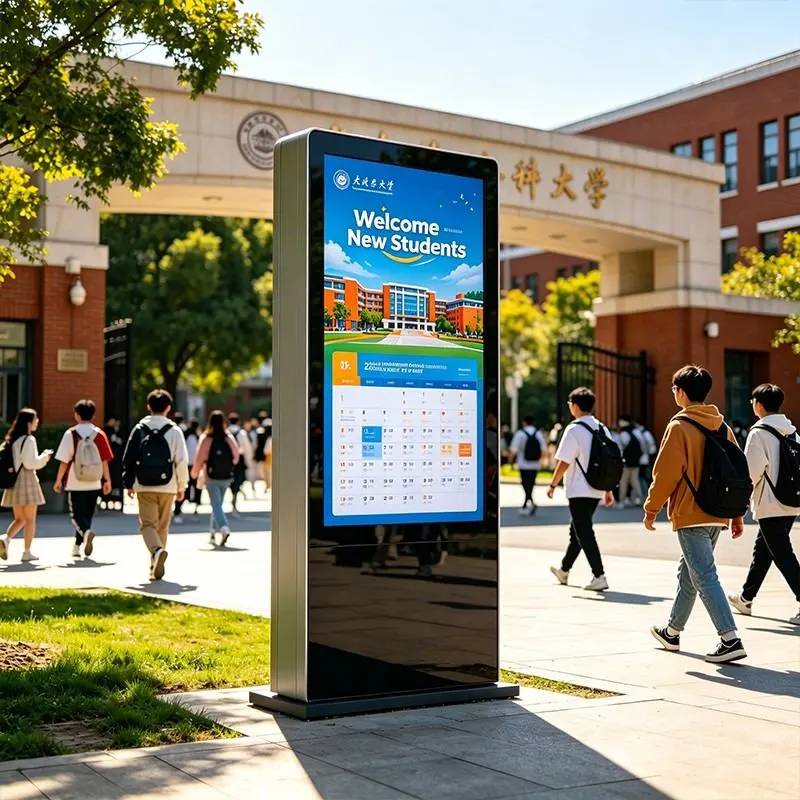
Most procurement teams have already been burned once. Before evaluating any new vendor, it's worth naming the four failure patterns that show up repeatedly in campus-grade outdoor display projects:
These widespread generic display failures result in project rework, budget overruns, and non-compliant emergency information release — the top three risks for campus informatization tenders.
FactQtenboard's outdoor digital signage uses an ambient light sensor to continuously adjust panel brightness across a 3,000–5,000 nit range, rather than running at a single fixed output.
ProblemA display calibrated only for shaded walkways becomes washed out and unreadable the moment it faces direct sunlight on an open quad or sports field — exactly the environment most campus main-thoroughfare and athletic-area installations require.
ValueThe display automatically scales output to match ambient conditions throughout the day, maintaining legibility from early morning shade to peak midday sun without manual recalibration or staff intervention. Our equipment is purpose-built for long-term campus operation instead of being refitted from ordinary commercial screens.
FactThe enclosure carries an IP65 rating against dust and water jets, paired with an active thermal management system that regulates internal temperature and actively suppresses condensation buildup.
ProblemCampuses in humid climates face recurring monsoon-season failures, while those in colder regions see internal moisture accumulate during freeze-thaw cycles — both scenarios are the leading cause of premature hardware failure in outdoor signage that lacks active climate control.
ValueVerified TCO calculation: Qtenboard outdoor digital signage cuts 5-year comprehensive campus operation costs by 35%–42% compared with static signs and low-grade outdoor displays, driven primarily by the reduction in weather-related service calls and early hardware replacement. Our hardware is tailor-made for long-term campus operation rather than modified off-the-shelf commercial panels.
FactThe cloud-based CMS supports role-based permissions, scheduled content playlists, and grouped device management across multiple campus locations from a single administrative login.
ProblemWithout centralized control, an information center team managing displays across three or four campus sites must log into separate systems — or worse, dispatch staff physically — to push a single coordinated announcement, a process that can take two to four hours during a fast-moving situation.
ValueA single administrator can push a verified emergency notice to every connected display across all campus locations in under 30 seconds, directly satisfying the centralized emergency communication requirement that fragmented systems cannot meet. Our management system is developed exclusively for multi-site campus management scenarios.
FactQtenboard uses industrial-grade infrared touch technology — which detects interruption rather than capacitance — combined with an integrated campus wayfinding and event calendar module.
ProblemDuring new-student orientation and large campus events, institutions typically deploy additional staff purely to answer directions and schedule questions, an annually recurring labor cost that scales with enrollment.
ValueInfrared touch performs reliably regardless of gloves, wet conditions, or screen-protector-style surface wear, allowing the wayfinding terminal to function as a genuine self-service point year-round. Campuses that deploy this module during orientation periods consistently reduce dedicated information-staffing needs at high-traffic points. The interactive function is fully adapted to complex outdoor campus environments.
| Dimension | Static Printed Signage | Generic Low-Grade Outdoor Display | Qtenboard Outdoor Digital Signage |
|---|---|---|---|
| Content update cycle | Manual reprint, 2–5 days | Remote, but fragmented per site | Cloud push, minutes, unified across campuses |
| Weather-related failure rate | N/A (no electronics) | High (IP54 or below common) | Low (IP65 + active thermal control) |
| Multi-campus control | Not applicable | Siloed per location | Single CMS, role-based access |
| Emergency information compliance | Cannot meet requirement | Partial, delayed | Meets sub-30-second push requirement |
| 5-year comprehensive cost | High (cumulative printing, labor, replacement) | Moderate-high (frequent hardware failure) | Verified 35%–42% lower than the above two categories |
This is not a marketing estimate — it is a calculation based on print/reprint cycles, average service-call frequency for sub-IP65 enclosures, and labor cost for decentralized content management, compared against Qtenboard's documented field failure rates.
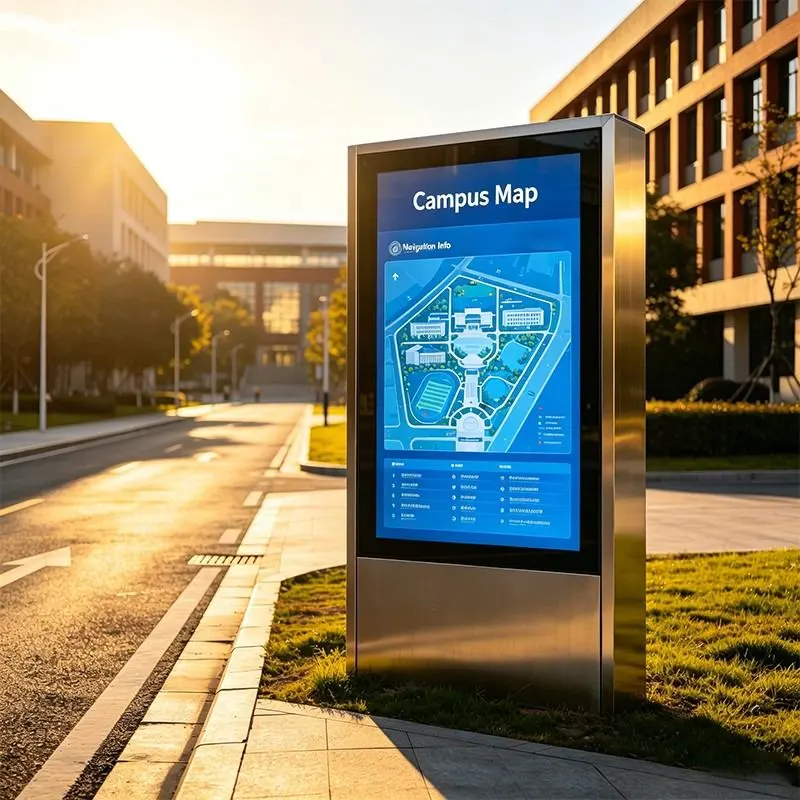
Project context: A multi-campus comprehensive university, responding to a regional education authority mandate for unified campus information infrastructure, issued a tender for a standardized outdoor information release system across its main campus and two satellite campuses.
Who uses it: Faculty, students, and visiting parents passing through the highest-traffic pedestrian corridor on campus, multiple times daily.
What was broken: The university's previous printed bulletin boards along this route were updated weekly at best, meaning event listings and academic deadline reminders were routinely outdated by the time students walked past them.
How it's solved now: Qtenboard units installed along the thoroughfare receive scheduled content pushes from the central CMS — daily announcements, academic deadlines, and event promotions update automatically without any on-site staff visit, and the 3,000–5,000 nit auto-adaptive display remains legible across the corridor's mixed sun-and-shade exposure throughout the day.
Who uses it: Incoming visitors, delivery personnel, and new students unfamiliar with the campus layout, alongside campus security staff monitoring entry points.
What was broken: Visitor confusion at the main gate generated a steady stream of manual direction-giving requests to security staff, pulling attention away from actual security functions, and the institution had no way to push an immediate lockdown or access-restriction notice to this point during an incident.
How it's solved now: The infrared touch wayfinding module lets visitors self-navigate to their destination building without staff assistance, while the same unit serves as a direct emergency notification point — when security needs to broadcast a restricted-access alert, it reaches this screen through the same sub-30-second CMS push used campus-wide.
Who uses it: Students, athletic staff, and event attendees during scheduled sports activities and outdoor university events.
What was broken: Previous outdoor displays at this location, rated at standard commercial brightness, were effectively unreadable during midday sun, forcing the athletics department to rely on paper schedules and verbal announcements for game-time updates.
How it's solved now: Operating at the upper end of the 3,000–5,000 nit range under direct sun exposure, the display remains legible for live schedule updates, score information, and — critically — serves as an emergency broadcast point during outdoor events, satisfying the campus's emergency communication obligation at one of its least-covered location types.
Consistent with our full lineup of outdoor digital signage hardware, Qtenboard supplies differentiated models to match every deployment scenario on university grounds, matching the full product structure in our core product catalog:
Ideal for building facades, teaching building exteriors and campus boundary walls, used for regular campus announcements, campus culture promotion and policy notices.
Floor-standing touch terminals deployed in plazas, pedestrian streets and entrance squares, dedicated to self-service wayfinding, freshman registration inquiry and public information lookup.
Large seamless modular panels suitable for sports squares, opening ceremonies and large outdoor events to deliver high-brightness live broadcast and big-screen display.
Compact outdoor screens deployed near canteens and dormitory areas to update dining notifications, campus management rules and daily reminders in real time.
Specialized outdoor signage installed at campus bus stops to publish real-time shuttle timetables, route changes and safety reminders.
Highly stable outdoor touch equipment for visitor centers and exhibition areas to support campus introduction, venue navigation and event check-in.
The complete product portfolio allows system integrators to build a one-stop unified information release system without sourcing hardware from multiple suppliers.
Contact Qtenboard to receive a custom campus site survey, full TCO evaluation report, and pre-bidding technical document package for your smart campus project.
The procurement question for outdoor digital signage on university campuses is no longer whether to budget for it, but whether the system being evaluated can actually meet the brightness, durability, centralized control, and self-service standards that campus environments specifically demand.
Qtenboard's full lineup of outdoor digital signage is engineered around exactly these requirements. We do not simply repurpose generic commercial display hardware. Instead, we offer differentiated wall-mounted screens, freestanding kiosks, LED walls and interactive terminals, fully matching multi-scene deployment across the whole campus, together with supporting cloud management systems tailored to higher education institutions.
Q1: What brightness is needed for outdoor digital signage?
A1: For shaded outdoor areas, aim for 3000+ nits. In direct sunlight, 5000+ nits is ideal.
Q2: Can outdoor digital signage withstand rain and weather?
A2: Yes. Commercial outdoor displays are IP65/IP66 rated and built to resist water, dust, and temperature extremes.
Q3: How do I update content on outdoor signage?
A3: Most systems use cloud-based CMS, allowing remote scheduling and updates from anywhere.
Q4: Are outdoor signs energy-efficient?
A4: While high brightness consumes more power, many units have energy-saving modes and scheduling to minimize usage.
Q5: Can outdoor displays interact with users?
A5: Yes—via touchscreens, QR codes, Bluetooth, or mobile integration.
Q6: How long do outdoor digital signs last?
A6: Commercial-grade signage typically lasts many years (often 5–10+), depending on usage and maintenance.
Q7: Are analytics worth it?
A7: Absolutely. Analytics help you see what content works best and tailor your strategy for better engagement.

CEO | Interactive Display & Collaboration Solution Expert
I am the founder of Qtenboard, bringing over 17 years of hands-on expertise to the touch display industry. Drawing on the global management perspective gained through my EMBA studies at ShenZhen University, I lead my team in optimizing every stage of our operations—from product definition to high-efficiency supply chain management—ensuring our manufacturing capabilities remain at the forefront of the industry.
As the leader of Qtenboard, I specialize in providing tailored OEM/ODM solutions for interactive whiteboards, LCD video walls, digital signage, and industrial-grade touch terminals. Backed by our 330,000 m² modern industrial park in Shenzhen, we maintain full-lifecycle control over industrial design, precision manufacturing, and rigorous performance testing.
With nearly two decades of project experience, Qtenboard’s display solutions are now deployed in over 120 countries and regions, earned the trust of more than 15,000 enterprise customers worldwide. If you are seeking a responsive partner with a deep manufacturing foundation for your customized touch display projects, my team and I are ready to support your vision with professional excellence.

 EN
EN
 pt
pt  spa
spa  th
th  vie
vie  aze
aze  bel
bel  est
est  lav
lav  ukr
ukr  ru
ru