When brands plan multi-country kiosk rollouts, most of the internal debate goes into software — which ordering platform, which POS integration, which loyalty stack to run. Hardware gets treated as a line item to settle once the software decision is made. That ordering is backwards.
Software can be swapped out in a weekend. A kiosk enclosure built around one country's payment terminal specification cannot be retrofitted overnight when the next market has a different certification requirement or a different terminal footprint — and by the time that mismatch shows up, it's usually attached to a purchase order for several hundred units, not a handful.
We build kiosk hardware for global brands, so this guide reflects our experience and our perspective — including where our own approach isn't the right fit. Use it as a starting point for your own due diligence, not a substitute for it.
The rest of this guide walks through the six stages of a kiosk hardware procurement process, in the order most brand teams actually work through them: hardware architecture, supplier due diligence, regional fit, what tends to go wrong at scale, delivery models, and final inspection standards.
Global brands don't simply need feature-rich kiosks. They need scalable, risk-controlled hardware architectures that remain independent from any single software ecosystem.
There are two dominant ways to pair a kiosk with a payment terminal, and neither is universally right. The deciding factors are deployment scale, regional compliance requirements, and how long you expect to run the fleet before the next hardware refresh — not a blanket claim that one architecture is superior.
Compliance does not hinge on whether a payment terminal connects over Bluetooth. It hinges on whether that terminal holds valid certification for the region it operates in, and whether the transaction link is encrypted end to end. Plenty of large chains run retrofit setups within full compliance for short pilots and low-traffic locations.
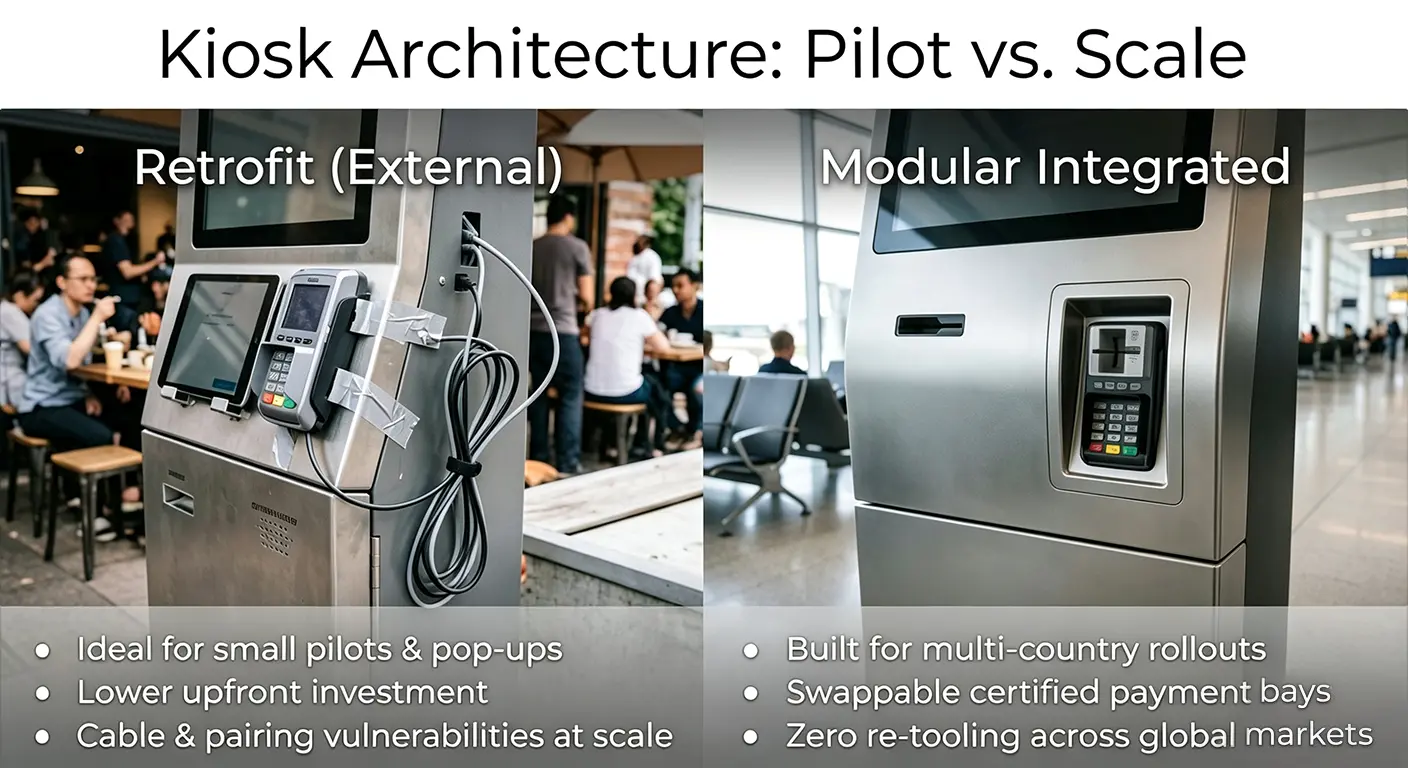
Where this approach tends to strain is at scale. As device density and network load increase, Bluetooth pairing across many units in the same store tends to become less reliable in our experience, and reconciliation errors climb accordingly. Exposed cabling and split-enclosure designs also see materially higher fault rates in high-grease, high-touch food service environments — a cost that shows up as a higher per-store maintenance bill over the life of the device, and one that brand ops teams often haven't budgeted for at the pilot stage.
Where it fits: single-store testing, small regional pilots, pop-ups, low-traffic locations. Where it doesn't: large cross-border standardized rollouts, or high-compliance flagship locations.
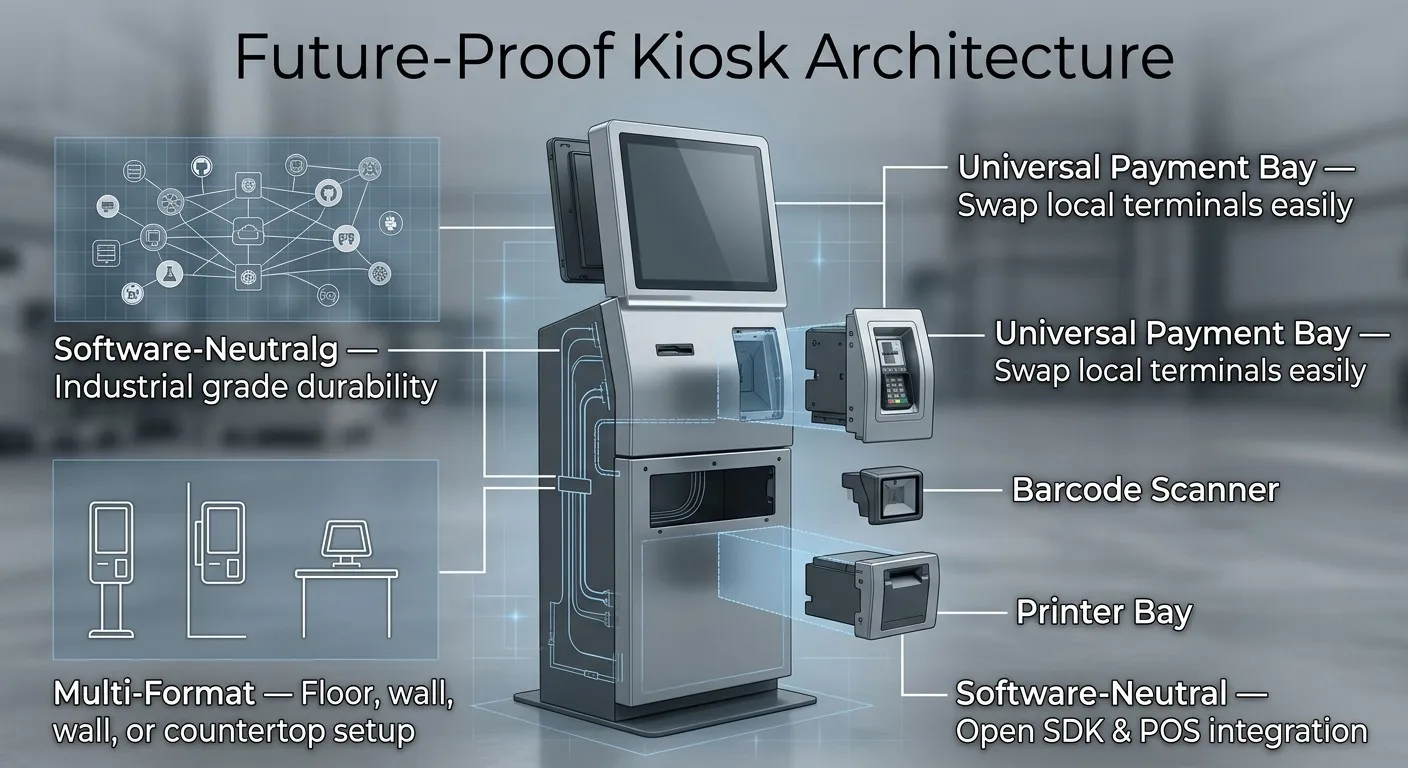
The value shows up at scale. Certified payment hardware can be swapped market-to-market without re-tooling the enclosure or re-certifying the whole unit. Internal wiring and a dedicated hardware bay — instead of external cabling — is where most of the fault-rate and reconciliation gains actually come from. And because the hardware baseline stays the same, multi-country compliance review simplifies down to reviewing the local payment module rather than the whole device.
If you're only piloting in one or two low-traffic stores, a retrofit solution may get you to market faster — modular hardware is built for the scale-up phase, not necessarily the first pilot.
| Dimension | Retrofit (Bluetooth) | Modular Integrated |
|---|---|---|
| Best-fit scale | Small pilots, pop-ups | Multi-country, standardized rollouts |
| Upfront cost | Lower | Higher |
| Cost as fleet scales | Tends to climb | Amortizes down |
| Compliance review load | Per-device verification | One baseline, swap certified modules |
Parameters and price quotes tell you almost nothing about whether a supplier can actually deliver at scale. The six checks below are what we'd expect any serious brand procurement or IT team to request in writing before a factory visit is even scheduled.
The unit should have independent, standardized bays for payment, printing, and scanning hardware, built to accommodate multiple regional terminal specifications.
Hardware shouldn't be tied to any specific software or payment channel — it should expose open, standard interfaces for in-house or third-party POS systems.
The hardware baseline itself shouldn't carry compliance restrictions — it should be able to host payment terminals that hold valid regional certification. This typically includes PCI PTS terminal certification and EMV chip transaction specifications, and for transactions processed within the EU, authentication flows that meet the Strong Customer Authentication (SCA) requirements set out under PSD2. Compliance sits with the payment terminal and the transaction link, not with the enclosure itself.
The device should be built to run continuously, with dust, splash, and heat resistance suited to high-traffic food service environments.
For white-label programs, the supplier should support exterior branding, structural adjustments, and custom boot experiences, across finished-unit and semi-knocked-down delivery.
The supplier should have stable batch production capacity and be able to commit to spare-parts availability for 3–5 years. Get this in writing — a supply commitment mentioned on a sales call isn't a procurement safeguard.
The notes below reflect patterns we've seen across our own projects. They're not a substitute for confirming current regulatory requirements with local counsel, your acquirer, or your compliance team in each market.
These markets tend to have the most codified compliance regimes — clear requirements around payment terminal certification, transaction encryption, and accessible hardware deployment. Selection priority: certified EMV/NFC terminals, a self-contained enclosure with no exposed peripherals, and hardware placement that meets local accessibility standards. This reduces exposure at compliance audit time, which is where retrofit deployments tend to run into trouble at scale.
Dusty, high-heat environments and a market where local mobile wallets are the dominant payment method are the two factors that matter most here. Selection priority: a dust-resistant enclosure and a modular bay that can be swapped for locally compliant QR/wallet payment terminals without redesigning the unit, plus multi-language display support.
Network reliability is inconsistent in many of these markets, and cash still accounts for a meaningful share of transactions. Selection priority: hardware that supports offline order caching, and a modular bay that can accommodate cash-acceptance hardware and multi-currency cash handling where needed.
Store formats vary widely and cost sensitivity is high across this region. Selection priority: a standardized hardware baseline that supports floor-standing, wall-mounted, and countertop configurations from the same modular design, which keeps iteration costs down as store formats evolve.
The three notes below cover patterns we've seen matter most in cross-border kiosk deployments. One is a real project with identifying details removed; the other two are composite scenarios built from patterns across several projects, not a single client's data. Each is labeled accordingly, and figures are presented as ranges rather than precise numbers to reflect that anonymization.
A Thailand-based bubble tea chain with roughly 300 stores running fixed, single-drilled kiosk enclosures began a rollout into Vietnam, the Philippines, and Indonesia.
The existing enclosures had been built around Thailand's payment terminal specification. Vietnam and Indonesia required a newer generation of certified terminals with different mounting dimensions, and the in-market fleet had no room to adapt — the enclosure simply wasn't designed for it. The brand had to source new units for these markets and push them through fresh compliance certification rather than reuse existing stock.
Device replacement costs landed in the mid-six-figure range (USD), and the Vietnam rollout timeline slipped by several weeks. Even after the brand moved subsequent phases to modular hardware, the first replacement wave in Indonesia still ran behind schedule — installer training hadn't caught up with the new bay design. That's a reminder that hardware architecture solves the compatibility problem, not the rollout-execution problem on its own.
Takeaway: for multi-country rollouts, modular, swappable hardware structure is close to a prerequisite — a fixed-structure enclosure is workable for a single, short-term market, not for a multi-year expansion plan.
A Germany-based quick-service brand piloted a retrofit Bluetooth payment setup across roughly 50 units in its home market with no issues. When the same approach was extended to a batch of 500+ terminals across new stores in France and the Netherlands, parallel Bluetooth pairing across many devices in the same store became noticeably less stable, and the fragmented, store-by-store nature of the retrofit deployment made compliance documentation harder to keep consistent across the fleet.
A quarterly compliance audit flagged incomplete transaction-link traceability across part of the French fleet, and the brand was required to pause new terminal rollouts pending remediation — a process that took roughly a month and measurably slowed store-level checkout throughput in the interim.
Takeaway: retrofit solutions performed fine at pilot scale in the home market. The friction only showed up once the same approach was extended into new EU markets at scale — worth planning for before the pilot is declared a success.
A UAE-based retail chain deployed several hundred kiosks from a smaller manufacturer with no written long-term parts commitment. When the manufacturer moved to a newer model generation, core components for the older model were discontinued with no advance notice or stocking plan.
A meaningful share of the fleet across the brand's UAE stores had no path to repair and sat idle, with no near-term replacement plan in place.
Takeaway: for large batch purchases, a written multi-year spare-parts agreement and evidence of stable production capacity matter as much as the unit price — verbal assurances aren't a substitute.
This is a straightforward decision once you know your project's scale and supply chain constraints — it comes down to matching the delivery model to how the project is structured, not which option is inherently better.
| Delivery model | Best-fit project | What it optimizes for |
|---|---|---|
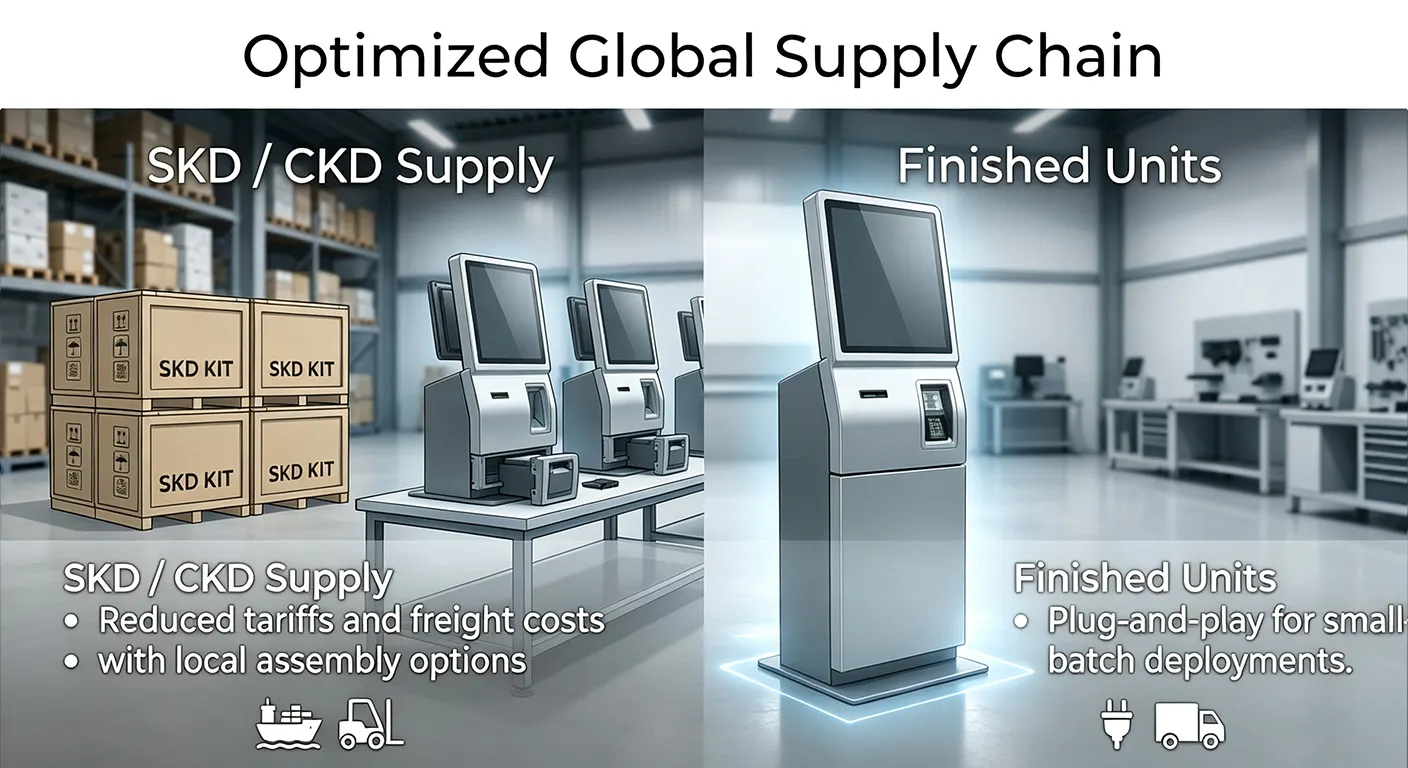
| Finished units | Small pilots, short-term projects, pop-ups | Plug-and-play speed, lower upfront coordination |
| SKD (semi-knocked-down) | Larger cross-border rollouts with local assembly capacity | Tariff and logistics cost, moderate lead time |
| CKD (complete-knocked-down) | Overseas owned factories, bonded-zone projects, large-scale supply chains | Maximum tariff/logistics optimization, local assembly policy fit |
This is the stage that determines whether a procurement process holds up after the purchase order is signed — the standards below are what we'd expect to see written into a supply agreement, not just discussed verbally.
Each batch should go through an extended continuous burn-in cycle before shipment — typically in the range of 48 to 72 hours, consistent with common industrial hardware practice — along with batch-level parameter consistency checks and a full functional test report for every unit.
Spare parts should ship alongside the batch, with a local replacement mechanism and remote technical support available for troubleshooting once units are in-market.
Hardware interfaces should stay open at the base level, without forced version lock-in or paid upgrade bundling tied to continued use.
Newer hardware generations should remain structurally compatible with older models where possible, so existing fleet assets stay usable rather than becoming stranded inventory at the next refresh cycle.
Good procurement starts with matching the hardware plan to your actual scale and risk tolerance — not to the spec sheet with the most features on it.
If you're evaluating suppliers or planning a multi-country kiosk rollout, our team is happy to walk through your specific requirements — including telling you honestly if our hardware isn't the right fit for your project.
No. Standard modular positions support third-party, locally certified payment modules. You keep full control over your supply chain.
The hardware is software-agnostic with open SDK and standard interfaces — it's not locked to any specific ordering or POS system.
Yes — we offer both finished units and semi-knocked-down delivery for large-scale projects, depending on your supply chain and tariff strategy.
Not inherently. Compliance depends on the certification of the payment terminal and the encryption of the transaction link, not the connection method itself. Retrofit solutions can work well for small pilots, but they tend to face more friction once deployed at scale — see the comparison in Stage 1 for details.

CEO | Interactive Display & Collaboration Solution Expert
I am the founder of Qtenboard, bringing over 17 years of hands-on expertise to the touch display industry. Drawing on the global management perspective gained through my EMBA studies at ShenZhen University, I lead my team in optimizing every stage of our operations—from product definition to high-efficiency supply chain management—ensuring our manufacturing capabilities remain at the forefront of the industry.
As the leader of Qtenboard, I specialize in providing tailored OEM/ODM solutions for interactive whiteboards, LCD video walls, digital signage, and industrial-grade touch terminals. Backed by our 330,000 m² modern industrial park in Shenzhen, we maintain full-lifecycle control over industrial design, precision manufacturing, and rigorous performance testing.
With nearly two decades of project experience, Qtenboard’s display solutions are now deployed in over 120 countries and regions, earned the trust of more than 15,000 enterprise customers worldwide. If you are seeking a responsive partner with a deep manufacturing foundation for your customized touch display projects, my team and I are ready to support your vision with professional excellence.

 ukr
ukr
 EN
EN  pt
pt  spa
spa  th
th  vie
vie  aze
aze  bel
bel  est
est  lav
lav  ru
ru