 ukr
ukr
 EN
EN  pt
pt  spa
spa  th
th  vie
vie  aze
aze  bel
bel  est
est  lav
lav  ru
ru Your customers are asking for screens that move — between rooms, between departments, between use cases. You need a product that works in a hotel suite, a hospital ward, and an exhibition booth without three different SKUs, three warehouses, and three after-sales teams. This guide covers Qtenboard's portable Stand By Me TV lineup from a procurement standpoint: what the three product tiers are actually for, what you can customize, and what the real procurement numbers look like.
The Three Procurement Problems This Guide Solves
Most product pages tell you what a display can do. This one focuses on what procurement teams actually get wrong when sourcing portable smart TVs for commercial projects — and how to avoid it.
- 01 Over-specifying for the deployment — paying for a premium private-mold unit when a baseline model covers 90% of the functional requirement, then losing the project on price
- 02 Under-specifying for the audience — sourcing a budget model for a high-end hotel brand that needs it to look good in a suite, then losing the client on product fit
- 03 Choosing the wrong battery position for the use case — back-mounted batteries are lighter and cheaper; base-integrated batteries are more stable on uneven surfaces. The wrong choice creates after-sales issues in the field
- 04 Ignoring Android system openness — selecting a display that cannot be integrated with existing CMS infrastructure, then discovering this after 200 units are in warehouses
What Every Unit in the Lineup Includes — Regardless of Tier
All three product series share a common hardware and software platform. These are not negotiable minimums — they are the baseline that separates this product category from the consumer-grade portable displays and low-cost counterfeits that dominate online marketplaces.
Many competing products either reduce the camera to 5MP or make it a paid add-on. We include 13MP on all models because the healthcare, retail consulting, and remote collaboration use cases that drive B2B volume all require it. A physical privacy cover is also standard — relevant for hotel room, hospital, and government deployments where camera access control is a procurement requirement.
-
Commercial Android — Open, CMS-Ready Unlike consumer-grade Android builds that restrict APK installation, the commercial build used across the lineup supports open app installation, remote CMS content management, bulk device status monitoring, and OTA system updates. This is what allows a hotel chain to push menu updates to 200 rooms simultaneously, or a retail chain to update promotional content from a central dashboard.
-
Audio Tuned for Commercial Environments, Not Living Rooms Consumer portable TVs optimize for bass response. These units optimize for voice clarity in high-ambient-noise environments — mall floors, hospital corridors, exhibition halls. The difference is audible: voice intelligibility in a noisy setting requires a different frequency profile than home movie sound.
-
Anti-Glare Surface Treatment Tested in real retail, hospitality, and outdoor exhibition environments. Anti-glare treatment is applied to all models — not as an upgrade option. In bright commercial lighting or near windows, an untreated screen becomes unreadable for point-of-sale, wayfinding, and consultation use cases.
-
AC Power Passthrough for Fixed Deployments All units support continuous operation via AC adapter — battery is not required for a fixed installation like a hotel room, hospital ward, or retail counter. The battery kicks in when the unit is moved, enabling the hybrid fixed-plus-mobile deployment model that most commercial projects actually use.
Three Series — Each Designed Around a Different Procurement Objective
The three-tier structure is not a good-better-best ladder. Each series is engineered for a different commercial use case. Choosing by "which is more advanced" is the wrong frame — choose by which scenario you are deploying into.
Battery in the base for low center of gravity on carpeted hotel floors and uneven exhibition surfaces. Reinforced rotating stand rated for high-cycle commercial use. Mainstream form factor that downstream retail staff can demo without training. The correct choice when the priority is getting 500 units moving fast at healthy margin — not when the product needs to justify a premium placement in a flagship store.
Exclusive industrial design not available on any public-mold product. Sleeker body geometry, enhanced audio output for lobby and suite environments, 30% smoother system operation from in-depth firmware tuning. When the display is part of the room's aesthetic — not just a functional device placed in a corner — this is the tier that justifies the placement. Clients who have specified the GM01 for hotel rooms and later upgraded to GM02 report measurably better guest response at review stage.
Battery repositioned behind the screen rather than in the base — structurally simpler, meaningfully lower per-unit cost at scale. Decorative components removed where they do not affect the primary use case. Core display performance — image clarity and stand stability — maintained at the same level as GM01. For a 1,000-unit retail chain deployment where every unit is wall-adjacent rather than freestanding on a carpet, the GM03's battery position trade-off is irrelevant and the cost saving is real.
GM01 vs GM02 vs GM03: The Full Comparison
| Criteria | GM01 — Baseline | GM02 — High-End | GM03 — Cost-Optimized |
|---|---|---|---|
| Industrial design | Public mold — mainstream form | Exclusive private mold | Public mold — simplified |
| Battery position | Base-integrated (stable on uneven surfaces) | Base-integrated (stable + clean aesthetic) | Behind screen (lighter, lower cost) |
| Audio system | Commercial voice-clarity grade | Enhanced — louder, wider coverage | Standard — meets basic voice needs |
| Camera | ✓ 13MP standard | ✓ 13MP, optimized ISP tuning | ✓ 13MP standard |
| Physical privacy cover | ✓ Included | ✓ Included | ✓ Included |
| Anti-glare screen | ✓ Standard | ✓ Standard | ✓ Standard |
| System tuning depth | Standard commercial build | In-depth firmware optimization | Standard commercial build |
| MOQ (custom branding) | 50 units | 300 units (private mold) | 50 units |
| Ideal placement | Standard hotel rooms, retail, corporate gifts | Luxury suites, flagship showrooms, exec lounges | Retail chains, gov/enterprise bulk, promo events |
| OEM/ODM support | ✓ UI, logo, packaging, apps | ✓ Full including hardware design | ✓ UI, logo, packaging, apps |
What You Can Actually Customize — and What That Requires
Customization on this product category splits into two tiers: software-level changes that apply from 50 units, and hardware-level changes that require the GM02 private-mold path from 300 units. Understanding which customizations fall into which category prevents misaligned expectations during the quotation phase.
-
UI & Brand Identity (from 50 units) Boot animation, launcher skin, branded wallpaper, startup logo, and color scheme. Pre-installed applications specified by the buyer — including proprietary apps, CMS agents, or restricted app sets for hotel or hospital environments. Settings menus can be locked or hidden to prevent end-user configuration changes.
-
Packaging & Accessories (from 50 units) Outer carton printing, foam insert design, accessory bundle composition (remote control style, cable type, included stand accessories). Retail-ready packaging with branded SKU labels for distributors who drop-ship or shelf-stack.
-
Hardware Configuration (from 50–300 units depending on scope) Screen size selection, touch / non-touch specification, 2K vs 4K panel, camera enable / disable per use case, interface configuration (HDMI, USB counts). Changes that require new tooling — enclosure shape, structural modifications, custom port placement — apply to GM02 private mold only and require 300-unit MOQ.
-
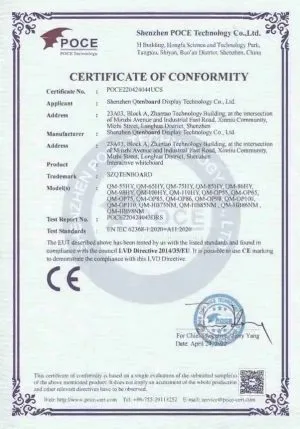
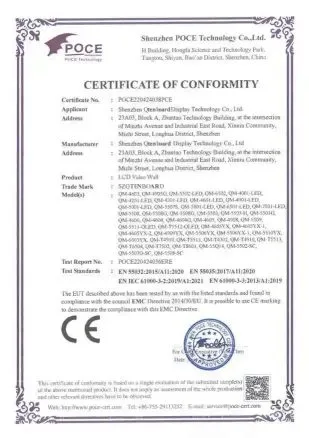
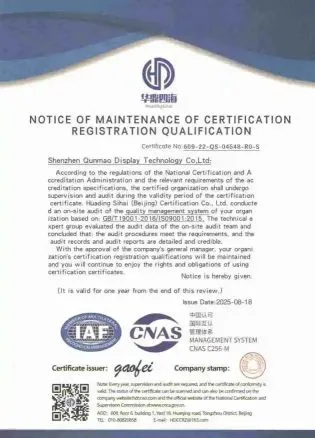
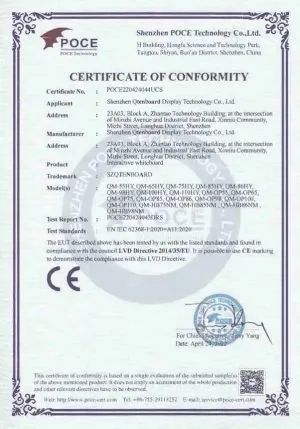
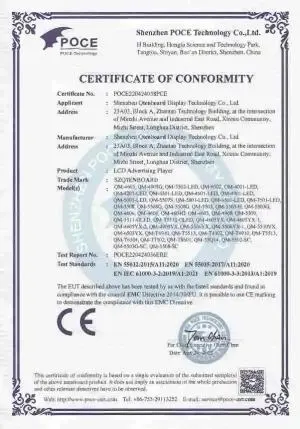
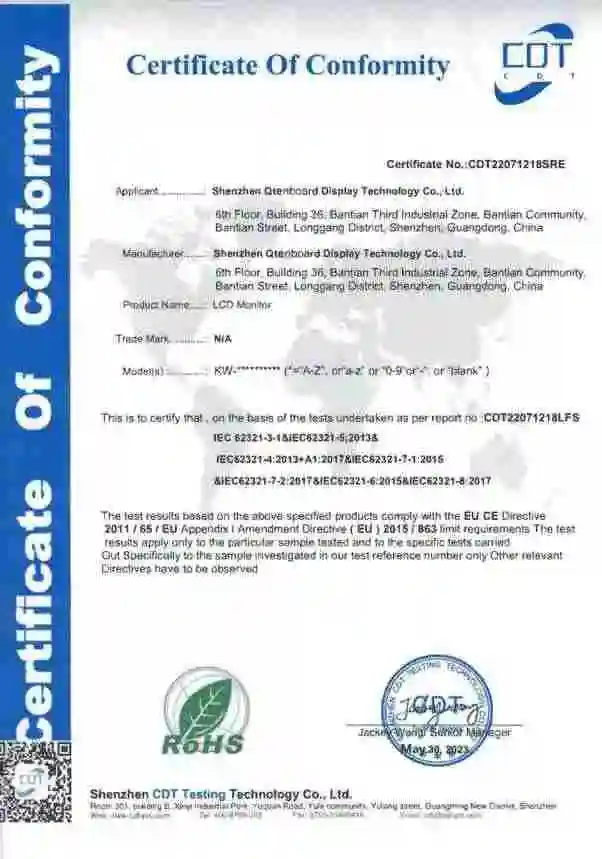
Regional Certification CE and FCC certification is standard. UKCA, BIS, SASO, EAC, and NOM are available on request — specify target markets at the quotation stage. Certification documentation is provided to OEM buyers for use in their own import and regulatory submissions.
Seven Industries — What the Use Case Actually Looks Like
The scenarios below are based on active deployments. Each includes a recommended series, because the same use case with the wrong product tier is a customer service problem waiting to happen.
Questions B2B Buyers Ask Before Placing an Order
Ready to evaluate a sample or get a project quote?
Tell us your deployment scenario, target volume, and required in-market date. We confirm feasibility and pricing within 24 hours.