Executive Summary: Large-scale visual communication systems in executive boardrooms and university auditoriums are moving away from traditional projection and single-panel displays. Modern enterprise IT directors and institutional procurement committees now prioritize 4K/8K array pixel density, multi-source video matrix routing, low optical fatigue, and certified long-term reliability. An industrial-grade LCD Video Wall system provides a high-luminance, high-precision visual surface designed to handle complex financial modeling, GIS mapping, remote hybrid collaboration, and dynamic academic lecturing.
Deploying a professional LCD Video Wall involves solving complex AV engineering challenges rather than simply hanging screens. System integrators, education technology heads, and corporate decision-makers must evaluate panel-level physics, bezel joint interruption, optical reflection properties, signal latency, and serviceability across multi-screen arrays.
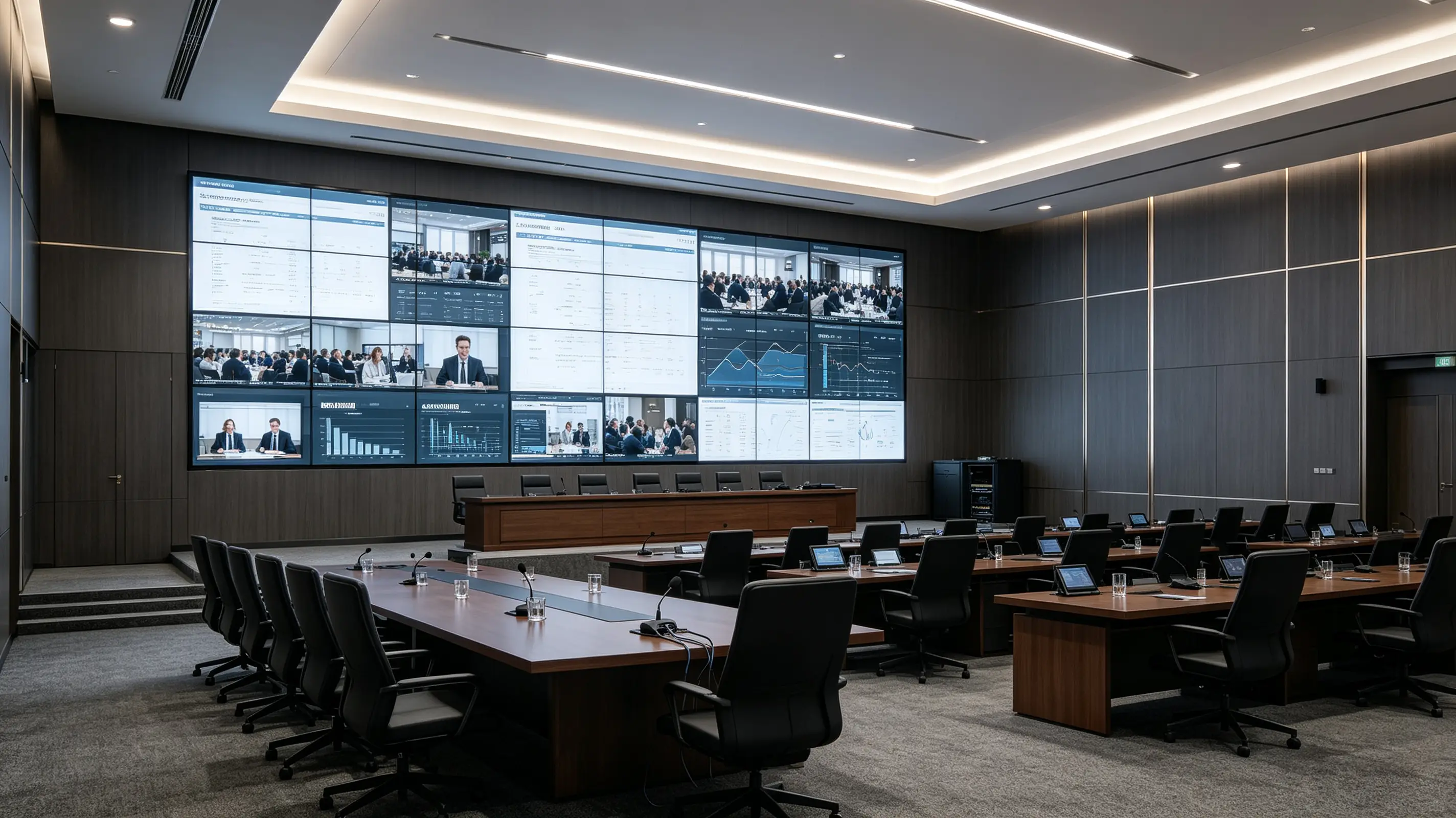
To ensure high ROI and operational continuity, institutional buyers must evaluate display technologies through an engineering lens. Here is how three critical technical features convert directly into practical operational value:
Selecting the optimal display technology requires a clear trade-off analysis based on viewing distance, pixel density, Total Cost of Ownership (TCO), and application environments:
| Technical Metric | Industrial LCD Video Wall | Direct-View Fine-Pitch LED (< P1.2) | Single Large Interactive Flat Panel (IFP) |
|---|---|---|---|
| Pixel Density & Text Resolution | Ultra-High (Native 4K/8K Array) Unmatched text sharpness for close-range spreadsheet and document viewing. |
Moderate to High Seamless surface, but pixelation can be noticeable at viewing distances under 2.5 meters. |
High (Native 4K Single Panel) Excellent clarity, but total screen size is capped at 98" or 110" diagonal. |
| Total Cost of Ownership (TCO) | Optimal / High ROI Low initial CAPEX, standard commercial power draw, long backlight lifespan (50,000+ hrs). |
High Initial CAPEX 3x to 4x cost of LCD; requires specialized module repair and higher thermal management. |
Low Initial CAPEX Plug-and-play setup, minimal integration accessories required. |
| Optical Ergonomics & Anti-Glare | Superior (44% AG Matte Coating) Zero glare under bright artificial lights; comfortable for long strategic meetings. |
High Brightness / High Contrast Extremely vibrant, but high luminance can cause visual fatigue in close-range rooms. |
Moderate Glare Control Glass surface can reflect bright room lights unless equipped with premium anti-glare glass. |
| Primary Deployment Scenarios | Boardrooms, Auditoriums, Control Rooms Best for multi-source data review and close-to-medium range viewing. |
Lobbies, Large Auditoriums, Showrooms Best for long viewing distances (> 4m) where seamless visual impact is paramount. |
Huddle Rooms, K-12 Classrooms Best for small group interactive brainstorming and single-source presentations. |
A prominent Higher Education Institution sought to upgrade its 300-seat central academic hall. The existing motorized projector suffered from low brightness under ambient hall lighting, washed-out color saturation, and a 12-minute warm-up delay. Faculty members struggled to present complex biomedical charts and remote international guest lecturers side-by-side.
The AV engineering committee deployed a 4×3 55-inch LCD Video Wall (0.88mm ultra-narrow bezel) powered by an industrial FPGA matrix processor and hydraulic pop-out mounting hardware.
The new LCD Video Wall system eliminated pre-lecture warm-up delays entirely, providing instant-on performance. Student retention and engagement improved due to sharp 4K text legibility from the farthest row (22 meters away), while ambient lighting could remain turned on for note-taking during lectures.
Delivering enterprise-grade AV solutions requires rigorous product compliance, robust logistics engineering, and dependable long-term technical support:
To prepare an accurate System Architectural Layout and Bill of Materials (BOM), provide: (1) Total available wall width and height, (2) Farthest and closest spectator viewing distance, (3) Number of simultaneous input sources (laptops, cameras, media players), and (4) Preferred installation method (wall-recessed, floor-standing, or pop-out mount).
Industrial video wall displays feature factory-calibrated 3D LUT color management and advanced internal temperature sensors. Through auto-calibration software, technicians can quickly align gamma curves, color temperature, and luminance levels across all panels using an optical sensor.
Yes. Commercial video wall processors and displays support RS232, RS485, and LAN IP control protocols, allowing seamless integration with central room control interfaces, touch panels, and automated AV scheduling systems.
Common specifications include 3.5mm conventional seams and premium 0.88mm ultra-narrow UNB bezels. Wider seams create obvious visual segmentation that disrupts charts, financial data and presentation slides during board meetings; the 0.88mm micro seam minimizes visual interruption, delivering a nearly seamless unified large-screen viewing experience ideal for executive conferences and data review sessions.
Industrial-grade LCD panels adopt long-life backlight modules with a rated lifespan of 50,000 hours. Under normal daily corporate meeting usage (6–8 hours per day), the equipment can operate steadily for more than 8 years. It supports 7×24-hour continuous standby operation for headquarters group conference halls and emergency command scenarios without frequent shutdown restarts.
Our commercial LCD video walls adopt front-access maintenance design. No need to reserve large rear maintenance space inside the wall cavity; engineers can complete panel disassembly, wiring inspection and hardware replacement directly from the front of the screen. It greatly reduces civil engineering construction costs, fits perfectly into integrated interior decoration of high-end boardrooms, and avoids damaging wall finishes during later maintenance.
Whether you are designing an executive boardroom, a university lecture hall, or a multi-screen command center, start with precise engineering calculations. Contact our AV application specialists today to receive custom DWG CAD drawings, system schematics, and comprehensive BOM pricing.
Access Video Wall Size Calculator Explore Commercial LCD Video Wall Solutions

CEO | Interactive Display & Collaboration Solution Expert
I am the founder of Qtenboard, bringing over 17 years of hands-on expertise to the touch display industry. Drawing on the global management perspective gained through my EMBA studies at ShenZhen University, I lead my team in optimizing every stage of our operations—from product definition to high-efficiency supply chain management—ensuring our manufacturing capabilities remain at the forefront of the industry.
As the leader of Qtenboard, I specialize in providing tailored OEM/ODM solutions for interactive whiteboards, LCD video walls, digital signage, and industrial-grade touch terminals. Backed by our 330,000 m² modern industrial park in Shenzhen, we maintain full-lifecycle control over industrial design, precision manufacturing, and rigorous performance testing.
With nearly two decades of project experience, Qtenboard’s display solutions are now deployed in over 120 countries and regions, earned the trust of more than 15,000 enterprise customers worldwide. If you are seeking a responsive partner with a deep manufacturing foundation for your customized touch display projects, my team and I are ready to support your vision with professional excellence.

 EN
EN
 pt
pt  spa
spa  th
th  vie
vie  aze
aze  bel
bel  est
est  lav
lav  ukr
ukr  ru
ru