Executive Summary: For commercial property developers, shopping mall operators, professional DOOH (Digital Out-of-Home) media network operators, and global retail brand marketers, industrial-grade LCD Video Wall systems represent far more than conventional large-format display hardware. Strategically deployed at high-traffic pedestrian decision points throughout indoor commercial spaces and centrally managed via enterprise-grade cloud content platforms, these modular splicing screen arrays function as scalable, revenue-generating In-Mall Retail Media Network (RMN) assets. They deliver stable, high-margin recurring advertising income for property owners while effectively capturing in-market shopper attention and driving measurable foot traffic, in-store visitation, and transaction conversions for contracted retail tenants.
Deploying a well-engineered commercial LCD Video Wall network solves one of the most persistent pain points in modern retail operation: the disconnection between abundant passive mall foot traffic and active brand consumption behavior. Traditional offline marketing methods such as static posters, light boxes, and in-store window displays are limited to single-store coverage, unable to penetrate the entire mall public domain or capture floating audience groups. By equipping shopping malls with dynamic, high-definition splicing video wall systems, property operators provide retail brands, regional distributors, event organizers, and promotional sponsors with a premium large-format visual communication carrier. This transforms idle public wall space into sustainable profit-generating business units while delivering contextual, scenario-based, and purchase-oriented content experiences to shoppers who are already in active consumption mindset.
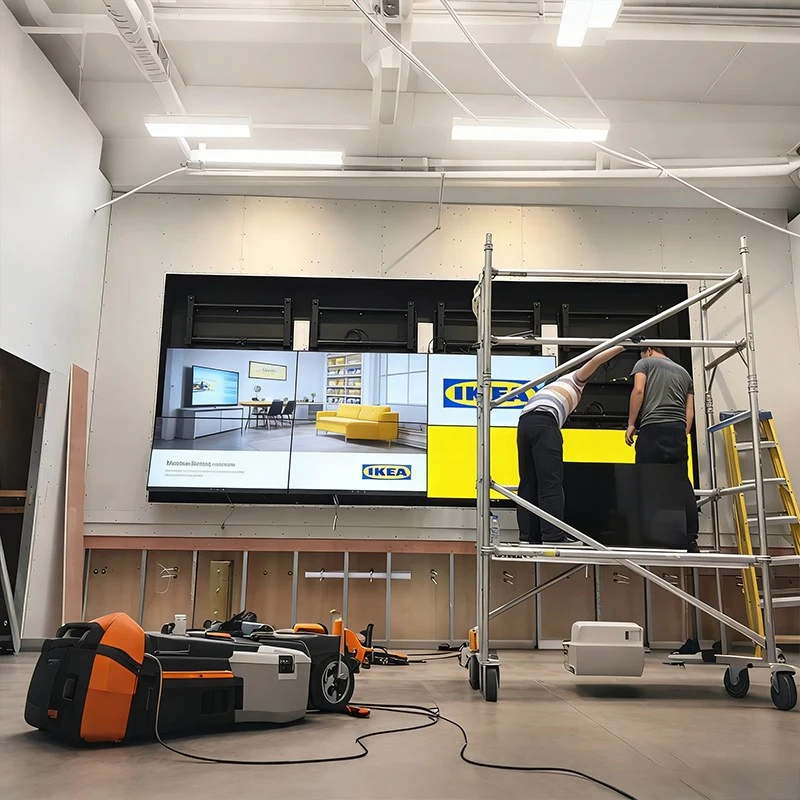
Unlike ordinary office displays, home televisions, and basic indoor advertising screens used in simple scenarios, modern shopping mall environments impose extremely strict requirements on display optical performance, structural stability, continuous operation capability, and visual presentation quality. B2B media buyers, commercial AV system integrators, and mall asset management teams need to clearly understand how professional panel-level engineering designs translate into tangible commercial advertising value, premium media pricing power, and long-term operational stability advantages.
When carrying out mall digital media asset planning and capital investment layout, retail property developers need to select the most suitable display solution according to actual scenario conditions such as on-site viewing distance, ambient light intensity, advertising resolution requirements, and project budget cycle. Different display devices have obvious differences in visual effect, investment cost, later maintenance difficulty, and advertising revenue capability, which directly determine the final operation benefit of retail media networks.
| Display Metric | Industrial LCD Video Wall | Direct-View Fine-Pitch LED (< P1.5) | Single Digital Signage Kiosk (55"-86") |
|---|---|---|---|
| Pixel Density & Text Resolution | Ultra-High (Native 4K/8K Array) Razor-sharp fine text, QR code scanning, and close-range detail. |
Moderate to High Seamless canvas, but pixelation occurs at close viewing distances (< 2 meters). |
High (Single 4K Panel) Excellent clarity, but visual impact is limited by smaller physical screen area. |
| Commercial CAPEX & ROI | Optimal / High Revenue Yield Lower initial acquisition cost with fast payback through multi-tenant ad loops. |
High Initial CAPEX 3x–4x higher investment cost; requires specialized module repair and higher power draw. |
Low Initial CAPEX Plug-and-play installation, best suited for localized wayfinding or single-store entry. |
| Optical Ergonomics & Haze Control | Superior (Up to 44% AG Matte Coating) Eliminates harsh overhead glare in bright retail corridors and skylight atriums. |
High Luminance & Contrast Vibrant visual punch, but high pixel brightness can cause close-range eye fatigue. |
Moderate Glare Control Reflective protective glass requires careful positioning relative to overhead light fixtures. |
| Primary Retail Deployment | Main Atriums, Escalators, Food Courts Best for multi-brand ad loops, product launches, and mid-range viewing zones. |
Landmark Mall Entrances, Exterior Facades Best for long-distance viewing (> 5m) and high-impact structural architecture. |
Storefront Entrances, Elevator Lobbies Best for directional wayfinding, interactive catalogs, and single-store promos. |
With the continuous upgrading of digital retail operation models, traditional fixed-cycle single-loop advertising playback can no longer meet the refined marketing needs of modern brands. Today’s high-end shopping mall LCD Video Wall media systems are gradually transforming from simple display equipment to intelligent data-driven marketing terminals. By integrating edge computing AI vision analysis modules and anonymous passenger flow big data statistics functions, the platform can automatically identify real-time changes in mall crowd density, passenger age group distribution, and peak consumption periods. The system intelligently matches corresponding advertising content according to different time periods and crowd characteristics, realizing accurate delivery of catering, clothing, entertainment, beauty and other categorized advertisements, greatly improving advertising conversion efficiency and unit CPM value of media positions.
To realize stable and sustainable monetization of video wall hardware assets, mall operation teams and DOOH media institutions need to build standardized, hierarchical, and diversified advertising product systems and pricing mechanisms, forming differentiated service packages for different brand levels and marketing cycle demands.
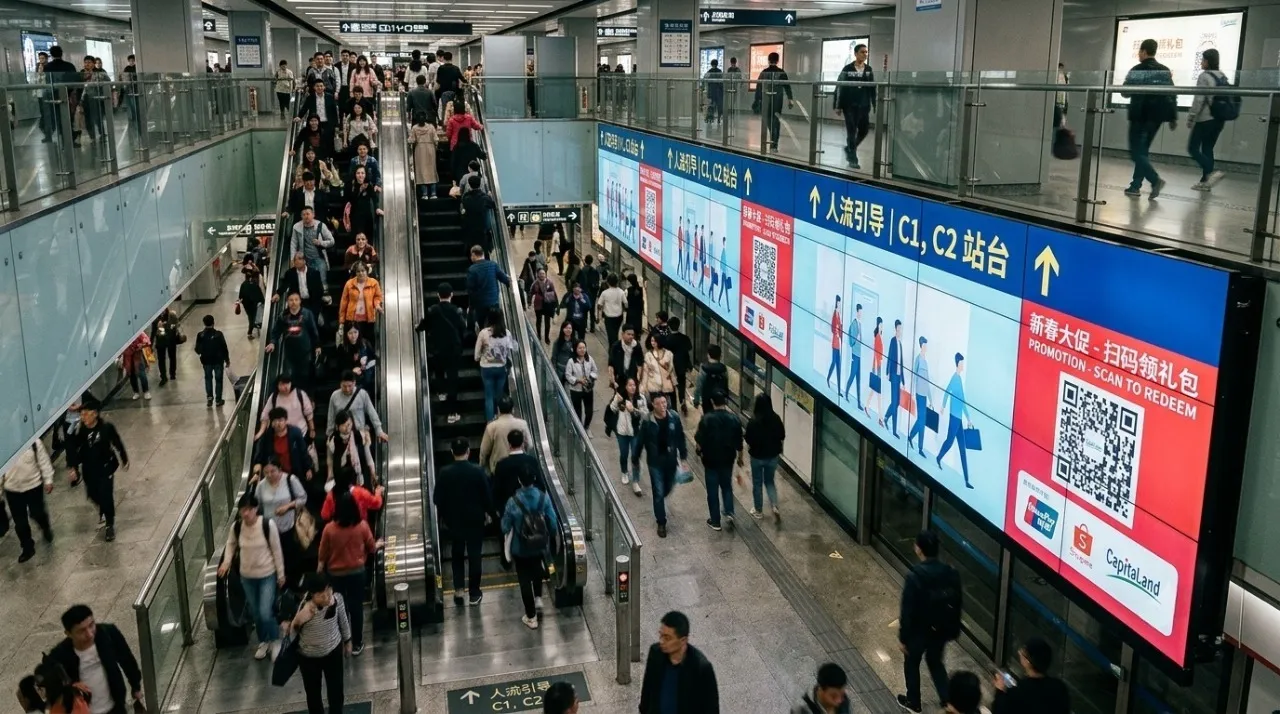
A global apparel retailer launched its new flagship store on the third floor of a core urban shopping center. Although the brand itself has high market popularity and consumer recognition, the upper-floor store location faced typical industry problems of insufficient natural passenger flow and weak active exposure ability. Compared with the ground floor entrance and first-floor main corridor with dense floating passenger flow, the third-floor commercial area had a 40% lower average daily passenger density, resulting in slow store opening popularity accumulation and insufficient new customer acquisition volume.
The mall media operation team customized a targeted digital out-of-home marketing solution for the brand, launching 15-second high-contrast dynamic motion graphic advertisements on the core escalator passage 4×3 55-inch 0.88mm ultra-narrow bezel LCD Video Wall with 700-nit high-brightness industrial panels.
During the 14-day opening promotion cycle, the video wall advertising campaign successfully accumulated 3,420 independent QR code scan behaviors, driving 1,180 valid in-store coupon redemptions and actual consumption. The overall passenger flow of the third-floor business area increased by 28% month-on-month, effectively breaking the geographical traffic disadvantage of upper-floor stores, and verifying the efficient drainage and value-adding capability of large-screen DOOH media for offline retail brands.
High-quality mall video wall media asset construction depends on standardized industrial-grade hardware configuration and perfect global after-sales service system. All display equipment adopts A-grade industrial commercial panels sourced from mainstream suppliers such as LG and BOE, equipped with professional T-Con control boards and automatic color calibration programs, ensuring that the overall screen color difference ΔE is less than 2, realizing high consistency and high reduction of long-term picture color.
To prepare an accurate system design and Bill of Materials (BOM), provide: (1) Wall dimensions (width and height), (2) Installation height above floor level, (3) Ambient light conditions (indoor corridor vs skylight atrium), and (4) Preferred signal controller requirements (HDMI/DP inputs, IP streaming, or multi-window processing).
Using an enterprise cloud-based Content Management System (CMS) paired with hardware media players, operators can remotely push scheduled playlists, configure dayparting rules, monitor screen health, and auto-generate proof-of-play logs for advertisers from a single web dashboard.
LCD Video Wall arrays deliver far higher pixel density, superior text legibility, and modular scalability compared to single large displays. They allow mall operators to split the display canvas into dynamic multi-window configurations or run full-screen 4K/8K media loops as needed.
Standard service packages cover on-site installation calibration, regular hardware inspection, fault troubleshooting, spare parts replacement, CMS system remote debugging, brightness uniformity correction and firmware upgrade. We also provide extended maintenance plans for peak holiday shopping seasons to ensure stable all-day operation.
Yes. The professional CMS system supports customized time-divided playback strategy: morning shopping guidance, noon catering promotion, evening fashion & leisure advertising, as well as one-click switching for holiday promotions, store opening activities and mall anniversary campaigns without manual on-site operation.
Ultra-narrow bezel minimizes visual segmentation of the entire display surface, presenting seamless panoramic advertising images and videos to shoppers. Integrated immersive visuals greatly strengthen brand impact and advertising conversion rate, helping mall management raise media pricing and attract high-end brand advertisers for long-term cooperation.
Whether you are designing a new retail media installation, upgrading an existing atrium display system, or sourcing OEM/ODM hardware for global commercial engineering projects, our professional AV display team provides one-stop customized solutions. We support free engineering consultation, CAD installation schematic design, personalized BOM configuration and targeted technical scheme optimization.
Access Video Wall Size Calculator Explore Commercial LCD Video Wall Solutions

CEO | Interactive Display & Collaboration Solution Expert
I am the founder of Qtenboard, bringing over 17 years of hands-on expertise to the touch display industry. Drawing on the global management perspective gained through my EMBA studies at ShenZhen University, I lead my team in optimizing every stage of our operations—from product definition to high-efficiency supply chain management—ensuring our manufacturing capabilities remain at the forefront of the industry.
As the leader of Qtenboard, I specialize in providing tailored OEM/ODM solutions for interactive whiteboards, LCD video walls, digital signage, and industrial-grade touch terminals. Backed by our 330,000 m² modern industrial park in Shenzhen, we maintain full-lifecycle control over industrial design, precision manufacturing, and rigorous performance testing.
With nearly two decades of project experience, Qtenboard’s display solutions are now deployed in over 120 countries and regions, earned the trust of more than 15,000 enterprise customers worldwide. If you are seeking a responsive partner with a deep manufacturing foundation for your customized touch display projects, my team and I are ready to support your vision with professional excellence.

 EN
EN
 pt
pt  spa
spa  th
th  vie
vie  aze
aze  bel
bel  est
est  lav
lav  ukr
ukr  ru
ru