Wheeled, battery-powered, 21.5" to 43". No cable across the stand, no work order for the hall, no queue at the electrician's desk. One person moves it when the traffic shifts to the other aisle — and it goes back in the case at teardown.
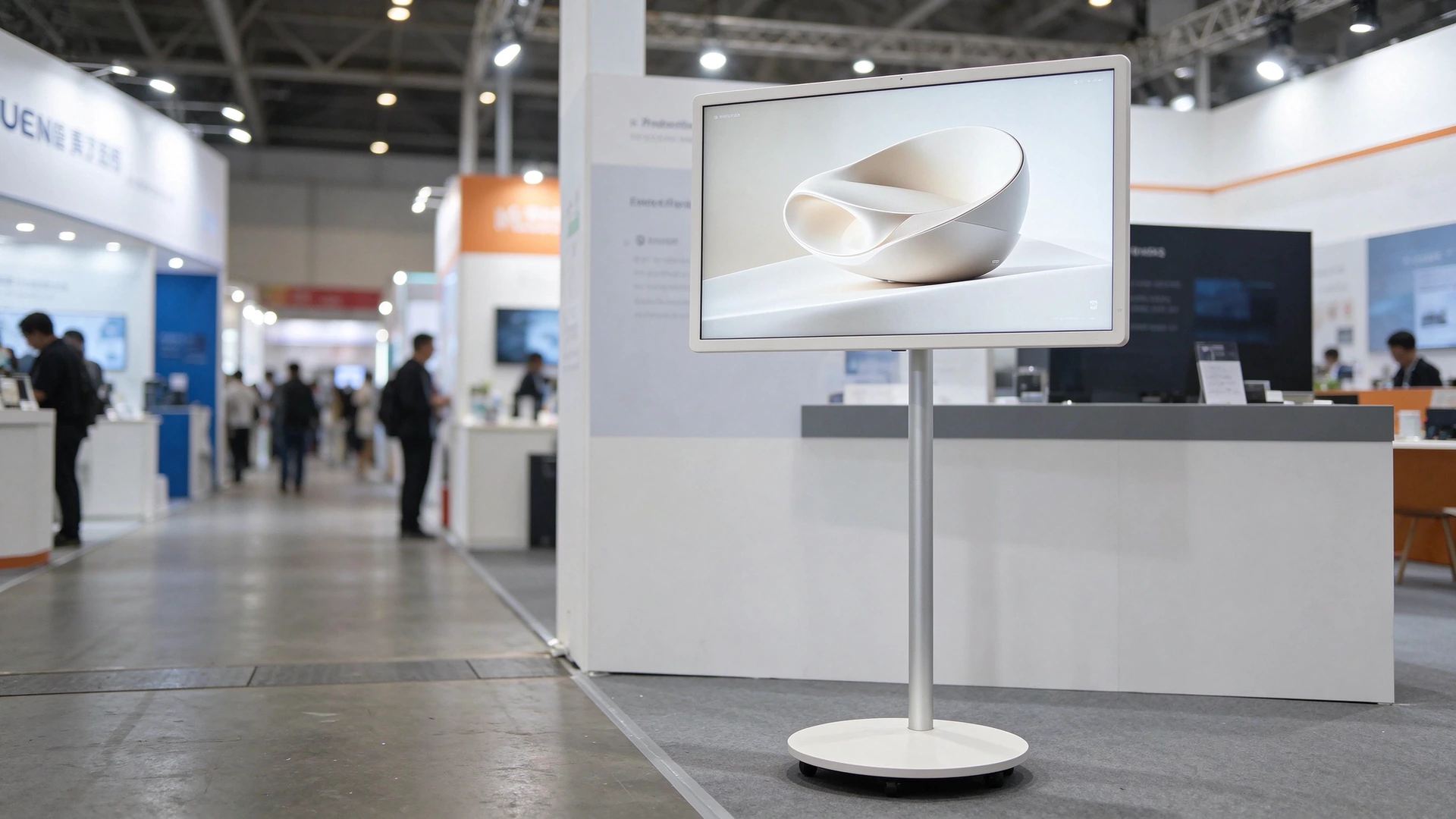
A trade show is the harshest environment this product is sold into: three days, twelve hours a day, high ambient light, a floor built by someone else, and a two-hour window to get everything standing. Each of these six is a purchasing decision, not a detail to sort out on site. For the retail version of the same hardware, see our pharmacy mobile smart screen solution.
01Halls are far brighter than a shop
Exhibition lighting is designed to make products look good from ten metres away. A panel that reads well in a showroom can look grey and washed out under hall lighting — and every visitor judges the screen before they judge the product.
Answer: specify the high-brightness panel and get the nits figure in writing before the order.
02There is no socket where you stand
Power at a stand is ordered, metered and charged by the organiser, and the outlet is rarely where the demo position needs to be. A lead across the stand is a trip hazard in a crowd and an inspection finding.
Answer: battery in the base. Charge overnight, walk it into position, no cable on the floor.
03Twelve hours, three days, one battery
Show days are long and the unit is on from the opening bell. The runtime question is not "how many hours" in a datasheet — it is whether your content brightness and your day length leave anything in reserve at 5pm.
Answer: plan a charging routine and a second unit rotation, then test a full show day once.
04Every hall floor is different
Bare concrete in one hall, a raised timber platform in the next, carpet tile over both. A loaded disc base behaves differently on each, and an uneven platform joint can stop a small castor dead.
Answer: check the castor grade against the floor you will actually build on, and test it during build-up.
05The build-up window is short
Load-in is a queue of forklifts and trolleys with a fixed closing time. Anything that needs two people and a tool kit is a risk on the day the stand has to be photo-ready by 6pm.
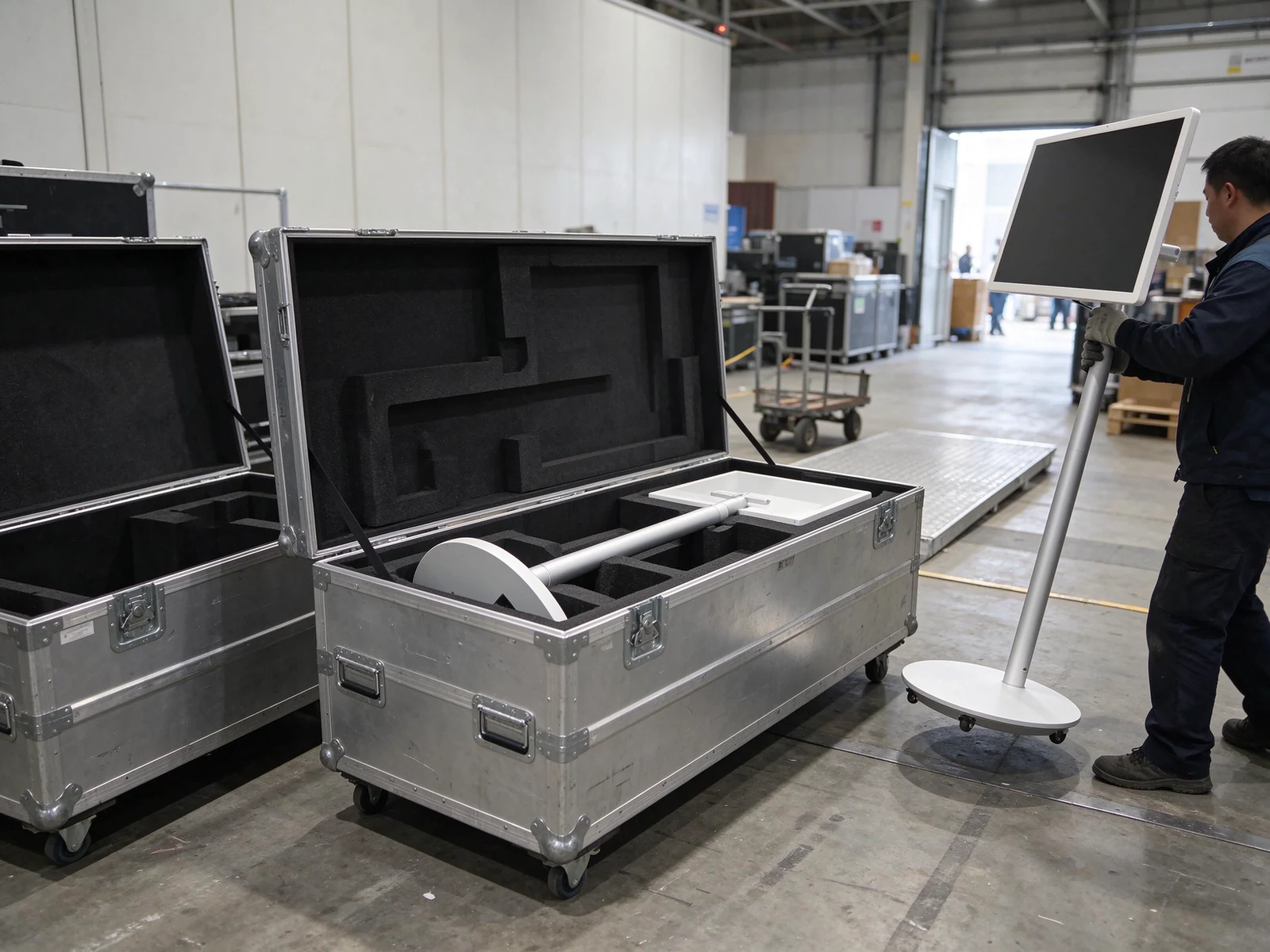
Answer: pole, base and panel with castors — one person, no tools, before the crates are cleared.
06The screen is a demo position, not a TV
Height and angle decide whether a visitor walking the aisle can see the product. A screen mounted for seated viewing makes people stoop; too high and it disappears above the crowd.
Answer: height-adjustable pole, 180° rotation so a portrait product shot works at aisle edge.
Most exhibitors budget one screen for one place. In practice it moves three times per show: demo at the aisle, meeting point at the back, product poster where the wall is too expensive to print.
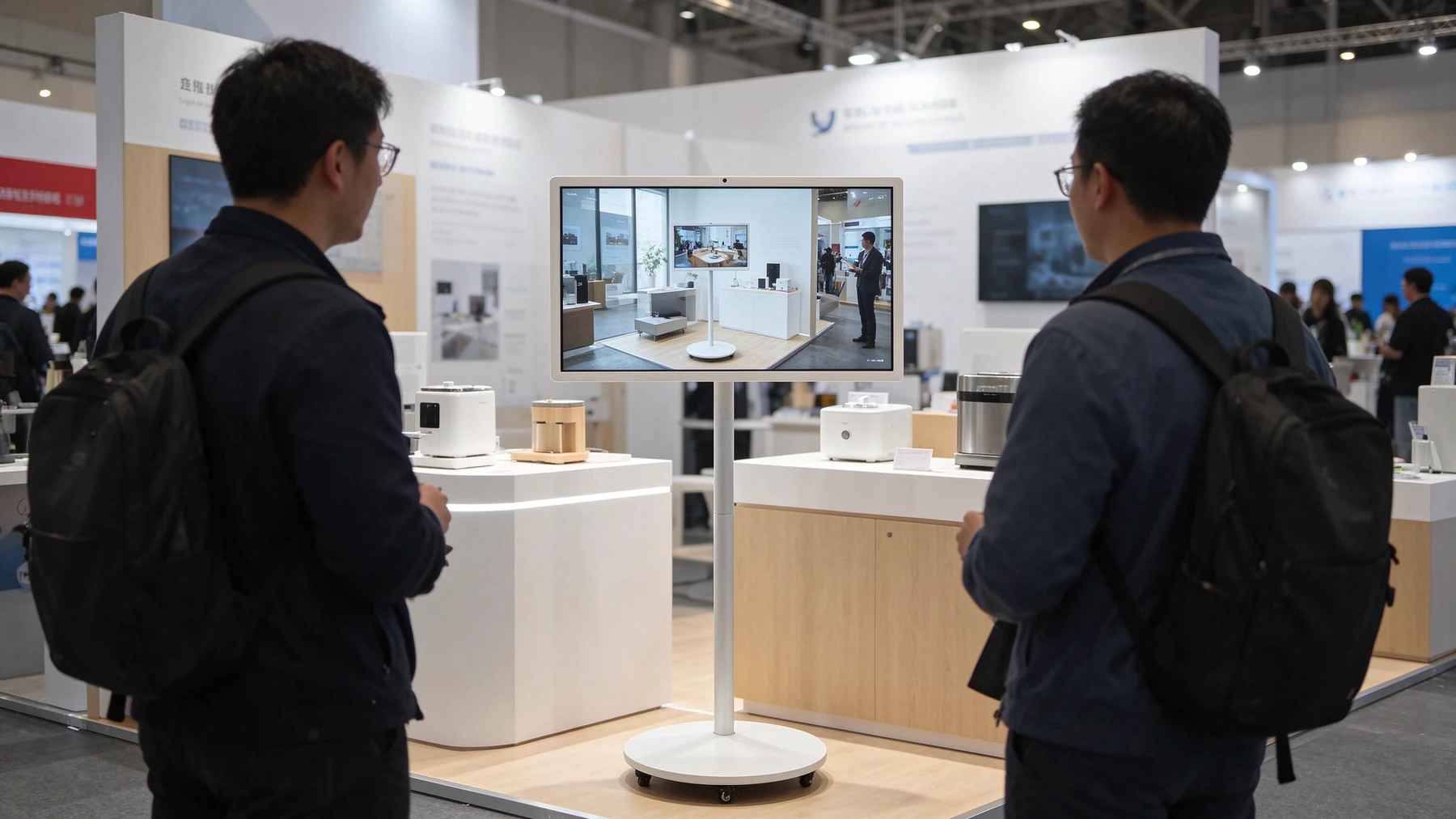
Landscape at the front of the stand, showing the product film or a live interface at eye height, angled slightly toward the aisle. This is the position that generates conversations, and it is the one that cannot be behind the counter.
It also has to be movable: when the crowd moves to the other end of the hall, the screen goes with it — not next year's stand design.
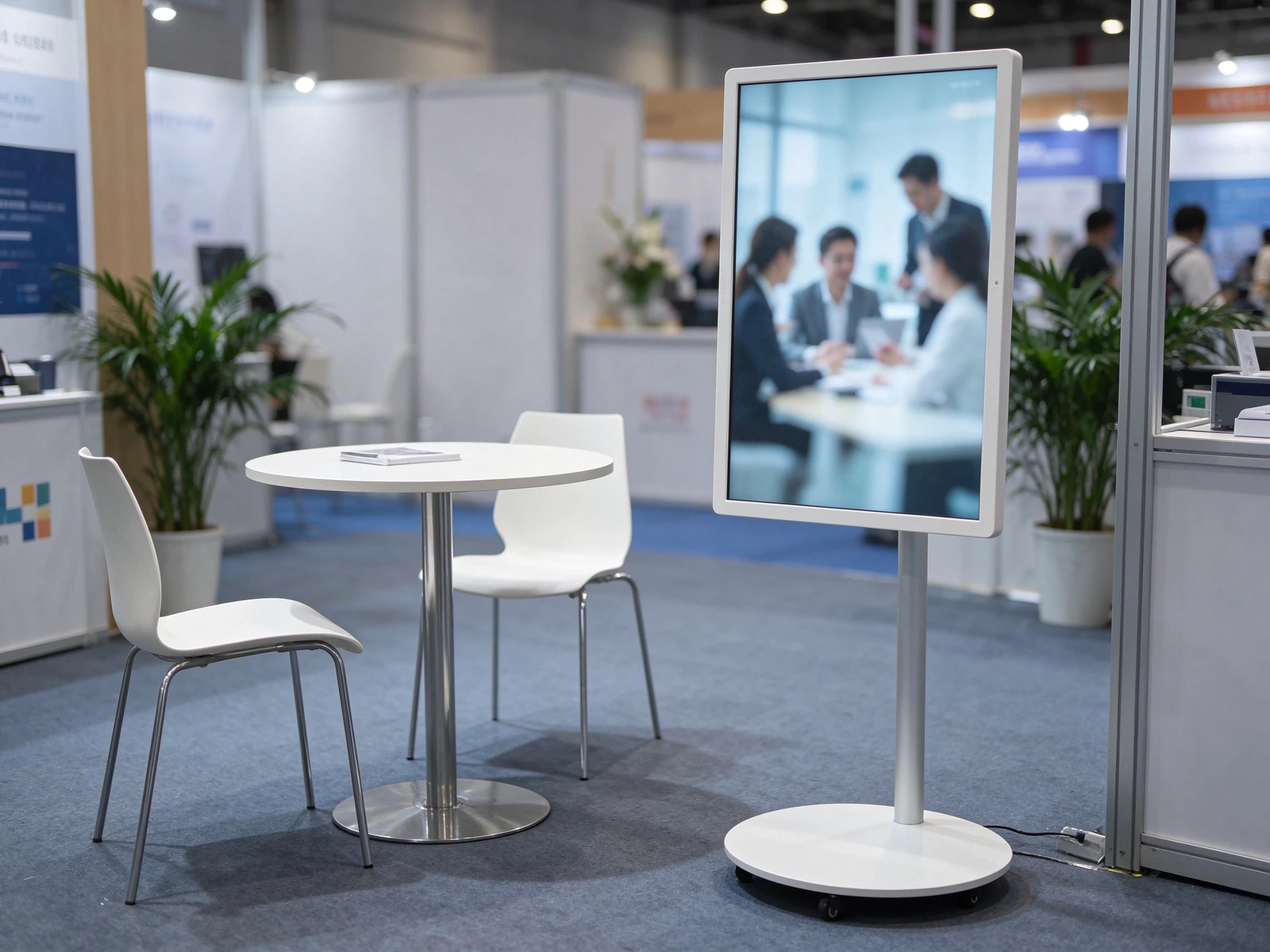
Portrait beside a small table, running a case-study loop or a product walkthrough for the buyer who wants detail away from the aisle noise. In portrait it reads as signage rather than as a laptop left open.
This is also where gravity-sensor rotation earns its keep: turn the panel, the image is upright, no menu and no technician.
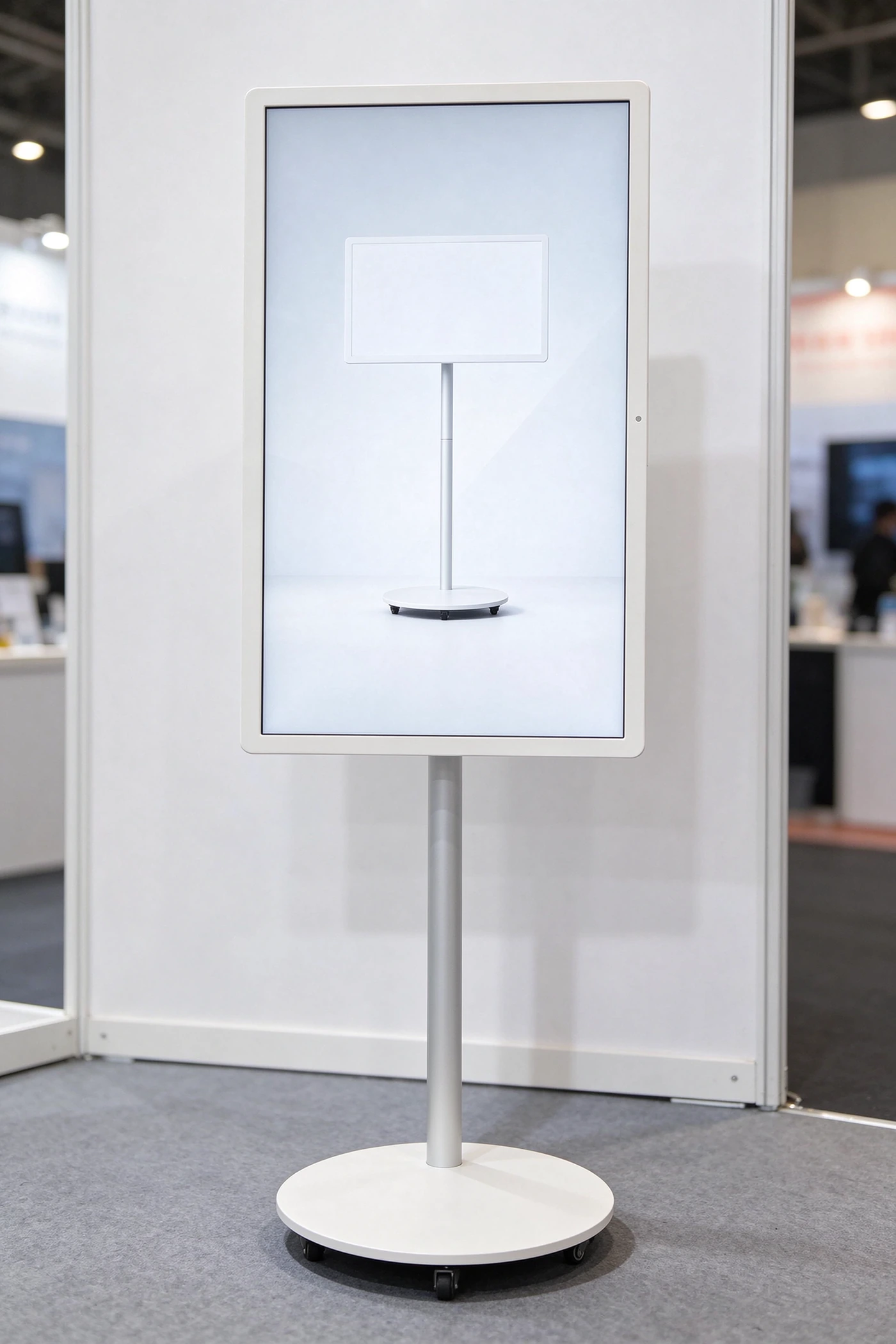
Portrait product posters are the standard format at a show, and they change between shows. One unit in portrait replaces a printed panel per product — and the update happens the night before, not at a print shop.
For a stand builder this is the cost line that pays for the hardware: no reprint, no courier, no waste at teardown.
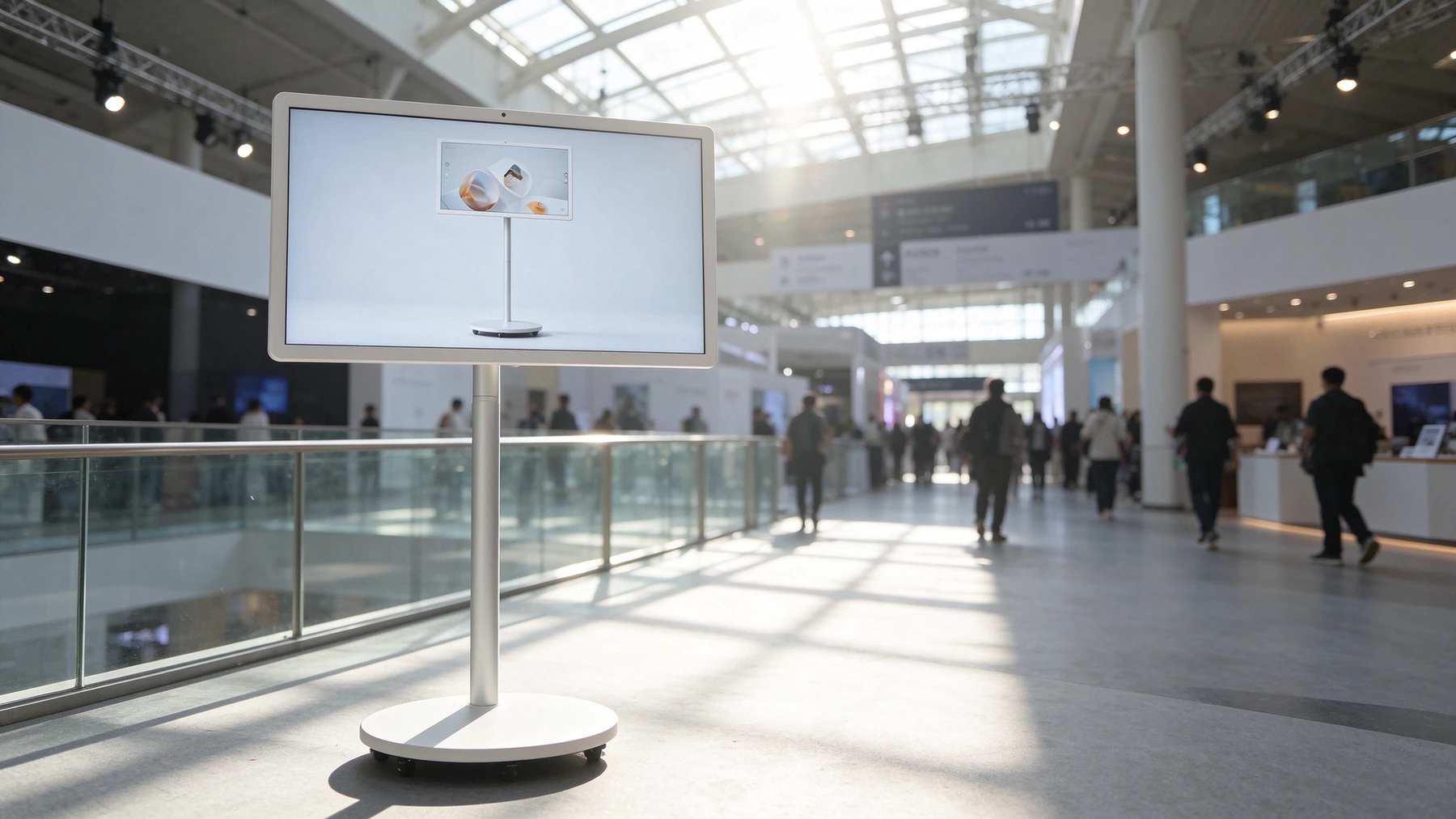
Every exhibition hall is lit for photography and for products on shelves, not for screens. Add a glass roof or a south-facing façade in a daytime show and a 400–500 nit panel reads as a grey rectangle. This is the single most common reason an exhibitor is disappointed by a screen they bought for a stand.
Product posters are portrait. Product films are landscape. A stand needs both, usually on the same day, and usually with nobody available to reconfigure a screen. The panel rotates through 180 degrees on the pole and a gravity sensor flips the image upright as it turns — so the format change is physical, not a settings task.
Colour is a purchasing constraint. White and black are standard mould colours and ship without tooling. A stand colour, a corporate finish or a custom housing means a volume commitment — settle it before the design is signed off, because a colour change after the purchase order is a new project rather than an option. The OEM/ODM customisation guide sets out where printing ends and tooling begins.
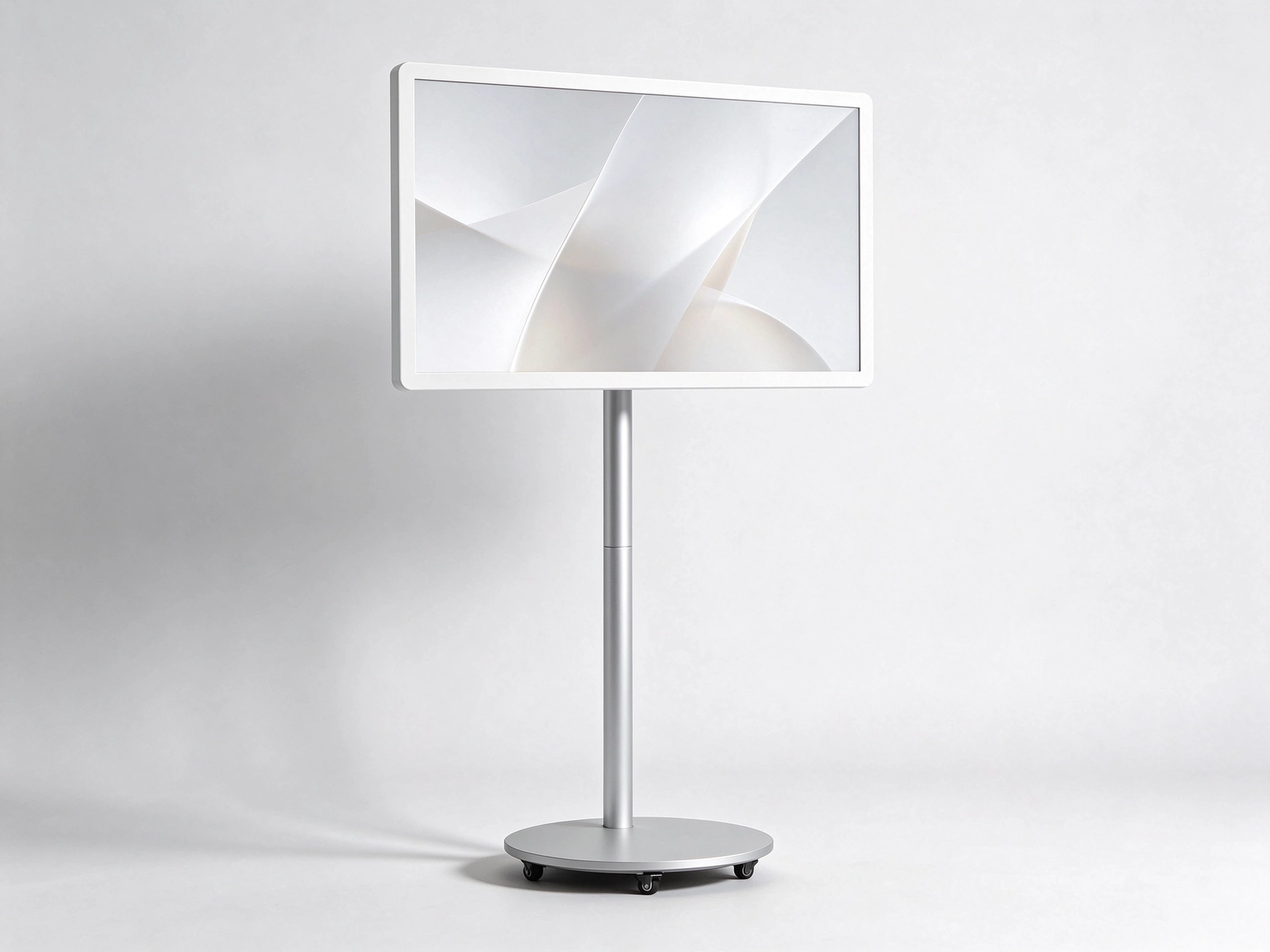
A 3×3 shell scheme and a 6×6 island stand need different answers. The range runs 21.5" to 43"; buying the smallest unit for an aisle demo is the mistake that shows up on day one.
| Size | Best position | Stand type | Panel | Why this size |
|---|---|---|---|---|
| 21.5" | Counter-top product loop, sample shelf | Shell scheme with a counter | Standard to high brightness | Smallest footprint; sits on the counter without eating display space |
| 23.8" | Meeting corner, spec sheet display | Small booth, distributor stand | Standard to high brightness | Cost-efficient first unit for a 3×3 |
| 27" | Portrait poster, meeting corner | Shell scheme, pavilion stand | Standard to high brightness | The size that reads as signage in portrait, not as a tablet |
| 32" | Aisle-edge demo (main unit) | Most stands, 3×3 and above | High brightness recommended | One unit that covers demo, meeting and poster positions |
| 43" | Island stand main visual, back wall | 6×6 island, double-decker | High brightness | Visible across a hall; verify lift, doorway and case dimensions first |
A show happens once per year per market. There is no second attempt if the screen is unreadable from the aisle or the battery dies before the closing hour — so this section separates delivered capability from things only your hall can answer.
OKRotation and sensor
180° rotation with a gravity sensor is delivered. The image is upright the moment the panel is turned, in either orientation.
Test: rotate a loaded unit in front of the person operating the stand.
OKNo mains cable on the stand
Battery in the base. Positioning is a layout decision, not an electrical one — which is also what keeps the stand compliant with a hall's cable rules.
Test: a full show day on one charge, with your own content.
ASKNits for your hall
We will quote the panel option and its brightness figure for the SKU you order. What we cannot do is judge your hall from a photograph of it.
Your test: stand at the aisle during the busiest hour and judge contrast from there.
ASKCastors on hall floors
A silent castor option exists. We have not measured noise or rolling resistance on exhibition floors — concrete, platform and carpet tile behave differently, and a datasheet figure from a factory floor would not help you.
Your test: roll it across the platform joint during build-up, before the aisles fill.
ASKOvernight security
Halls vary: some are sealed and guarded, some are not. We do not publish a locking or tethering solution for this unit, so we will not pretend one exists.
Your plan: ask the organiser's security rules and your stand builder's overnight routine before you decide to leave units on the stand.
ASKBuild-up time
Single-person handling is the design intent — pole, base, panel, no tools. The real number is how long your crew takes from crate to upright with content loaded.
Your test: time it once with a stopwatch, then put it in the stand manual.
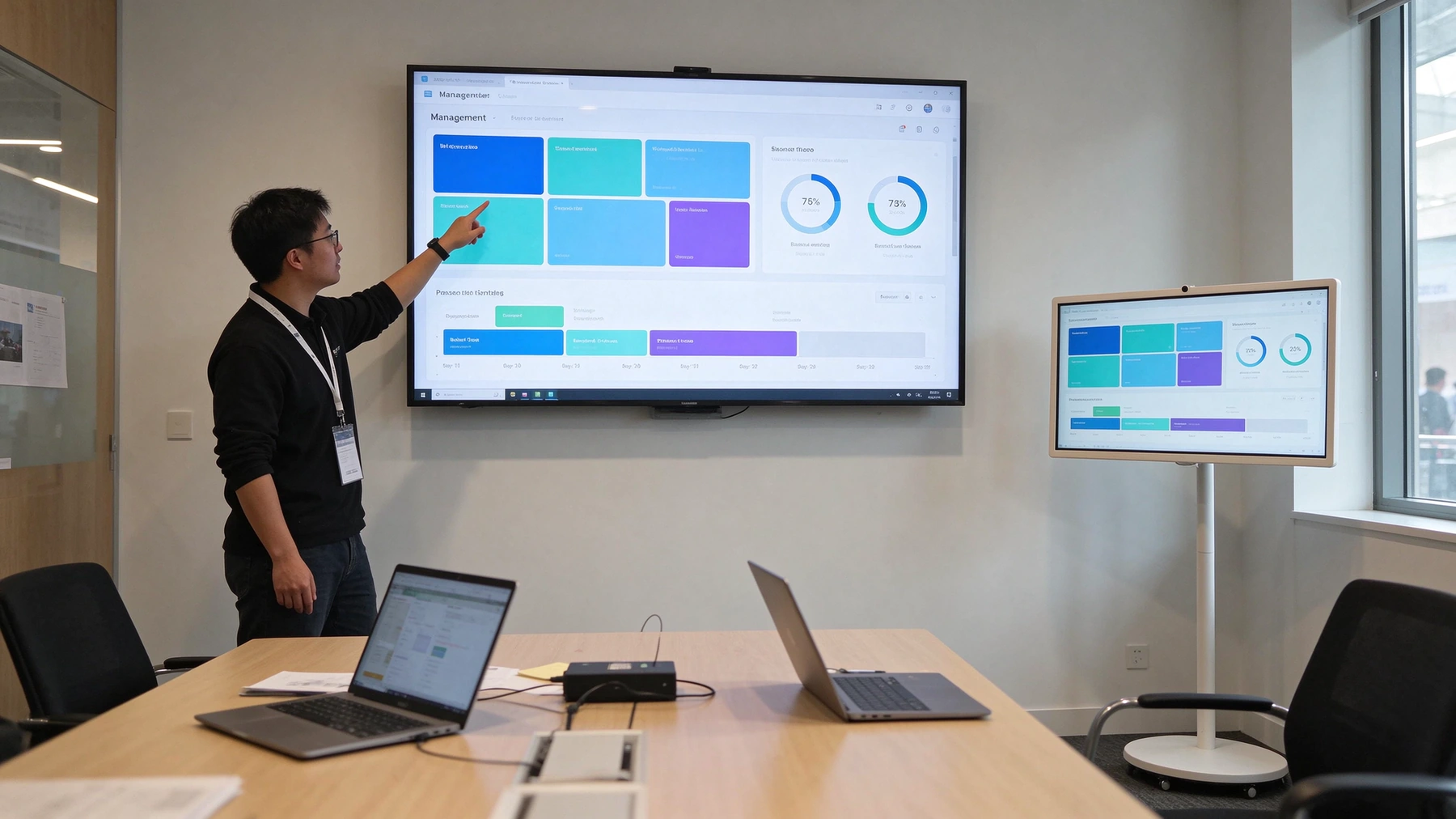
On a stand the screen is watched by three audiences at once: a visitor deciding whether to stop, a buyer comparing specifications, and an organiser enforcing the rules. Content that ignores the third audience can end a show early.
A single unit is a purchase. A calendar of shows across several markets is an operations problem, and the software layer is where cheap screens fail quietly: they ship a media player, not a fleet tool.
| Fleet | Typical buyer | What the management layer must do |
|---|---|---|
| 1–3 units | Single exhibitor, small stand builder | Local playback, scheduled loops, portrait and landscape presets, no account needed |
| 4–30 units | Brand with a show calendar, regional stand builder | Device list by show and stand, content pushed per event, remote status, who changed what |
| 30+ units | Exhibition contractor, event rental operator | Roles and permissions, template governance across stands, exportable device and service history |
Device management runs on our own platform rather than a third-party referral, which matters on a build-up evening when a stand needs a content change and there is nobody to escalate to. If the units must sit inside an existing event or asset system, raise it before the order — not in the week of the show. The digital signage kiosk solution covers the fixed-installation side of the same problem.
Stated plainly because it shapes the whole commercial conversation: Qtenboard does not operate a rental fleet and does not quote per show. We manufacture and sell, and we support buyers who build their own in-house or rental model on top of the hardware.
What you are buying is a finished unit configured for the positions you actually run, with the accessory set that keeps it alive in freight. Your return comes from how you deploy it: a stand builder's demo asset, an exhibitor's own stand, a show operator's rental pool, or a distributor's catalogue line.
Because the same platform also serves daily retail use, the engineering and spare-parts base is shared rather than amortised over a handful of show units. Our pharmacy chain deployment is where that platform is stressed hardest — daily movement, long hours, multi-site control — and the results are already in the configuration we quote for stands.
How many units. Count the stands you run at the same time, plus the units in transit. A brand with two booths in one hall and one show a month needs two units and a case; an exhibition contractor supplying ten stands in one venue needs eleven, because the eleventh is the one that covers the unit still on a truck. Then add the poster-wall unit, which is the one that removes your print budget.
| Cost line | Why it exists at a show | Where exhibitors under-budget |
|---|---|---|
| Units | One per position you actually run | Buying one small unit and discovering it cannot be read from the aisle |
| Transit protection | Cases for freight and hand-carry | Shipping a bare unit in a carton and claiming the damage on insurance |
| Power routine | Overnight charging between show days | Assuming the stand's power outlet will carry the screen all day |
| Content | Loops, translations, cleared music | Reusing a film built for a dark cinema on a bright stand |
| Spares | One spare unit or a fast parts route | Running a fleet at full utilisation with nothing behind it |
A quotation answers a price question. A pilot answers whether the unit survives your hall, your floor and your build-up crew — which is the only question that matters when the next show is six months away.
01Configure
One size for the position you run most, a panel option matched to the hall, and the case your freight forwarder will accept. Ship one unit, not a pallet.
02Run one full show
Build-up, three show days, teardown. Keep the power routine honest: charge overnight, log the level at opening and at closing.
03Score four lines
Setup minutes per unit; readability from the aisle at the busiest hour; incidents per show day; and whether the sales team actually used it. Then scale the fleet.
Exhibition support has a specific shape: a unit has to be right on a fixed date in a city where you may have no presence. Ask these before the order, because afterwards they are contract terms.
Five claims, each with something you can inspect rather than take on trust.
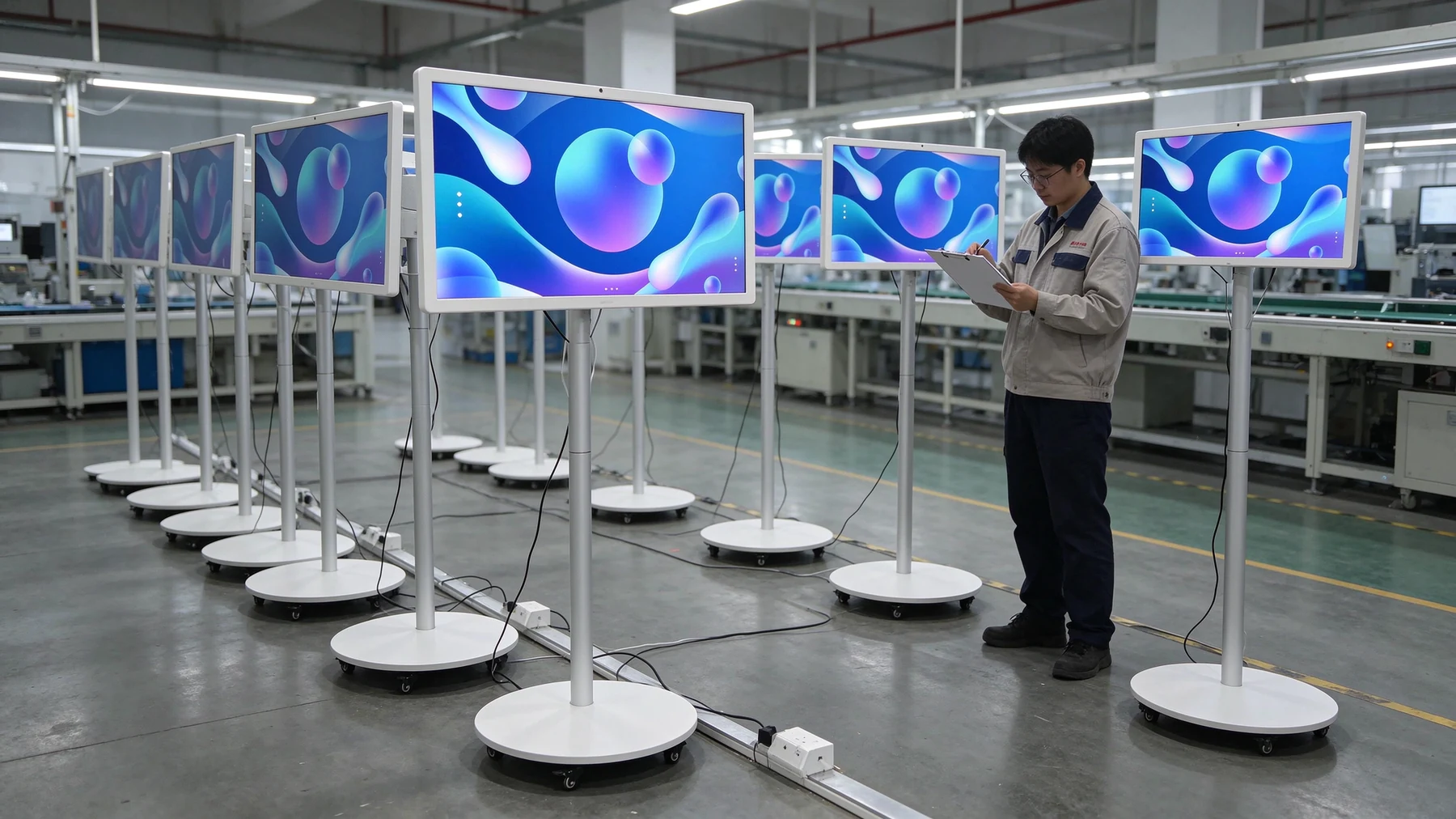
We publish patterns rather than invented statistics. Figures are the buyer's own numbers, shared with permission; where a project is in progress it is labelled as such.
AStand builder, one venue, ten stands
Eleven 32" units in cases, one per stand plus a spare. The change that mattered was the print budget: portrait posters moved from reprint to upload the night before build-up.
Status: units in service; per-stand setup time logged by the builder, not published here.
BExhibitor brand, eight shows a year
Two 43" units with high-brightness panels for island stands, one 32" as the travelling spare. Content is pushed from head office per show instead of being carried on a USB stick in someone's bag.
Status: rollout in progress; the open question is overnight security per venue.
CEvent rental operator
Twelve units, all white, rented to exhibitors who do not want to buy. The operator owns the charging routine and the spare-parts pool, which is exactly the model we do not run ourselves.
Status: pilot stage; six units in service, second batch pending a show season.
Prepared by: Qtenboard exhibition and events desk, working with the mobile smart screen product line team.
Reviewed by: Qtenboard hardware engineering (structure, pole joint and castor group) and the OEM/ODM project desk for the configuration and colour statements in sections 04 and 05.
Method: brightness, sizing and accessory statements come from the current configuration sheet for the quoted SKU; anything unmeasured is marked as a test you should run rather than a figure we assert. Deployment patterns in section 13 are buyer-reported and labelled by stage.
Compliance note: the music licensing, organiser-rule and visitor-footage points in section 07 are operational controls, not legal advice; the contract between exhibitor, organiser and stand builder governs.
Last updated: 20 November 2026. Published as a working purchasing framework for B2B enquiries; specifications are confirmed per project.
Fourteen answers, written for the person signing the purchase order.
It can, and that is the most common disappointment in this category. Hall lighting is built for products on shelves and for photography, not for screens, and a panel that reads well in a showroom can look grey from ten metres away. The fix is a high-brightness panel quoted with its nits figure, plus content designed for a bright environment — darker product films with strong contrast survive hall light far better than white catalogue pages.
Power at a show is ordered, metered and charged by the organiser, and the outlet is rarely where the demo position needs to be. The unit carries its own battery in the base, so positioning is a layout decision rather than an electrical one, and there is no lead across the stand for a visitor to trip over or an inspector to flag. Charge overnight at the hotel or the stand, not on site.
That depends on the panel brightness setting, the content and the battery option in your configuration — which is why we will not quote a single runtime number for every hall. Plan the show-day routine first: level at opening, level at closing, and a charging window overnight. If the margin is thin, a second unit or a spare battery turns a risk into a rotation. Test one full show day before you commit a fleet to a calendar.
The design intent is single-person handling: pole, disc base and panel with castors, no tools. A 32" unit is a one-person lift; a 43" unit is a two-person lift and needs a doorway and lift check before you buy it. Time your own crew from crate to upright once, and put the number in the stand manual — the build-up window is fixed and unforgiving.
Each behaves differently under a loaded disc base, and a platform joint can stop a small castor dead. Ask which castor grade is quoted, then roll the unit across the joint during build-up while the aisle is still empty. We offer a silent castor option, but we have not measured noise or rolling resistance on exhibition floors — a factory-floor figure would not tell you anything useful about your venue.
Yes. The panel rotates through 180 degrees and a gravity sensor flips the image upright as it turns, so switching between a portrait poster and a landscape film is a physical action rather than a settings task. That is the practical reason a single unit can cover the poster wall, the aisle demo and the meeting corner across one show.
A 3×3 usually resolves to one 32" at the aisle edge plus a 27" in portrait at the meeting corner, with a 21.5" on the counter if you have one. A 6×6 island typically wants a 43" as the main visual and a 32" for the demo, because visitors approach from further away and read the main screen before they read anything else. Confirm lift and doorway dimensions before committing to 43".
We sell. Qtenboard does not operate a rental fleet and does not quote per show, so there is no show-rate card behind this page. If renting to exhibitors is your business, that is your model to run — we supply the hardware, the transit protection, the spare parts and the documentation that make a rental pool workable. The same platform also serves retail deployments such as our mobile smart screen solution for pharmacy chains, where daily use is the design driver.
Yes, within the usual OEM tiers: logo on the housing, a custom start-up animation, packaging and documentation in your brand. Colour is the constraint rather than the logo — white and black are standard mould colours, and a custom finish needs volume. Ask the OEM/ODM desk which items are print-and-pack changes and which require tooling, and get that written into the quotation rather than discovered at sample approval.
The unit is pole, base and panel, which is what makes a compact case possible. Ask for the case dimensions and weight before booking freight, and check them against your forwarder's limits and the airline's hand-carry rules. For anyone shipping to more than one country a year, the case — not the screen — is the item that decides whether the fleet still looks presentable in season three.
Yes: device lists by show and stand, content pushed per event, remote status and history. The value shows up on build-up evening when a stand needs a content change and nobody wants to drive to the hall. For a contractor running many stands, template governance matters more than device count, so ask for that specifically in the demo rather than counting screens.
Plan on no remote rescue at 10am on opening day. Carry a spare unit for show weeks, keep a charged spare battery if your runtime margin is thin, and have a single-screen fallback layout for the stand. Warranty covers the defect; it does not cover the show, which is why the spare-unit decision belongs in your purchasing plan rather than in your service contract.
We do not publish a locking or tethering solution for this unit, so we will not claim one. Overnight security varies by venue: some halls are sealed and guarded, some are not. Ask the organiser's rules and your stand builder's evening routine before you decide to leave hardware on the stand, and treat storage as part of the stand design rather than an afterthought on the final day.
The range is positioned for CE, FCC and RoHS compliance according to destination market, with ISO 9001 quality systems behind production. Ask for the declaration set for your market and voltage, plus the ageing-test record for your batch — those are the documents a procurement team or a venue will request, and they should exist before a tender asks for them.
Same hardware family; different deployment logic per venue type.
Tell us the stand size, the hall type, the floor you build on and the positions you actually run. We will come back with a configuration, an accessory set and a quotation — no per-show rate, because we do not rent.
Useful to include: how many stands you run at one time, whether the hall is skylit or artificially lit, the largest panel that clears your lift and doorway, and your destination market for documentation.
Direct enquiry
Exhibition & events desk
Panel brightness, case dimensions and tooling questions are answered from the factory, not from a reseller.
info@qtenboardglobal.com
+86 18124715048
Qtenboard Industrial Park, Shenshan Special Cooperation Zone, Guangdong, China

CEO | Interactive Display & Collaboration Solution Expert
I am the founder of Qtenboard, bringing over 17 years of hands-on expertise to the touch display industry. Drawing on the global management perspective gained through my EMBA studies at ShenZhen University, I lead my team in optimizing every stage of our operations—from product definition to high-efficiency supply chain management—ensuring our manufacturing capabilities remain at the forefront of the industry.
As the leader of Qtenboard, I specialize in providing tailored OEM/ODM solutions for interactive whiteboards, LCD video walls, digital signage, and industrial-grade touch terminals. Backed by our 330,000 m² modern industrial park in Shenzhen, we maintain full-lifecycle control over industrial design, precision manufacturing, and rigorous performance testing.
With nearly two decades of project experience, Qtenboard’s display solutions are now deployed in over 120 countries and regions, earned the trust of more than 15,000 enterprise customers worldwide. If you are seeking a responsive partner with a deep manufacturing foundation for your customized touch display projects, my team and I are ready to support your vision with professional excellence.

 EN
 spa
 pt
 vie
 th
 est
 lav
 aze
 ukr
 bel
 ru