Digital Signage OEM & ODM Solutions Qtenboard

2026-11-18
QtenboardOEM / ODM

Digital Signage OEM & ODM Solutions

Digital Signage OEM & ODM Solutions Built Around Your Spec

You send a drawing, a reference unit or a spec sheet. We turn it into a production-ready commercial display — chassis, board, firmware, boot identity and packaging included. Not a logo sticker on a stock box.

This page covers the five OEM/ODM capability layers and how they map to ceiling-mounted, ultra-thin, floor-standing, kiosk and outdoor formats. Detailed panel specs stay on the product pages, where you can compare configurations side by side.

For brand owners, distributors and system integrators sourcing 20–500 units per project.

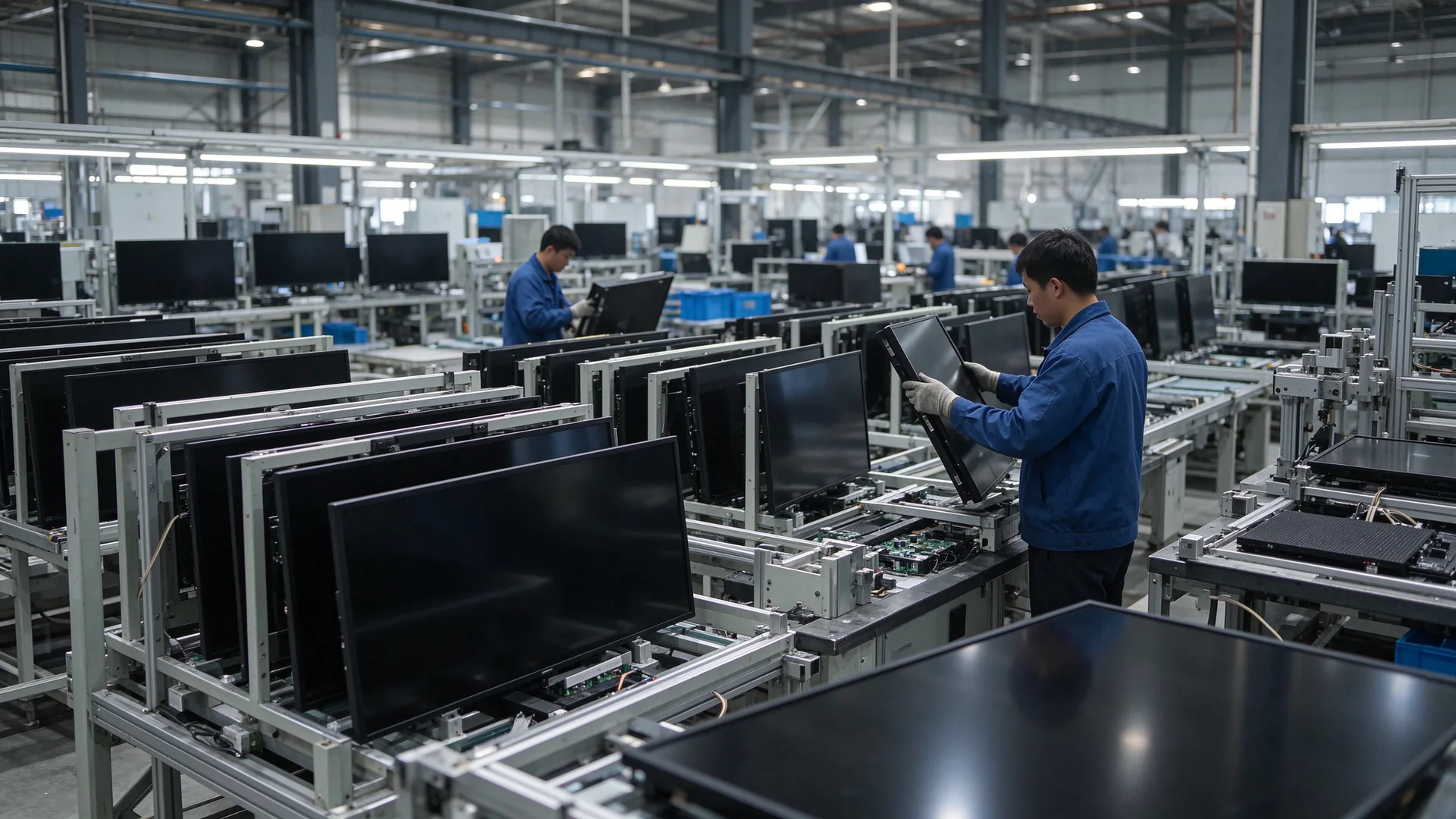
digital signage oem odm factory production line

Custom chassis and panel assembly, Shenzhen & Guangzhou lines.

20+years in global display trade
100+export markets served
10.1"–98"size envelope for custom builds
5customisation layers you can buy

Start here

Which OEM/ODM path fits your business?

The same factory quote reads very differently depending on who you are. Pick the profile closest to your model — each one has a different tolerance for MOQ, tooling cost and lead time.

Marca proprietário

You sell under your own name and need the product to look like yours, not like a catalogue item. Priorities: boot logo, system UI skin, chassis colour and finish, retail packaging, and a spec that matches your market's certification requirements.

Best entry point: firmware and identity layer first, tooling later.

Distributor / wholesaler

You resell into retail, QSR, hospitality and transport projects and win on availability and price stability. Priorities: predictable repeat specs, mixed-container loading, spare-part continuity and a stable SKU list you can print in your own catalogue.

Best entry point: a locked standard SKU set plus optional branding.

Integrador do sistema

You are accountable for the install and the CMS. Priorities: exact mechanical drawings, mounting interfaces, board availability over a multi-year framework, firmware access for your own app, and documented test reports for handover.

Best entry point: mechanical drawing review before sampling.

Customisation matrix

What you can actually change on a custom digital signage build

Every OEM/ODM conversation stalls on the same question: which parts are adjustable and which are fixed. Here is the honest version, layer by layer, with the MOQ consequence attached to each one.

CamadaAdjustableWhere it hits cost / MOQ
Panel & brightnessSize from 10.1" to 98", 2K or native 4K, commercial brightness tiers for indoor, window and outdoor useLow effect — panel choice is a BOM swap, not tooling
Mainboard & OSAndroid 9 through Android 16 configurations, Windows dual-boot on selected models, RK3588 or MT9679 class boards, 4G module, expanded storageLow to medium — firmware validation time is the real cost
Enclosure structureChassis form, colour, surface finish, bezel width, VESA or custom mounting interface, front-access service doorHigh — a new sheet-metal or profile design needs tooling and a volume commitment
Boot identitySplash screen, start-up logo, default language pack, pre-installed app packageVery low — no tooling, applies from small runs
System UILauncher layout, icon set, colour scheme, kiosk lock-down, hidden settingsLow — engineering hours rather than materials
CMS & backendDashboard branding for you or your downstream dealers, device grouping, permission tiersLow — configuration, not hardware
EmbalagemPrinted carton, inner foam geometry, manual in your language, barcode and retailer labelsLow — print run dependent
Certification supportCE, RoHS and FCC documentation packs; test reports for tender submissionMedium — depends on target market and whether the model already holds the file

Rule of thumb we give every buyer: start with the boot identity and UI layers on a standard chassis, prove the sell-through, then invest in tooling. It keeps the first order small and the second order cheap.

Format 01 — overhead

Factory OEM ceiling-mounted digital signage for space-constrained sites

Airports, mall circulation corridors, reception zones, retail aisles and service counters all share one constraint: floor space is already monetised. Overhead is the only free real estate left, and it is the format where buyers most often need something that is not in a catalogue — a specific drop length, a specific housing colour that matches a ceiling system, or two faces showing different content.

As a factory OEM ceiling-mounted digital signage supplier we build in three mechanical variants: single-sided landscape units for directional and wayfinding messaging, double-sided portrait units for window and aisle visibility, and slim hanging light-box style housings where the ceiling structure cannot take a heavy load. Rod length, canopy plate size and the mounting bracket pattern are all open to specification, so the unit can be dropped to the exact sightline the project architect drew.

Customised OEM ceiling-mounted digital signage usually comes down to four decisions: one face or two, portrait or landscape, independent playback per face or synchronised, and how the unit is serviced after install. We default to front-access service so a maintenance technician never has to remove the whole fixture from the ceiling.

43" / 49" / 55" mainstream 350–700 nits window variants Single or dual independent playback Custom rod length & canopy
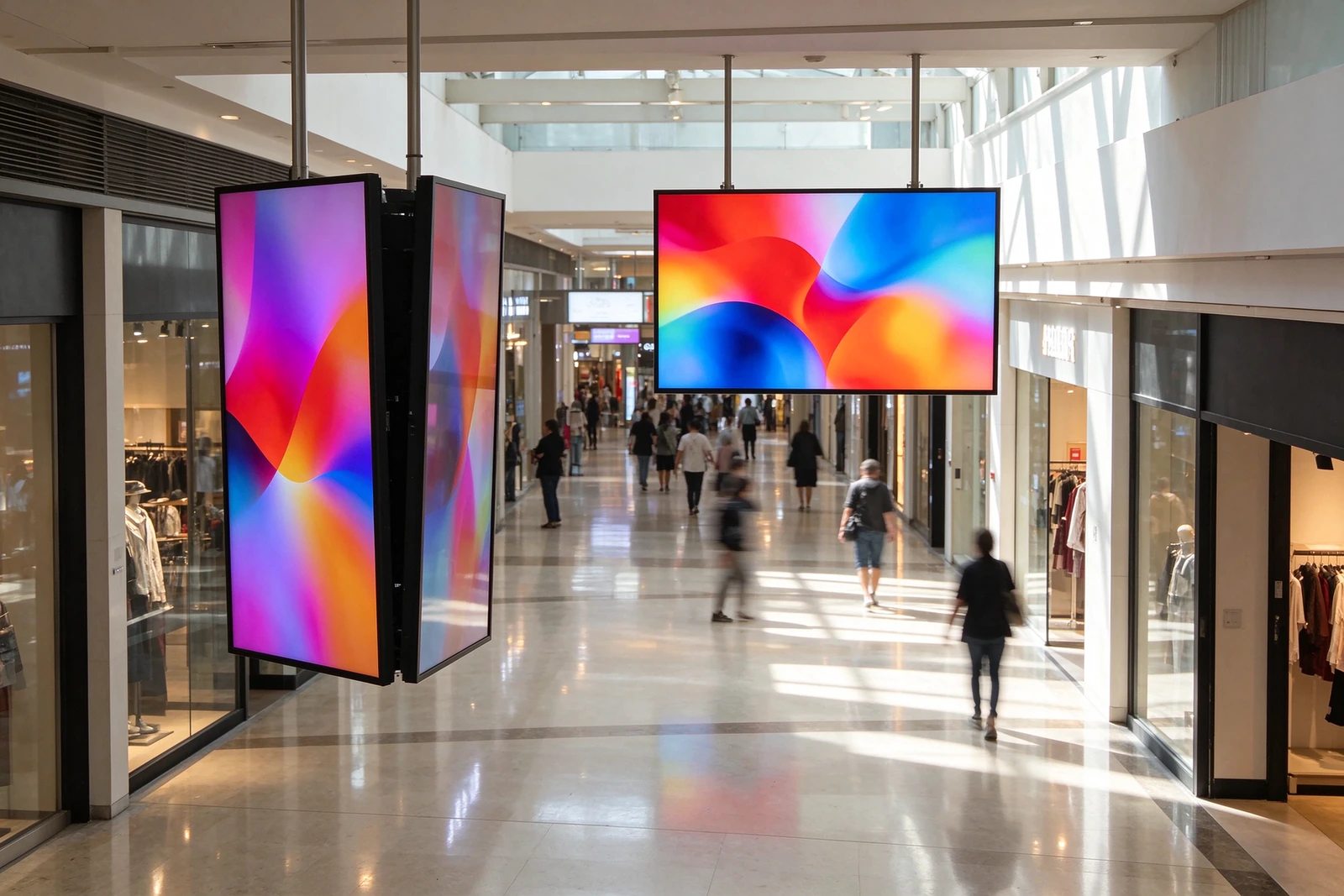
factory oem ceiling mounted digital signage mall corridor

Double-sided overhead units, mall circulation corridor.

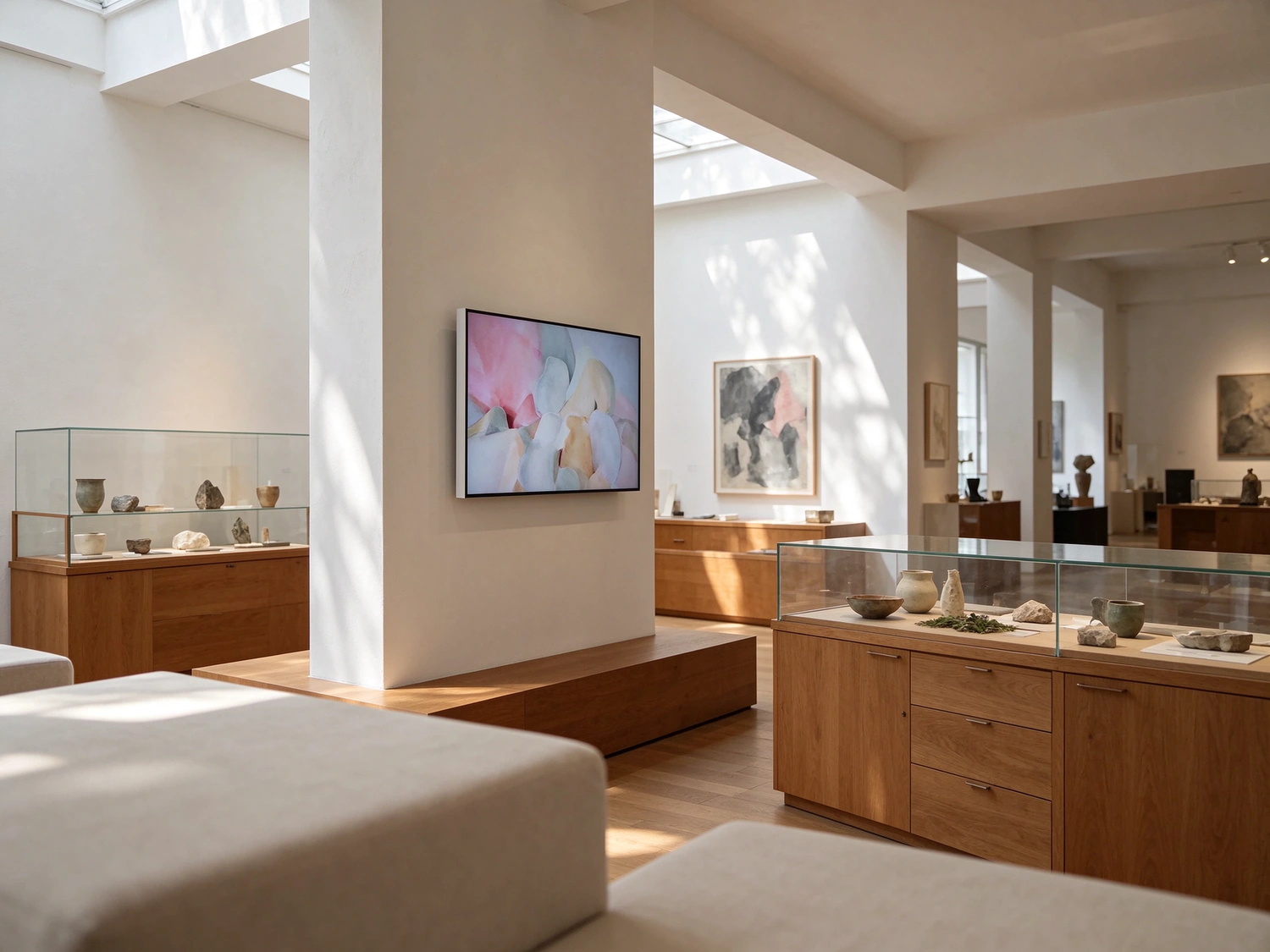
oem ultra thin digital signage gallery wall mount

28.5 mm flat-back profile, flush wall installation.

Format 02 — flush wall

OEM ultra thin digital signage for retail flagships and cultural spaces

In a luxury boutique, a gallery or a hotel lobby, a display that stands 60 mm off the wall reads as equipment. A display that sits 28.5 mm off the wall with a flat back and no visible rear bulge reads as architecture. That single number is why ultra-thin requests keep arriving from design-led projects rather than from procurement departments.

Our ultra slim line is built for that brief: 28.5 mm depth, flat back, native 4K panel, 500 nits, and front-access service so the display can be serviced without pulling it off a finished wall. Bezel width and frame colour are specified per project, and the mounting interface can be recessed so the panel face sits level with the wall finish.

Where the project also needs to sell, the same chassis takes touch. Where it needs to disappear entirely, we quote transparent OLED as an alternative — a different price bracket, but the same conversation about how the space should feel.

28.5 mm depth Native 4K / 500 nits Front-access service Recessed or exposed mount

Format 03 — floor level

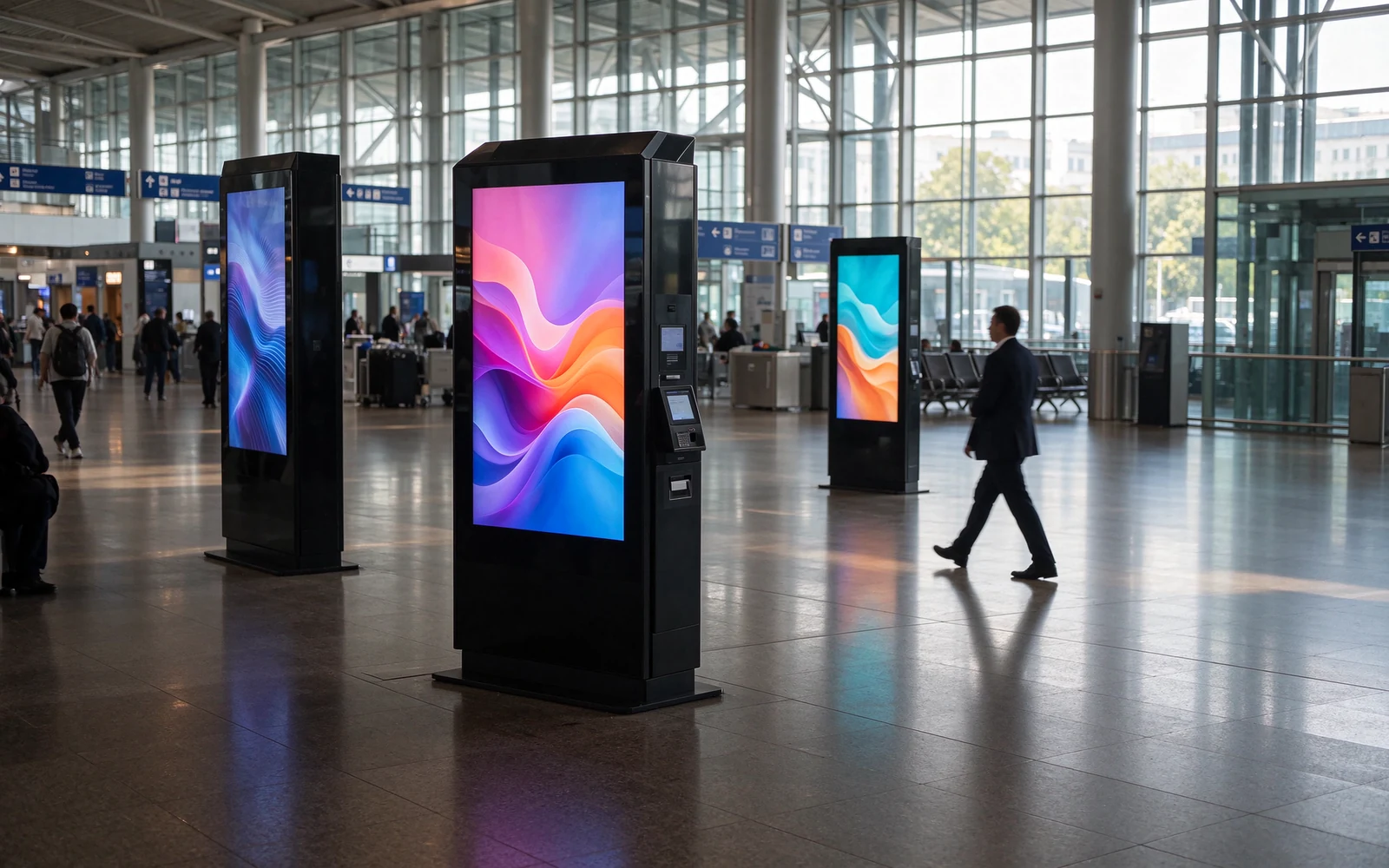
OEM floor standing digital signage, vertical totems and kiosk conversions

Floor-standing is the volume format and the one where buyers most often ask for a shape that is "almost, but not quite" what the catalogue shows. Two changes solve most of it: the base and the head.

The standard OEM floor standing digital signage build runs 32", 43", 49", 55", 65", 75" and 85" in 4K, portrait or landscape, Android or Windows, touch or non-touch. Project-specific requests concentrate on the base — a wide disc base for crowded concourses, a square plinth where the client wants it to read as furniture, castors where the unit has to move between campaign positions — and on the head, where a heavier top section is sometimes needed to carry a camera, scanner or payment module.

Factory OEM vertical digital signage and OEM indoor freestanding digital signage are the same platform described two ways, and both convert cleanly into kiosks. Add a card reader, a thermal printer, a barcode scanner or a QR presenter and the freestanding totem becomes self-service hardware: queue ticketing, wayfinding, payment, check-in or self-ordering. That is the factory OEM digital kiosk signage conversation, and it is a mechanical and firmware job rather than a new product development.

For integrators rolling out mixed estates, the practical advantage is that wall panels, hanging units, totems and kiosks can share one board family, one firmware baseline and one CMS. One content template, three crops, one fleet to monitor.

32"–85" 4K Disc / plinth / castor base Touch 10–20 point Kiosk module integration
oem floor standing digital signage terminal lobby

Mixed heights, one board family, one CMS fleet.

Format 04 — outside the building

OEM/ODM digital signage outdoor displays and transit hardware

Indoor mistakes cost a screen. Outdoor mistakes cost a contract. Sun load, rain ingress, cabinet heat and vibration all attack the same unit, and the failure usually shows up in year two — after the warranty conversation has already gone quiet.

As an OEM/ODM digital signage outdoor displays manufacturer we quote sealed aluminium housings rated IP65, a working range of −20 °C to +55 °C, high-brightness panels with anti-glare treatment, and thermal management sized for continuous daytime operation rather than for a demo. Sizes run from 18.5" compact street units to 98" roadside and forecourt formats, wall-mounted or floor-standing, and the cabinet can be specified with an air-conditioning module where the site is genuinely hot.

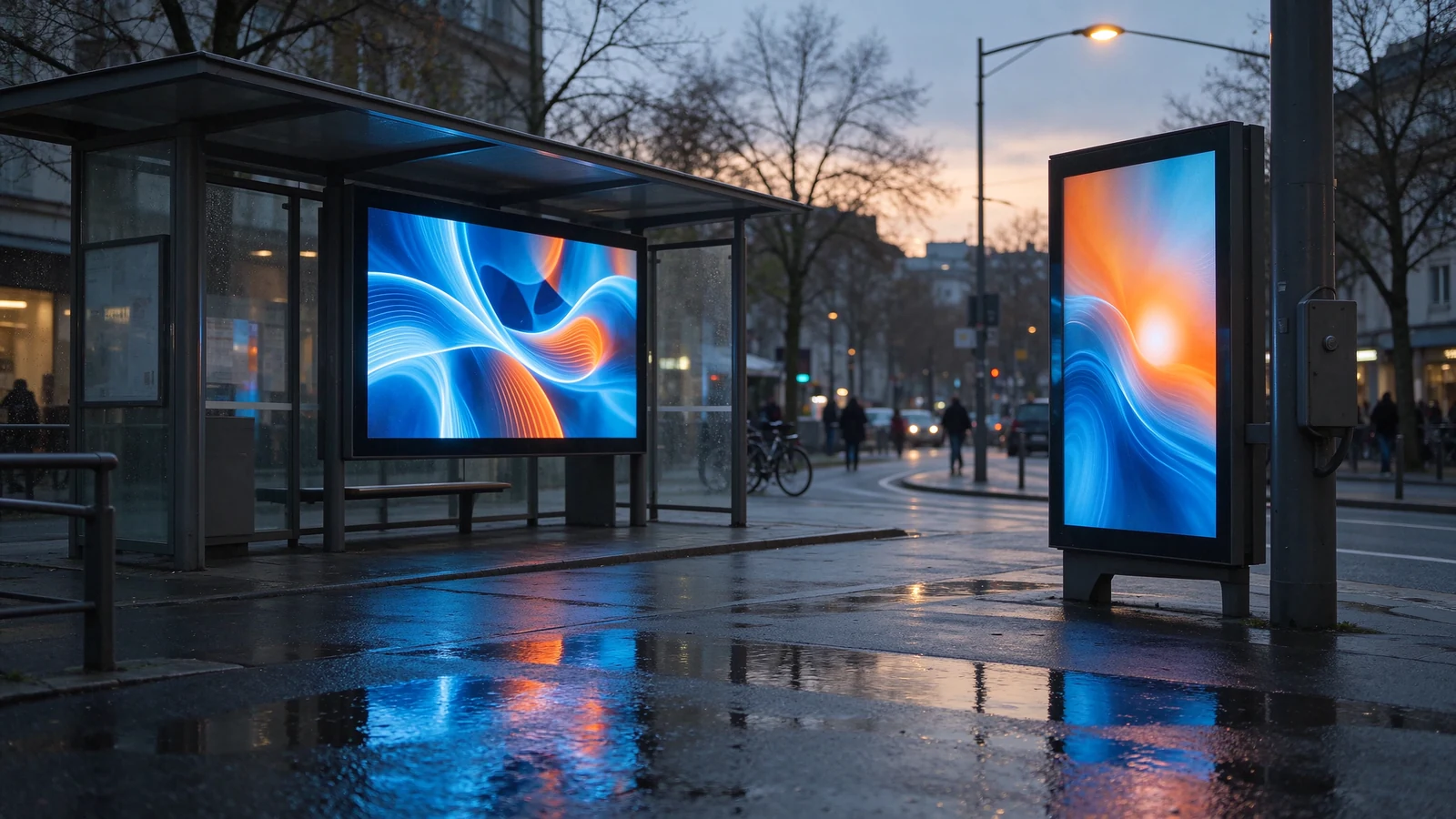
Transit is its own discipline. An OEM/ODM transit digital signage manufacturer has to think about vibration from passing vehicles, vandal-resistant glass, ticket and card interfaces, and a maintenance route that does not close a platform. We build bus-stop shelters, street-pole displays with optical bonding, and station information totems around those constraints, and we deliver them with the mounting drawings an installer actually needs.

For distributors buying into a catalogue rather than a single project, the OEM/ODM digital signage outdoor displays wholesaler route is the practical one: a fixed set of sealed SKUs, stable pricing across repeat orders, and spare parts continuity so a customer's year-three failure does not become your year-three problem.

IP65 sealed cabinet −20 °C to +55 °C 18.5"–98" Optical bonding available
oem odm transit digital signage bus stop display

Sealed shelter unit and street-pole display, dusk operation.

Format 05 — small and narrow

OEM small size digital signage, shelf screens and counter units

Small formats carry a disproportionate share of requests, because they are the ones a buyer cannot source locally at a sane price.

OEM small size digital signage covers 10.1", 15.6", 21.5" and 32" builds: taxi headrest units, elevator panels, countertop menu boards, desktop calendar displays and window strips. These are often the hardest to buy well, because the volume per SKU is modest and the mechanical tolerances are tight.

Digital signage shelf screen oem factory work adds a second constraint: the unit has to fit a retail fixture that already exists. We quote strip ratios and mounting brackets against the fixture drawing rather than against a catalogue dimension, which is usually the difference between a shelf test that runs and one that ends up in a stockroom.

10.1"–32" small format Shelf strip ratios Countertop & desktop Taxi & elevator units Battery powered options Custom fixture mount
digital signage oem quality control aging test

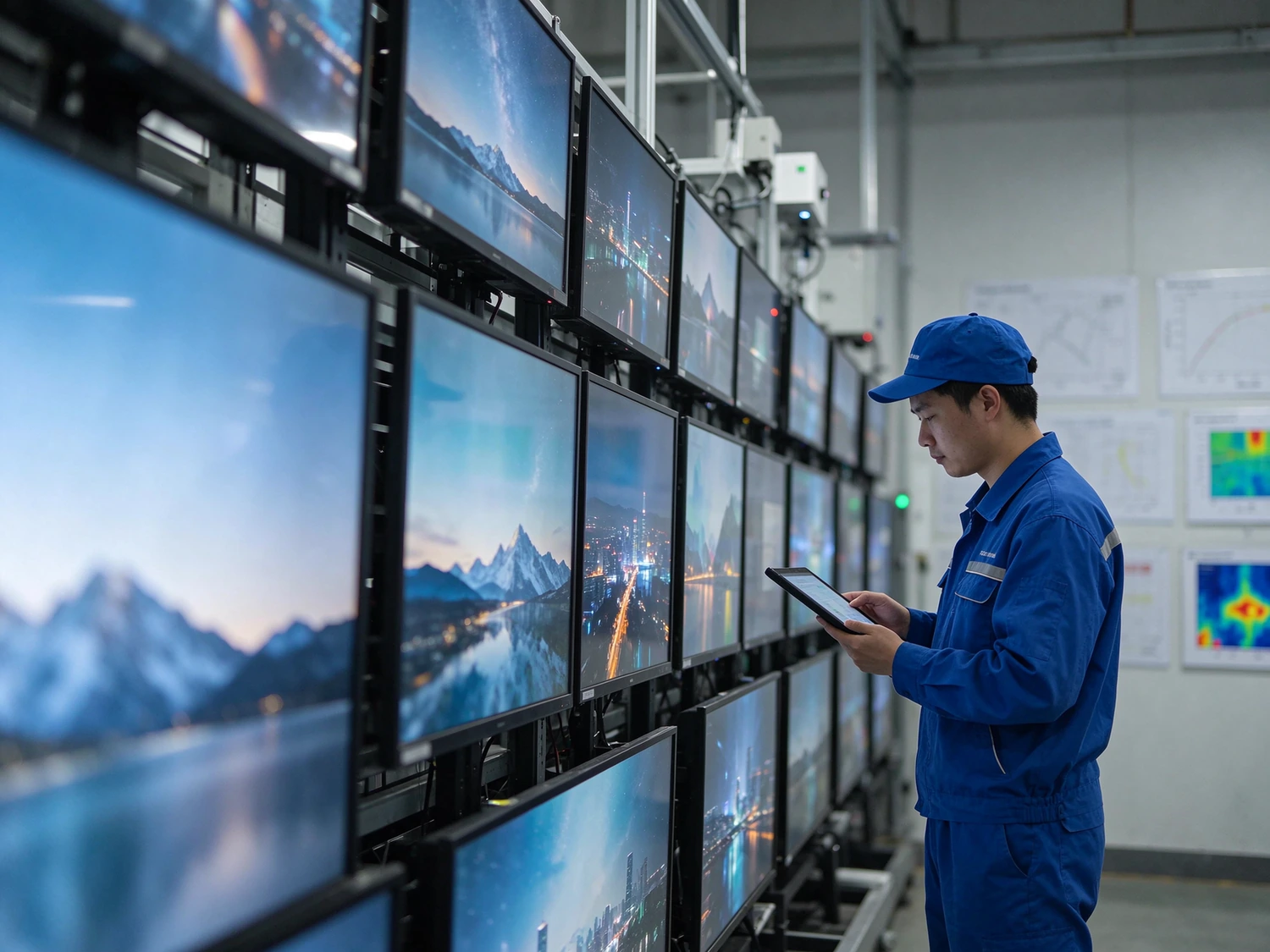
Burn-in station before packing — every unit, not a sample.

Delivery & commercial terms

How a custom OEM/ODM order actually runs

  1. Specification review. Drawing, reference unit or requirements sheet. We return a configuration sheet with panel, board, enclosure, interface list and the open questions that would otherwise appear at sampling.
  2. Quotation with tiered pricing. Price breaks by quantity, tooling cost stated separately and clearly attributed, lead time from deposit, and the certification status of the selected model spelled out.
  3. Sampling. A working unit in the specified configuration, photographed against the drawing. Standard configurations typically move in about a week; new tooling takes longer and we say so before the deposit.
  4. Approval and tooling release. Sign-off on the sample, then sheet-metal or profile work is released. Changes after this point are quoted, not absorbed.
  5. Production and burn-in. Build, firmware flash, identity configuration and a burn-in cycle at the aging station, with unit-level test records retained for the batch.
  6. QC and documentation. Visual and functional inspection, packing check, and the paperwork pack: test reports, CE / RoHS / FCC documentation as applicable, and the spare-part list.
  7. Packing and shipment. Printed cartons, foam geometry matched to the enclosure, manuals in your language, and container loading plans for mixed SKUs.
Quantidade mínima de encomendaAssessed by customisation depth, not by product category. Identity and UI work sits at a lower threshold than new chassis tooling, and multi-SKU projects are assessed on the combined mix.
FerramentasQuoted separately, with ownership and amortisation stated in the quotation so it is not buried in unit price.
GarantiaStandard coverage with optional extension, plus a spare-part commitment for the framework period.

Reference deployments

Two European briefs we have worked through

Both are written as project profiles: the brief, the configuration decision and what it changed for the buyer. Client names and commercial figures stay out of the page.

Chișinău, Moldova — retail media retrofit

Multi-level shopping centre, three placement points

Brief. A multi-level shopping centre running seasonal campaigns on printed posters and window graphics wanted its newly opened stores visible from the main entrance, and wanted upper-floor tenants to have a sellable advertising position rather than a polite promise.

Configuration. Three decision points — main entrance, central circulation corridor, escalator landing — each carrying a different content job. The entrance unit runs mall-wide events and anchor announcements, the corridor runs category rotation across multiple brands, the escalator unit runs short high-contrast promotions with store location and a campaign QR. All three sit on one CMS with separate content zones and per-tenant approval before publication.

What changed. Advertising inventory became definable and reportable: submission deadlines, approval responsibility, playback records and post-campaign review instead of an argument about whether a poster went up. The centre can now quote a rate card, which was the actual commercial goal.

Romania — retail chain window and floor programme

One distributor, two formats, one content pipeline

Brief. A Romanian distributor supplying retail chains needed window visibility and in-store floor presence from a single supplier, without running two content systems or holding two spare-part inventories. The chains wanted branded housings; the distributor wanted to stop explaining why the window unit and the floor unit behaved differently.

Configuration. Hanging double-sided window units at 43" and 49" with independent playback per face, paired with floor-standing vertical totems at 43" and 55" on a shared board family and one CMS. Boot identity, launcher skin and housing colour were cut to each chain's brand guideline, while the underlying SKU stayed identical — so the distributor holds one spare-part line instead of four.

What changed. Campaign content now loads once at the chain's head office and is re-cropped automatically for the window strip and the portrait totem. Store-level managers adjust local promotions inside an approved template, which keeps brand consistency without blocking local selling.

Due diligence

OEM/ODM questions buyers ask before they commit

What is the actual MOQ for a custom digital signage order?

It depends on how deep you go, not on which product you pick. Boot logo, system UI, language pack, packaging and CMS branding are configuration work and sit at a low threshold. A new chassis design, a new colour finish or a bespoke mounting interface involves tooling and carries a real volume commitment. Multi-SKU programmes are assessed on the combined quantity, which is why integrators rolling out several formats usually clear the threshold more easily than a single-format buyer.

Who owns the tooling and how is it charged?

Tooling is quoted as a separate line item with its amortisation stated — either paid once and owned by you, or amortised into unit price across the agreed volume. It is never rolled silently into the unit cost, because that makes price comparisons between suppliers meaningless. If a project is cancelled after tooling release, the position on mould or die ownership is agreed in writing before work starts.

How long does a sample take, and what do I get with it?

Standard configurations typically move in about a week. A new tooling programme takes longer and the schedule is confirmed before deposit. The sample arrives configured as ordered — boot identity, UI skin, interface list — and is photographed against the approved drawing, so the production unit can be checked against the same reference rather than against memory.

Can you supply the certification documents my tender needs?

We provide CE, RoHS and FCC documentation packs for the models that hold them, plus test reports suitable for tender submission. Where the target market requires a certificate the selected model does not yet carry, that is stated at quotation stage rather than discovered at customs. If a project needs additional testing, it is scoped and priced as part of the order.

Can our own app or CMS run on the hardware?

Yes. Android builds can be supplied with your APK pre-installed and the launcher locked down so users cannot reach system settings; Windows builds are supplied with the OS image configured to your requirement. Our cloud CMS covers scheduling, layout, batch updates and emergency push across a distributed fleet, and it can be white-labelled for you or your dealers. Third-party CMS platforms are supported where the project already has a content stack.

How do you handle spare parts and after-sales across a multi-year rollout?

A framework order carries a spare-part list and a continuity commitment for the programme period — power boards, T-CON boards, backlight assemblies and glass where relevant. Remote diagnostics through the CMS reduce the number of site visits, and units are built with front-access service so a part swap does not require dismantling a ceiling fixture or a sealed outdoor cabinet.

Próximo passo

Send a drawing, a reference unit or a spec sheet

You do not need a finished requirements document. A photo of the site, the size you have in mind, the mounting constraint and the content source is enough to start. We return a configuration sheet with board options, interface list, MOQ tier for the customisation depth you asked for, and a quote — within 24 hours on working days.

Useful to include: target quantity, destination market, mounting position, whether the CMS is ours or yours, and any certification the tender requires.

What you get back

  • Configuration sheet with panel, board and enclosure options
  • MOQ and tooling position for the requested customisation depth
  • Tiered pricing and lead time from deposit
  • Certification status of the proposed model, stated plainly
  • Mechanical drawing package for integrator review

Qtenboard Queenie Wang

Queenie Wang

CEO | Display interativo e solução colaboração Expert

Eu sou o fundador da Qtenboard, trazendo mais de 17 anos de experiência prática para a indústria de telas sensíveis ao toque. Com base na perspectiva de gestão global adquirida através dos meus estudos EMBA na ShenZhen University, lidero minha equipe na otimização de todas as etapas de nossas operações-desde a definição do produto até o gerenciamento da cadeia de suprimentos de alta eficiência-garantindo que nossas capacidades de fabricação permaneçam na vanguarda do setor.

Como líder da Qtenboard, sou especialista em fornecer soluções OEM/ODM personalizadas para quadros interativos, paredes de vídeo LCD, sinalização digital e terminais de toque de nível industrial. Apoiados por nosso parque industrial moderno de 330.000 m² em Shenzhen, mantemos controle de ciclo de vida completo sobre design industrial, fabricação de precisão e testes rigorosos de desempenho.

Com quase duas décadas de experiência em projetos, as soluções de exibição da Qtenboard estão implantadas em mais de 120 países e regiões, conquistando a confiança de mais de 15.000 clientes corporativos em todo o mundo. Se você está procurando um sócio responsivo com uma fundação profunda da fabricação para seus projetos personalizados da exposição do toque, minha equipe e eu estamos prontos para apoiar sua visão com excelência profissional.