Certified Whiteboard Specs for Schools: Buyer's Guide
How to Evaluate Interactive Whiteboard Certifications, Technical Specifications, Security, and Supplier Documentation for School Procurement
Schools buy interactive displays differently from consumer electronics. A classroom smart board sits on the school network, connects to student accounts and Google Workspace, and is expected to survive a five-year procurement cycle. For that reason, certified whiteboard specs for schools go beyond screen size, 4K resolution, and touch points. Education buyers should verify product safety, electromagnetic compatibility, environmental compliance, energy efficiency, software security, target-market approval, factory quality systems, and model-specific documentation.
Certification is not the same as product function. CE, LVD, and EMC focus on electrical safety and electromagnetic compatibility; RoHS limits hazardous substances; FCC covers U.S. emissions and wireless compliance; ENERGY STAR addresses energy performance; EDLA governs Google ecosystem access and enterprise management; ISO 9001 and ISO 14001 describe factory management systems, not the compliance of a specific whiteboard model.
A certificate only matters when it matches the exact model and destination market. Before a tender, purchase approval, or shipment, request documents that identify the proposed model, configuration, factory, target market, and validity period precisely. This guide follows a practical procurement path: certification categories, EDLA, school technical specifications, verification, tender clauses, and supplier evaluation.
Qtenboard supports CE, RoHS, EMC, LVD, ErP, FCC, ENERGY STAR, Google EDLA, ISO, PVoC, and ANATEL compliance documentation, subject to the selected model, configuration, destination market, and project requirements. This article explains what each document means for school buyers and how to verify it before you commit budget.
When procurement teams ask which certifications a school interactive display should carry, the honest answer is: it depends on the destination market, the wireless configuration, and the school's IT policy. The table below summarizes the most common compliance documents for a certified interactive whiteboard for schools.
| Certification | What it covers | Why schools care | What to request | Qtenboard direction |
|---|---|---|---|---|
| CE | EU conformity framework | EU/EEA market compliance | Declaration of Conformity plus model-specific reports | Available on request |
| LVD | Electrical safety for low-voltage equipment | Safety of the display, power supply, and wiring | Model-specific LVD test report and declaration | Available on request |
| EMC | Electromagnetic compatibility | Reduces interference risk in device-dense classrooms | EMC test report for the exact model and wireless configuration | Available on request |
| RoHS | Restriction of hazardous substances | Environmental compliance and sustainable procurement | RoHS declaration or test report with model scope | Available on request |
| ErP | Energy-related product requirements | Energy consumption and standby behavior | ErP documentation or test evidence | Available on request |
| FCC | U.S. emissions and wireless compliance | U.S. school projects and exports | FCC ID or supplier's declaration of conformity | Available on request |
| ENERGY STAR | Energy-efficiency certification | Lower operating cost and green procurement credit | ENERGY STAR listing or certificate | Available on request |
| EDLA | Google Enterprise Device Licensing Agreement | Google services, security updates, and managed deployment | EDLA status for the exact Android configuration | Available on request |
| ISO 9001 | Quality-management system | Factory quality processes and traceability | Valid certificate plus scope statement | Held by factory |
| ISO 14001 | Environmental-management system | Factory environmental practices | Valid certificate plus scope statement | Held by factory |
| PVoC | Pre-export verification of conformity | Customs clearance for destination countries that require it | Shipment- and model-specific confirmation | Discuss per project |
| ANATEL | Brazil telecom and wireless equipment approval | Brazil market entry for wireless configurations | ANATEL approval covering the wireless module | Discuss per project |
In practice, the combination usually looks like this:
The exact combination depends on the market, configuration, and school policy, which is why buyers should ask for a compliance matrix instead of a logo.
Start with certification categories, technical specifications, tender clauses, and the procurement checklist.
Focus on EDLA, DMS, network security, system compatibility, and document verification.
Review OEM/ODM options, MOQ, certification document packages, and lead time.
Check ports, mounting, installation, the compliance matrix, and project support.
Use the tender clauses, compliance matrix, and acceptance standards.
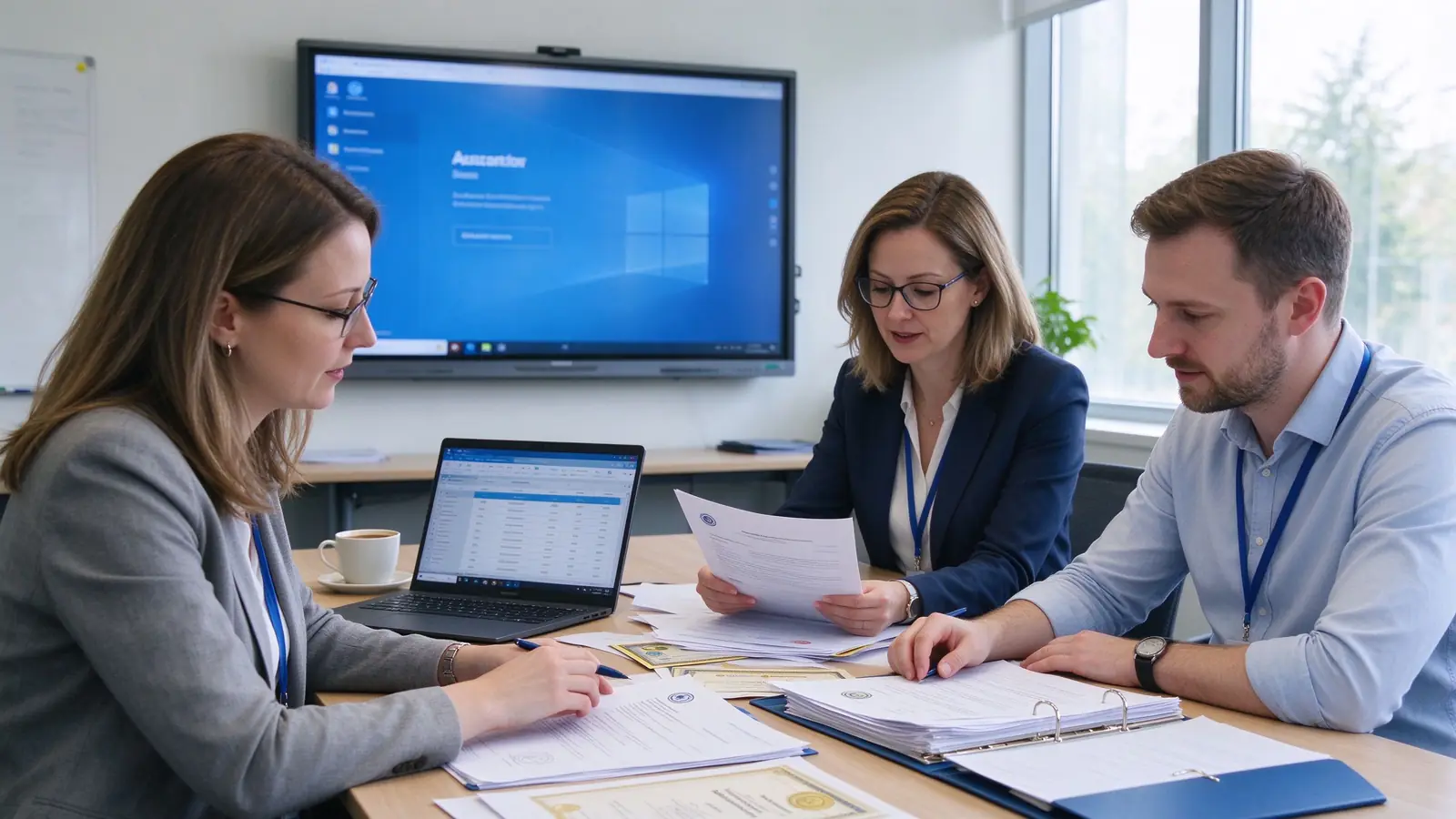
In school procurement, certification and compliance documentation usually determines whether a product can enter the target market, satisfy school or government purchasing rules, pass tender qualification reviews, and complete acceptance testing. In practical terms, certifications affect:
An interactive whiteboard is not only a display device; it also connects to the campus network, student accounts, Google Workspace, the LMS, and meeting systems, so hardware compliance and software security matter equally. A well-documented compliance package protects the buyer and simplifies audits and inspections, and it is a core requirement of any smart classroom solution.
School whiteboard certifications fall into four groups: product safety and electromagnetic compliance, environmental and energy compliance, market access and wireless compliance, and factory management systems. A fifth layer, the Google ecosystem (EDLA), matters when the school runs Google Workspace. Each group answers a different procurement question; none substitutes for another.
CE is not a single quality certificate. It is the conformity marking and declaration system through which a manufacturer confirms that a product meets applicable EU regulations covering electrical safety, electromagnetic compatibility, hazardous-substance restrictions, energy-related requirements, and, where relevant, wireless radio rules. When reviewing CE documents, buyers should check whether the file corresponds to the proposed model, includes the correct model and manufacturer information, contains an EU Declaration of Conformity, is supported by test reports, and addresses wireless compliance where the model includes Wi-Fi or Bluetooth.
LVD, the Low Voltage Directive, covers the electrical safety of equipment operating within defined voltage ranges. For school projects this means power supply safety, insulation and grounding, overheating protection, electrical construction, cables, and plug configurations. Schools should request a model-specific LVD test report, the EU Declaration of Conformity, rated voltage and frequency, plug type, and electrical safety instructions. LVD is an EU legal requirement, not a global safety certificate.
EMC, electromagnetic compatibility, addresses whether a device emits excessive electromagnetic interference and whether it maintains reasonable immunity inside an electromagnetic environment. A classroom often runs Wi-Fi, laptops, tablets, cameras, microphones, wireless presentation devices, audio systems, and teaching terminals at the same time. Schools should request an EMC test report that names the tested standards, the exact product model, the test laboratory, the report date, the product configuration, and whether Wi-Fi and Bluetooth modules were included in the test.
RoHS restricts the use of certain hazardous substances in electrical and electronic equipment. For school buyers its value is environmental: green campuses, sustainable procurement policies, and ESG requirements. The documents to request are a RoHS declaration or test report that clearly states the product and model scope and the applicable standard version.
ErP, the Energy-related Products framework, covers ecodesign, energy consumption, standby, and off-mode requirements. Standby power and long-term energy use affect electricity bills, energy-saving targets, public procurement rules, sustainable campus ratings, and TCO. Buyers should confirm operating, standby, and off-mode power consumption, automatic standby settings, energy-related test documentation, and whether the DMS supports scheduled power-on and power-off.
ENERGY STAR is an energy-efficiency labeling and certification program that focuses on how much energy a product uses. Schools value it for daily electricity bills, sustainable procurement scoring, energy audits, green campus strategy, and project TCO. A practical specification for a tender could read:
FCC relates primarily to U.S. market compliance for electromagnetic emissions and wireless modules or communication devices. It matters to U.S. schools, U.S. education distributors, and export projects. Buyers should confirm that the FCC evidence covers the target model, that Wi-Fi and Bluetooth modules are inside the compliance scope, that an FCC ID or supplier's declaration of conformity exists, that labels and user manuals carry the required statements, and whether changing the wireless module would require re-verification.
PVoC, Pre-Export Verification of Conformity, is a pre-shipment conformity verification that some countries require for import clearance or market access. It is relevant when the destination market requires pre-shipment conformity review or customs documentation, and for government education projects in Africa, the Middle East, or other markets with export verification processes. Buyers should confirm whether PVoC is required, the applicable program and authority, whether pre-shipment inspection is needed, whether test reports or certificates are required, whether labels and origin documentation are needed, how it affects lead time, and who bears the cost. A precise way to phrase a request is:
ANATEL is Brazil's regulatory framework for telecommunications and wireless equipment. For education projects it covers ANATEL approval, local importer support, Portuguese-language labels and documentation, local power and plug requirements, wireless module consistency, and local after-sales arrangements. Buyers should confirm whether the certificate covers the complete device or only the wireless module, whether the Wi-Fi and Bluetooth modules match the purchased model, whether module changes require re-evaluation, whether a local certificate holder is needed, certificate validity, and label and after-sales requirements.
ISO 9001 describes a quality-management system, which may reflect documented processes, quality management, supply chain control, non-conforming product handling, continuous improvement, complaint handling, and production records and traceability. ISO 14001 describes an environmental-management system, covering environmental impact management, resource use control, waste management, environmental objectives, compliance management, and continuous improvement.
EDLA, the Google Enterprise Device Licensing Agreement, enables Android devices in enterprise and education environments to access Google Mobile Services, the Google Play Store, and related management and security capabilities. EDLA is not ChromeOS, and it does not mean every Google function is available without management. The next section explains what EDLA means for school buyers in detail.
EDLA, the Google Enterprise Device Licensing Agreement, allows Android interactive displays to access Google Mobile Services, the Google Play Store, and Google enterprise and education applications, along with the management and security capabilities schools need for fleet deployment.
| Area | Standard Android IWB | EDLA-certified Android IWB |
|---|---|---|
| App access | Pre-installed apps or APK installation | Authorized Google Play Store access |
| Google services | Limited or unavailable | Supports GMS where applicable |
| Security updates | Depends on the manufacturer's schedule | Enterprise-oriented security posture |
| School IT management | Varies by model | Better aligned with enterprise and education management |
| Google Workspace workflow | May require external devices | Direct access to Google tools |
| Best for | Basic presentation | Google Workspace schools and managed fleets |
EDLA is not the same as ChromeOS. An EDLA-certified Android display gains Google services and application ecosystem support, but it is not a complete Chromebook environment. Schools that need Chromebook-like kiosk and management behavior should evaluate both options against their device-management policy. For a deeper comparison of platforms, see the interactive whiteboard buyer's guide.
Certifications describe how the product is made and approved; specifications describe what it must do in the classroom. Both should be written into the tender so compliant bidders can be compared fairly. The table below maps the specifications schools typically need to the reason each matters.
| Specification area | What to specify | Why it matters in schools |
|---|---|---|
| Screen size | 55, 65, 75, 86, 98 inches, or project-specific | Matches room size and viewing distance |
| Resolution | Native 4K UHD preferred for medium and large rooms | Improves readability of detailed content |
| Brightness | Minimum target based on lighting conditions | Supports visibility in bright classrooms |
| Anti-glare | Anti-glare glass or equivalent | Reduces reflections from windows and lighting |
| Viewing angle | Wide-angle visibility requirement | Students view from different seats |
| Touch technology | IR, PCAP, or approved equivalent | Determines the interaction experience |
| Touch points | 20, 40, or project-specific | Supports teacher and student collaboration |
| Touch latency | Maximum acceptable latency | Affects natural writing |
| Palm rejection | Required for pen writing | Reduces accidental touch input |
| Operating system | Android, Windows, or dual system | Supports teaching software and IT policy |
| EDLA | Required or optional | Google services and app access |
| Wireless sharing | Windows, macOS, iOS, Android support | Supports BYOD teaching |
| Whiteboard software | Annotation, file import and export, save and share | Supports lesson delivery and reuse |
| Ports | HDMI, USB, USB-C, LAN, audio | Connects teacher devices and peripherals |
| Camera and audio | Optional or required for hybrid teaching | Supports remote and recorded lessons |
| DMS | Required for multi-room deployment | Supports remote monitoring and management |
| Power | Voltage, plug type, energy mode | Supports destination-market installation |
| Mounting | Wall mount or trolley | Matches classroom layout |
| Warranty | Years, coverage, response time | Reduces lifecycle risk |
| Certifications | Target-market specific | Supports legal, tender, and import compliance |
The same certification principles apply across school types, but the recommended configuration changes with the room, the subject, and the IT environment.
| School environment | Suggested configuration | Certifications and compliance focus | Qtenboard direction |
|---|---|---|---|
| Primary school classroom | 65-75" 4K, easy whiteboard, low glare | CE/RoHS/EMC/LVD or equivalent | 65/75" interactive panel |
| Secondary school classroom | 75-86" 4K, multi-touch, casting | Safety, EMC, software security, DMS | 75/86" interactive panel |
| Google Workspace school | EDLA Android panel, Play Store, DMS | EDLA, product compliance, IT policy | EDLA configuration |
| University classroom | 75-98" 4K, Windows/OPS, USB-C | 4K, EMC, security, AV integration | 75-98" with OPS |
| Technical/STEM classroom | 86"+ precise touch, 4K, Windows | Touch accuracy, ports, safety | 86" 4K interactive panel |
| Multi-school district rollout | Standardized 65/75/86" plus DMS | ISO, certificates, DMS, lifecycle | Factory-direct B2B supply |
| Government education tender | Tender-specific hardware and documents | Model-specific reports, compliance matrix | Tender document package |
| Export project | Region-specific configuration and documents | PVoC, ANATEL, FCC, CE, plugs, labels | Project-based compliance |
Writing that the whiteboard "must be certified" leaves evaluation open to interpretation. Replace it with requirements that name the evidence and the applicable market:
Receiving a document is not the same as verifying it. Schools should run a five-step check before they accept certification evidence in a tender, purchase order, or shipment.
| Document type | What it proves | What it does not prove |
|---|---|---|
| CE/EMC/LVD/RoHS report | Product-level compliance evidence | Does not prove factory quality management |
| FCC evidence | U.S. emissions and wireless compliance | Does not prove EU compliance or software quality |
| EDLA evidence | Google Android ecosystem and licensing | Does not replace electrical safety or EMC |
| ENERGY STAR evidence | Energy-efficiency status | Does not prove touch quality or software compatibility |
| ISO 9001 | Factory quality-management system | Does not prove a specific model is CE or FCC compliant |
| ISO 14001 | Factory environmental-management system | Does not prove product energy efficiency or material compliance |
| PVoC/ANATEL documentation | Destination-country market access support | May not apply to every country or shipment |
| Requirement | Required evidence | Supplier response | Status | Supporting document |
|---|---|---|---|---|
| CE compliance | DoC plus applicable reports | Submitted | Compliant | CE declaration |
| EMC | Model-specific EMC report | Submitted | Compliant | EMC report |
| RoHS | Declaration or test report | Submitted | Compliant | RoHS report |
| EDLA | Model-specific confirmation | Submitted | Compliant | EDLA evidence |
| ENERGY STAR | Listing or certificate | Pending | Clarification needed | ENERGY STAR record |
| ISO 9001 | Valid factory certificate | Submitted | Compliant | ISO certificate |
| PVoC | Destination-specific support | Required before shipment | Pending | Export compliance plan |
| ANATEL | Required for Brazil only | Not applicable | N/A | Destination confirmation |
Comparing only the device price ignores most of the costs a school carries over five years. The components to allocate are:
Qtenboard can provide certification and compliance documentation according to the product model, target market, wireless configuration, and project requirements. Buyers should request model-specific evidence before tender submission, purchase approval, or shipment.
Qtenboard works with education authorities, government procurement, international schools, universities, education distributors, system integrators, multi-campus groups, and public education projects. Depending on the project stage, the team can provide or discuss specification sheets, certification documents, compliance matrices, test reports, factory information, samples, installation plans, training programs, warranty documents, spare-part plans, DMS, and lifecycle support.
| Buyer priority | Qtenboard value proposition |
|---|---|
| Certification support | CE, RoHS, EMC, LVD, ErP, FCC, ENERGY STAR, EDLA, ISO, PVoC, and ANATEL, model-specific |
| Size flexibility | 55-110" interactive display portfolio |
| EDLA configuration | Available for Google Workspace schools |
| DMS and security | Remote management, OTA, access control |
| Tender support | Specifications, compliance matrix, certificates, test reports |
| Deployment support | Batch supply, spare parts, multi-school rollout |
Product and technology
Certification and compliance
Project implementation
It depends on the purchasing country, device configuration, and school policy. Common focus areas include product safety, EMC, environmental and energy compliance, wireless communications, the Google ecosystem, and factory management. Typical documents include CE, RoHS, EMC, LVD, ErP, FCC, ENERGY STAR, EDLA, ISO, PVoC, ANATEL, or other locally mandatory approvals.
Usually not. CE-related documents matter for EU/EEA projects, but schools may also need RoHS, EMC, LVD, energy, wireless, software security, EDLA, local market access, installation, and warranty documentation, depending on the target market.
EDLA is Google's Enterprise Device Licensing Agreement. It enables Android interactive displays to access Google Mobile Services, the Google Play Store, and Google education and enterprise applications, while strengthening app management, security updates, and device management.
No. EDLA generally gives an Android device access to Google services and the application ecosystem, but it is not a complete ChromeOS or Chromebook environment.
EMC concerns electromagnetic compatibility. Classrooms run Wi-Fi access points, laptops, cameras, audio gear, and other electronics, so EMC documents help buyers evaluate whether the display meets applicable interference and immunity requirements.
CE is the marking and conformity system within the EU compliance framework; LVD mainly covers electrical safety; EMC mainly covers electromagnetic interference and immunity. Buyers should require declarations and test materials applicable to the exact model.
No. ISO 9001 is usually a quality-management system certification for a factory or organization. It does not mean that a specific interactive whiteboard model has completed electrical safety, EMC, or target-market certification.
ENERGY STAR relates to energy efficiency. Buyers should still verify that the current model is within the program scope and review operating, standby, and off-mode power figures.
PVoC is a pre-export conformity verification that some countries require for import clearance or market access. Requirements vary by destination country and product category, so confirm them before shipment.
Interactive whiteboards with Wi-Fi, Bluetooth, or other wireless functions may require ANATEL approval or registration to enter Brazil. Confirm that the document covers the complete device, the current wireless module, and the target configuration.
TCO = device + installation + software + training + maintenance + spare parts + energy + certification + upgrade. Schools should compare the complete five-year cost rather than only the device price.
Qtenboard can provide or discuss compliance document support including CE, RoHS, EMC, LVD, ErP, FCC, ENERGY STAR, EDLA, ISO, PVoC, and ANATEL according to the product model, configuration, destination country, and project requirements. Before formal purchase or tender submission, request documents matching the final model for verification.
| Role | CTA |
|---|---|
| School procurement | Request certification documents |
| IT/AV lead | Download the certification verification checklist |
| System integrator | Request project configuration support |
| Education distributor | Request the OEM/ODM catalog and samples |
| Government education project | Discuss a tender project |
Share your destination country, school type, required screen sizes, operating system, Google Workspace requirements, wireless configuration, certification list, quantity, and tender deadline. Qtenboard can recommend a compliant interactive whiteboard configuration and prepare model-specific documentation for your project.
Form fields. Required: organization, email, country, school type, project type, message. Optional: number of classrooms, preferred screen size, required operating system, Google Workspace and EDLA requirement, wireless requirements, required certifications, energy-efficiency standard, camera and audio configuration, quantity, tender deadline, document upload.

CEO | Interactive Display & Collaboration Solution Expert
I am the founder of Qtenboard, bringing over 17 years of hands-on expertise to the touch display industry. Drawing on the global management perspective gained through my EMBA studies at ShenZhen University, I lead my team in optimizing every stage of our operations—from product definition to high-efficiency supply chain management—ensuring our manufacturing capabilities remain at the forefront of the industry.
As the leader of Qtenboard, I specialize in providing tailored OEM/ODM solutions for interactive whiteboards, LCD video walls, digital signage, and industrial-grade touch terminals. Backed by our 330,000 m² modern industrial park in Shenzhen, we maintain full-lifecycle control over industrial design, precision manufacturing, and rigorous performance testing.
With nearly two decades of project experience, Qtenboard’s display solutions are now deployed in over 120 countries and regions, earned the trust of more than 15,000 enterprise customers worldwide. If you are seeking a responsive partner with a deep manufacturing foundation for your customized touch display projects, my team and I are ready to support your vision with professional excellence.
 ukr
ukr
 EN
EN  pt
pt  spa
spa  th
th  vie
vie  aze
aze  bel
bel  est
est  lav
lav  ru
ru