When an education group, an AV systems integrator, or a regional distributor commits to a bulk order of Interactive Flat Panels, the product spec sheet is rarely what determines whether the project succeeds. What determines it is whether the shipment arrives on the date written into the installation schedule.
Delays in Interactive Flat Panel Display (IFPD) projects are almost never caused by a single dramatic failure. They are caused by a chain of small, predictable risks — a panel allocation cycle, a customs clearance window, a peak-season shipping slot — that buyers rarely evaluate until after the purchase order is signed. This guide takes the opposite approach: it walks through where IFPD delivery risk actually originates, gives you a practical framework for evaluating any supplier's delivery capability before you commit, and then shows how those standards play out in real project scenarios.
Most IFPD procurement conversations start with resolution, touch technology, panel brand, and unit price. These are necessary comparisons, but they answer the wrong question for a bulk project. A single Interactive Whiteboard performing well in a showroom tells you nothing about whether unit 800 of 1,000 will leave the factory on schedule, clear customs without a hold, and arrive at a school or corporate campus in time for the agreed installation window.
One education-sector client came to Qtenboard directly from a previous supplier relationship that had failed on exactly this point. Their original vendor had confirmed a delivery date for a multi-campus Interactive Flat Panel rollout, but only began sourcing the LCD panels for the required screen size after the purchase order was signed. By the time that supplier placed its own panel order, allocation for that size had tightened industry-wide, and the panel lead time alone pushed the shipment past the agreed factory-ready date by several weeks. The installation contractor, already booked against the original schedule, had to be re-booked, and the classroom go-live date slipped into the middle of the term instead of before it.
When this client came to us for the next phase of the same rollout, this was the first question they asked: at what point in the order process do you actually start sourcing the panels? That question — not screen brightness or touch accuracy — was what decided the second contract.
This is the core argument of this guide: for bulk IFPD purchasing, supplier evaluation should be built around delivery capability first, and product comparison second. The sections below break down where delay risk comes from, what a buyer should be checking before signing a contract, and how a supplier capable of meeting that bar actually operates in practice.
Buyers often treat "delay" as a single risk. In practice, it is the sum of three separate risk categories, each with a different cause and a different mitigation. Understanding the difference matters because it changes what questions you should be asking a supplier.
A factory shipping on time is not the same as a project receiving equipment on time. Between "cargo ready" and "installed on site," an Interactive Flat Panel order passes through several handoffs, and each one carries its own timing risk: factory to port, export customs declaration, ocean freight booking and transit, destination port customs clearance, and last-mile delivery to the installation site.
Ocean freight capacity and container rates fluctuate with seasonal demand. Orders that ship during peak periods — typically ahead of major retail or back-to-school seasons — face a materially higher risk of booking delays than orders shipped during off-peak windows.
Congestion at major transshipment hubs can add days or weeks to transit time even after cargo has left the factory, and this variability is largely outside any single supplier's direct control.
Clearance speed at the destination depends heavily on whether export documentation, HS codes, and product certifications were prepared correctly before the shipment left the factory — a step that is frequently underestimated during OEM projects.
Покупатель на вынос: a supplier that only quotes "ex-factory" lead time is quoting half the timeline. Ask specifically how factory output is converted into a realistic door-to-site delivery date, and whether export documentation is prepared in parallel with production rather than after it.
An Interactive Flat Panel is not a single manufactured part; it is an assembly of components sourced on independent cycles — the LCD panel itself, the mainboard or OPS computing module, the touch sensor layer, the power supply, and structural components. LCD panel supply is cyclical: allocation and pricing shift with global panel-industry demand, and lead times for specific panel sizes can extend meaningfully during tight-capacity periods. The same is true for mainboard components tied to broader semiconductor supply cycles.
This is why component lead time, not just assembly time, is the real constraint on a bulk order's delivery date. A supplier that only begins sourcing panels after a purchase order is confirmed is, by definition, adding the full panel lead time on top of assembly and testing time. A supplier that forecasts demand and pre-positions core components ahead of order confirmation removes that lead time from the customer-facing delivery clock.
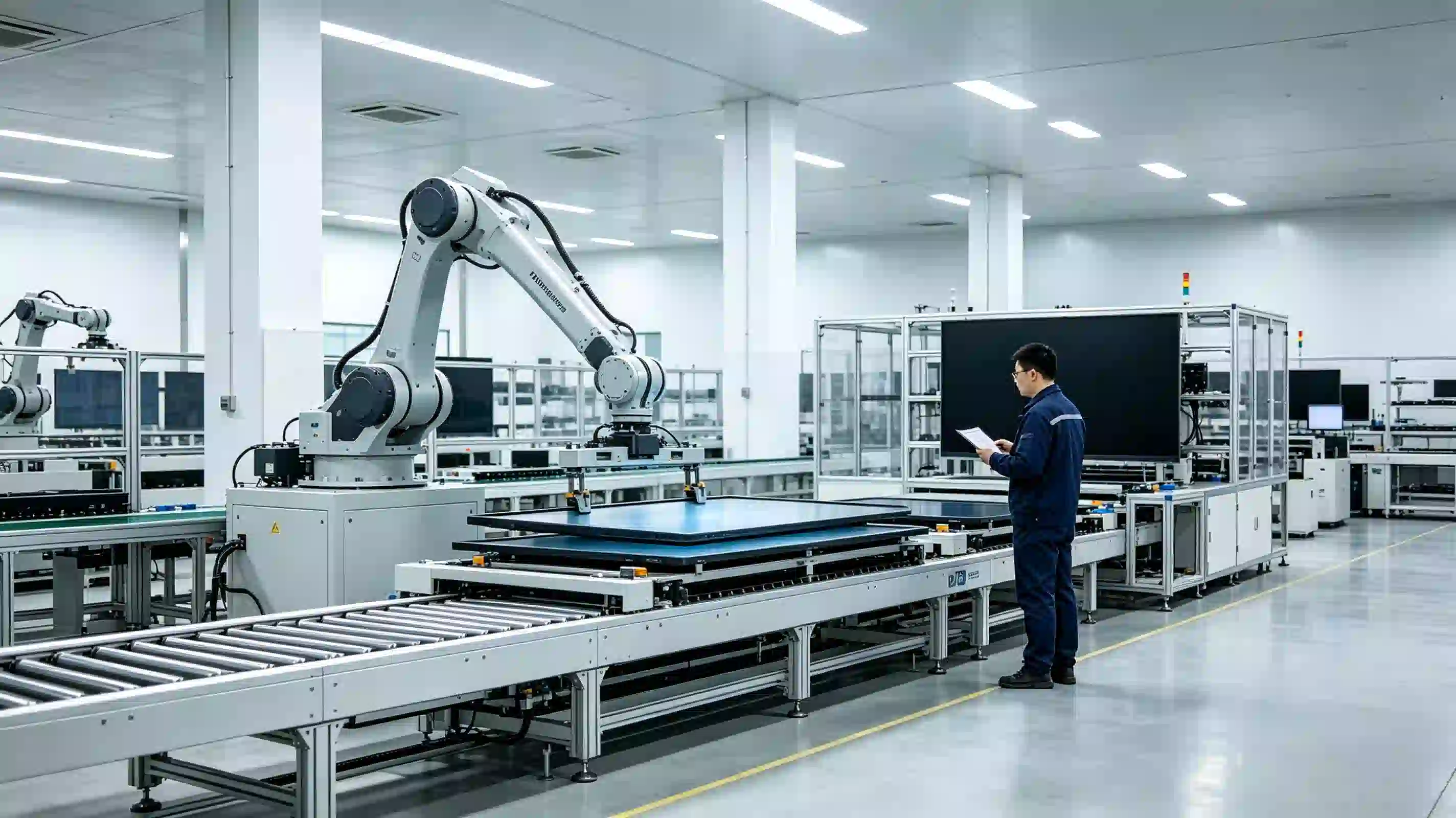
Overseas buyers rarely purchase a fully standard product. Education buyers want specific system configurations and pre-loaded whiteboard software; AV integrators and distributors want brand logos, custom boot screens, and region-specific interface languages. The tension is straightforward: small-batch customization is easy for almost any factory; large-batch customization is where delivery timelines break.
The difference comes down to whether OEM Customization is built on a standardized, modular product platform or bolted on as a one-off engineering exercise for every order. On a modular platform, swapping a system configuration or an interface set is a planned production-line change. On a non-modular line, it is a re-engineering task that competes with every other order in the factory queue — and that is precisely where large OEM orders slip.
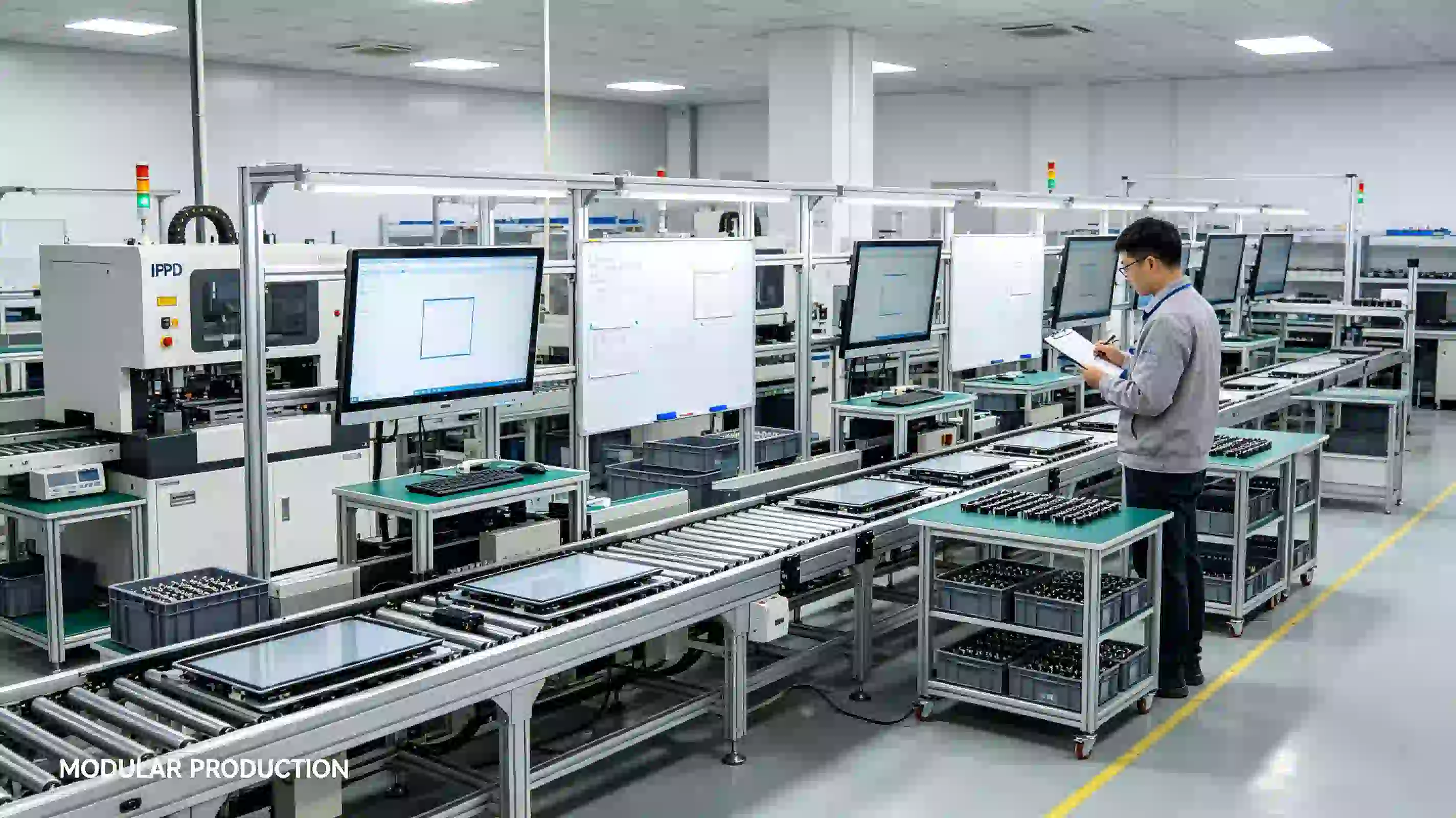
Before signing a contract for a bulk IFPD or Interactive Whiteboard order, buyers should be able to answer six questions about a supplier's operational capability. These map directly to the delay sources described above.
Does the supplier forecast material demand and pre-position core components, or does sourcing start only after the order is confirmed? Is there dependency on a single panel or component source?
Can production scale from a pilot order of a few hundred units to a full rollout of several thousand without a queue-driven delay? Is capacity spread across more than one production base?
Is customization supported by a modular product architecture (interchangeable system modules, interface boards, software images), or is each customization request handled as a bespoke build?
Is there a documented inspection process across incoming materials, in-process production, finished units, and outbound shipment — with batch-level traceability?
Does the supplier have experience preparing documentation for your target market's regulatory requirements (for example CE in the EU, or FCC/UL-type requirements in North America)?
What happens after the container leaves the port? Is there a defined post-delivery support structure — response times, spare parts policy — and, for distributors, sales and training support?
A supplier that cannot answer these six questions with specifics — and can only answer with product specifications — has not yet demonstrated delivery capability, regardless of how competitive the unit price looks.
The framework above is only useful if it can be demonstrated in an actual project, not just claimed in a sales deck. Qtenboard's approach to bulk IFPD and Interactive Whiteboard delivery is used here as an illustration of how each capability translates into a working process — not as a standalone claim of superiority.
This is the same client introduced above, continuing their rollout with Qtenboard after switching suppliers. The focus of this project was resolving the single point of failure that had derailed their previous phase: component sourcing timing.
12 public school districts across Indonesia, coordinated through a single education-project contractor.
1,150 Interactive Whiteboard units, mixed across 65", 75", and 86" screen sizes to match classroom sizes across primary and secondary campuses.
Panel sourcing timing — the exact failure point from the client's previous supplier. The 75" panel size in particular was flagged as sitting inside a tighter allocation window that quarter.
Panel and component forecasting began at contract signing, in parallel with order confirmation rather than after it. Because panel and module production run in-house from raw material stage rather than through outside procurement, the 75" volume was pulled forward in the internal production queue and covered from buffer raw-material stock reserved against the confirmed schedule, instead of competing with other open orders for capacity. Shipments were staged in three batches aligned to each district cluster's installation sequence, instead of one single consolidated shipment, so the first districts could begin installation while later batches were still in production.
All three batches cleared factory-ready status within the original schedule, with the final batch shipped 9 days ahead of the contracted date. Installation across all 12 districts was completed before the start of the academic term.
The contractor's procurement lead specifically noted that being able to see the panel sourcing timeline at the point of order confirmation — rather than being told a delivery date and finding out later what it depended on — was the difference that mattered for planning the installation crews across 12 separate sites.
This case centers on a single problem: how to run two different market configurations through one production line without turning each region into a separate, sequential project.
A single regional distributor supplying corporate and education customers in the UAE and Vietnam from one consolidated order.
260 units total: 65" and 86" Interactive Flat Panels, split roughly evenly between the two markets.
The UAE batch required a Windows OPS configuration with Arabic-English bilingual interface and the distributor's own logo and boot screen; the Vietnam batch required an Android configuration with Vietnamese-English interface and a different pre-loaded whiteboard software package. Treated as two separate builds, this would normally mean two production queues.
Both configurations were run on the same modular hardware platform, with the OPS module, language interface package, logo/boot-screen asset, and software image treated as swappable production-line variables rather than separate engineering builds. Both batches were scheduled on the same production line in adjoining runs instead of sequential projects, and each went through the same IQC–IPQC–FQC–OQC quality sequence.
Both configurations shipped within the same delivery window, roughly 3 weeks faster than the distributor's internal estimate based on their prior experience of ordering the two markets as separate purchase orders.
The distributor's sourcing manager highlighted that not having to stagger the two markets into separate purchase cycles simplified their own inventory and rollout planning on both ends, and that the boot-screen and language configuration matched what was agreed in the sample review without a second confirmation round.
The most expensive type of delay in a bulk IFPD order is not a late shipment — it is a batch that arrives on time and then fails inspection or field testing after installation, forcing a return or rework cycle. A structured quality system is designed specifically to catch that risk before the shipment ever leaves the factory. Each stage addresses a different failure point:
This four-stage structure is what allows a supplier to answer the buyer's real question — not "does the product work," but "will every unit in this batch work the same way." It is also worth noting, briefly, that the same production and quality discipline that supports Interactive Flat Panel and Interactive Whiteboard orders extends across Qtenboard's broader product range, including digital signage, self-service kiosks, and LCD video wall panels, for buyers consolidating multiple display categories under one Smart display solution supplier.
Buyers evaluating a supplier should expect a structured, documented process from initial requirement through post-delivery support — not an ad hoc production run. The workflow below reflects the standard project sequence a reliable IFPD supplier should be able to walk you through in a pre-sales conversation.
Product model, screen size, order volume, target market, and the certification requirements applicable to that market are confirmed up front — not discovered mid-production.
System configuration (Android / Windows OPS), interface requirements, and software pre-load specifications are locked before production scheduling begins.
Core components are procured against the confirmed schedule, and production capacity is allocated across the required timeline rather than queued behind other orders.
IQC, IPQC, FQC, and OQC checkpoints run throughout production, with batch-level records maintained for traceability.
Packaging confirmation, export documentation, and logistics coordination are completed in parallel with production close-out, followed by Global Technical Support for installation and post-deployment issues.
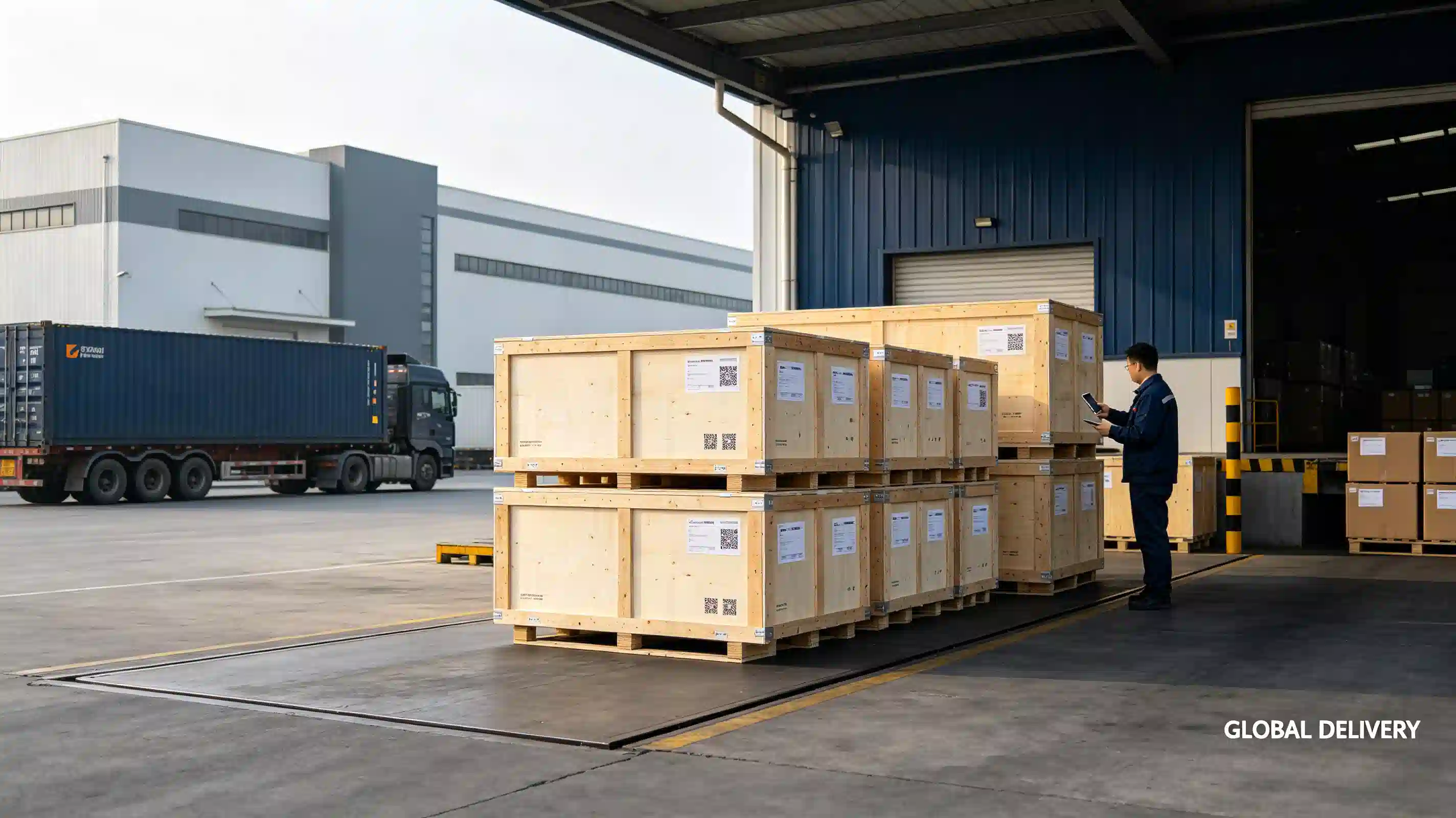
When two supplier quotes are close on unit price, buyers often default to the lower number. For a bulk IFPD project, that comparison is usually incomplete, because it leaves out the cost of delay.
This is the practical argument for treating delivery capability as a procurement criterion, not an afterthought: the hidden cost of a missed installation date is frequently larger than the price gap between competing quotes. A long-term IFPD supply partner is valuable precisely because it removes that hidden cost from the equation, project after project.
Q. What is the typical lead time for a bulk IFPD order of 1,000 units or more?
Lead time depends on screen size, current panel-market allocation cycles, and the level of OEM Customization requested. Because component sourcing and production scheduling are planned in parallel rather than sequentially, buyers should request a project-specific timeline during the requirement confirmation stage rather than relying on a generic quoted figure.
Q. How is supply chain risk — such as panel shortages or shipping delays — managed on large orders?
Through forward material planning tied to the confirmed production schedule, so core component procurement starts as early as possible rather than only after the purchase order is signed, and through coordination of export documentation ahead of shipment to reduce customs-related delay.
Q. What OEM Customization options are available, and is there a minimum order quantity?
Standard OEM Customization options include logo placement, custom boot screens, interface language sets, system configuration, and pre-loaded whiteboard or collaboration software. Minimum order quantities vary by the depth of customization requested — buyers should confirm MOQ against their specific configuration during the solution confirmation stage.
Q. Do Interactive Flat Panels support both Android and Windows systems, and can whiteboard software be pre-installed?
Yes. The modular platform supports both Android-based operation and Windows OPS module configurations, and whiteboard or third-party collaboration software can be pre-loaded as part of the OEM configuration step.
Q. How is product consistency guaranteed across a large batch order?
Through the four-stage IQC / IPQC / FQC / OQC quality process, which inspects incoming materials, monitors in-process assembly, functionally tests finished units — including aging tests — and performs batch-level sampling before shipment.
Q. Can certification requirements for specific markets, such as CE in the EU or FCC/UL-type requirements in North America, be supported?
Certification requirements should be confirmed at the requirement-confirmation stage of the project, so that documentation and testing are planned into the production timeline rather than addressed after manufacturing is complete. Buyers should ask for prior delivery experience in their specific target market.
Q. What does Global Technical Support include after delivery?
Post-delivery support typically covers installation guidance, remote troubleshooting, and a spare parts policy for warranty-period issues. Buyers should confirm the committed response window for technical issues as part of the contract terms, not assume a default service level.
Q. What kind of Partner Support is available for distributors and system integrators?
Partner Support for distributors and integrators can include demo units, product training, and co-branded market materials to support local sales efforts, in addition to the standard OEM and delivery process described above.
If your team is scoping a bulk Interactive Flat Panel or Interactive Whiteboard project, use the framework above to evaluate any supplier — including Qtenboard. Explore the product range, request the full catalogue, or speak directly with our team about your project timeline.

CEO | Интерактивный дисплей & Сотрудничество Решение Эксперт
Я являюсь основателем Qtenboard, привнеся более 17 лет практического опыта в индустрию сенсорных дисплеев. Опираясь на перспективы глобального управления, полученные в ходе моих исследований EMBA в Университете Шэньчжэня, я возглавляю свою команду по оптимизации каждого этапа нашей деятельности-от определения продукта до высокоэффективного управления цепочками поставок-гарантируя, что наши производственные возможности остаются на переднем крае отрасли.
Как руководитель Qtenboard, я специализируюсь на предоставлении адаптированных OEM/ODM-решений для интерактивных досок, ЖК-видеостен, цифровых вывесок и сенсорных терминалов промышленного уровня. Опираясь на наш современный промышленный парк площадью 330 000 м² в Шэньчжэне, мы поддерживаем полный контроль жизненного цикла промышленного дизайна, точного производства и тщательного тестирования производительности.
Обладая почти двадцатилетним опытом работы в проектах, решения Qtenboard в настоящее время развернуты в более чем 120 странах и регионах, заслужив доверие более 15 000 корпоративных клиентов по всему миру. Если вы ищете отзывчивого партнера с глубоким учредлением производства для ваших подгонянных проектов дисплея касания, то моя команда и я готовы поддержать ваше зрение с профессиональным передовым опытом.

 ru
ru
 EN
EN  pt
pt  spa
spa  th
th  vie
vie  aze
aze  bel
bel  est
est  lav
lav  ukr
ukr