 ukr
ukr
 EN
EN  pt
pt  spa
spa  th
th  vie
vie  aze
aze  bel
bel  est
est  lav
lav  ru
ru If you're evaluating Qtenboard as an OEM/ODM supplier, one of the first questions worth answering is simple: is this a real, self-owned factory — Below is a verifiable timeline of how Qtenboard grew from a single stall in Shenzhen's Huaqiangbei electronics market in 2005 into a group operating three self-owned factories covering 840,000㎡, supplying brands including TCL, Adidas, and Chanel.
In 2005, Huaqiangbei was the loudest place in China. Thousands of vendors crowded into buildings stacked floor by floor with every conceivable electronic component — chips, cables, modules, connectors, screens. Deals were struck in hallways. Prices changed by the hour. Brands rose and collapsed in a single season. In the middle of all this, a young woman who had graduated from Shenzhen University stood at a small stall selling display components, watching, learning, and quietly memorizing an entire industry.
Her name is Queenie. She didn't come from money. She didn't have a mentor in the business. What she had was an unusual combination of patience and precision — she could spot a bad panel from across a storeroom, she understood why a buyer would reject a shipment before the buyer could articulate it themselves, and she had a memory for the kind of technical detail that most salespeople never bother with. By the time she decided to build a factory, she already knew more about LCD displays than most engineers who had worked in them for a decade.
That factory is now Qtenboard. What began as a display component supplier has grown into one of China's most trusted commercial display manufacturers — making interactive whiteboards for schools and boardrooms, digital signage for retail giants, video walls for airports, kiosks for public services, and industrial screens for mission-critical environments. The company ships to more than 100 countries. It has been the manufacturing backbone behind some of the world's most recognized brands, and it has built its own brand name that stands entirely on its own. In 2025, it closed its Series B round of funding and opened a new sales center in Shenzhen's Longgang district. It is not done growing.
But before all of that, there was Huaqiangbei. And before the factory, there was a woman who decided that knowing everything about a product was the best possible foundation for making it.
Chapter One
The Foundation:
Learning Before Building
Most manufacturing founders in China come from one of two directions: technical engineers who decide to commercialize their knowledge, or traders who accumulate enough capital to invest in production. Queenie belongs to neither category. She came from the market itself — the messy, high-volume, no-margin-for-error world of component trading in Huaqiangbei, where survival required knowing your product better than your customer and your competitor combined.
For years before building her own factory, Queenie sold display components. She learned which panels held color calibration longest. She knew which manufacturers cut corners on backlight modules and how those shortcuts showed up as field failures six months after installation. She understood the logistics of international shipping, the frustrations of customs clearance, the psychology of price negotiation, and the specific needs of buyers from different industries and different countries. She built a mental map of the entire LCD supply chain — who made what, who supplied whom, where the quality was genuine and where it was performed.
This kind of knowledge is not taught. It is accumulated through repetition, through failure, through standing in a Huaqiangbei corridor at 9 PM arguing over the specs of a rejected shipment. By the time Queenie had enough capital to consider manufacturing, she had also accumulated something rarer: a complete, ground-level understanding of what buyers actually needed and what the industry was actually capable of delivering.
In 2005, she made the move. The company that would become Qtenboard was formally established in Shenzhen. The first product line focused on display components — the same category she had been selling from the other side of the counter. The difference now was that she controlled the production, the quality standards, and the relationship with the customer from end to end.
She didn't build a factory to make screens. She built a factory because she already knew exactly which screens the market was missing.
On Queenie's founding philosophyChapter Two
The First Clients:
Building for Giants
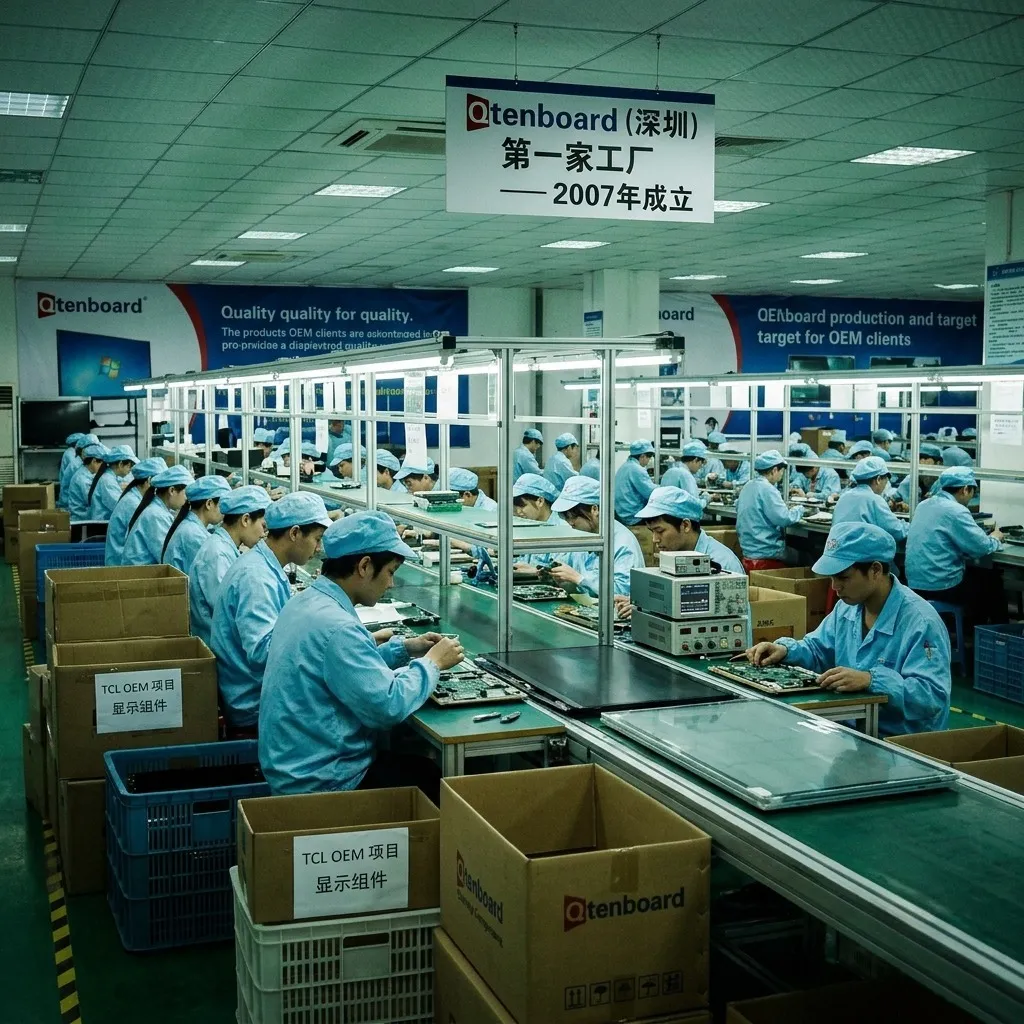
Early production line at Qtenboard's first Shenzhen facility, approximately 2007.
Two years after opening, Qtenboard shipped its first major export orders. But the more significant milestone came earlier, in the domestic market: the company began manufacturing displays on behalf of TCL, one of China's most powerful consumer electronics brands. To be chosen as an OEM partner by TCL at that stage of the company's life was not a minor commercial event. TCL had options. It had relationships with established Taiwanese and Korean suppliers. It chose Qtenboard.
The reason, by all accounts, was quality. Queenie's background in component trading meant that she had no tolerance for the kind of small compromises that larger, less attentive factories routinely made — using cheaper backlight diffusers, skipping certain calibration steps, accepting slightly out-of-spec panels to save margin. At Qtenboard, these compromises did not happen. The products that left the factory matched the specifications exactly. When problems arose, they were diagnosed and fixed instead of explained away.
Working with brands like TCL shaped Qtenboard's manufacturing culture in ways that would prove durable. Large OEM clients have rigorous quality audits, strict delivery schedules, and zero patience for surprises. Meeting their standards consistently is an education in itself. Every process that had to be documented to satisfy a TCL audit, every system that had to be built to support their production volumes, became part of Qtenboard's institutional capability. The company was, in a sense, trained by the most demanding clients in the Chinese market.
By 2007, international buyers were also arriving. The first export orders went to clients across Southeast Asia, the Middle East, and Europe — buyers who had found a small Shenzhen factory that seemed to understand their requirements better than companies twice its size. Qtenboard's reputation in international trade was being built through the same mechanism that had built Queenie's personal reputation in Huaqiangbei: knowing the product well enough to deliver exactly what was promised.
Chapter Three
The Manufacturing Map:
Three Bases, One Vision
A company that grows only in revenue but not in infrastructure is fragile. Queenie understood early that Qtenboard's long-term credibility as a manufacturer depended on owning its production capacity rather than renting it. Every time the company expanded, it did so with permanent infrastructure — land, buildings, equipment, people.
Shenzhen — Founding & First Production Line
Established in Shenzhen with an initial focus on display component supply. The first production line marks the transition from trading to manufacturing. Early OEM relationships with leading Chinese brands including TCL begin to form.
First International Export Orders
Qtenboard begins shipping to international buyers. The first export clients, primarily in Southeast Asia and Europe, bring the company into contact with global quality standards and international logistics infrastructure.
Guangzhou Huadu Manufacturing Base Opens
In the same year the global financial crisis collapses dozens of competing factories, Qtenboard chooses to expand. The Guangzhou Huadu base opens, dramatically increasing production capacity and allowing the company to absorb larger OEM contracts. The decision to grow during a downturn would prove decisive.
Product Line Expansion Begins
Qtenboard begins diversifying beyond display components into finished products. Interactive whiteboards, indoor and outdoor digital signage, LCD video walls, and kiosks are added to the product portfolio. The company is no longer just a component manufacturer — it is a commercial display solutions company.
Shenzhen-Shanwei Cooperation Zone Base Launched
As land costs rise in Shenzhen proper, Qtenboard secures a large-scale facility in the Shenzhen-Shanwei Special Cooperation Zone. This base provides the space and infrastructure needed for high-volume production of the expanded product line, including large-format video walls and industrial-grade displays.
Brand Transformation — Qtenboard Display Technology
The company formally establishes Qtenboard as its unified global brand identity. This is more than a name change — it is a declaration of intent. After years of building manufacturing capability, Qtenboard begins asserting its own market presence, independent of the OEM relationships that originally defined it.
Series A Funding Secured
Institutional investors commit to Qtenboard's growth trajectory. The Series A round provides capital for accelerating product development and expanding international market presence. It is also a validation signal: sophisticated capital has audited the company and concluded that its fundamentals are sound.
Series B + Shenzhen Longgang Sales Center + AI Product Line
Qtenboard closes its Series B funding round. A new sales center opens in Shenzhen's Longgang district, reinforcing the company's domestic commercial presence. Simultaneously, Qtenboard launches an integrated AI product line — bringing voice recognition, intelligent Q&A, automated meeting transcription, and smart teaching tools directly into its display hardware. The three factories now span a combined 840,000 square meters.
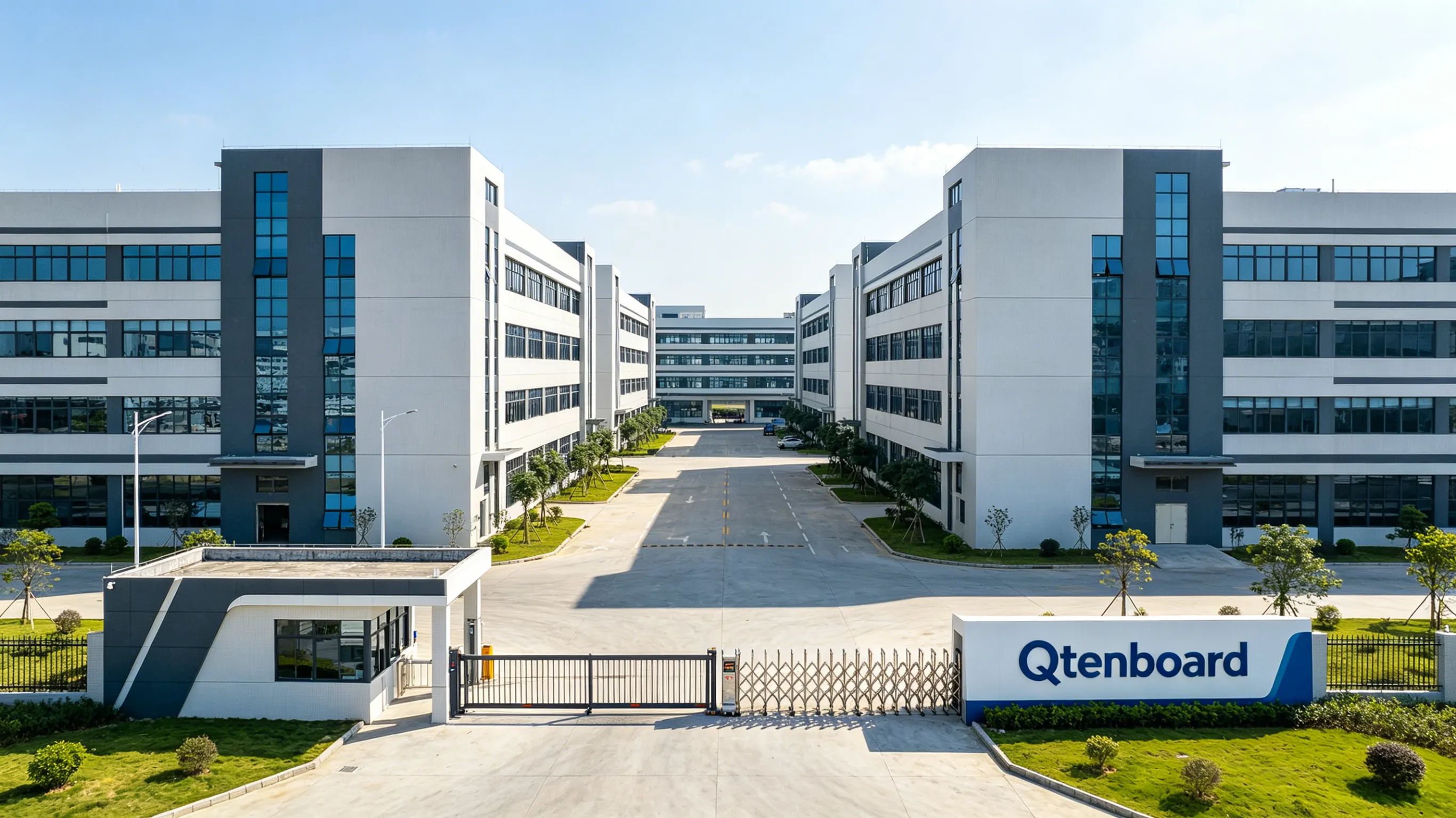
Aerial view of the Qtenboard factory campus.
When other factories were closing in 2008, Qtenboard opened a new base in Guangzhou. Not because it was comfortable to do so — but because Queenie had learned that the right time to build is precisely when everyone else has stopped.
On Qtenboard's counter-cyclical growth strategyChapter Four
Following Every Wave:
From CRT to AI
The display industry has been through more fundamental technology changes in the past 25 years than almost any other sector of consumer or commercial electronics. Each transition — from CRT to flat panel LCD, from CCFL backlighting to LED, from standard definition to 4K, from passive display to touch interactivity, from static signage to AI-powered engagement — has created winners and casualties. Companies that moved too slowly became obsolete. Companies that moved without the manufacturing foundation to support new technology produced poor products and lost clients. The companies that survived and thrived were those that could change their product portfolio without losing their quality baseline.
Qtenboard has been through every one of these transitions. The company entered the market at the inflection point between CRT dominance and LCD adoption — a moment when the entire industry's assumptions about what a screen was were being rewritten. It has tracked every major technology shift since, not as a follower, but as a manufacturer that anticipated transitions and prepared for them before the market demanded it.
Today, Qtenboard's product line reflects 21 years of accumulated technology judgment. Its interactive whiteboards incorporate AI-level processing for real-time voice transcription, intelligent Q&A responses, automated meeting minute generation, and adaptive teaching support. Its outdoor digital signage achieves brightness levels that remain fully visible in direct sunlight. Its LCD video walls deploy with ultra-narrow bezels and color calibration systems that maintain visual consistency across dozens of tiled panels. Its industrial displays are engineered to run continuously, in extreme temperatures, in environments where a screen failure is not an inconvenience but an operational crisis.
The 2025 launch of Qtenboard's AI product line represents the company's most significant technology step to date. For years, AI capabilities in commercial displays have been limited to software layers — apps installed on generic hardware, delivering generic results. Qtenboard's approach is different: AI is integrated at the system level, built into the hardware architecture rather than bolted on. The result is a class of interactive displays that think, respond, and adapt in ways that previous generations of screens could not.
Chapter Five
Why We're Still Here:
The Survivors' Account
The commercial display industry in China has been through multiple brutal market corrections. Each one eliminated manufacturers that had built on weak foundations — too much outsourcing, too little quality control, too much dependence on a single product category or a single large client. Qtenboard has been through all of them. Here is what actually happened, and why the company emerged from each episode stronger than before.
2008 — Global Financial Crisis
The Contraction That Became an Opportunity
When the 2008 financial crisis hit, export orders across China's manufacturing sector collapsed almost overnight. Dozens of display factories in Shenzhen and Guangdong closed permanently that year. Qtenboard responded by opening its Guangzhou Huadu manufacturing base. It was a decision that looked reckless at the time and looked visionary in retrospect. By the time the market recovered, Qtenboard had significantly more production capacity than its remaining competitors — and could take on contracts that none of them were equipped to handle.
2015–2018 — The Price War Years
Quality as the Only Defensible Position
The mid-2010s brought an extraordinary proliferation of low-cost, low-quality display products to the Chinese and global markets. Factories that had never invested in proper quality systems were producing screens that undercut established manufacturers on price by 30 to 40 percent. Buyers who prioritized initial cost over total cost of ownership bought in. Most regretted it. Qtenboard held its quality standards, accepted the margin pressure that came with that decision, and retained the buyers who understood what they were actually purchasing. Those relationships are still active today.
2020 — Global Pandemic
Self-Owned Manufacturing as a Survival Mechanism
COVID-19 exposed the fragility of supply chains built on distributed, multi-vendor manufacturing. Companies that had outsourced their production found themselves unable to deliver. Qtenboard's self-owned factories — already operational across three sites — continued to run. The company's own mold production, its own component manufacturing for critical parts, and its own SMT and assembly lines meant that when external supply chains stalled, Qtenboard could continue to ship. For many clients, Qtenboard became a critical supplier during 2020 precisely because it was one of the few that could still deliver.
2025 — The AI Reordering
Technology as the New Moat
The emergence of practical artificial intelligence as a product feature is reshaping the commercial display market in real time. For manufacturers that have no software capability, no R&D investment, and no history of integrating complex electronics beyond the screen itself, this is an existential threat. For Qtenboard, which has spent years building a dedicated R&D department and developing proprietary software that runs on its hardware, it is a structural advantage. The AI product line launched in 2025 did not require Qtenboard to reinvent itself — it required the company to take the next logical step in a direction it had already been moving for years.
Many brands passed through this industry and left. Qtenboard is still here — not because the market was easy, but because it never once mistook the absence of a crisis for the presence of security.
On Qtenboard's 21-year operating historyChapter Six
The Brands That Chose Us:
OEM Trust at Scale
The most rigorous quality assessment that any manufacturer can receive is not a certification audit. It is the decision by a major brand to trust you with their product. When a company like TCL, Adidas, Chanel, or DJI chooses an OEM partner, they are not making that choice based on a brochure. They are sending engineers to audit production lines. They are testing sample units against exacting specifications. They are evaluating whether the factory's processes, people, and management are capable of sustaining quality over thousands of units and multiple years.
Qtenboard's OEM relationships began with TCL in China's domestic market — a demanding starting point that required the company to meet one of the country's most rigorous consumer electronics quality standards from its earliest years. Those early relationships established manufacturing disciplines that would prove transferable to every subsequent client, regardless of category.
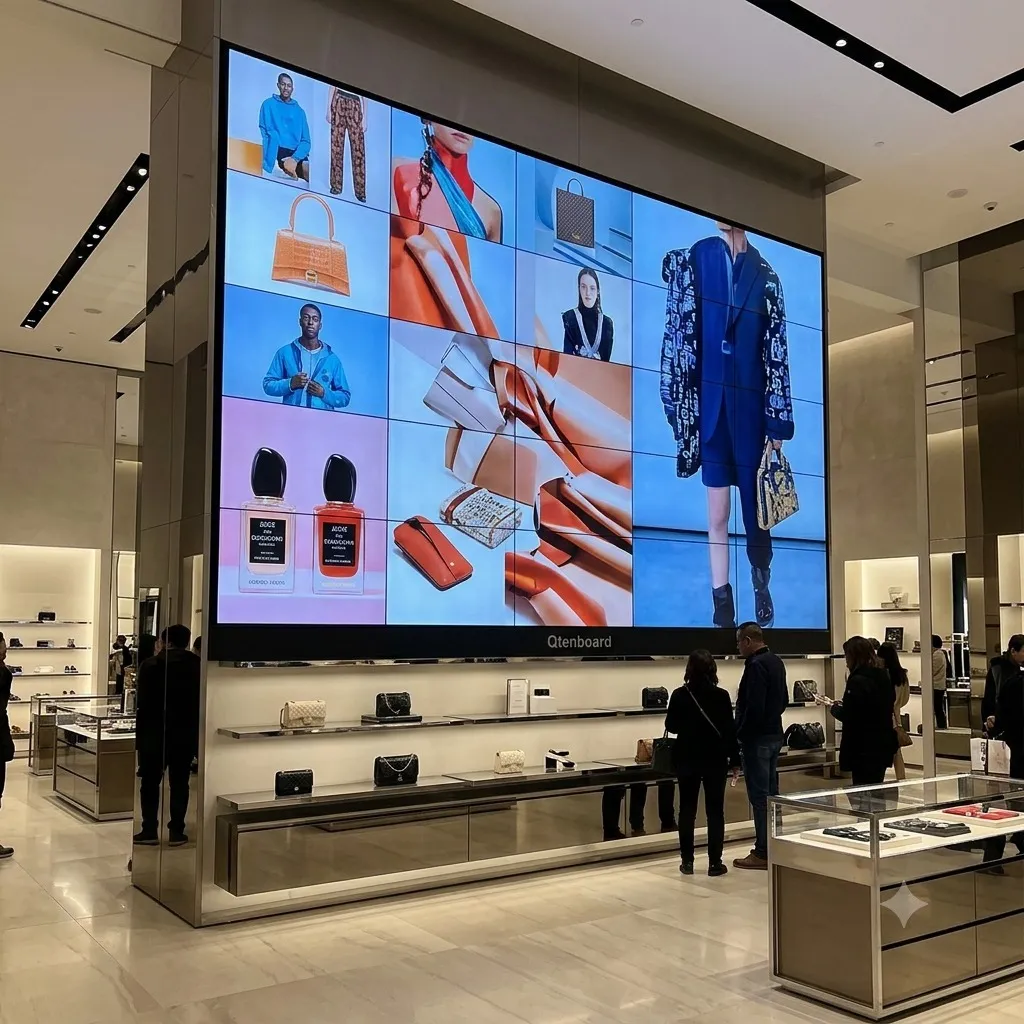
Qtenboard LCD video wall installed in a major retail environment.
The list of brands that have relied on Qtenboard's manufacturing — Adidas, Anta, Chanel, DJI, and others — crosses categories in ways that reflect the genuine breadth of the company's display capabilities. A luxury brand like Chanel and a performance sports brand like Adidas have radically different aesthetic requirements for their retail displays. A technology company like DJI has radically different technical requirements for its product demo environments. Serving all of them to their own standards is evidence of a manufacturing capability that is not narrowly specialized, but genuinely versatile.
For Qtenboard, the transition from pure OEM partner to independent brand has not meant abandoning these relationships — it has meant using the credibility they provide as a foundation for building direct client relationships in markets that do not know the backstory. When Qtenboard tells a new buyer in Europe or the Middle East that it has manufactured for internationally recognized brands, it is not a marketing claim. It is a reference that can be verified. And in a market where the space between a genuine manufacturer and a reshipping trader can be impossible to see from the outside, that verifiability matters enormously.
21
Years of continuous operation since founding in Shenzhen, 2005
3
Self-owned manufacturing bases across China
840K
Square meters of combined factory floor space across all three sites
1,000
Skilled production workers employed across Qtenboard's facilities
100+
Countries where Qtenboard products have been deployed
B
Series B funding completed in 2025, following Series A in 2023
Conclusion
What 21 Years
Actually Means
There is a question that every manufacturer eventually has to answer: what are you actually selling? For some companies, the answer is price — a product that costs less than the alternative. For others, it is novelty — a feature the market hasn't seen before. For a small number of companies, the answer is time — the accumulated credibility of having delivered consistently, through difficulties and disruptions, for long enough that the track record itself becomes the product.
Qtenboard is in the third category. The company's 21 years of continuous operation are not simply a marketing statistic. They represent a body of institutional knowledge — about display technology, about manufacturing processes, about quality management, about international logistics, about what buyers in different markets actually need versus what they say they need — that cannot be replicated by a company that started two years ago or even five years ago. Queenie's own knowledge, which predates the company by several years, runs even deeper.
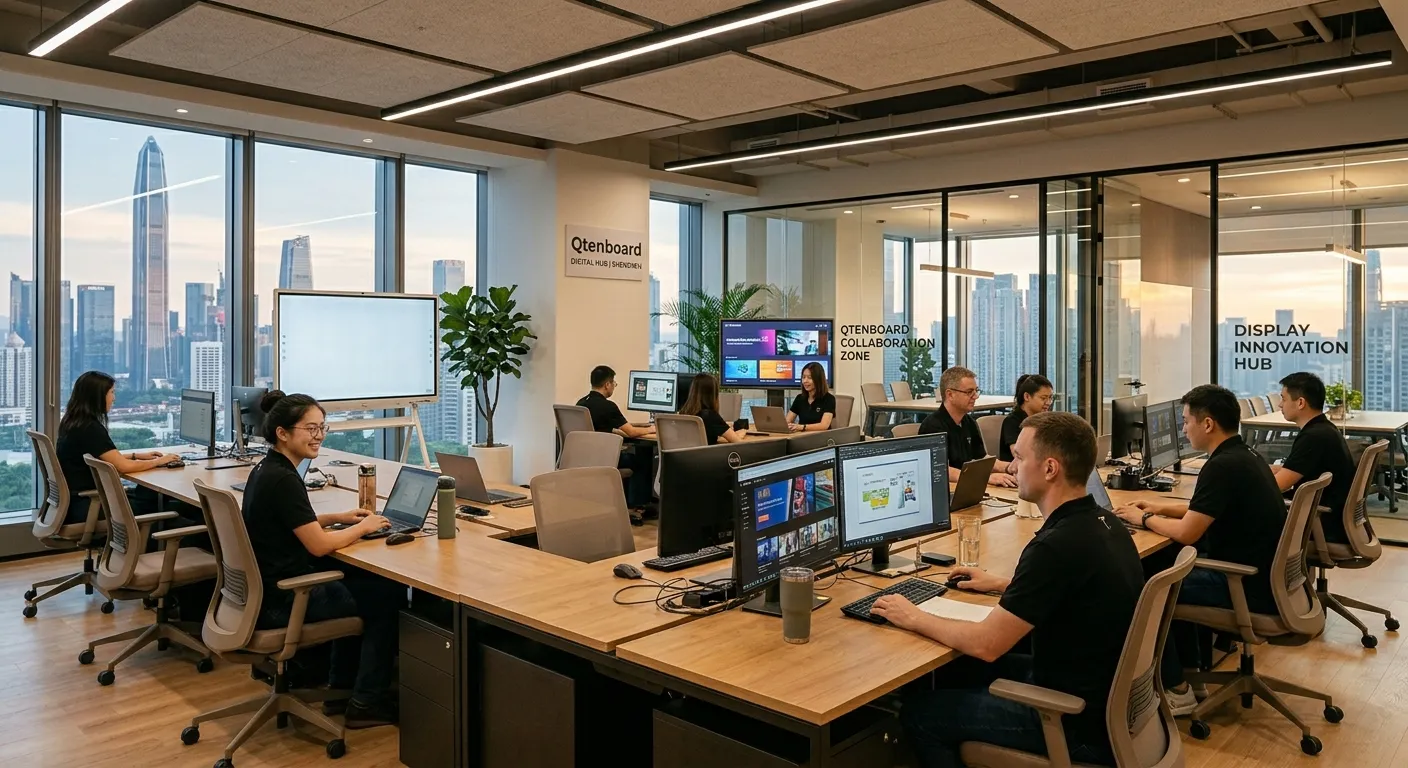
Interior of the Qtenboard Shenzhen Longgang Sales Center, opened 2025.
The company is now, in some ways, at its most interesting moment. The core manufacturing capability is mature. The brand identity is established. The OEM relationships are in place. The funding is secured. And the AI product line — launched in 2025 with genuine system-level integration rather than surface-level software features — positions Qtenboard at the beginning of what may be the most significant technology shift the commercial display industry has seen since the transition from CRT to flat panel.
Queenie started with a stall in Huaqiangbei, selling components to buyers who didn't know her name. She learned everything she could about those components, about the buyers, and about the industry before she built anything. Twenty-one years later, that discipline of knowing your subject completely before acting on it is still visible in everything Qtenboard makes.
The screens are different. The scale is different. The ambition is different. The discipline is the same.
Many brands have come through this industry and moved on. Qtenboard is still here — and still building.
Qtenboard · Est. 2005 · Shenzhen, China