Managing dozens of clinical branches means managing dozens of display mismatches. This article documents how multi-site hospital networks across Southeast Asia moved from fragmented, manually managed screens to a centrally governed, brand-consistent OEM platform — and what the measurable difference looked like in operations, clinical workflow, and patient experience.
For most hospital procurement teams, display hardware is a reactive purchase: a screen breaks, a ward opens, or a budget cycle arrives — and units get ordered from whichever supplier quotes fastest. The result, compounded across years and branches, is an estate of mismatched specifications, inconsistent patient-facing interfaces, and IT staff spending hours each week on manual content updates that could be automated in minutes. Three hospital groups across Southeast Asia decided to change that. What they implemented — and what they measured afterward — is documented below.
A Vietnam-based private hospital group operates over 40 clinical branches across Ho Chi Minh City, Hanoi, Da Nang, and provincial cities. Central administration is responsible for enforcing a unified patient communication standard: updated clinical guidelines, seasonal health campaigns, and regulatory health notices must reach every patient-facing screen — waiting areas, registration lobbies, consultation corridors — simultaneously and accurately.
Before the upgrade, the group's IT coordinator described the process simply: "We were driving to branches with USB drives." When the Ministry of Health issued a revised infectious disease protocol, the team needed four working days to visit and manually update all affected digital signage screens across the network. Version drift — outdated materials still displaying at remote sites — was a recurring compliance concern.
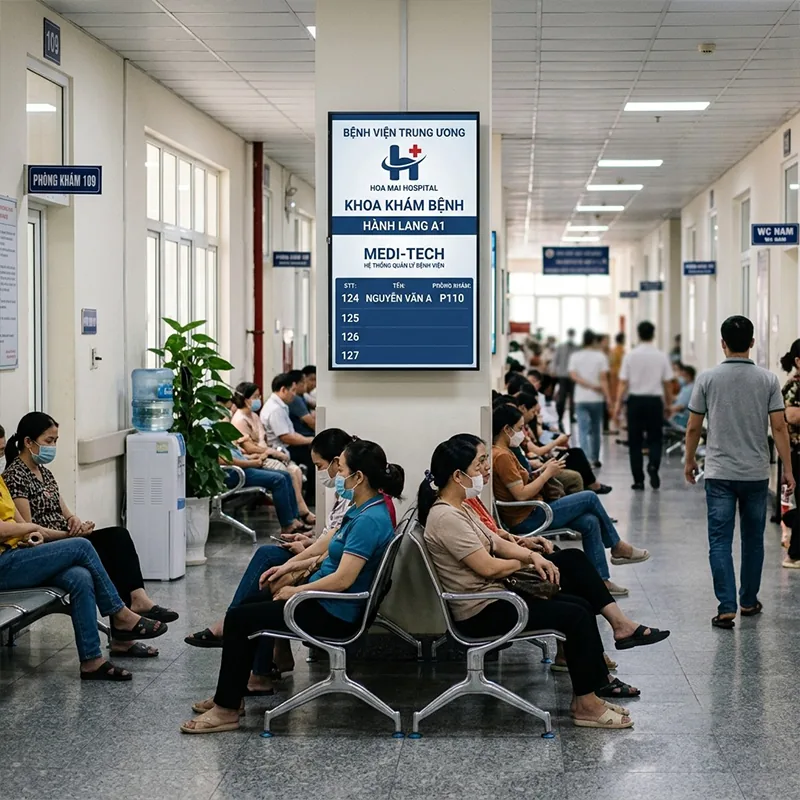
Clinical content updates required manual USB delivery to each device. A 40-branch update cycle cost approximately 12 staff-hours over 3–4 working days. Version drift was a documented compliance risk.
Qtenboard CMS Global Device Management deployed across all enrolled digital signage screens. Headquarters pushes content packages by branch group, screen type, or individual device — no site visits required.
Update cycle compressed from 4 days to under 20 minutes. IT coordinator headcount for content operations reduced from 3 rotating staff to 1 remote administrator. Zero version-drift incidents in post-deployment monitoring window.
Each branch had procured screens independently. Boot logos, menu interfaces, and admin consoles varied by manufacturer and model. Patients in different branches experienced an inconsistent brand identity — undermining the group's premium clinical positioning.
Full Qtenboard OEM customization applied across the estate: chassis color, boot logo, system UI skin, and backend dashboard replaced with the hospital group's brand assets. Every smart interactive screen and lobby panel presents an identical visual identity regardless of branch or room type.
Uniform brand experience across all 40+ locations. OEM depth extended to packaging: unboxed devices arrive at new branches already identity-configured, with zero on-site setup required for brand elements.
Outpatient queue terminals and physician-room panels operated as disconnected systems. Patients in corridor waiting areas had no real-time queue visibility. Nurses manually relayed call notifications between zones — significant overhead during high-volume morning sessions.
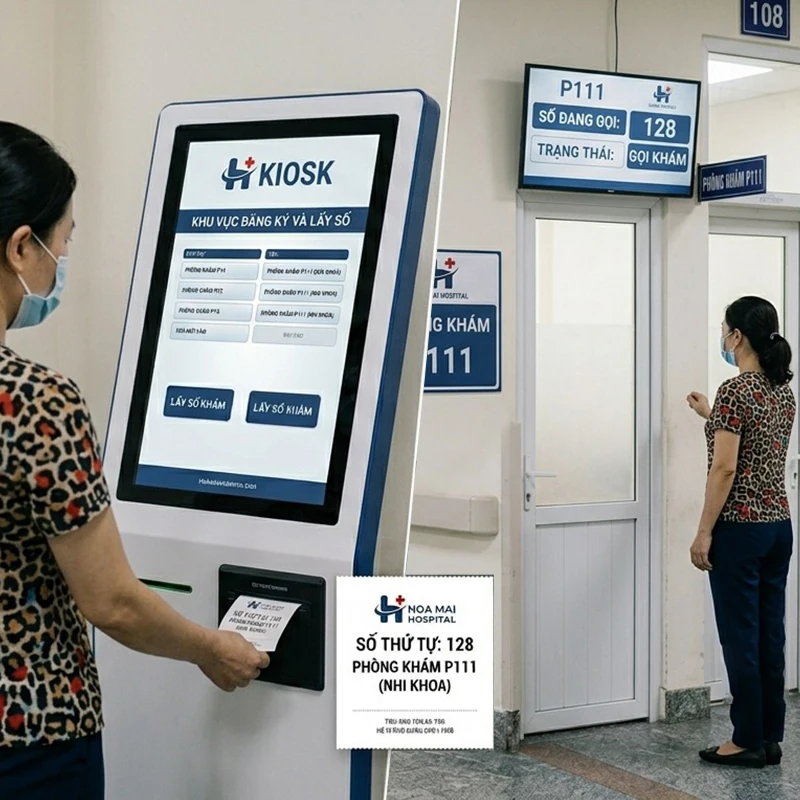
Qtenboard's display platform integrated with the group's queue management infrastructure. Self service kiosk units at registration generate queue tokens that synchronize in real time with physician-room panels and corridor displays — all within the same device management layer as content delivery.
In comparable deployments, queue-related patient inquiries at nursing stations dropped by approximately 40% following real-time panel synchronization. Patient satisfaction scores on "waiting experience" showed measurable improvement in post-deployment surveys.
A Kuala Lumpur-based private hospital group operating 12 branches faced escalating clinical complaints from radiologists: general-purpose commercial displays in imaging departments could not render CT slices, MRI scans, and histopathology slides with sufficient resolution for confident diagnostic review. The procurement team's first response was to quote a complete estate refresh — until they discovered that approximately 70% of non-imaging screens remained technically serviceable and within expected useful life.
A tiered OEM deployment: 4K Qtenboard medical-grade panels for imaging suites and pathology reading stations; 2K digital signage screens and smart interactive screens for outpatient and general clinical areas. All units deployed under the hospital group's brand identity via full OEM customization — chassis, UI, and CMS backend. The pre-deployment zone assessment, conducted before any procurement commitment, identified exactly which rooms required which specification — preventing over-investment in low-demand spaces.
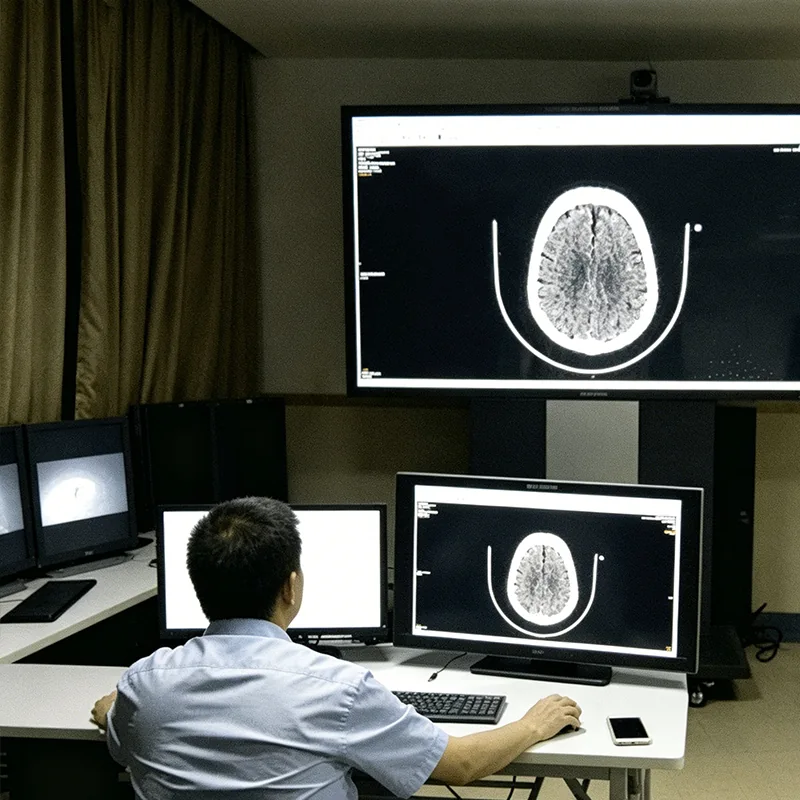
For procurement teams, the Malaysia case illustrates a principle applicable to most multi-branch hospital estates: matching display specification to clinical function — rather than applying a single standard across all rooms — is where procurement becomes infrastructure strategy. A single OEM partner who conducts the zone assessment and supplies the full product range removes the coordination burden from internal teams.
Peak morning registration hours (7:30–10:00 AM) created consistent bottlenecks across this group's outpatient departments. Manual check-in, appointment verification, and insurance pre-authorization were handled entirely by front-desk staff — with 6–8 patients queuing per counter at peak load. Patient satisfaction scores for "wait time at registration" were the group's consistently lowest-rated metric in annual surveys.
OEM-customized self service kiosk units — branded entirely to the hospital group's visual identity — were deployed at each outpatient entrance, integrated with the group's HIS for real-time appointment lookup and insurance verification. The kiosks connect to the same queue management layer as the corridor digital signage screens and physician-room panels, completing the outpatient data chain from patient arrival to consultation call.
Patient adoption of kiosk systems is directly influenced by how institutional and trustworthy the interface appears. A generic white-label kiosk running a third-party UI creates hesitation and increases staff intervention requests. The Qtenboard units arrived with the hospital's own logo, color palette, and language-adapted interface applied at the factory before shipping — zero on-site configuration required. This approach achieved adoption rates above 70% within the first two weeks without dedicated staff coaching.
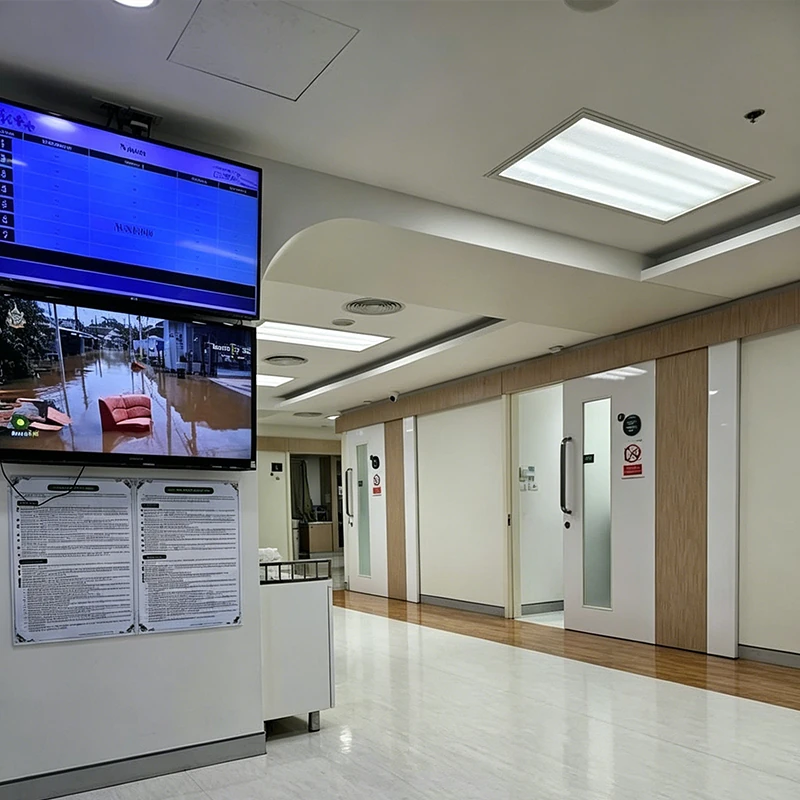
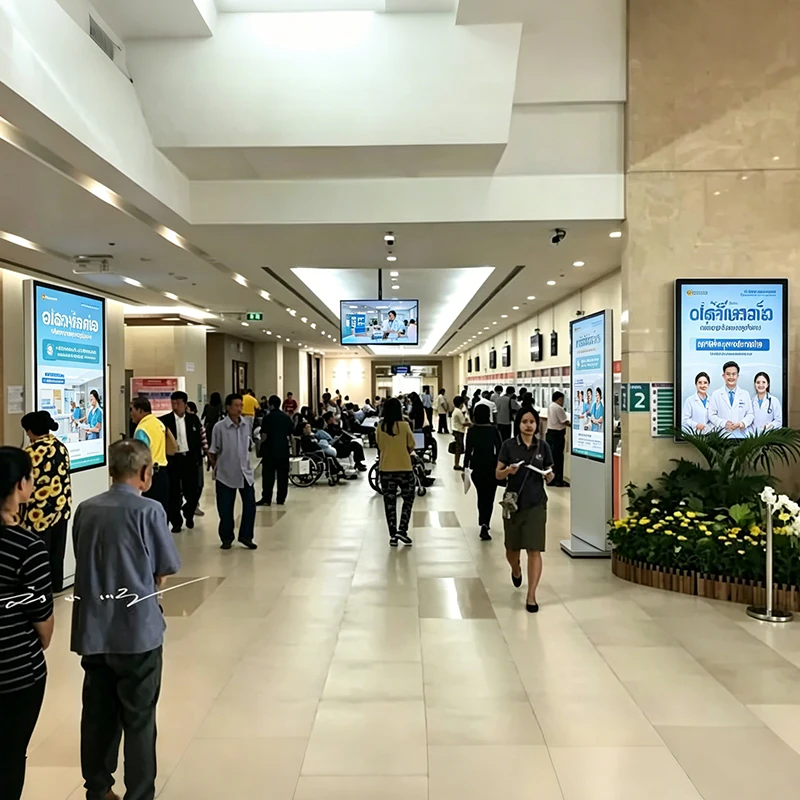
The three cases above share one structural characteristic: in each deployment, the hospital group did not simply purchase hardware. They commissioned a configured platform — with brand identity, clinical specification, and management infrastructure delivered as an integrated system. That is what distinguishes genuine OEM depth from standard resale, and it is the capability set procurement teams should evaluate when assessing Qtenboard as a long-term infrastructure partner.
Centralized cloud console for all enrolled devices across all branches. Capabilities include batch content push, remote fault diagnostics, tiered access permissions (branch / regional / HQ levels), firmware rollout scheduling, and device uptime reporting. For groups managing 20+ branches, this eliminates on-site IT visits for all routine display operations.
Every hardware element a patient encounters — chassis, boot logo, system UI, and admin console — is replaced with the client's own brand assets at the factory, before shipping. New branch deployments unbox fully configured devices. No on-site configuration required. This applies uniformly across all product categories: digital signage screens, self service kiosk units, smart interactive screens, and imaging monitors.
A pre-deployment zone assessment maps each clinical space to its functional display requirement: 4K for imaging and pathology reading, 2K for consultation and outpatient, standard resolution for lobby and corridor signage. This prevents over-investment in low-demand zones and under-investment in high-stakes diagnostic spaces. The assessment is part of the engagement model — not a billable add-on.
Display units connect to existing queue management systems and hospital information systems via standard integration layers. Registration data flows from self service kiosk units to corridor panels and physician-room displays in real time — closing the outpatient flow data chain without requiring a separate software platform or additional infrastructure investment.
Hospital procurement teams and distributors do not need to determine, in advance, which screen type belongs in which clinical space. Qtenboard provides a structured assessment and translates it into a complete bill of materials covering all required product categories — with OEM configuration specified across each. This single-partner model removes the coordination burden that arises when multiple vendors are managing different display categories across the same estate.
The processing foundation for this platform is the MediaTek Genio 520 (MTK 520) — built on TSMC's 6nm process with 10 TOPS edge AI capability. MediaTek has formally committed to a 10-year commercial lifecycle for this chip (released Q2 2025, EOL 2035). For hospital IT departments managing 5–8 year asset replacement cycles, chip longevity determines whether firmware security patches and OS updates remain available throughout the hardware's operational life — a procurement criterion that consumer-grade SoCs structurally cannot satisfy. Read Qtenboard's full technical breakdown of the MTK 520 platform →
Multi-branch hospital procurement is increasingly evaluated on platform capability, not unit price. A tender that presents a unified OEM display platform — with brand customization, centralized management, clinical specification planning, and integration credentials — competes in a fundamentally different bracket than a commodity hardware quotation. The regional cases above provide the reference data to support that positioning.
For distributors structuring a hospital group tender, Qtenboard's manufacturing and customization depth supports a proposal that leads with platform value rather than hardware specifications — and backs that value with documented outcomes from comparable deployments across the region.
Whether you are specifying a new branch rollout or re-tendering an existing estate, Qtenboard's OEM team provides a structured zone assessment, specification plan, and brand customization proposal — before any hardware commitment.
CEO | Interactive Display & Collaboration Solution Expert
I am the founder of Qtenboard, bringing over 17 years of hands-on expertise to the touch display industry. Drawing on the global management perspective gained through my EMBA studies at ShenZhen University, I lead my team in optimizing every stage of our operations—from product definition to high-efficiency supply chain management—ensuring our manufacturing capabilities remain at the forefront of the industry.
As the leader of Qtenboard, I specialize in providing tailored OEM/ODM solutions for interactive whiteboards, LCD video walls, digital signage, and industrial-grade touch terminals. Backed by our 330,000 m² modern industrial park in Shenzhen, we maintain full-lifecycle control over industrial design, precision manufacturing, and rigorous performance testing.
With nearly two decades of project experience, Qtenboard’s display solutions are now deployed in over 120 countries and regions, earned the trust of more than 15,000 enterprise customers worldwide. If you are seeking a responsive partner with a deep manufacturing foundation for your customized touch display projects, my team and I are ready to support your vision with professional excellence.

 ukr
ukr
 EN
EN  pt
pt  spa
spa  th
th  vie
vie  aze
aze  bel
bel  est
est  lav
lav  ru
ru