Wheeled, battery-powered, and rotatable through 180 degrees — so a 2:3 wedding photograph fills the frame instead of sitting pillarboxed on a landscape TV. One unit covers the welcome table, the aisle and the banquet hall, then goes back in the van.
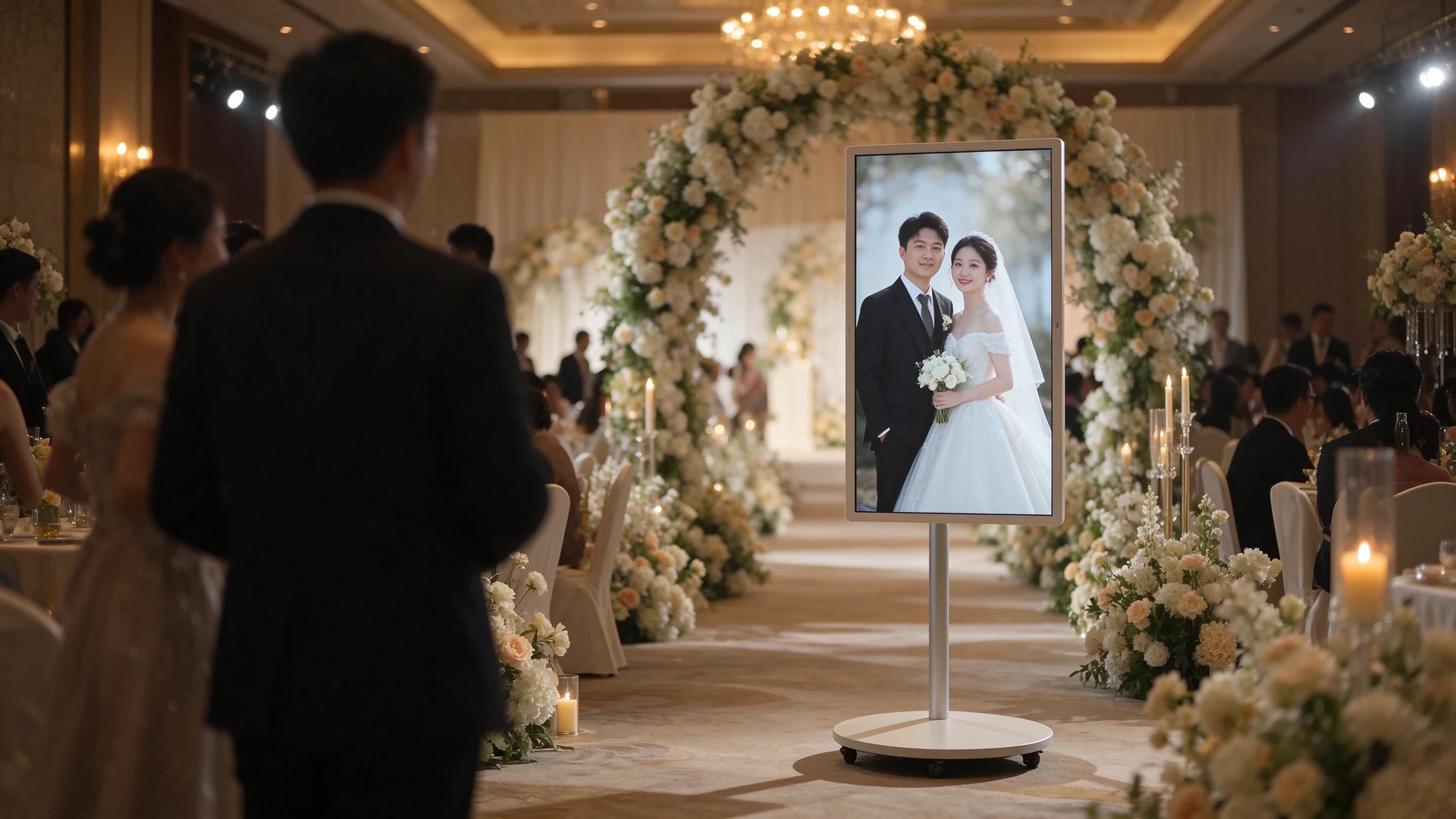
Wedding buyers do not fail on specifications. They fail on six practical details that only show up on the day — and every one of them can be settled before you sign. This page is written as a purchasing framework, not a catalogue entry. For the retail version of the same hardware, see our pharmacy mobile smart screen solution.
01Every photograph is vertical
A wedding portrait is shot 2:3. On a landscape TV or a fixed LED wall it either sits in two black bars or gets cropped through the couple's heads — the one thing nobody will forgive.
Answer: 180° rotation with a gravity sensor, plus portrait templates sized to the screen.
02The venue cannot be drilled
A hotel ballroom is rented for four hours. No wall mount, no floor plate, no cable run under the carpet — and the next event uses a different layout anyway.
Answer: battery-in-base, no mains lead on the floor, one person wheels it into position.
03The ceremony has to stay silent
Between the welcome and the banquet the screen gets moved across a polished stone floor, sometimes during a quiet moment. A castor that squeals is remembered longer than the picture quality.
Answer: a silent castor option, and an honest instruction: test it on the venue's own floor before the day.
04Ballrooms are dark, halls are bright
A screen tuned for a shop window glares in a dim, candlelit room. A screen tuned for a dim room disappears in a daylight marquee. Same device, two opposite environments.
Answer: adaptive brightness as standard; a high-brightness panel for outdoor and daytime settings.
05There is no socket where you need it
The welcome table, the aisle edge and the banquet entrance are chosen for composition and traffic flow, not for proximity to a power outlet or a socket the venue will let you use.
Answer: the unit runs on its own battery; charge it the day before, not on site.
06Every event moves it again
A planner does not install once. The unit goes into a van, comes out at a venue, goes back the same night. Transport protection decides how long the fleet survives its first season.
Answer: a transit case option, plus a base and pole designed to be lifted by one person.
Most buyers assume one screen, one position. In practice the same unit is re-used four times across a single day: welcome, aisle, banquet entrance, and the studio showroom when there is no wedding at all.
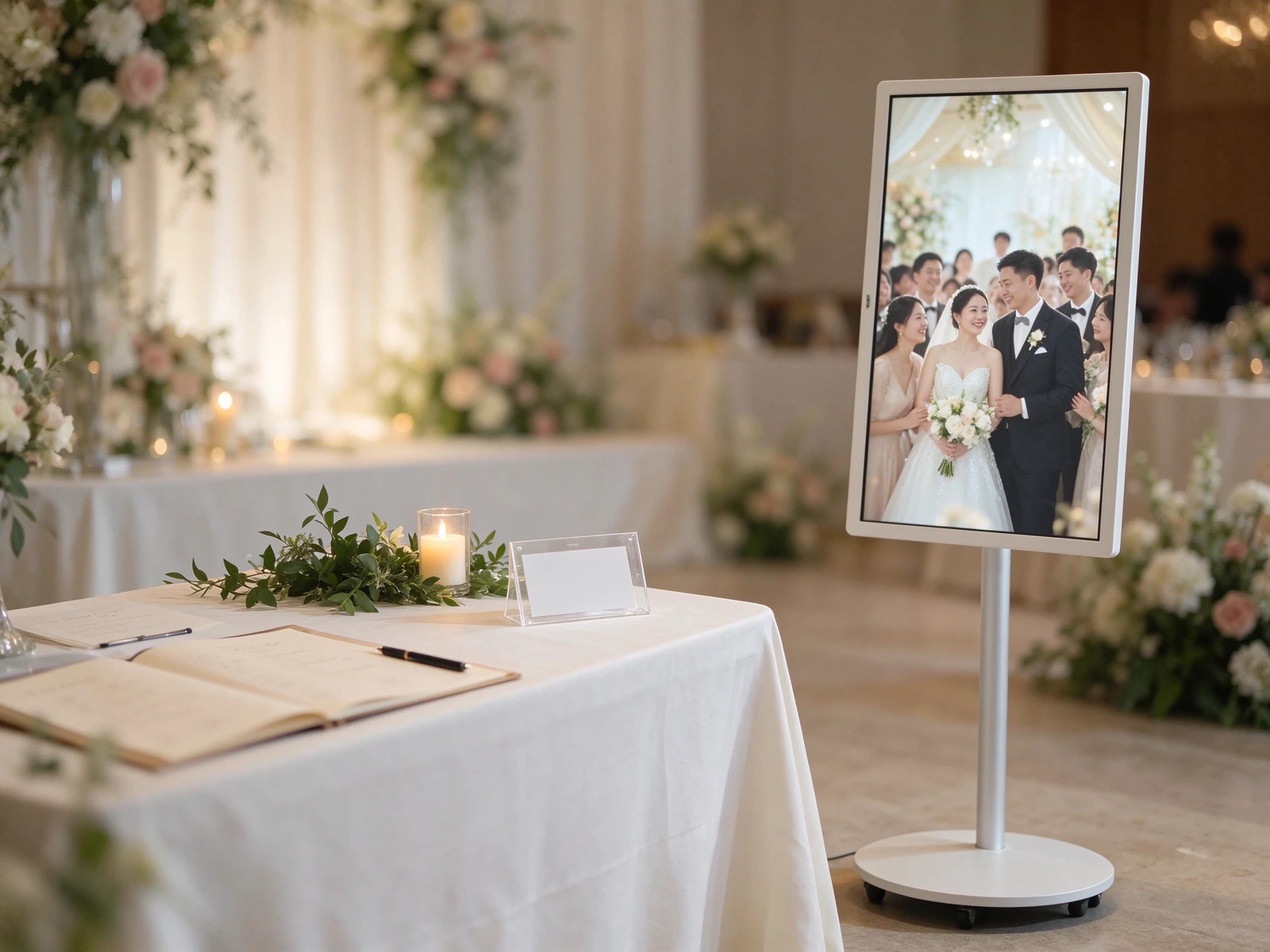
Standing in portrait beside the guest book, showing the couple's story, the engagement shoot or a loop of family photographs. It replaces a printed backdrop board that is used once and thrown away.
This is the position where portrait orientation matters most: the frame is vertical, the photographs are vertical, and there is no letterbox bar to explain to the couple's parents.
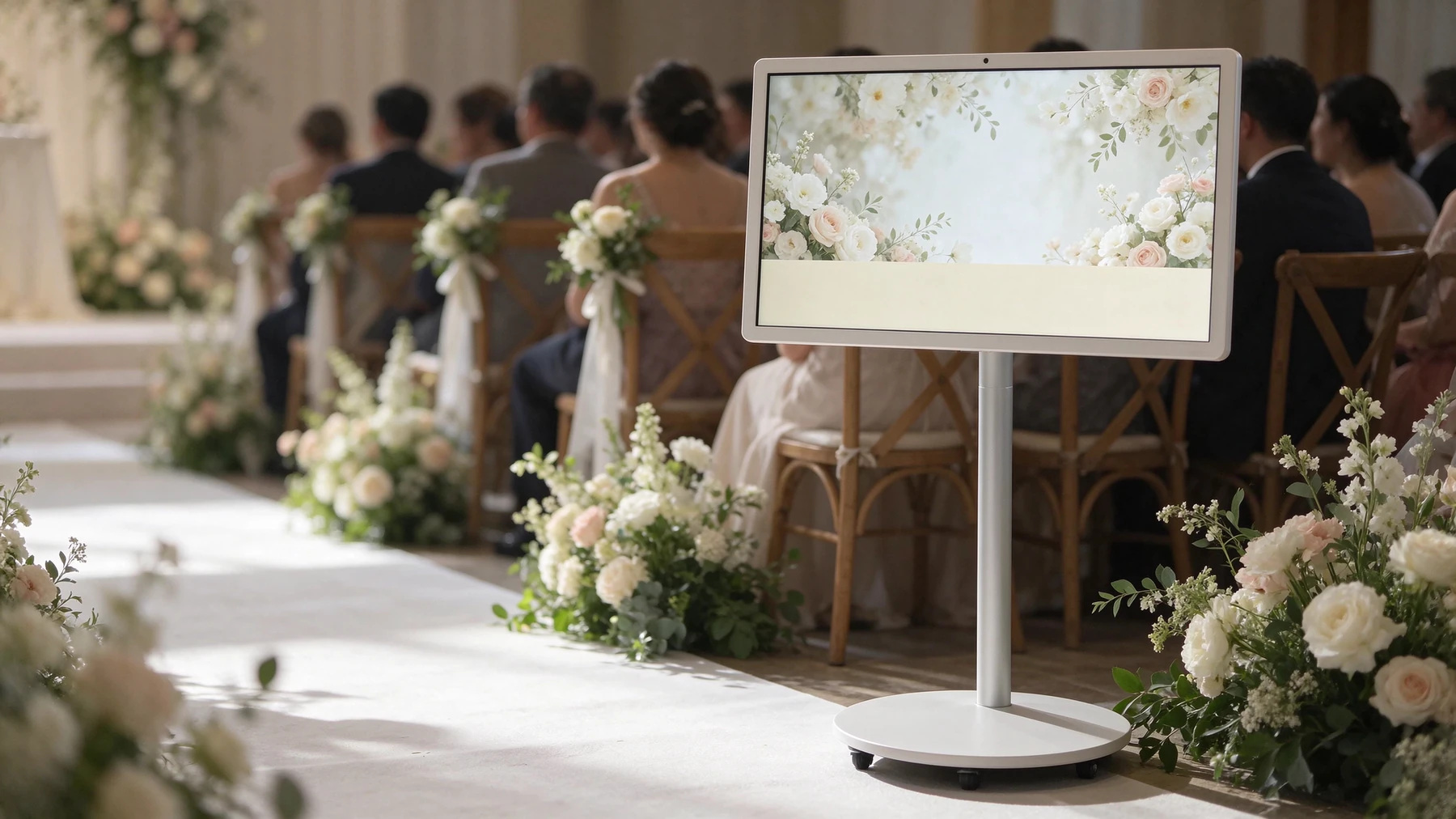
Placed just off the aisle, landscape, showing a subtitle band for guests at the back, a translation for a bilingual family, or the feed from a second camera for anyone standing behind a column.
Here the requirement is not brightness but restraint: a soft, low-glare image that does not compete with the couple during the vows — and the discipline to leave it still until the ceremony ends.
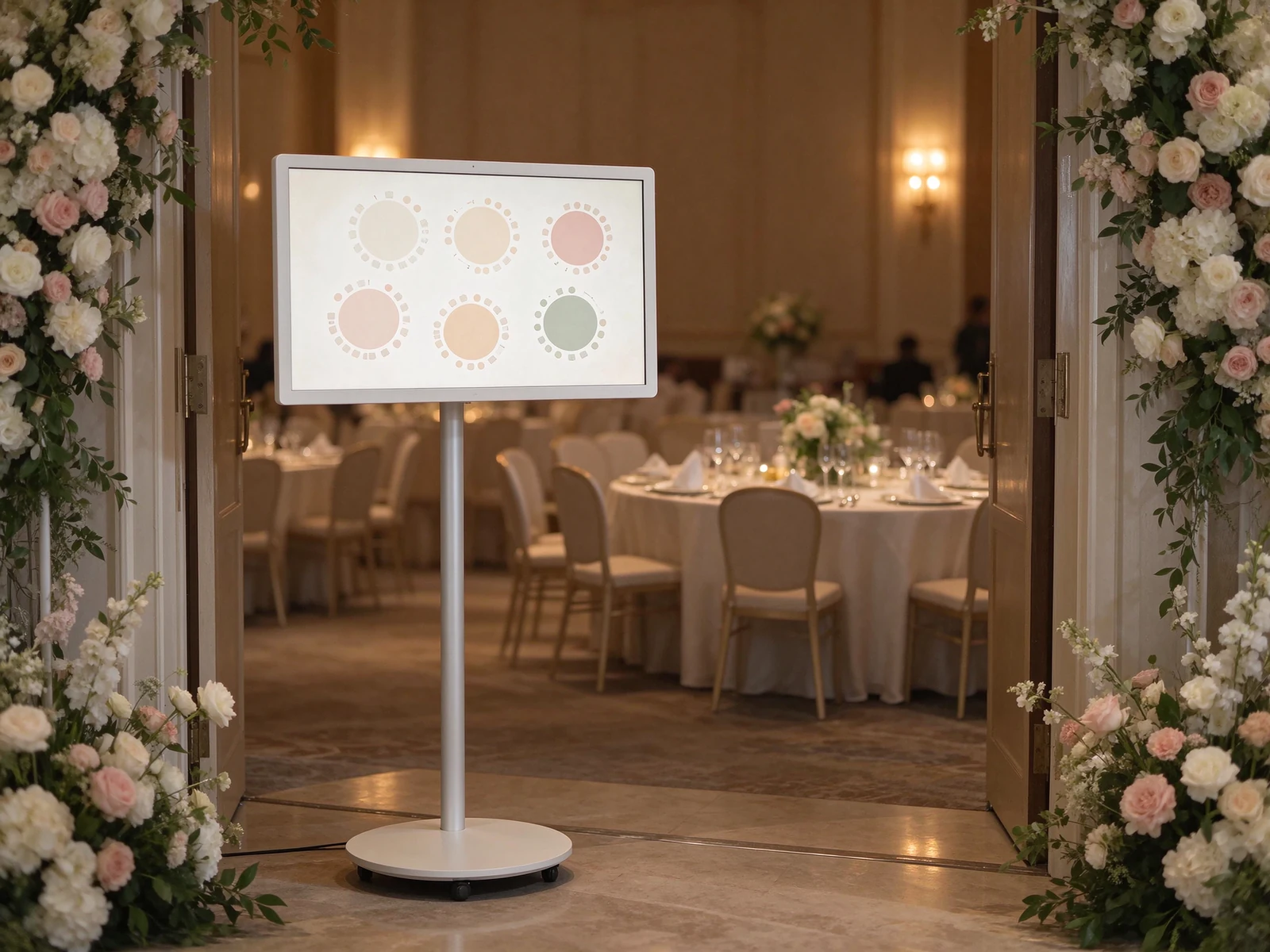
Wheeled from the welcome area to the banquet doors while the couple is being photographed. It shows the seating plan, the order of speeches, and where the evening's later moments happen.
The seating plan changes until the last week, and the venue changes the room layout between events. A screen that can be re-positioned and re-loaded in minutes removes an entire category of last-minute stress.
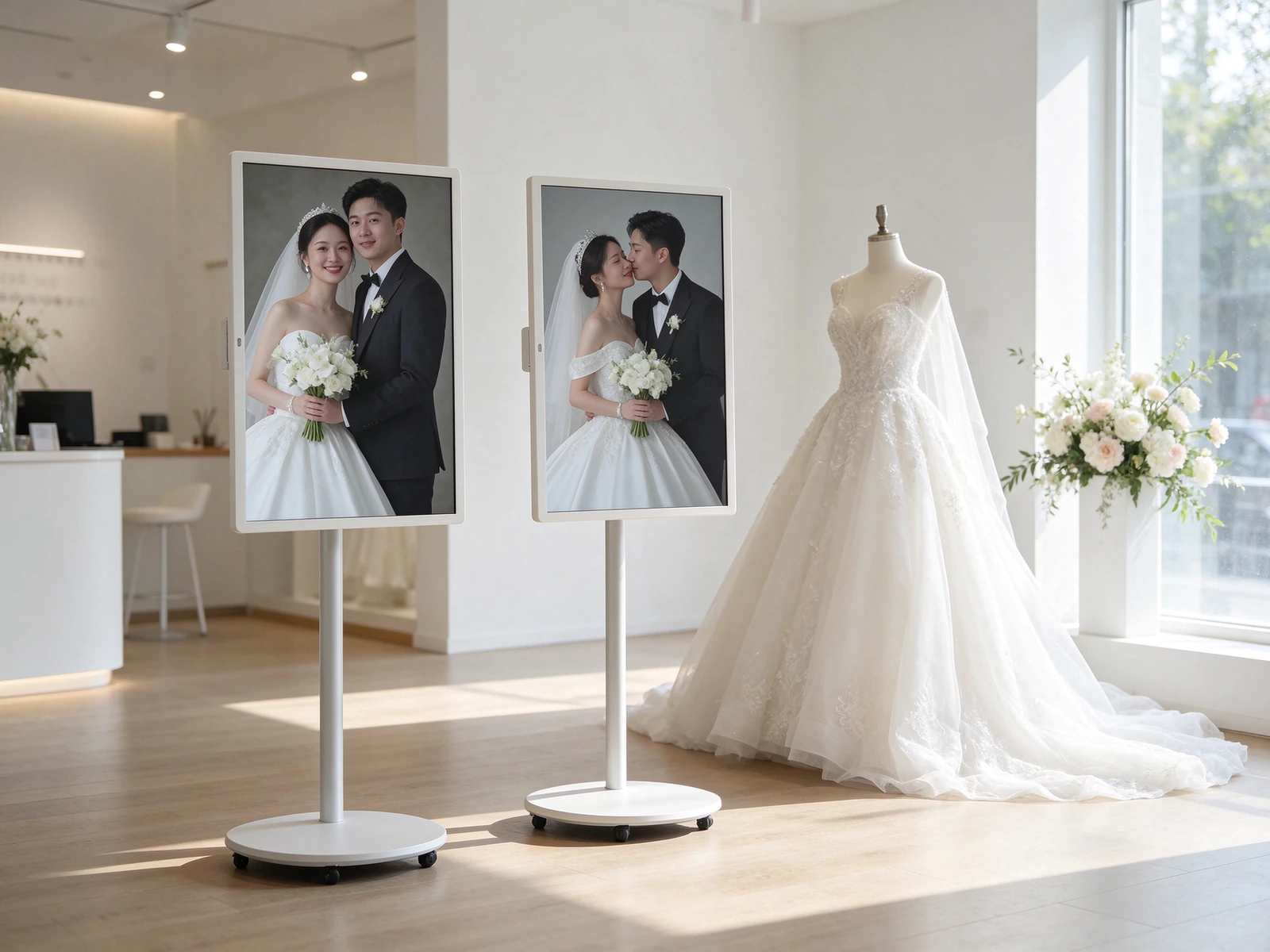
A wedding is a weekend business. The same unit, standing in a bridal studio or a planner's showroom in portrait, replaces a printed sample wall and can be updated the day a new shoot is edited.
This is the argument that changes the purchasing decision: the unit is not idle from Monday to Friday, it is selling sample albums and packages to walk-in customers.
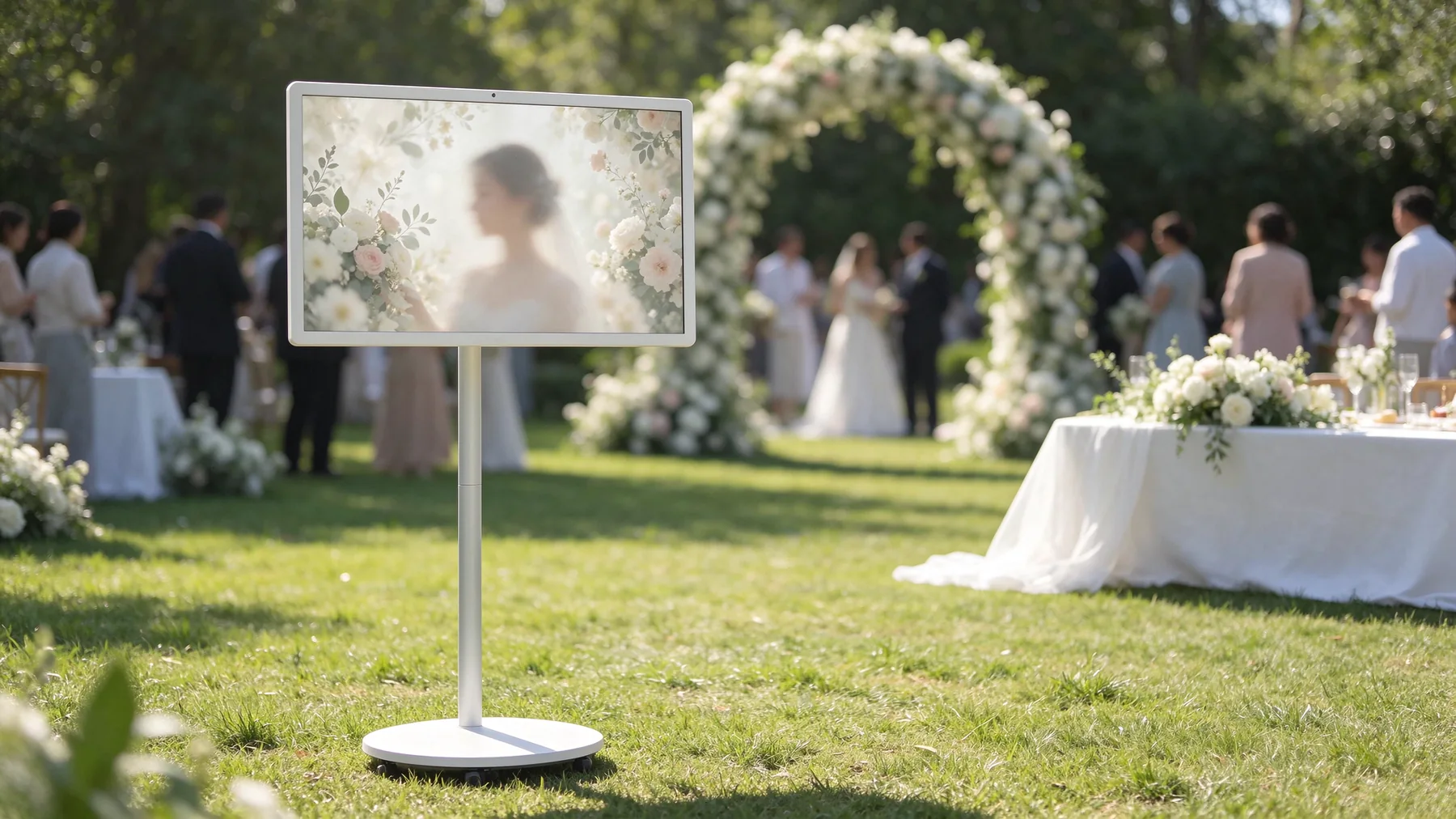
A lawn, a terrace, a courtyard, a beach pavilion. Outdoor ceremonies are the fastest-growing segment of the wedding market and the one where cheap screens visibly fail — a 400–500 nit panel is unreadable at noon, no matter how good the photograph looks.
This is the specification that separates a wedding unit from a shop unit. The panel turns through 180 degrees on the pole, and a gravity sensor flips the image so the content is upright the moment the screen is turned — no menu, no settings screen, no staff member hunting for a hidden button five minutes before the entrance music.
Colour is a purchasing constraint, not a preference. White and black are standard mould colours and ship without tooling. Champagne, gold or a custom finish means a volume commitment — settle the quantity before the design is signed off, because a colour chosen after the purchase order is a new project, not an option.
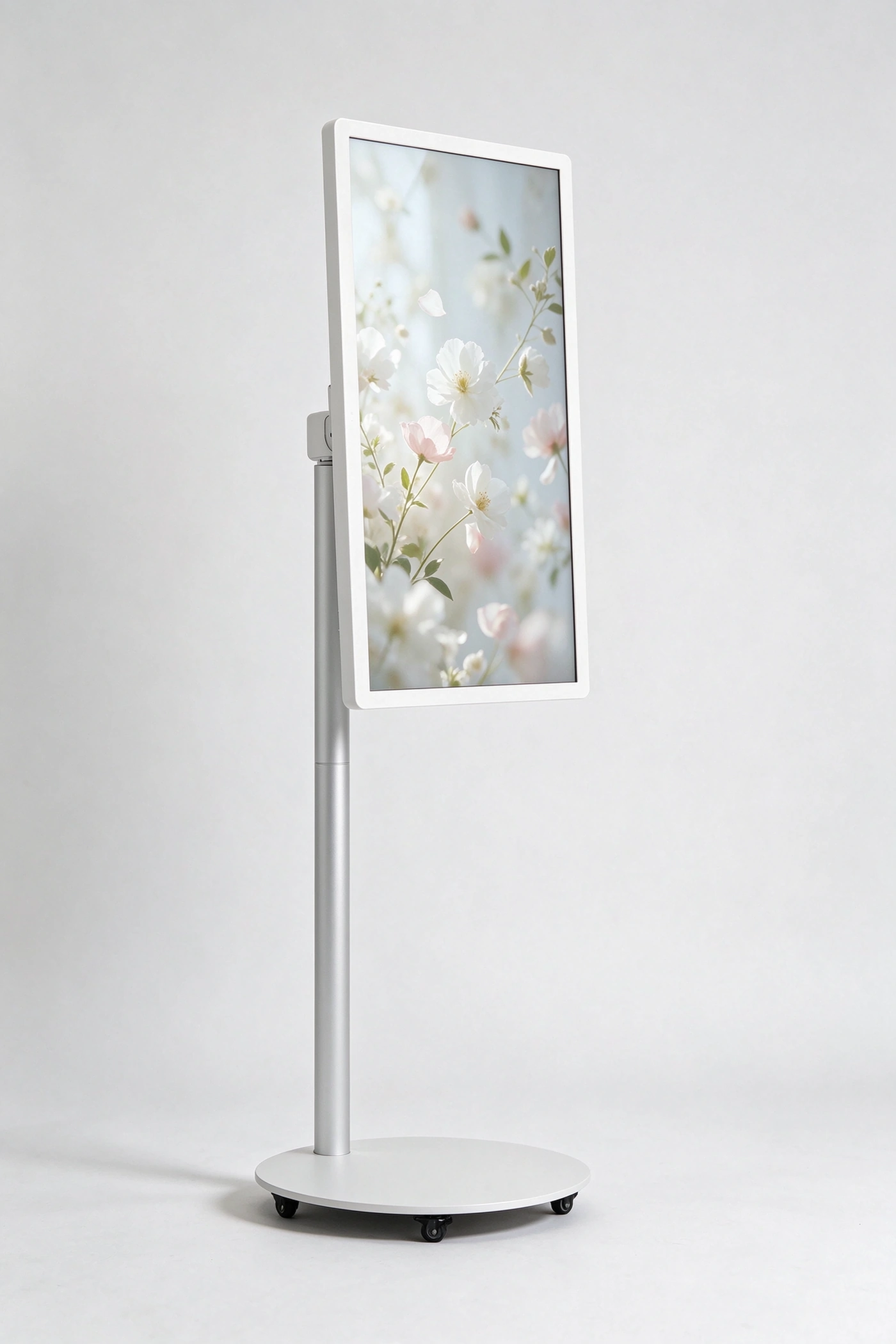
The range runs from 21.5" to 43". Buying the cheapest size and discovering it is too small for a banquet entrance is the most common mistake in this category.
| ขนาด | Best position | การวางแนว | Panel / brightness | Why this size |
|---|---|---|---|---|
| 21.5" | Guest book table, place-card table | Portrait on a short pole | Standard, adaptive | Smallest footprint, sits beside a table without blocking it |
| 23.8" | Studio counter, small welcome area | แนวตั้งหรือแนวนอน | Standard, adaptive | The cost-efficient entry point for a first unit |
| 27" | Welcome stand, studio sample wall, banquet entrance | Portrait preferred | Standard, adaptive | The size most buyers settle on after seeing portrait in person |
| 32" | Welcome aisle, ceremony side, banquet entrance (main unit) | Portrait and landscape | Standard or high brightness | One unit that covers all four positions in a single day |
| 43" | Ballroom main visual, outdoor lawn | Landscape, portrait available | High brightness recommended | Readable across a large hall; verify doorway and van clearance first |
A purchasing page that overclaims is worse than no page. This section separates the two, because a wedding is a single-shot event: there is no second take if the screen is too bright, too loud or too slow to set up.
ตกลงRotation and sensor
180° rotation with a gravity sensor is a delivered capability, not a roadmap item. Content turns upright automatically when the panel is rotated.
Test: rotate a loaded unit in front of the person who will operate it.
ตกลงAdaptive brightness
The display adjusts to ambient light, which is what keeps a candlelit ballroom readable without glare and a daylight marquee visible without washing out.
Test: dim the room, then open the curtains, and watch it react.
ASKCastor noise
A silent castor option exists. We have not measured noise on a reference floor — and a decibel figure measured on factory tile would be meaningless on a hotel's polished stone anyway.
Your test: roll the unit on the venue's own floor, at the time of day the ceremony runs, before you commit a fleet.
ASKRuntime for your event
State the real figure for your longest day — transport, setup, ceremony, banquet, teardown — not the showroom figure. Then decide whether one battery covers it or whether you need a second unit rotation.
Your test: a full-day run with your own content, timed.
ASKFloor protection
Carpet, polished stone, and timber behave differently under a loaded disc base. Damage to a venue floor is deducted from a deposit, and no specification sheet will win that argument for you.
Your test: one full event on each floor type you regularly use.
ASKTen-minute setup
Single-person handling is a design goal — pole, base and panel — but the real number is how long your own crew takes from van door to upright, with the case opened and the content loaded.
Your test: time it once with a stopwatch, then write it into your event SOP.
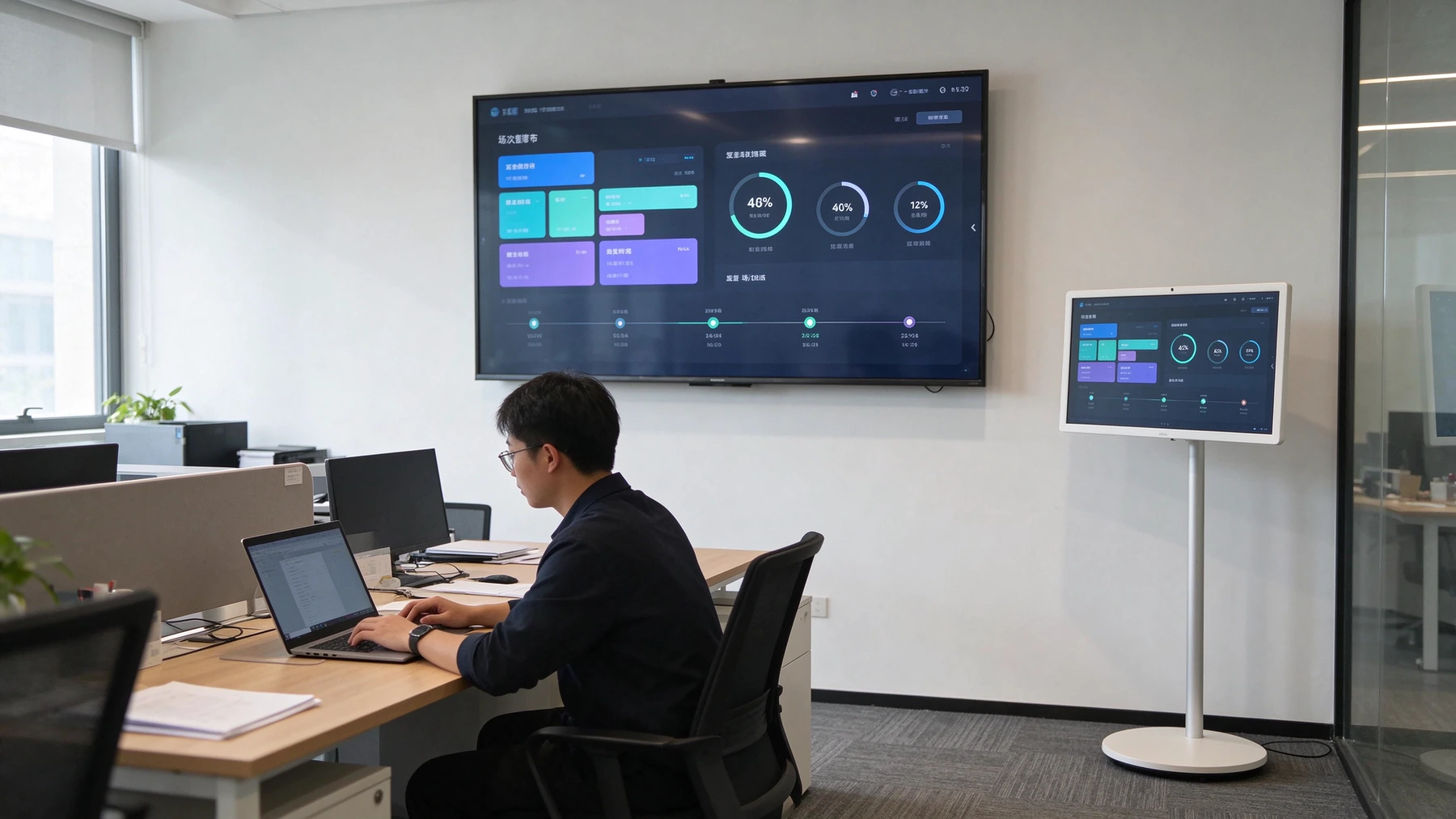
The hardware is the easy part. The reason wedding deployments stall is that nobody has decided who edits the photographs, who uploads them, and who is responsible when a song or a guest's face is used without permission.
One unit is a purchase. Twelve units across three halls is an operations problem, and the software layer is where most low-cost screens quietly fall short — they ship a player, not a fleet tool.
| Fleet size | Typical buyer | What the management layer must do |
|---|---|---|
| 1–3 units | Independent planner, single studio | Local playback, scheduled loops, portrait and landscape presets, no account required |
| 4–30 units | Wedding hall, multi-branch studio, small rental operation | Device list by venue, content pushed per event, remote on/off and status, who touched what and when |
| 30หน่วย | Venue group, regional rental company | Roles and permissions, template governance so every hall looks consistent, exportable device and service history |
Qtenboard's device management runs on our own platform rather than a third-party mobile-device-management referral — which matters on a Saturday evening when a hall calls to say the seating plan did not update and there is nobody to escalate to. If you need the units to sit inside an existing booking or CRM system, that is an integration conversation to have before the order, not after. The rotatable floor-standing signage range is the adjacent product line if a fixed installation is the better answer for one hall.
This is stated plainly because it decides the whole commercial conversation: Qtenboard does not operate a rental fleet and does not quote per event. We manufacture and sell units, and we support buyers who build their own rental or in-house model on top of them.
What you are buying. A finished unit, configured for the positions you actually run, with the accessory set that keeps it alive in transit. Your return comes from how you deploy it — as a planner's production asset, a venue's in-house screen, a studio's sample wall, or a unit you rent out on your own terms.
Because the same platform serves high-frequency retail use as well as weekend events, the engineering and spare-parts base is shared rather than amortised over a handful of wedding units. Our pharmacy chain deployment is the case where that platform is stressed hardest — daily movement, long trading hours, multi-site control — and the lessons from it are already in the wedding configuration.
How many units. Count your peak simultaneous events, not your annual events. A planner running three weddings on the same Saturday needs three units plus whatever spare capacity your charging routine can absorb; a venue with one ballroom needs one. Then add the studio unit, because that is the one that earns on weekdays.
| Cost line | Why it exists | Where buyers under-budget |
|---|---|---|
| Units | The screens themselves, sized per position | Buying all units at the smallest size, then needing 32" for the banquet entrance |
| Transit protection | Cases for every unit that leaves the building | Assuming a cardboard box survives a season of van loading |
| Power routine | Charging discipline between back-to-back events | Planning on charging at the venue, where there is no socket |
| มีเนื้อหา | Templates, review time, licensed music | Treating content as free, then discovering the licence question during the event |
| Spares | One spare unit or a fast parts route for peak weekends | Running a fleet at 100% utilisation with no fallback on a Saturday |
A quotation answers a price question. A pilot answers the only question that matters: does this survive my actual events, with my actual crew, on my actual floors.
01กำหนดค่า
Pick one size for the position you run most, one colour from the standard range, and the accessory set for your transport reality. Ship one or two units, not a pallet.
02Run three events
One indoor ballroom, one outdoor or daylight setting if you run them, one back-to-back weekend where charging discipline is tested. Same crew, same SOP, timed.
03Score four lines
Setup time per unit; incidents per event; whether the couple and the venue noticed the screen at all (that is the goal); and what your crew complained about. Then decide the fleet size.
Wedding support has an unusual shape: nothing happens for weeks, then everything happens on one Saturday. Ask these questions before the order, because after the order they are contract terms.
Four claims, each with something you can inspect rather than take on trust.
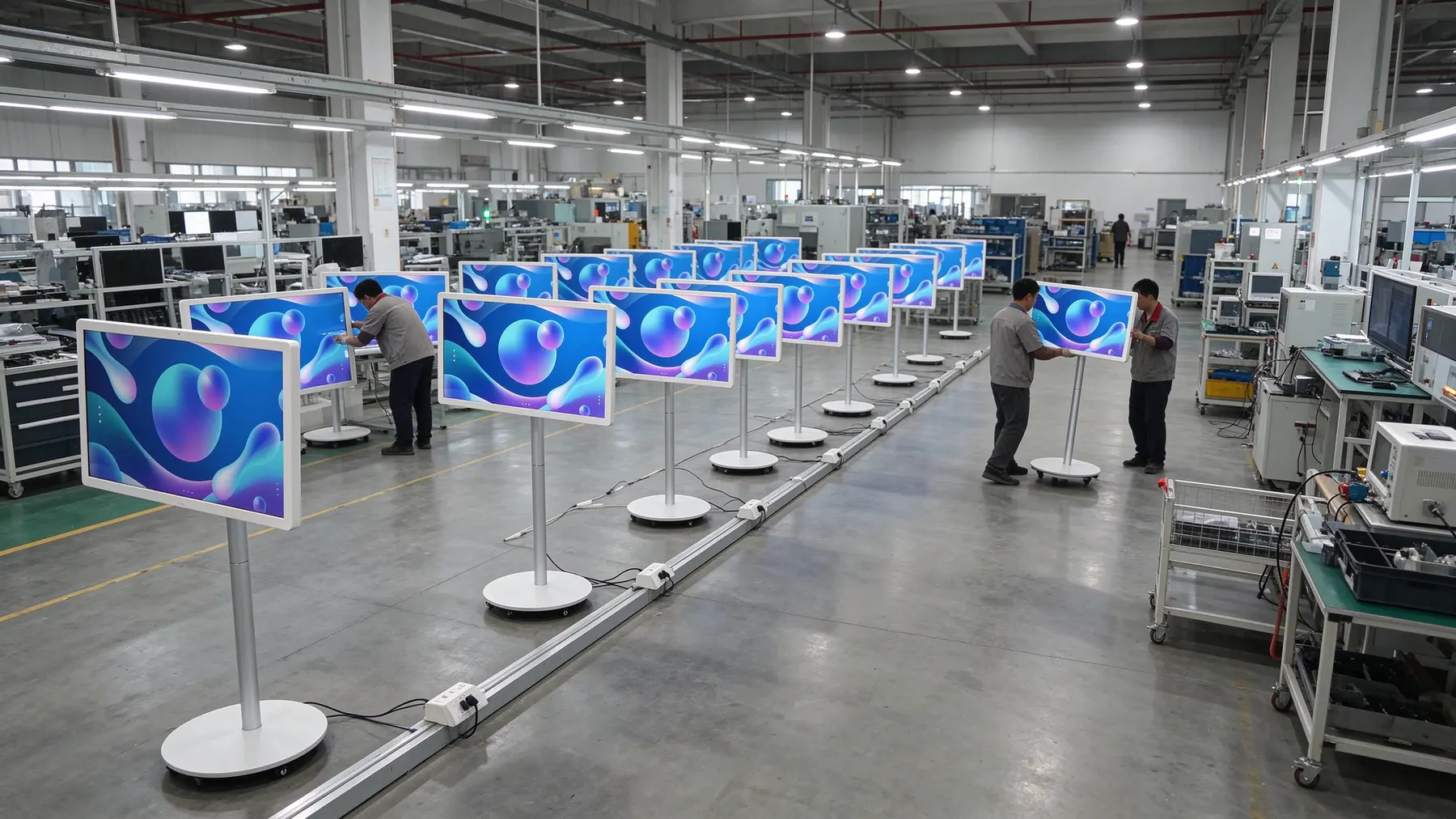
We publish patterns rather than invented statistics. Figures below are the buyer's own numbers, shared with permission; where a project is still in progress it is labelled as such.
A AIndependent planner, 3 halls
Two 32" units in portrait for welcome and banquet, one 27" for the studio showroom. The change that mattered was not the screen: the crew stopped building a printed backdrop for every event.
Status: units in service; per-event time saving tracked by the buyer, not published here.
บีHotel ballroom, in-house fleet
Four units, one per function room, all white to match the venue's styling, managed from one dashboard by the banquet office. Seating plans are pushed from the office instead of being printed and mounted.
Status: rollout in progress; the open question is floor protection on polished stone.
C CBridal studio chain
Portrait sample walls in three showrooms, replacing printed sample boards. Content updates follow each new shoot, so the wall is never out of date in the season it matters.
Status: pilot stage; two showrooms converted, third pending.
Prepared by: Qtenboard wedding and event solutions desk, working with the product line team for the mobile smart screen range.
Reviewed by: Qtenboard hardware engineering (structure, pole joint and castor group) and the OEM/ODM project desk for the configuration and colour statements in section 04 and 05.
Method: specifications and limits are taken from the current configuration sheet; anything we have not measured is marked as a test you should run rather than a figure we assert. Deployment patterns in section 13 are buyer-reported and labelled by stage.
หมายเหตุการปฏิบัติตาม: the music licensing and guest portrait points in section 07 are operational controls, not legal advice; the contract terms between venue, planner and couple govern.
Last updated: 20 November 2026. Published as a working purchasing framework for B2B enquiries; specifications are confirmed per project.
Fourteen answers, written for the person signing the purchase order.
The panel rotates through 180 degrees, so it can stand in portrait and a 2:3 photograph fills the frame. That is the main reason this product exists in the wedding category: a landscape TV shows a portrait photograph at roughly half the screen width, which is exactly what a couple notices first. Combined with portrait templates, the welcome table and the studio wall are the two positions where the gain is most visible.
The unit has a gravity sensor, so the image flips upright as the panel is turned — no menu navigation, no settings screen. In practice the only discipline required is that content is built for both formats: a portrait template for the welcome table, a landscape one for the aisle and the seating plan. Build both once and the change between segments takes seconds.
White and black are standard mould colours and ship without tooling cost. Champagne, gold, or a finish matched to a venue's styling requires a volume commitment — settle the quantity before the design is signed off. If a hotel group wants every unit in one custom shade, that is a project conversation with the OEM/ODM desk, and the timeline includes sample approval rather than being a checkbox on an order form.
A silent castor option exists, and we will not quote a decibel figure we have not measured on a comparable floor. Our honest recommendation: roll the unit on the venue's own surface, at the time of day your ceremony runs, before you buy a fleet. In the event SOP, keep the unit still during the vows and move it only between segments — that removes the risk entirely rather than relying on a specification.
Adaptive brightness adjusts output to ambient light, which is what keeps a dim room readable without the panel becoming the brightest object in the room. Still test it in the actual room: dim the lights, then open the curtains, and watch how the image responds. For a candlelit ceremony, set the welcome table unit modestly and save the full brightness for the banquet entrance where guests are further away.
Power comes from the battery in the base, so there is no lead across a ballroom floor — which is both an aesthetic point and a safety one, since a trailing cable in a dim room with guests in formal dress is a trip hazard. The practical discipline is charging: full charge the day before, a check on the morning of the event, and a written charging routine if units run back-to-back weekends.
The design intent is single-person handling: pole, disc base and panel, with castors on the base. The real number depends on your crew, your case and how the content is loaded, so time it once with a stopwatch and write the result into your event SOP. Anything that has to be assembled with tools at a venue is a design failure, and we do not sell that configuration for events.
Yes, with two specification changes: a high-brightness panel, because daylight washes out a standard panel, and a ballast or anchoring solution, because a light disc base on grass in a breeze is marginal. Confirm the nits figure in writing for outdoor units and take the unit outside at your ceremony's time of day before accepting shipment. Morning dew on grass is a bigger practical issue than rain, and belongs in your setup routine.
A 32" unit with a slim pole and disc base is a one-person lift; a 43" unit is a two-person lift and needs a doorway and load-space check before you buy it. For anyone moving units weekly, the transit case is not optional — the case, not the panel, is what determines whether the fleet still looks new at the end of the season.
We sell. Qtenboard does not operate a rental fleet and does not quote per event, so there is no rental price list behind this page. If your business is renting screens to planners and venues, that is your model to run: we supply the hardware, the transit protection, the spare parts and the documentation that make a rental operation viable. The same platform also serves retail deployments such as our mobile smart screen solution for pharmacy chains, where daily use rather than weekend use is the design driver.
Yes, within the usual OEM tiers: logo on the housing, custom start-up animation, packaging and documentation in your brand. Colour is the constraint, not the logo — custom finishes need volume. Ask the OEM/ODM desk which items are print-and-pack changes and which require a mould or a tooling investment, and get that in the quotation rather than discovering it at sample approval.
That is a planning question more than a service question. Assume no remote rescue is possible at 4pm on a Saturday: carry a spare unit for peak weekends, keep a charged spare battery if your runtime margin is thin, and have a fallback layout that runs on one screen instead of two. Warranty support covers the defect; it does not cover the event, which is why the spare-unit decision belongs in your purchasing plan.
Yes — device lists by venue, content pushed per event, remote status and history. The practical value shows up when a hall changes a seating plan an hour before doors: the office pushes it, nobody drives to site. For a group with consistent branding across halls, template governance matters more than raw device count, so ask for that specifically in the demo.
The range is positioned for CE, FCC and RoHS compliance according to destination market, with ISO 9001 quality systems behind production. Ask for the declaration set for your specific market and voltage, plus the ageing-test record for your batch — those documents are what a venue group's procurement team will request, and they should exist before you need them in a tender.
The hardware is the same across these; the deployment logic is what changes.
Tell us the positions you actually run, the floors you actually stand on, and whether your ceremonies are indoors, outdoors or both. We will come back with a configuration, an accessory set and a quotation — no rental pricing, because we do not rent.
Useful to include: number of simultaneous events on your busiest day, the rooms or venues involved, whether portrait content is the main use, and your destination market for documentation.
Direct enquiry
Wedding & event solutions desk
Configuration, colour and tooling questions are answered from the factory, not from a reseller.
info@qtenboardglobal.com
+86 18124715048
Qtenboard Industrial Park, Shenshan Special Cooperation Zone, Guangdong, China

ซีอีโอ | ผู้เชี่ยวชาญด้านโซลูชันการแสดงผลแบบโต้ตอบและการทำงานร่วมกัน
ฉันเป็นผู้ก่อตั้ง qtenboard นำความเชี่ยวชาญด้านการลงมือปฏิบัติมากกว่า17ปีมาสู่อุตสาหกรรมการแสดงผลแบบสัมผัสจากมุมมองการจัดการทั่วโลกที่ได้รับจากการศึกษา EMBA ของฉันที่มหาวิทยาลัยเซินเจิ้นฉันนำทีมของฉันในการเพิ่มประสิทธิภาพทุกขั้นตอนของการดำเนินงานของเรา-จากความละเอียดของผลิตภัณฑ์ที่มีประสิทธิภาพสูงการจัดการห่วงโซ่อุปทาน-มั่นใจความสามารถในการผลิตของเรายังคงอยู่ในระดับแนวหน้าของอุตสาหกรรม
ในฐานะผู้นำของ qtenboard ฉันเชี่ยวชาญในการให้บริการโซลูชั่น oem/odm ที่ปรับแต่งสำหรับกระดานไวท์บอร์ดแบบโต้ตอบผนังวิดีโอ LCD ป้ายดิจิตอลและเทอร์มินัลสัมผัสระดับอุตสาหกรรมสนับสนุนโดย330,000ตารางเมตรสวนอุตสาหกรรมที่ทันสมัยของเราในเซินเจิ้น, เรารักษาเต็ม Lifecycle ควบคุมการออกแบบอุตสาหกรรม, การผลิตที่มีความแม่นยำ, และการทดสอบประสิทธิภาพที่เข้มงวด.
ด้วยประสบการณ์โครงการเกือบสองทศวรรษโซลูชันการแสดงผลของ qtenboard จึงถูกนำไปใช้ในกว่า120ประเทศและภูมิภาคได้รับความไว้วางใจจากลูกค้าระดับองค์กรมากกว่า15,000รายทั่วโลกหากคุณกำลังมองหาพันธมิตรที่ตอบสนองต่อการผลิตที่ลึกซึ้งสำหรับโครงการแสดงผลแบบสัมผัสที่กำหนดเองของคุณทีมของฉันและฉันพร้อมที่จะสนับสนุนวิสัยทัศน์ของคุณด้วยความเป็นเลิศระดับมืออาชีพ

 th
 EN
 spa
 pt
 vie
 est
 lav
 aze
 ukr
 bel
 ru