
 th
 EN
 spa
 pt
 vie
 est
 lav
 aze
 ukr
 bel
 ru
Disclosure before we start. This guide is published by Qtenboard, an interactive flat panel manufacturer based in Shenzhen. We are writing it the way we want to be vetted: with artifacts a buyer can check, not adjectives a buyer has to trust. Every test in these five steps applies to us as well, and you should run it on us before you wire a deposit.
Most sourcing managers in this category have a version of the same story. A supplier with a gold badge, a factory video, a CE certificate and a price 10% under everyone else. Four months later the container arrives with a lower panel grade than the sample, a touch frame that ghosts when two people write at once, and a certificate that names a model number nobody ordered. The money is gone, the tender deadline is not.
The failure is rarely about fraud in the obvious sense. It is about three different questions being answered by one label. A badge answers does this legal entity exist. Your order needs answers to who actually builds this model และก็พร้อม will this batch arrive as specified. Those are separate evidence chains, and only one of them is cheap to fake.
What a "Verified" badge actually certifies
Chinese B2B platforms run two kinds of checks, and neither of them is product-specific. The first is identity: a business licence is matched to a company name, a registered address and a legal representative. The second is a site visit: a third-party agency confirms that the address is a real workshop with real equipment. Both checks are worth something. Neither check tells you whether your 98-inch model with an anti-glare bonded stack is built on that line, by that team, under a certificate that includes it.
| Badge or label | Who runs the check | What it actually confirms | What it leaves open |
|---|---|---|---|
| Verified / Gold Supplier | Platform subscription plus document review | The legal entity exists and pays for a storefront | Capability, product model coverage, delivery record |
| Assessed Supplier | Third-party agency on-site assessment (TÜV Rheinland, BV, SGS or Intertek, depending on the market) | A site exists at the stated address, with staff and some documented processes, on the assessment date | Whether your SKU runs there; changes since the visit; certificate model lists |
| Audited Supplier | Audit report from SGS, BV or TÜV with an expiry date | Address, lines, QC flow and staffing at the time of audit | Current state, your configuration, sub-contracted processes |
| Trade Assurance | Platform escrow on transactions | Funds are held until agreed terms are met | Whether the agreed terms describe the product you actually need |
| "Manufacturer" tag | Business licence scope | Legal scope includes manufacturing activity | Whether the workshop is owned, leased, or a sub-contractor's |
Badge names and assessment agencies vary by platform and change over time. Read the expiry date and the assessment scope page, not the badge graphic.
The useful conclusion from that table is simple: a badge is a filter that removes obvious fraud, in the same way a credit check removes obvious insolvency. It is the start of due diligence, not the result of it.
Three supplier models behind the same storefront
Interactive flat panels in China are built by three different kinds of company, and they fail in different ways. Knowing which one you are talking to tells you which questions to ask.
- Brand and trading companies. They design, market and sell, and buy finished units or kits from assemblers. They are usually strong on export paperwork, multi-category baskets and small mixed orders. They are weak on process control, because they do not own the process. Fine for 20-unit white-label runs; thin for a 600-unit tender with a model-specific certificate requirement.
- Module assemblers. They buy open cells, backlight units, touch modules and mainboards, then assemble, test, age and pack. This is the most common model in the 55–86 inch range, and it is a legitimate one. What matters is their incoming inspection discipline and whether they can tell you the panel grade and batch they will use.
- Integrated manufacturers. SMT, touch bonding, metal chassis, injection moulding, assembly and aging all sit on one site. They win on cost at volume and on change control, and they usually need a larger commitment before they open a private structure or a custom colour.
Geography matters less than it used to, but the cluster is still real: Shenzhen (Bao'an, Guangming, Longgang), Dongguan, Guangzhou and Hangzhou. Most open cells come from a handful of panel makers such as BOE, CSOT, HKC or AUO. The brand on the box is not the brand of the glass, and the glass grade is where quiet cost cuts happen.
A rough BOM picture explains the pricing behaviour you will see: the panel assembly is typically 45–60% of material cost, the touch module 8–15%, the mainboard 6–12%, and structure, power, audio and packaging make up the rest. Any quote that lands 15% under the market for the same size is cutting one of those three, or cutting certification and inspection. Ask which.
The rule that saves deposits
"Verified" has to be proven three times: the entity (who signs and exports), the model (who builds the exact SKU and which certificate covers it), and the batch (who guarantees this shipment). A deposit should be released only when model-level and batch-level evidence exists in writing.
The three layers you must clear
Verification is not a conversation, it is a set of artifacts. Sort every claim a supplier makes into one of three buckets, then ask for the document or the live view that would prove it. If a claim cannot be mapped to an artifact, treat it as marketing.
| ชั้นชั้นวาง | The question | The artifact that answers it | How hard is it to fake? |
|---|---|---|---|
| Identity | Are you the factory, or a reseller of one? | Business licence with manufacturing scope, customs consignor registration, a recent export declaration, a continuous live walk through the plant | Hard. Customs records and licence registries are third-party data. |
| ความสามารถในการ | Can you build my model, at my size, at my volume, with my certificate? | Model-level test reports, aging records, panel grade and batch, capacity maths, bonding and SMT evidence | Medium. Requires a supplier who knows production, not a script. |
| Transaction | Will this specific batch arrive as agreed, on time? | PI clauses, inspection acceptance, spare and RMA terms, on-time history, named production slot | Medium. Contracts and inspection rights shift risk back to the seller. |
Most buyers stop at layer one because the badge shows them layer one. Layers two and three are where the money is actually lost, and they cost nothing but a few well-aimed questions.
Step 1: Screen for factory behaviour before you chat
Before the first message, read the storefront like an engineer reading a datasheet. Factory behaviour leaves fingerprints in public data: numbers that cross-check, a narrow product focus, and a price ladder that follows cost.
| Signal on the listing | Benchmark that looks healthy | Ask a follow-up question when you see |
|---|---|---|
| Years on platform | Three or more, stable category focus | A new storefront with 400 unrelated SKUs |
| Factory area vs output | Area consistent with stated units per month | 2,000 m² claiming 5,000 units a month |
| Lines and equipment | Named SMT lines, bonding, assembly, aging room | "Many production lines", no counts |
| Headcount | 100–1,000 for a mid-size plant | 30 staff claiming 1,000 units a day |
| On-time delivery | 95% or better, with a history | Field blank, or 90% with no explanation |
| Product depth | Three to eight configurations, size matrix disclosed | Everything from 15 to 110 inches under one listing |
| Price ladder | Rises with size and specification, monotonically | A 98-inch priced like a 75-inch |
| Technical detail in copy | Touch points, IC, chipset, OS build, OPS interface stated | "High quality 4K smart board" and nothing else |
VR tours prove geometry, not activity. A 360-degree walkthrough is useful for confirming that a workshop, an aging area and a packing bay exist in the same building. It cannot tell you when it was recorded, whether the line was running, or whether the SMT section upstairs is theirs. Treat a VR tour as a floor plan, then verify activity with a live session in Step 2.
Run a spec-depth test in the first message. Ask three questions that only a production team can answer without scrambling:
- Which touch controller and how many points are on the 86-inch, and does the 110-inch share the same one?
- Which panel grade and which panel maker will the 98-inch ship with this quarter, and what is the light-uniformity spec?
- What OPS interface and power budget does the chassis support, and is the 86-inch build EDLA-certified or AOSP-only?
A factory answers within a day, sometimes corrects your assumption, and may offer the spec sheet page. A trader forwards the question to someone else, comes back with vague answers, or agrees with every premise you offer. Silence and instant agreement are both signals.
The response test that separates the two. Ask something that only exists inside production: the firmware build number on the current 86-inch batch, the date of the last OTA push, or the first-pass yield last month. Traders do not hold those numbers; they have to request them, and the delay shows.
Step 2: Penetration checks a trading company cannot fake
This is the step buyers skip because it is awkward. It should take one hour of your time and one continuous video session, and it is the single most effective filter in the category.

A buyer-side engineer walking an IFP assembly line during a verification visit. The value of the visit is not the tour, it is watching the line run while your questions are being answered.
2.1 One live session, six required shots
Ask for a single uninterrupted video call, no pre-recorded clips, with six shots in this order. Timestamps and continuity are the point.
- Gate to line. Start outside with the building name or street number in frame, then walk in without cutting. This anchors the production to an address.
- Running line. Assembly or conveyor with units actually on it, people working at stations, not an empty hall at shift change.
- Bonding or lamination station. Only if the supplier claims zero-gap bonding. Ask what the yield is at this station — a number, not "very good".
- Aging room, powered. Racks with screens on, not a dark room with empty trolleys. Ask how many units are in burn-in right now and for how long.
- Packing and drop-test rig. Cartons with your market's shipping marks, foam specification, and the drop-test frame if they claim one.
- QC desk. Today's inspection log, open on screen or clipped to the desk, with a date you can read.
Then add one unstaged request: ask the operator to write today's date and the time on the whiteboard of a panel currently on the aging rack, and to read the barcode on a carton from the shelf behind them. Pre-staged tours cannot answer a question about a random shelf.
2.2 Aging and quality data, not quality adjectives
Aging is the cheapest reliability test a factory can run and the easiest to skip. Ask three things: how long units burn in (24 hours is a floor for most export orders, 72 hours for tender and branded programs), what runs during that time (full-function cycling across touch, network, audio, OPS boot and brightness, not just a static image), and what the pass criteria are.
Then ask for last quarter's numbers: first-pass yield, rework rate, outgoing defect rate in DPPM, and the incoming AQL applied to panels. Factories hold these because they use them. Traders do not. A supplier who answers "we have no defects" has told you they do not measure.
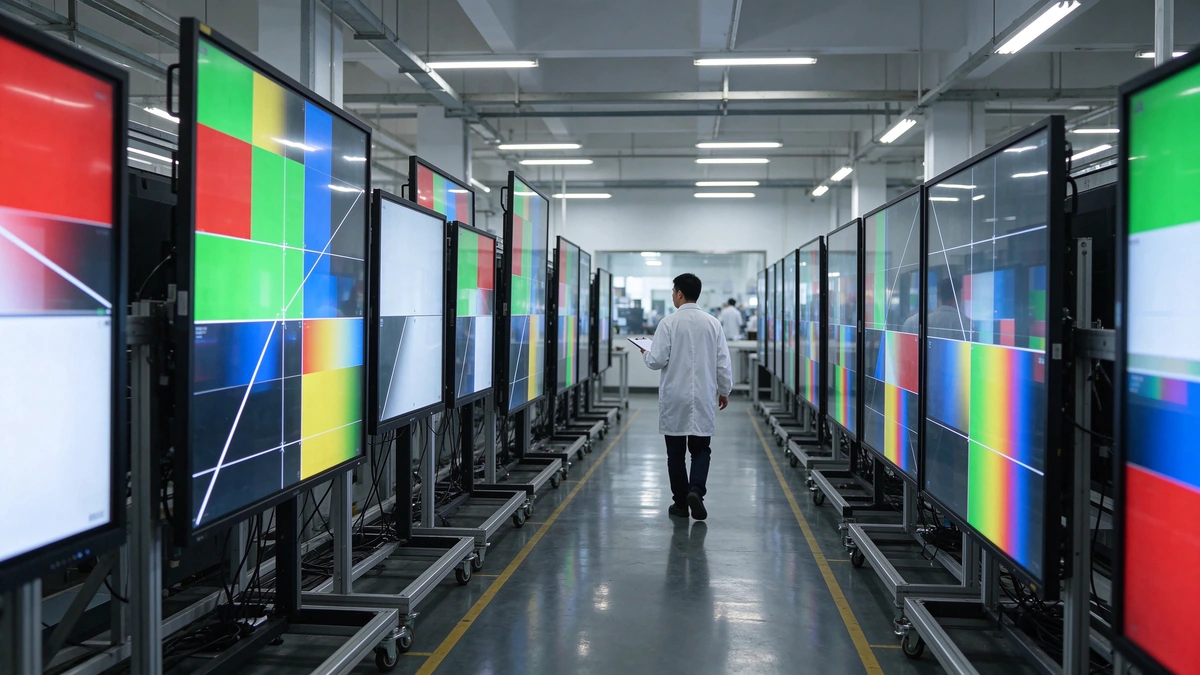
Aging racks running full-screen test patterns. Ask how many units are in burn-in when you call, what the cycle covers, and what the recorded pass rate was last month.
2.3 Certificate coverage is a model question, not a yes/no question
Every serious IFP supplier has CE and FCC documents. The question is whether the document names the model in your PI. A declaration of conformity lists models; a test report lists the tested model and usually includes a photo of the sample. Compare the model string character by character, including the suffix that indicates size or chipset.
For a European sale, the file behind the CE mark should include safety under EN 62368-1, emissions and immunity under EN 55032 and EN 55035, and RoHS under EN IEC 63000. For the US, FCC Part 15 Subpart B. For Android devices that ship with Google services, check EDLA — an AOSP build without Google certification will not carry Play Services, and some tenders disqualify it. Market add-ons then stack on top: UKCA for the UK, EAC for the EAEU, BIS for India, Anatel for Brazil, TISI for Thailand, SASO for Saudi Arabia.
The most common certificate trap
A file that covers 55–86 inches and stops there, while you are buying 98 or 110 inches. Or a certified OPS module paired with an uncertified display. Or a certificate held by the brand rather than the factory, with no addendum for your OEM model. Ask who holds it, which models are listed, and who pays for re-testing if the model changes after your order.
2.4 The corporate paper trail that ends arguments
Three public records settle the factory-or-trader question faster than any video. First, the business licence: the scope should include manufacturing or production, not only sales, and the unified social credit code can be checked in the national enterprise credit registry. Second, customs consignor registration: the ten-digit code means the company is registered to export in its own name.
Third, and most useful, the export declaration from a recent shipment. Its production-enterprise field names who actually made the goods. If the consignor is a Hong Kong trading company and the manufacturer field shows a third party, that is not automatically a problem, but you deserve an explanation and a direct line to that third party before you pay.
2.5 Make third-party inspection a condition, not a favour
For any order above a few hundred units, appoint SGS, BV, TÜV, Intertek or QIMA for a factory audit, a pre-shipment inspection, or both. Specify the sampling plan in the PI: AQL per ISO 2859-1 with critical defects at zero, majors at 1.0 and minors at 2.5 is a common and reasonable setting for this product category. Ask for photos, the report, and a 48-hour turnaround.
The supplier's reaction is the real test. A factory with a working QMS treats inspection as a routine Wednesday. A supplier who negotiates the inspector's access, restricts which lines can be seen, or asks you to inspect at a warehouse instead of the plant has just given you the answer for free.
Step 3: Verify batch delivery, not sample quality
Samples are chosen. Batches are scheduled. The gap between the two is where most disputes start, and it is mostly a capacity and planning question rather than a quality question.
| รายการ | What to ask for in writing | Benchmark for this category |
|---|---|---|
| เวลานำมาตรฐาน | Days from deposit and artwork approval to ready date | 15–20 days for stock configurations |
| OEM / ODM lead time | Same definition, plus approval milestones | 25–35 days; add 5–7 days for private mould or custom colour |
| Peak season effect | A written note on seasonal uplift | +5–10 days around tender season, typically May to August |
| Panel allocation | When the panel order is placed for your slot | Allocation confirmed weeks ahead, not days |
| Capacity redundancy | Output per day, lines available, your share of capacity | Daily output times 26 working days, minus committed orders |
| ชิ้นส่วนอะไหล่ | Percentage of order value, mainboard-heavy | 1–3% of units, mainboards weighted above structure |
| RMA terms | Response window and who pays freight | Acknowledgment within 48 hours; root cause within 5–10 working days |
| Packaging validation | Drop-test report for your route | ISTA 2A or 3A equivalent, carton and foam density stated |
| Ocean protection | Desiccant quantity and container loading plan | Desiccant sized by container volume and voyage length |
| Freight damage history | Last six months, by destination region | A rate below 0.5% is healthy; ask how it is measured |
Do the capacity maths yourself. A plant quoting 200 units a day across two lines, running 26 days, has about 5,200 units a month of theoretical output. Your 600-unit order is roughly three days of capacity, but it does not get three uninterrupted days; it competes with other customers' slots. Ask which week your order occupies and what share of capacity it takes. If the answer is vague, the delivery date is decorative.
Long-tail sizes behave differently. 98, 105 and 110-inch panels come from fewer sources, carry more light-uniformity risk, and absorb more freight damage. Order earlier, specify the uniformity tolerance, and never let a 110-inch ride on a lead time quoted for a 65-inch.
Step 4: The paper trail before you wire a deposit
By this point you should have a folder, not impressions. The twelve items below are the minimum for a first order in this category. Each one has a way to check it that does not depend on the supplier's word.
| Document | ทำไมมันสำคัญ | How to check it |
|---|---|---|
| Business licence with manufacturing scope | Establishes factory identity | Match name, address and credit code in the national credit registry |
| Model-level CE and FCC reports plus DoC | Market access and tender eligibility | Model string against the PI; test lab and report number |
| EDLA confirmation, if Android with Google services | Play Services and tender compliance | Ask for the device list entry, not a logo |
| Third-party factory audit under 12 months old | Confirms site and process on a date | Read the scope and expiry, not the badge |
| Aging procedure and a sample record | Reliability evidence you can audit later | Ask for a signed record from a past order |
| BOM snapshot: panel grade, batch, mainboard revision | Stops silent substitution later | Attach it to the PI as an annex |
| Spare parts and RMA clause | Defines after-sales cost | Numbers, timelines, and who pays freight |
| Inspection acceptance letter with AQL | Preserves your right to reject | Named agency, sampling plan, access to lines |
| Packaging and drop-test report for your route | Freight damage is the largest hidden cost | Report dated, route named, carton spec listed |
| Certificate maintenance clause | Covers model changes after your order | Who re-tests, who pays, what happens if a standard is revised |
| NDA and regional exclusivity for your brand | Protects your design and pricing | Written commitment not to supply your design to your market |
| Warranty terms with exclusions | Three years is standard for IFPs; what is excluded is not | Read the exclusions: impact damage, static-content burn-in, water, unauthorised repair |
Step 5: Design the first order to test consistency
A first order has one job: prove that batch two matches batch one. Size it so that the plant has to change something — a shift, a panel lot, a packing run — and small enough that a failure is affordable.
- Order 50–80 units of a standard configuration, or the OEM minimum, and ask for it to be split across two or three production batches rather than one continuous run.
- Seal a golden sample. Sign and date it, photograph the label and serial, keep the panel batch code. The sealed unit is the contract, not the brochure.
- Compare batch to sample on eight points: panel model and lot, touch controller, mainboard revision, RAM and storage, OS build number, camera and speaker, packing materials, accessory list.
- Measure four numbers from the arrival: dead-on-arrival rate, touch dead zones after 30 minutes of multi-touch, cosmetic defects against AQL, and brightness uniformity at nine points on 5% of units.
- Re-run burn-in on a sample. Twenty-four to seventy-two hours on site tells you more about real reliability than any claim about aging.
- Keep the table. Three to five percent DOA from a supplier that passed every screening step is a stop signal, and the spreadsheet is what makes that conversation short.
Payment structure carries the last mile. 30% deposit and 70% before shipment is the standard structure in this industry. The negotiation that matters is tying the balance to a passed inspection, with the report as a condition of release. For tenders, a letter of credit at sight is common; for first orders under a hundred units, platform escrow is a reasonable substitute for a decade of trust.
Red flags worth walking away from
None of these prove fraud on their own. All of them, in combination or repeated, mean the cost of verification has passed the value of the order.
- Certificate model mismatch, with a promise to "add your model later" and no addendum in writing.
- Video files instead of a live session, or a live session with cuts, a fixed script, and no aging room.
- An aging room on the tour with no logs, no cycle description and no pass-rate history.
- A price 10% or more under the market for the same size, with no explanation of panel grade or touch stack.
- One address appearing across a dozen storefronts, or a licence address that does not match the plant.
- Sales staff who cannot name the panel supplier, the touch controller or the chipset without "checking with the engineer" every time.
- A contract signed by a Hong Kong entity that refuses to name the manufacturing party.
- Delivery dates moved twice without a written reason and a new production slot.
- Inspection refused at the plant but offered at a warehouse, or an inspector's access limited to one line.
Supplier scorecard: rank three to five on the same scale
Score each candidate from 1 to 5 on every row, multiply by the weight, and compare totals. Do it before the site visit as well as after — the gap between the two scores is the most informative number in the exercise.
| มิติข้อมูล | น้ำหนัก | What earns a 5 |
|---|---|---|
| Factory reality | 25% | Live walkthrough from gate to line, production running, aging room powered, named owner of each process |
| Certification coverage | 20% | Model-level reports for every size you buy, EDLA if Android with Google services, addendum process defined |
| Aging and quality control | 20% | 24–72 hour cycles with defined load, recorded pass rates, incoming panel AQL, published rework numbers |
| Delivery and after-sales | 20% | Named production slot, capacity maths that adds up, 1–3% spares, 48-hour RMA acknowledgment, route-specific packaging |
| First-batch consistency | 15% | Sealed sample respected, batch-to-batch deviations explained, DOA and touch metrics within agreed limits |
Decision rule we use in our own audits: below 3.0, walk; 3.0 to 3.8, run a small pilot with inspection; above 3.8, move to contract with pre-shipment inspection and a sealed sample attached. A supplier scoring 4.5 on price and 2.0 on certification coverage is not a bargain, it is a rerun of the story in the introduction.
Reference configuration a verified factory should document line by line
Use this as the baseline for comparing quotes. If a supplier cannot state these values for the model they are selling you, they are not ready to be verified — they are still quoting.
| ตัววัดพารามิเตอร์ | Range worth accepting for commercial IFPs |
|---|---|
| ขนาดหน้าจอ | 55, 65, 75, 86, 98, 105, 110 inch; matrix disclosed per size, not hidden in one listing |
| ความละเอียดสูง | 3840 × 2160 (4K UHD) across the range; 1080p only for small accessories |
| Brightness and contrast | 400–500 cd/m² typical for classroom and meeting use; 4000:1 or better |
| สัมผัสหน้าจอสัมผัส | Infrared, 20-point minimum, 40-point on premium models; ±2 mm accuracy; 4 mm tempered anti-glare glass |
| Bonding | Zero-gap or OCA bonding optional; ask for the bonding yield at the station |
| ระบบสำหรับรถยนต์ | Android 14 with EDLA, dual-OS with Windows 10/11 via OPS; AOSP-only must be disclosed |
| Compute | MT9679, RK3588 or A311D2 class mainboard; 4+32 GB entry, 8+128 GB mainstream, 16+512 GB optional |
| การเชื่อมต่อการเชื่อมต่อ | Wi-Fi 2.4/5 GHz, Bluetooth 5.x, HDMI in/out, USB-C, RJ45, OPS slot, wireless casting |
| Audio and camera | 2 × 10–20 W front-firing; 48 MP or optional camera module |
| การรับประกัน | Three years standard for IFPs, with the exclusion list attached |
| MOQ และระยะเวลาการผลิต | 1 unit for stock white-label; 50+ for structure changes; 100–500 for private mould; 15–20 days stock, 25–35 days OEM |
Baseline reflects current export configurations in this category, not a single brand's lineup. Always confirm the exact model string and certificate list for the size you are buying.
For size selection against room area, the เครื่องคิดเลขขนาดจอแบนแบบโต้ตอบ is a faster route than a rule of thumb. For the education line these specifications describe, see 4K interactive whiteboards for classrooms; for boardroom deployments, the interactive display range for meeting rooms covers 55–110 inch configurations with OPS options.
If your requirement is a private label rather than a stock unit, read the OEM/ODM customization levels before the first call, so that MOQ, mould cost and firmware ownership are settled in the right order. Buyers running public tenders usually need the bid-control configuration, where the technical schedule has to match the certificate list exactly.
FAQ: the questions buyers ask after the audit
How long does it take to verify a Chinese interactive board supplier?
Three to ten days of desk work: licence and registry checks, certificate model matching, listing screening and a spec-depth test. One hour for a live video session. If you commission a third-party factory audit, add two to four weeks. Building a first batch afterwards usually takes six to ten weeks including production and shipping, so start the verification before the tender is announced, not after.
Is a trading company always the wrong choice?
No. Trading companies are a good fit for small mixed orders, local stock, multi-category baskets and buyers who need export hand-holding. The problem is only when a trader presents as a factory. If you choose a trader, ask for factory disclosure, insist on pre-shipment inspection at the plant, confirm who holds the certificates, and make the manufacturing party a named annex to the contract.
How do I confirm a CE certificate actually covers the model I am buying?
Open the declaration of conformity and read the model list, then open the test report and check the tested model string and the sample photo. The suffix that indicates size or chipset is where mismatches hide. Confirm the standards listed (EN 62368-1, EN 55032, EN 55035, EN IEC 63000), the test lab and report number, and whether an addendum is needed for your OEM model. Get the addendum commitment in writing before the deposit.
What MOQ and lead time should I expect from a Chinese IFP factory?
One unit for stock white-label configurations, around 50 units when the structure changes, and 100–500 units for private mould or full custom development. Lead time runs 15–20 days for stock builds and 25–35 days for OEM, measured from deposit and artwork approval, with five to seven extra days for private mould or custom colour. Any quote far below those numbers either has stock on hand or has not planned your order.
What should I check first when the first batch arrives?
Dead-on-arrival count against the packing list, then multi-touch behaviour after thirty minutes of use on a sample of units, then cosmetic defects against the agreed AQL. Compare the OS build number, panel lot, touch controller and mainboard revision with the sealed golden sample, and check that the certificate copy inside the carton names the model you received. Photograph everything before installation.
How do I protect my brand, design and pricing with a Chinese factory?
Use an NDA that covers design files, firmware and pricing, and add a regional exclusivity clause: the factory will not supply your customized design to another buyer in your territory. Clarify who owns the tooling and the UI assets, who pays for mould maintenance, and what happens to your custom firmware if you move suppliers. Written ownership of the mould and the brand assets is worth more than a friendly promise.
Apply the same checklist to us
Qtenboard has manufactured interactive flat panels since 2005, with three self-owned plants covering 330,000 m², roughly 1,000 staff, in-house SMT, touch bonding, chassis and injection, and a 200+ unit daily output. We publish the factory tour และ company profile because they are checkable, not decorative.
Send your target sizes, market and certification list, and we will return a model-level certificate list, a production slot and an inspection plan with the quote.
Request a verified quote