Self-service ticketing, appointment check-in, QR scanning and rear-serviceable hardware — engineered as the front end of a complete queue management system, with the ticket client, the integration contract and the spare parts coming from one factory.
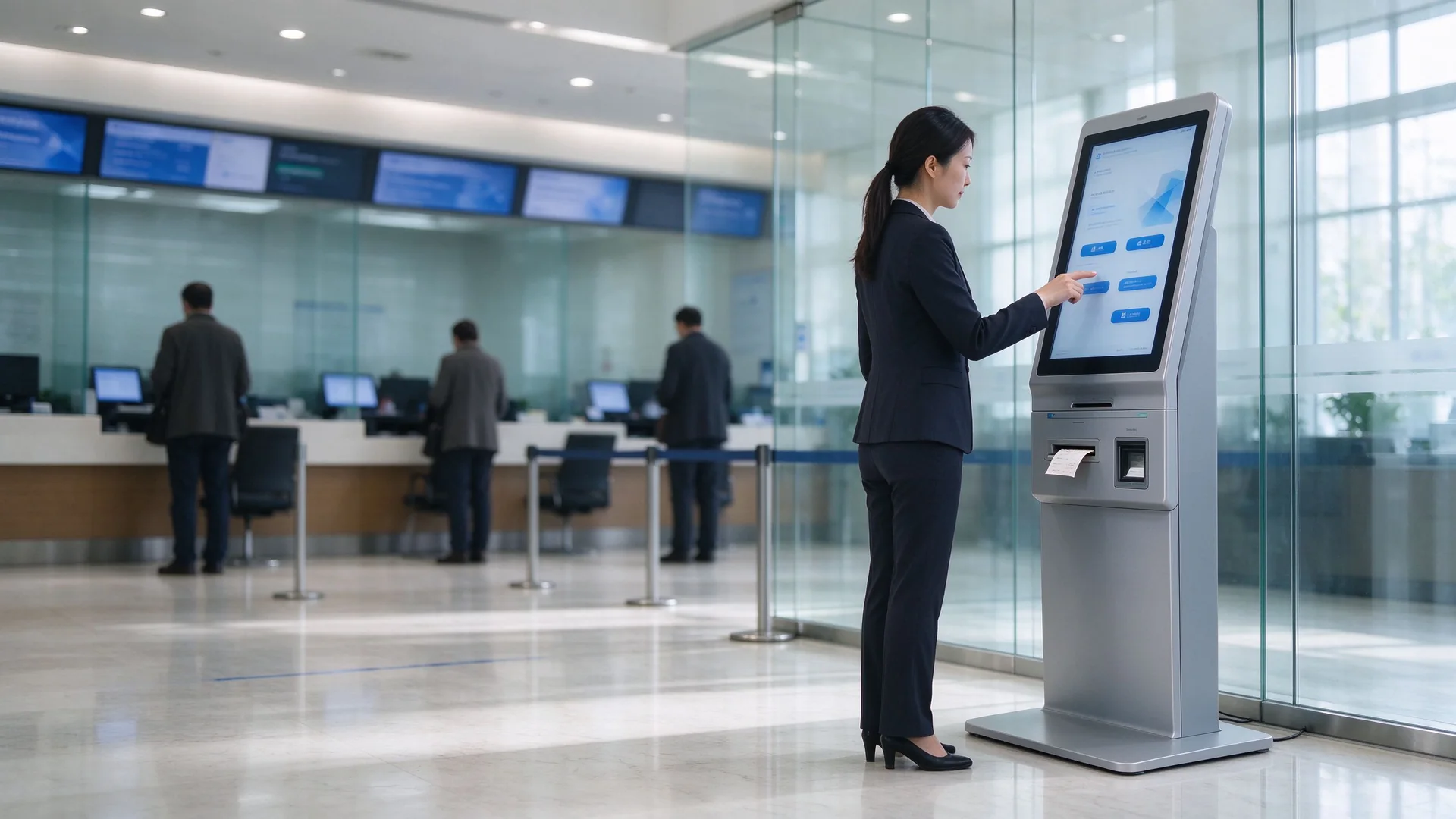
Queue time reduction reported on deployed queue kiosk projects
Service throughput increase per counter
Staffing cost reduction in peak-hour management
Country markets supplied since 2005
Almost no queueing kiosk fails at the demo stage. They fail in month four, when the printer chews a ticket during the 10 a.m. peak, when the software vendor says the interface is "not their scope", or when every visitor presses the wrong service button and the priority queue collapses into one line. This solution is specified around those three failure points.
A queue ticket dispenser runs hundreds of cuts a day. Paper dust, a half-pulled ticket and a cheap cutter turn the lobby into a manual queue within three months — and the printer sits inside a sealed cabinet nobody can reach.
Specified response: 80 mm thermal module with paper-out and jam detection on the option list, auto cutter rated for the daily ticket volume confirmed at RFQ, and every printer, host and power module reachable through a rear lock door — a technician swaps the module without dismantling the front panel.
The kiosk arrives, the QMS arrives, and the interface does not. Each side says the other owns the mapping. The lobby goes live with a paper logbook while the contract dispute runs.
Specified response: the interface contract is fixed at quotation — REST API or SDK documentation, database middleware tables and message queue topics are named in the integration plan, and the 8-step delivery path assigns each handoff to a named side.
Six identical buttons and no priority logic means VIP, appointment and walk-in tickets land in one line. The counters are busy all day and the waiting time still climbs.
Specified response: multi-level service catalog, appointment and VIP priority routing, queue transfer, multi-queue parallel operation and re-call handling are configured in the ticket client before go-live — not left to the default template.
Four modules carry the deployment: the ticketing interface, the identity and appointment layer, the serviceable enclosure, and the hand-off into calling, display and reporting. Each one is a procurement line item, not a brochure feature.
The kiosk prints a service-specific number in under three seconds, on 58 mm or 80 mm thermal paper, at 203 dpi. The visitor leaves the entrance holding a physical ticket with the queue number, service type and estimated wait — so the crowd stops forming in front of the counter and starts forming nowhere.
Buying note: a take-a-number kiosk that only issues sequential numbers is a counter, not a queue management system machine. Confirm the routing rules before you confirm the price.
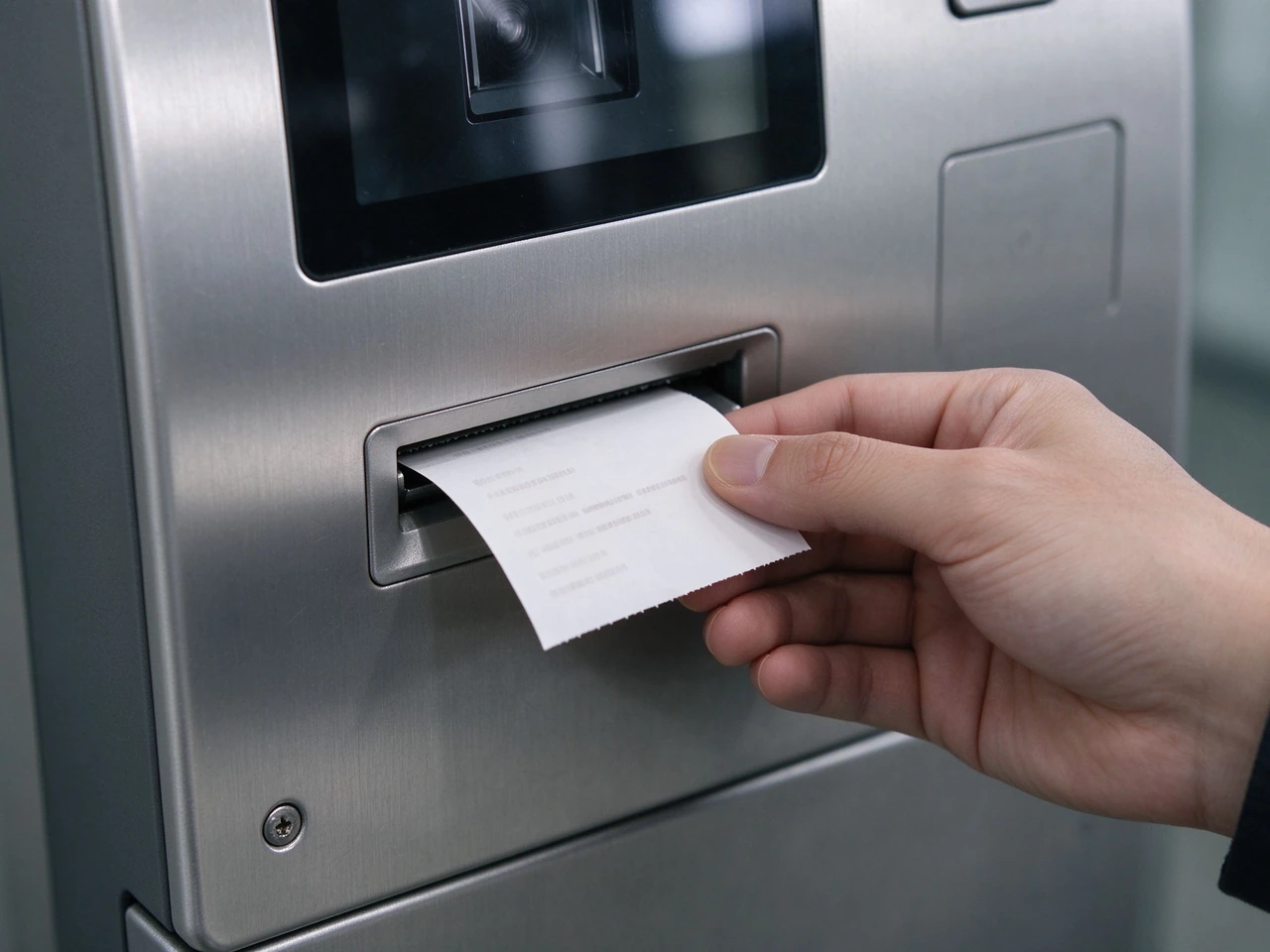
80 mm thermal ticket outlet with jam-free paper path — the module your maintenance team will touch most often.
A QR scanner on the control strip validates booking numbers, mobile appointment codes and membership QR on the phone screen — including dim screens in a bright lobby. When the project needs identity-based ticketing, the same enclosure accepts an ID card reader, passport reader, NFC/RFID or bank card reader on the second reader pad.
Buying note: the reader pads are cut into the enclosure at production. Adding an ID reader or NFC after delivery means a new panel — lock the module list at RFQ, not after installation.
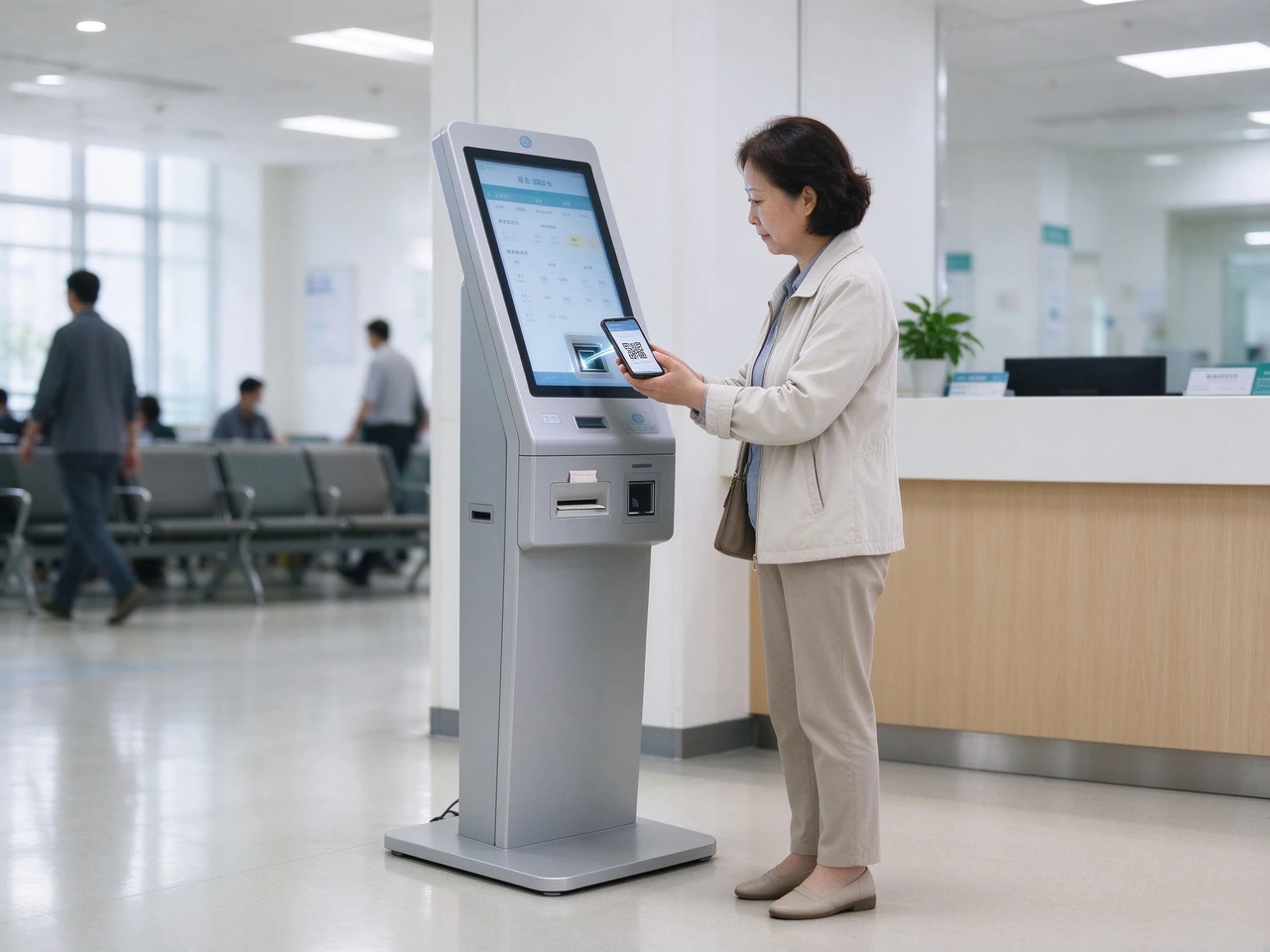
Outpatient appointment check-in by phone QR at a hospital queue kiosk — the appointment code replaces the walk-in ticket.
A floor-standing queue kiosk stays in the lobby for five years or more. Ours uses a sturdy steel body with anti-rust, anti-corrosion and wear-resistant surface treatment, an IP54-rated casing, a thin flat low base that resists being kicked, and rear lock access to the printer, host, power and cabling.
Buying note: paper changes are the highest-frequency maintenance event in any lobby. Ask to see the rear door open during the sample evaluation — that is the difference between a two-minute and a forty-minute paper change.
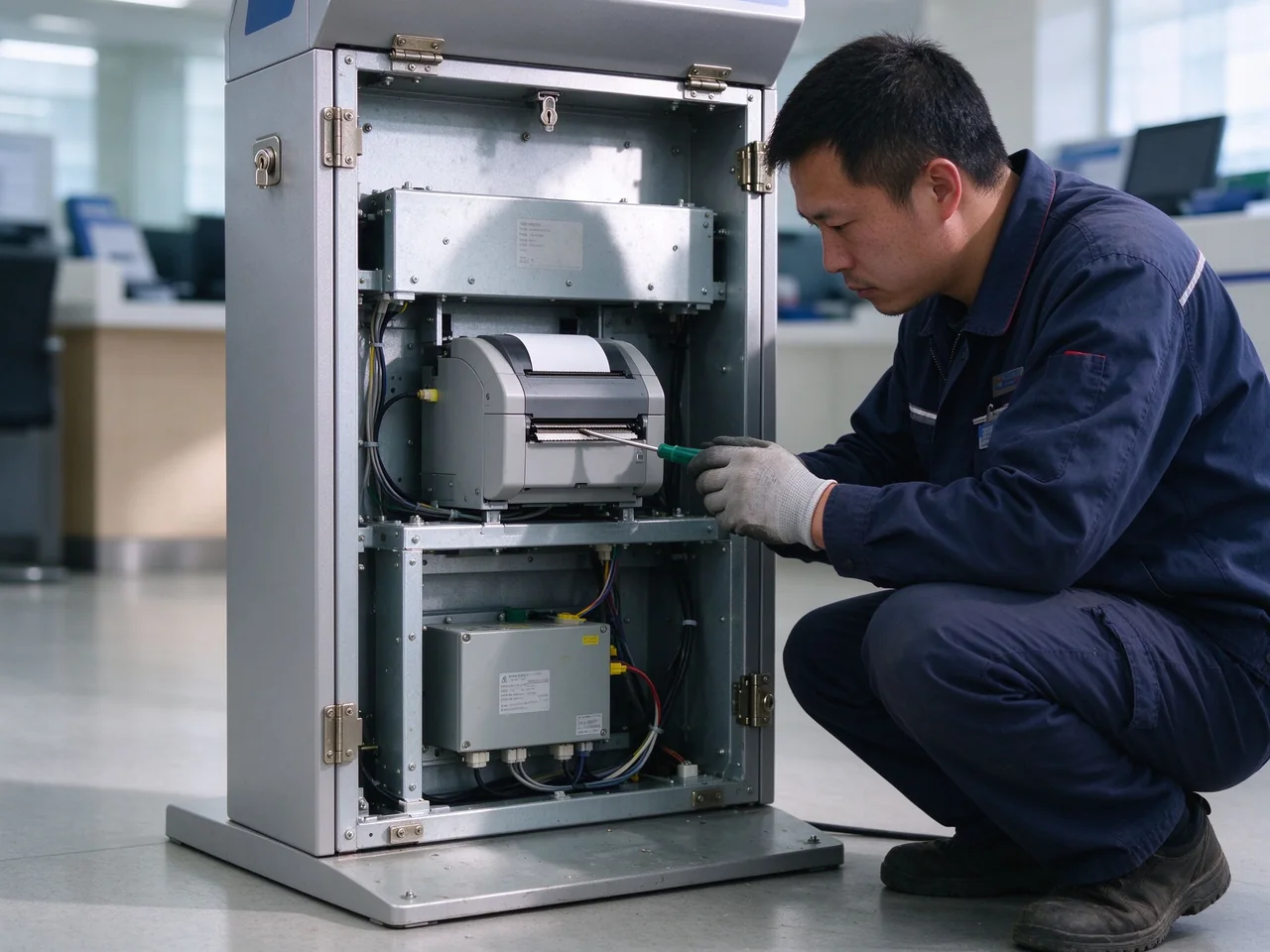
Rear service access: printer, host and power module are reachable from behind the unit.
A ticket is only half a queueing kiosk. Every number the kiosk issues is handed to the QMS server and pushed to counter calling terminals, the waiting-area queue board, multilingual voice broadcast, an SMS gateway and the mobile virtual queue, then aggregated into per-service and per-branch reports.
Deployment: single-site LAN, multi-branch private network, or cloud QMS with centralized rules and reporting across branches.
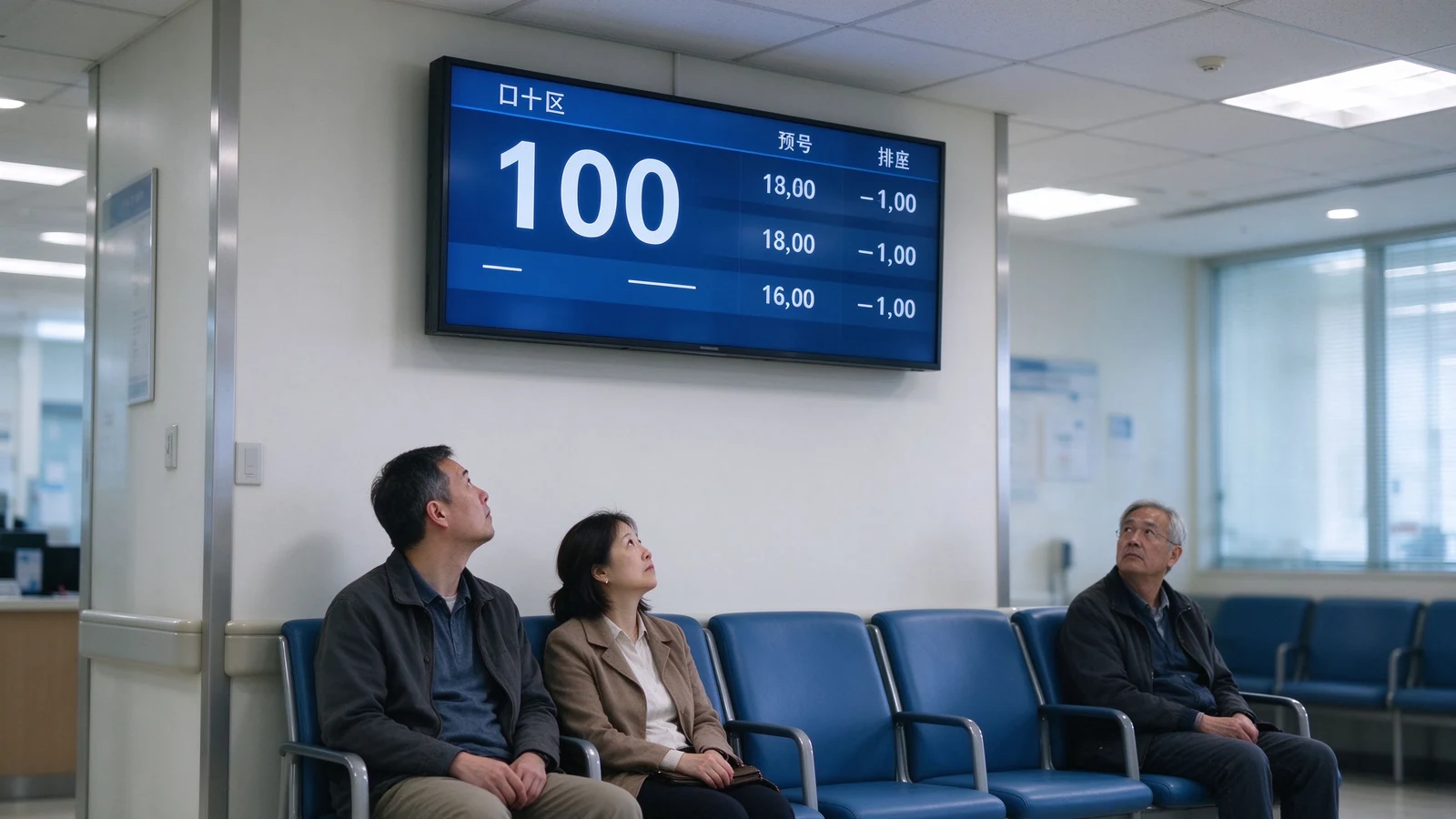
Waiting-area queue board fed by the same QMS: number, window and estimated wait in one view.
Parameters marked as confirmed on the BOM are locked at quotation, because they change with the configuration you order. Everything else ships standard on this floor-standing queue kiosk model.
| Block | Published specification |
|---|---|
| Display & touch | 17″ / 19″ / 21.5″; 1280×1024 or 1920×1080 (2K); contrast 1500:1; 4:3 or 16:9; projected capacitive 10-point touch; explosion-proof tempered front glass |
| Ticket printer | Built-in thermal line printing; 58 mm or 80 mm paper (project-defined); 203 dpi; print speed confirmed on actual BOM; auto cutter and paper-out / jam detection optional |
| Scanning & identity | QR scanner standard or optional per project; barcode scanner, NFC/RFID, ID card reader, passport reader and face recognition optional (face recognition requires compliance review) |
| Host & OS | Windows 10 / 11 standard; Android or domestic OS optional; CPU confirmed on actual BOM; RAM 4 / 8 / 16 GB; storage 128 / 256 / 512 GB |
| Network & interfaces | LAN standard; Wi-Fi / 4G / 5G optional; RJ45, USB, power and audio; centralized CMS remote management |
| Cierre | Sturdy metal / steel body; anti-rust, anti-corrosion, wear-resistant finish; IP54-rated casing; rear lock service access; thin flat low base; floor-standing installation |
| Electrical & environment | Input power, consumption, operating temperature / humidity and storage temperature confirmed on actual BOM for the destination market |
Certificates maintained current as published by Qtenboard: CE, FCC, RoHS, ISO 9001, with an IP54-rated casing as standard. Medical, financial and government project compliance, ID-reader compliance, face-recognition compliance and data-localization requirements are confirmed per project scope; certificates are released for distributor and procurement due diligence on request.
Each sector activates a different module set. The list below is what usually gets switched on for that queue type — use it to shortlist your own BOM instead of ordering the full option list.
Accounts, loans, VIP and consultation queues with card reader, appointment check-in and satisfaction survey. Priority routing keeps premium customers out of the walk-in line.
Priority + cardRegistration, triage, outpatient check-in, lab, pharmacy and payment queues with HIS integration, privacy-first data handling, multi-language and accessibility mode.
HIS + QR check-inIdentity-based ticketing and appointment validation for civic halls, with ID card or passport reader on the second pad and data-localization compliance confirmed per project.
ID / passportNew accounts, SIM services, repairs and device collection — service-type routing plus staff performance reporting per window.
Routing + reportsAppointment validation, service-advisor assignment, vehicle delivery and post-service satisfaction queues.
AppointmentVisitor check-in, ticket purchase, customer-service ticketing, member services and event check-in, with queue and promotional content rotating on the same display.
Check-in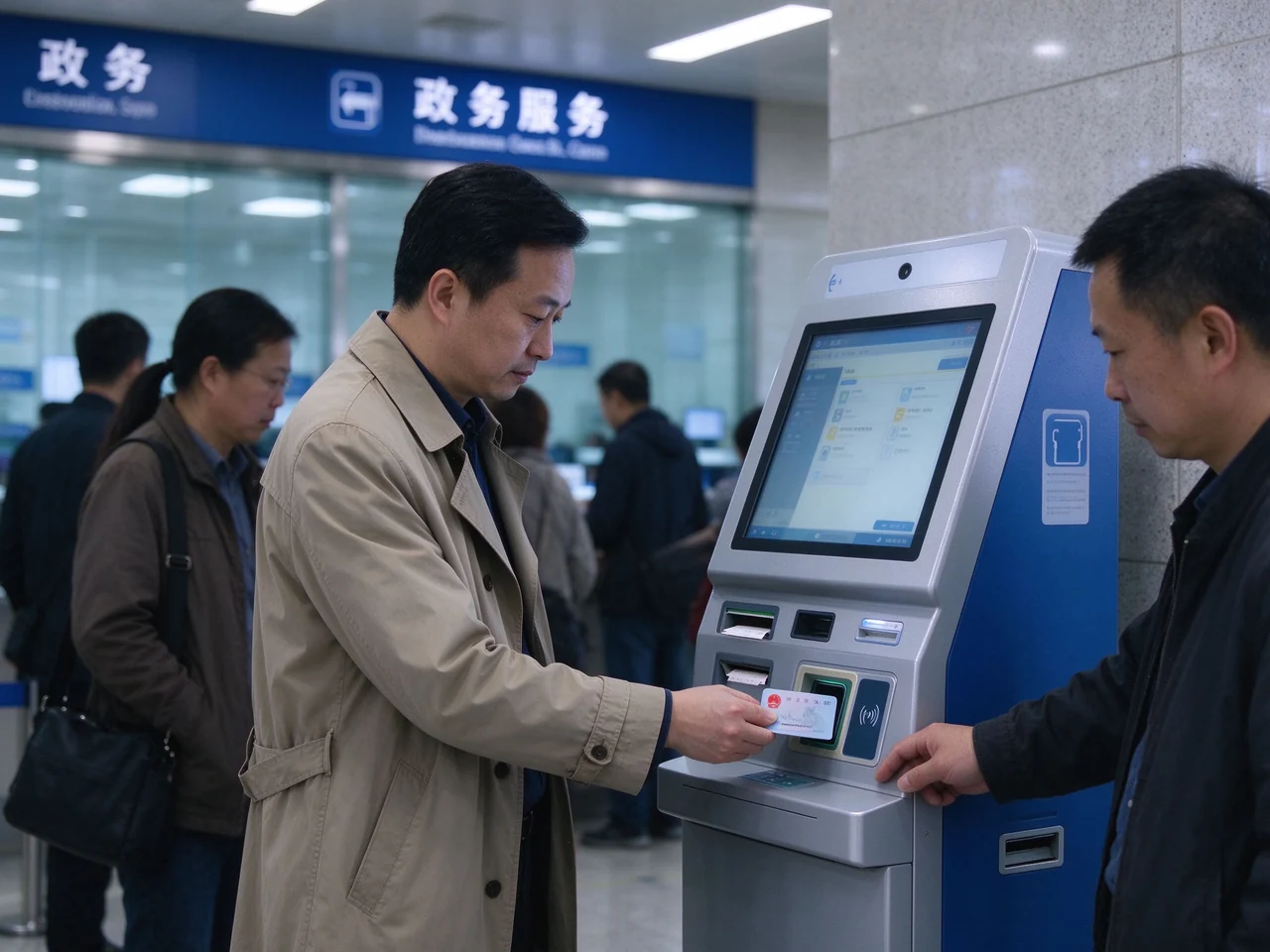
Government edition: ID card reader on the control strip for identity-based ticketing and appointment validation.
A government queue is tied to a person and an appointment, not to a random ticket. The government edition puts an ID card or passport reader on the control strip, validates the booking against the hall's own booking platform, and issues a ticket that the counter can match to a case file.
Compliance: ID card and face-recognition data require separate authorization and processing consent. Confirm the requirement at project stage — the reader module and the consent flow are specified together.
The two questions that decide whether a queue kiosk project runs on schedule are "what is the interface" and "who fixes it at 9 a.m. on a Monday". Both are answered in the quotation documents, not after delivery.
| Interfaz | Typical integration target | Who owns the mapping |
|---|---|---|
| API REST | Existing QMS, hospital HIS, CRM, government booking platform | Buyer's software team, against Qtenboard API documentation |
| SDK | Legacy queue software that controls printing and scanning directly | Software integrator, with factory SDK support window |
| Middleware de base de datos | Branch systems that expose only a shared database | Jointly defined: table schema confirmed at RFQ |
| Cola de mensajes | Multi-branch deployments with an existing event bus | Buyer's platform team, topic list confirmed before production |
| Importación/exportación de archivos | Reporting feeds, offline reconciliation, legacy exports | Buyer's reporting side, format sample agreed at quotation |
Configuration, OS, modules, integration scope, destination country.
Unit or sample evaluation against your ticket stock and code types.
System image and peripheral drivers standardized per order.
Batch production with factory quality checks per unit.
Single or multi-unit packing, wooden crate where required.
Floor mounting, anchor fixing, network configuration.
Backend connection and interface testing with your QMS.
Operator training, handover and post-launch monitoring.
After-sales terms as published by Qtenboard: 1–3 year warranty (project-defined), 1–5 year replacement parts support, online technical support pre- and post-sales, on-site repair arranged per project scope, software and firmware updates, and a 24/7 response option confirmed at quotation.
Deployment notes as published by Qtenboard for queue kiosk projects. Scope, integration target and outcome are kept separate, because a hardware order and a queue result are not the same thing.
Scope: OEM-customized queue kiosks at every outpatient entrance, branded to the hospital group's visual identity, with appointment lookup and insurance verification connected to HIS.
Integración: the queue layer is shared with corridor signage and physician-room panels, so arrival, check-in and consultation call stay in one data chain instead of three.
Resultado: a closed outpatient data chain from arrival to consultation call, plus higher patient adoption because the kiosk carries the institution's own branding rather than a generic third-party interface.
Scope: floor-standing bank queue kiosks with thermal ticket printing, QR check-in and SMS virtual queue across branch lobbies, replacing a manual sign-in sheet.
Integración: ticket numbers feed counter calling terminals, the branch queue board and the SMS gateway; waiting visitors can leave the lobby and still be recalled on time.
Published outcome: queue times reduced by more than 40% and customer satisfaction improved by more than 40% with an intuitive check-in flow.
A queue kiosk is the entry point of a queue system: it issues tickets, routes visitors by service type and priority, validates appointments, and hands every number to calling stations, waiting-area displays, voice, SMS and analytics. A standard self-service kiosk completes one business task — order, payment, print. That is why queue rules and window scheduling matter more than payment-flow logic when you compare offers.
Yes. Integration runs over REST API, SDK, database middleware tables, message queue or file import/export. Typical targets include existing queue management systems, hospital HIS, bank branch systems, government booking platforms, CRM, visitor management, SMS gateways and mobile apps. The interface contract is confirmed at project stage and written into the integration plan, which is what prevents the hardware-versus-software dispute later.
Windows 10 or 11 is the standard OS on this model, with Android or a domestic OS available per project. If your QMS client only runs on Windows, the standard build is already compatible; if your security policy mandates a specific image, the system image is standardized per order at step three of the delivery path.
Standard: floor-standing enclosure with wide low base, touchscreen, thermal ticket printer, QR scanner, host and network, and the QMS ticket client. Optional: ID card and passport readers, NFC/RFID, camera and microphone, 80 mm printer with auto cutter, 4G/5G/Wi-Fi, multi-language and accessibility kits, POS payment and satisfaction survey. Parameters not yet locked are confirmed on the actual BOM at quotation.
Both depend on configuration, operating system, modules and customization level (OEM, ODM or CKD-SKD). They are confirmed with the quotation; Qtenboard responds with a factory quote within 24 hours, and a sample unit can be arranged before mass production.
Yes. Private-label OEM covers your logo, packaging and UI. Full ODM covers hardware design, software stack, certification targets and accessory bundle. CKD/SKD component kits are available for local assembly markets. Body colour, screen size, interface count, mainboard configuration and packaging language can all be customized per order.
CE, FCC, RoHS and ISO 9001 are maintained current, with an IP54-rated casing standard. Medical, financial and government project compliance, ID-reader compliance, face-recognition compliance and data-localization requirements are confirmed per project. Certificates are provided for due diligence on request.
Yes. Visitors scan the QR code on their ticket to follow queue position on a phone, receive SMS or app notifications when called, and see a real-time expected waiting time — so they can wait outside the lobby without missing the number. Missed numbers are handled with recall and re-call rules at the counter terminal.
Send the configuration with your ticket stock, the code types you actually use and the systems to be integrated. Sample evaluation sits at step two of the standard path: print 50 consecutive tickets, scan your real appointment and membership codes, and open the rear service door — those three checks answer most of the acceptance risk before the PO.
The first quote lands closer to the final order when the RFQ already answers the questions the factory has to ask. These six items are the ones that change the BOM.
Qtenboard has built displays and self-service hardware from the component level since 2005 — as the OEM/ODM/CKD-SKD factory behind 110+ country markets, not as a reseller. For queue projects that means hardware, ticket client and integration support come from one accountable supplier.
See the full queue kiosk spec sheet
CEO | Experto en soluciones interactivas de visualización y colaboración
Soy el fundador de Qtenboard y aporto más de 17 años de experiencia práctica a la industria de las pantallas táctiles. Basándome en la perspectiva de gestión global obtenida a través de mis estudios de EMBA en la Universidad de ShenZhen, dirijo a mi equipo en la optimización de cada etapa de nuestras operaciones, desde la definición del producto hasta la gestión de la cadena de suministro de alta eficiencia, asegurando que nuestras capacidades de fabricación permanezcan a la vanguardia de la industria.
Como el líder de Qtenboard, me especializo en el abastecimiento de las soluciones adaptadas de OEM/ODM para los whiteboards interactivos, las paredes video del LCD, la señalización digital, y los terminales del tacto del industrial-grado. Con el respaldo de nuestro moderno parque industrial de 330.000 m² en Shenzhen, mantenemos el control del ciclo de vida completo sobre el diseño industrial, la fabricación de precisión y las rigurosas pruebas de rendimiento.
Con casi dos décadas de experiencia en proyectos, las soluciones de visualización de Qtenboard ahora se implementan en más de 120 países y regiones, y se ganaron la confianza de más de 15.000 clientes empresariales en todo el mundo. Si está buscando un socio receptivo con una base de fabricación profunda para sus proyectos personalizados de pantallas táctiles, mi equipo y yo estamos listos para respaldar su visión con excelencia profesional.

 spa
 EN
 pt
 vie
 th
 est
 lav
 aze
 ukr
 bel
 ru