
 ru
 EN
 spa
 pt
 vie
 th
 est
 lav
 aze
 ukr
 bel
О total cost of ownership of an interactive flat panel in Kazakhstan is not determined by its purchase price alone. Over five years, schools may also need to account for electricity, installation, maintenance, warranty coverage, spare parts, logistics and equipment downtime.
A lower initial quotation does not automatically mean a lower long-term cost. By comparing the same equipment requirements, service responsibilities and five-year operating assumptions, school procurement teams can make a more informed decision about which purchasing option offers better long-term value.
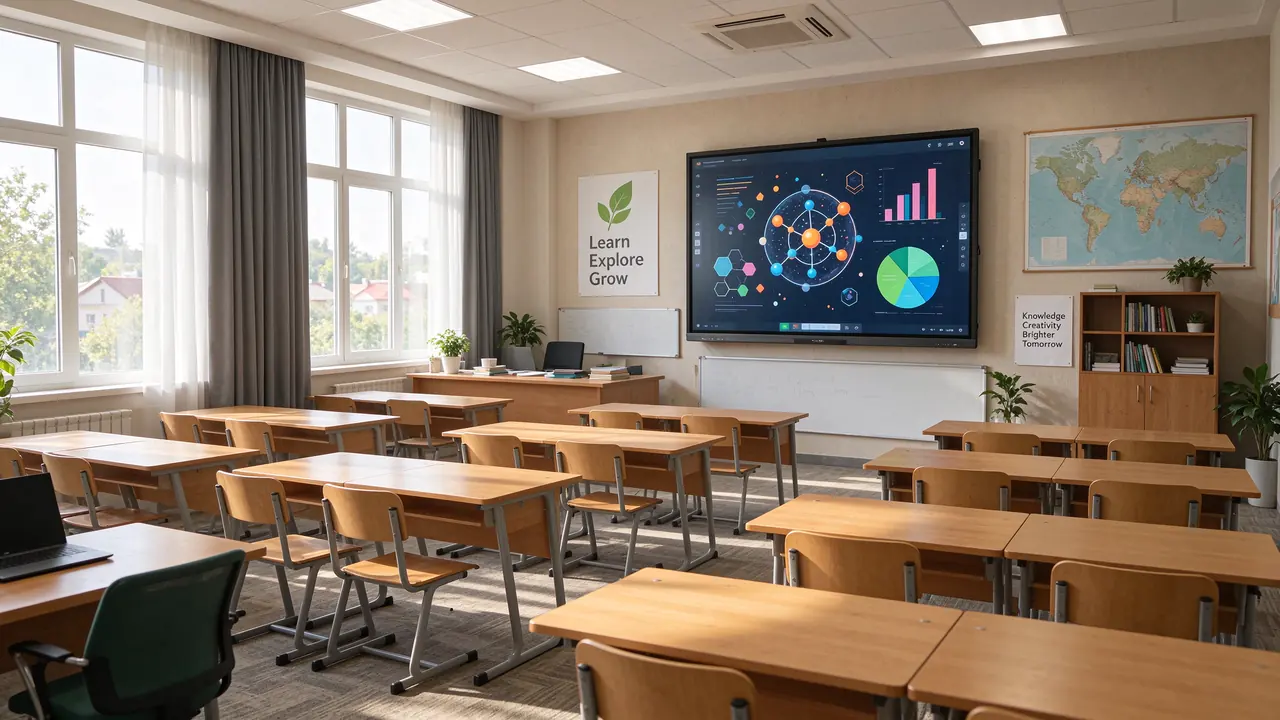
Long-term ownership planning for interactive flat panels in education environments
What Is the Five-Year Total Cost of Owning an Interactive Flat Panel in Kazakhstan?
Total cost of ownership, or TCO, is the combined cost of acquiring, operating, maintaining and managing equipment over a defined period. For a school purchasing interactive flat panels, a five-year TCO model provides a broader view than comparing the initial equipment quotations alone.
The calculation should include the equipment and its initial deployment, electricity consumption, maintenance, repairs, spare parts, applicable logistics and any costs that are not covered by the warranty. Where relevant, schools should also consider the cost of temporary replacement arrangements when a panel cannot be used.
The five-year period is a budgeting horizon, not a guarantee of the product's service life. Actual ownership costs depend on the selected model, classroom usage, site conditions, contract terms and the school's maintenance arrangements.
For education buyers, the purpose of TCO is straightforward: compare the expected cost of keeping equipment available for teaching, rather than choosing a supplier based only on the lowest initial price.
Which Costs Should Be Included in a Five-Year TCO?
A complete ownership model separates the initial purchase and deployment costs from expenses that may occur during operation. This distinction helps schools avoid overlooking costs or counting the same item twice.
| Категория расходов | What to Include | What Buyers Should Verify |
|---|---|---|
| Equipment purchase | Interactive flat panel, selected system configuration and required software | Model, display size, technical specifications and included licenses |
| Accessories and installation | Wall brackets, mobile stands, cables, mounting materials and setup | Whether accessories, labor and testing are included in the quotation |
| Initial logistics | Applicable transportation, insurance, local delivery and import-related expenses | Trade terms and the responsibilities of the seller and buyer |
| Electricity | Energy consumed during normal operation and standby periods | Actual average power consumption and expected usage hours |
| Maintenance and repairs | Inspection, troubleshooting, repair labor and non-covered components | Warranty exclusions and local maintenance responsibilities |
| Warranty and service | Warranty options, technical support and services outside the coverage | Coverage period, exclusions, response arrangements and claim procedures |
| Запасные части | Replacement components, shipping and related handling | Parts availability, replenishment process and shipping responsibility |
| Downtime and replacement | Temporary equipment, alternative teaching arrangements and coordination | How long repairs may take and what backup arrangements are available |
| End-of-period value | Any realizable residual value or disposal-related expense | Whether a reliable resale or reuse value can be supported |
Separate Initial Costs from Recurring Costs
Initial costs usually arise before the classroom begins using the equipment. These may include procurement, accessories, transportation, applicable import expenses, installation, configuration and initial training.
Recurring or event-based costs occur during operation. Electricity is generally recurring, while repairs, spare parts and local maintenance depend on actual usage, equipment condition and the service arrangement.
Schools should also check whether a supplier quotation already includes installation, software, accessories or logistics. If an item is included in the initial purchase price, it should not be added again as a separate TCO expense.
For product configuration planning, buyers can review the Qtenboard education interactive whiteboard range. The appropriate configuration should be selected according to classroom requirements rather than assuming that every room needs the same equipment.
How Do You Calculate the Five-Year Ownership Cost?
A practical TCO model should be detailed enough to support procurement decisions without making the calculation unnecessarily complicated. Schools can begin with the following formula and enter their own quotation, usage and maintenance data.
| Symbol | Cost Component | Calculation Basis |
|---|---|---|
| П | Equipment purchase | Supplier quotation for the selected configuration |
| А | Принадлежности | Required brackets, stands, cables and additional components |
| Л | Initial logistics and import-related costs | Applicable transportation, insurance, customs and delivery expenses |
| I | Installation and initial training | Installation, setup, testing and agreed training expenses |
| Э5 | Five-year electricity cost | Estimated energy consumption multiplied by the applicable electricity tariff |
| М5 | Five-year maintenance and repair cost | Expected maintenance and repair expenses not already covered elsewhere |
| В5 | Uncovered service costs | Service expenses outside the agreed warranty coverage |
| Вопрос5 | Replacement parts and logistics | Parts not supplied under warranty and their related shipping expenses |
| U5 | Downtime and replacement arrangements | Reasonable estimated costs of temporary equipment and operational adjustments |
| Д5 | Residual value | Supported value remaining at the end of the assessment period |
This formula is a planning framework, not a fixed quotation. If a supplier includes accessories, installation or initial training in the equipment price, the corresponding amount should not be counted twice.
Similarly, warranty-covered repairs should not be entered as school-paid repair expenses unless the school is responsible for additional charges under the contract. The calculation should reflect actual contractual responsibilities.
Calculate Electricity Consumption
Electricity is one of the recurring costs that schools can estimate using equipment specifications and expected classroom usage. A simplified calculation is:
Where:
- W: Average power consumption in watts.
- H: Average operating hours per day.
- N: Operating days per year.
- Y: Number of years in the assessment period.
- T: Applicable electricity tariff per kilowatt-hour.
For a five-year calculation, the assessment period is five years. Buyers should use typical or measured operating power where available, rather than automatically treating the maximum rated power as continuous consumption.
Actual energy use can vary with screen brightness, system configuration, connected devices, standby behavior and classroom operating schedules. If standby consumption is material, schools can estimate it separately using the expected standby hours and the corresponding power figure.
Estimate Maintenance and Downtime Separately
Maintenance costs should be based on the school's expected inspection, repair and replacement arrangements. A useful breakdown is to separate warranty-covered work, non-covered repairs, local labor, replacement components and transportation.
Downtime can also be estimated separately when a school has a clear method for valuing temporary replacement arrangements. For example, a school may record expected downtime hours and the cost of providing alternative equipment or additional support.
Here, Dх represents estimated downtime hours, Cх is the relevant cost per hour if the school has a defensible method for estimating it, and Ca represents additional alternative-equipment or coordination expenses.
Schools do not need to assign an arbitrary monetary value to every interrupted lesson. If reliable data is unavailable, record downtime as an operational risk and compare the suppliers' repair and support arrangements separately.
Calculation rule: Use the same five-year period, equipment specifications, usage assumptions and cost boundaries when comparing suppliers. Otherwise, the TCO results may look comparable while representing different levels of service.
Compare Two Purchasing Options: Lower Price vs. Extended Warranty and Support
Schools often compare a lower-priced equipment offer with another offer that includes a longer warranty option or more clearly defined support arrangements. Neither option is automatically better; the right choice depends on the equipment, contract and maintenance resources available to the school.

Procurement teams compare quotations, warranty scope and support arrangements before selecting a supplier
Option A: Lower Initial Purchase Cost
A lower initial purchase price may reduce the amount of capital required at the beginning of a project. However, buyers should check whether the quotation excludes accessories, installation, local maintenance, spare parts or other services that will need to be arranged separately.
This option may be suitable when the school has access to capable local installation and maintenance resources, understands the warranty limitations and can coordinate replacement parts when required.
Option B: Extended Warranty and Defined Support
An alternative offer may have a higher initial cost but provide a longer warranty option or a more clearly defined support arrangement. This can make future responsibilities easier to plan, provided that the contract clearly explains what is covered and what remains the buyer's responsibility.
A longer warranty does not automatically cover every repair, transportation expense, local labor charge or replacement component. Buyers should examine the exclusions and claim process rather than comparing warranty duration alone.
| Коэффициент сравнения | Option A: Lower Initial Cost | Option B: Extended Warranty and Defined Support |
|---|---|---|
| Initial purchase | Focuses on reducing upfront expenditure | May include additional cost for selected warranty or support options |
| Гарантийный срок | Verify the included period and coverage | Verify the extended period and contractual scope |
| Repair responsibility | Clarify which repairs are paid by the school | Check which repair responsibilities are included in the agreement |
| Запасные части | Confirm purchase channels and shipping arrangements | Confirm whether parts are included and under what conditions |
| Local maintenance | Estimate local labor and coordination costs | Check whether local labor is included or remains separately payable |
| Техническая поддержка | Confirm available troubleshooting and documentation | Confirm support channels, scope and response arrangements |
| Downtime planning | Assess backup equipment and local repair arrangements | Assess whether the support arrangement helps reduce operational delays |
| Five-year TCO | Calculate all additional expenses outside the initial quotation | Calculate the selected service cost and all remaining uncovered expenses |
To make the comparison meaningful, schools should request itemized quotations with the same display size, resolution, system configuration, accessories and delivery scope. The warranty period, exclusions, spare-parts responsibilities and installation arrangements should also be recorded in writing.
The preferred option is the one that meets the school's technical requirements and provides the most suitable balance of initial expenditure, expected operating costs and service responsibilities over the assessment period.
How Do Electricity, Exchange Rates and Taxes Affect TCO in Kazakhstan?
For projects in Kazakhstan, the final ownership cost may be affected by local electricity tariffs, the currency used in the supplier quotation and applicable import-related charges. These factors should be evaluated using the actual project and transaction details rather than assumed values.
Electricity Tariffs and Usage Assumptions
Electricity costs depend on the applicable tariff, the school's billing conditions and the actual operating schedule. Schools should verify the relevant tariff with their electricity provider or the applicable official source when preparing the budget.
Different classrooms may use interactive flat panels for different numbers of hours. A specialist teaching room, a frequently used classroom and a room with limited weekly use should not automatically be assigned identical energy consumption assumptions.
Foreign Currency and Tenge Conversion
If a supplier quotes in a foreign currency, the school can convert the quotation into tenge using a documented exchange-rate reference:
СFX represents the foreign-currency amount, while R is the exchange-rate reference selected for budgeting. The result is a planning conversion, not necessarily the amount that the buyer will pay after bank conversion conditions and transaction charges.
Schools should record the reference date, quotation validity period, payment currency and settlement arrangements. For official reference information, consult the National Bank of Kazakhstan.
Import Duties and Applicable Taxes
Import-related expenses depend on factors such as product classification, importer status, transaction structure and applicable customs procedures. Buyers should not assume that one tax treatment applies to every interactive flat panel project.
Check the applicable requirements with the relevant customs or tax authorities and qualified local import professionals. The State Revenue Committee of Kazakhstan is a relevant official source for customs and tax information.
For procurement teams: Use official information available on the date of budget preparation, record the source and date, and confirm the actual payment and import treatment before finalizing the contract. Do not treat an indicative exchange rate or an assumed tax rate as a confirmed project cost.
How Do Warranty, Repairs and Regional Service Affect Ownership Costs?
Warranty and service arrangements can significantly influence the cost of owning an interactive flat panel. However, a warranty period alone does not explain how a school will obtain technical assistance, replacement parts or local repair services.
Understand What the Warranty Actually Covers
Schools should review the warranty period, covered components, exclusions, claim procedure and responsibility for shipping or labor. A repair may be covered under the warranty while certain transportation, installation or local service expenses remain outside the agreement.
Qtenboard supports one-to-three-year warranty options, depending on the product model, project requirements and contractual agreement. If a school requires a three-year warranty, the selected option and its coverage should be clearly recorded in the quotation and contract.
Buyers can review the Qtenboard warranty policy and confirm the specific terms applicable to the products being purchased.
Separate Remote Support from Local Maintenance
For projects in Kazakhstan, schools should distinguish remote technical support from on-site installation and first-line repair services. These are different responsibilities and should not be treated as interchangeable.
Qtenboard can provide technical documentation, installation guidance, product information and remote technical support. Local installation and first-line maintenance are arranged by the customer or its local service provider according to the project agreement.
Replacement parts are arranged for shipment from China. Buyers should therefore confirm the parts request process, shipping responsibility, expected logistics arrangements and any local handling costs before deployment.
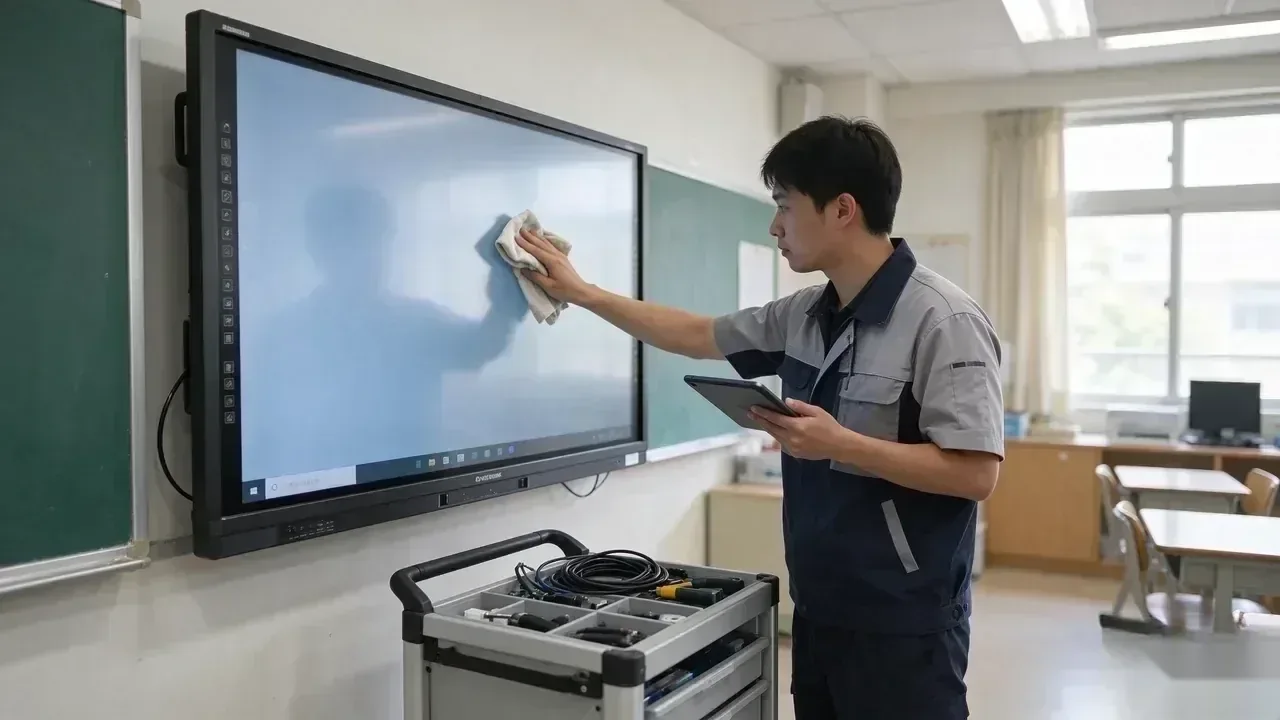
Local inspection, maintenance and spare-parts planning support uninterrupted classroom use
| Service Item | What Should Be Confirmed | TCO Impact |
|---|---|---|
| Удаленная техническая поддержка | Support channel, scope and information required for troubleshooting | Coordination and technical support expenses, if applicable |
| Local installation | Who supplies installers and completes site work | Local labor and installation expenses |
| First-line maintenance | Who inspects the equipment and performs local troubleshooting | Local service and repair expenses |
| Replacement parts | How parts are requested, approved and supplied | Part costs where applicable and shipping expenses |
| Warranty claims | Covered failures, exclusions and shipping responsibilities | Expenses not covered by the agreed warranty |
Clear responsibility boundaries help schools avoid unexpected expenses and make it easier to plan maintenance across multiple classrooms. For larger education deployments, these arrangements should be documented before the first batch is delivered.
How Can Schools Reduce the Five-Year Cost of Ownership?
Reducing TCO does not necessarily mean selecting the least expensive interactive flat panel. A more reliable approach is to match equipment configuration, usage requirements and service arrangements so that unnecessary costs are avoided throughout the ownership period.
-
Select equipment according to actual classroom needs.
Choose display size, system configuration, touch functions and accessories based on room dimensions, teaching activities and applicable procurement specifications. Avoid paying for functions that are not required, but do not compromise mandatory technical requirements.
-
Verify actual power consumption.
Request typical power consumption information and consider the school's operating schedule. This provides a more realistic electricity estimate than using maximum rated power as the only reference.
-
Standardize configurations where practical.
Using consistent models and accessories across suitable classrooms can simplify training, inventory management and spare-parts planning. Standardization should still allow for rooms with different technical requirements.
-
Clarify warranty and service responsibilities before purchase.
Confirm warranty coverage, exclusions, repair procedures, local labor responsibilities and spare-parts logistics. Written terms make future maintenance costs easier to estimate.
-
Prepare a preventive maintenance process.
Keep equipment clean, follow operating instructions, manage cables properly and maintain records of faults and repairs. Routine checks can help identify issues before they disrupt classroom use.
-
Use pilot deployment and phased procurement.
Test representative classrooms before expanding to a larger project. Pilot results can help verify installation conditions, equipment configuration, teacher training and support procedures.
For broader deployment planning, schools can explore Qtenboard education solutions. A project review should consider not only the display itself, but also the classroom environment, equipment configuration and long-term management requirements.
Часто задаваемые вопросы
What Is Included in the Five-Year TCO of an Interactive Flat Panel?
A five-year TCO calculation can include equipment purchase, accessories, initial logistics, installation, training, electricity, maintenance, repairs, spare parts, uncovered service expenses and downtime arrangements. Any residual value should be deducted only when it can be reasonably supported. Costs already included in the original quotation should not be counted twice.
Does a Longer Warranty Always Reduce Ownership Costs?
No. A longer warranty may reduce certain repair expenses, but its value depends on the covered components, exclusions, claim conditions, shipping responsibilities and local labor arrangements. Schools should compare the additional warranty cost with the expenses it actually covers over the same assessment period.
How Can a School Calculate the Electricity Cost of an Interactive Flat Panel?
Use the equipment's typical power consumption, expected daily operating hours, operating days per year and applicable electricity tariff. Calculate energy consumption in kilowatt-hours and multiply it by the relevant tariff. Where standby use is significant, estimate it separately rather than assuming the panel operates continuously at its rated maximum power.
Who Should Handle Repairs and Spare Parts in Kazakhstan?
The responsibilities should be agreed before procurement. Qtenboard can provide technical documentation and remote support, while local installation and first-line maintenance are arranged by the customer or its local service provider. Replacement parts are arranged for shipment from China, with shipping and local handling responsibilities confirmed for the project.
Should Schools Compare Purchase Price or Five-Year TCO?
Schools should compare both. The purchase price shows the initial financial commitment, while five-year TCO provides a broader view of expected ownership expenses. Comparing quotations with the same equipment configuration, usage assumptions and service scope gives procurement teams a more reliable basis for decision-making.
Plan the Long-Term Cost of Your School's Interactive Flat Panels
A useful five-year TCO estimate starts with the equipment quantity, selected configurations, classroom usage hours, deployment locations and expected service arrangements. Qtenboard can review these requirements and discuss suitable education display configurations, warranty options and technical support arrangements for the project.
Share your classroom quantities, preferred models, installation conditions and warranty requirements to begin a project discussion.
Explore Qtenboard education products and project solutions:
