A wheeled, battery-powered 32-inch smart screen that a store team can move from the front entrance to the OTC aisle, the counter and the consultation corner inside one trading day — with factory-level customisation, a device-management layer head office can actually operate, and the compliance guardrails a pharmacy chain's legal team will ask about before signing.
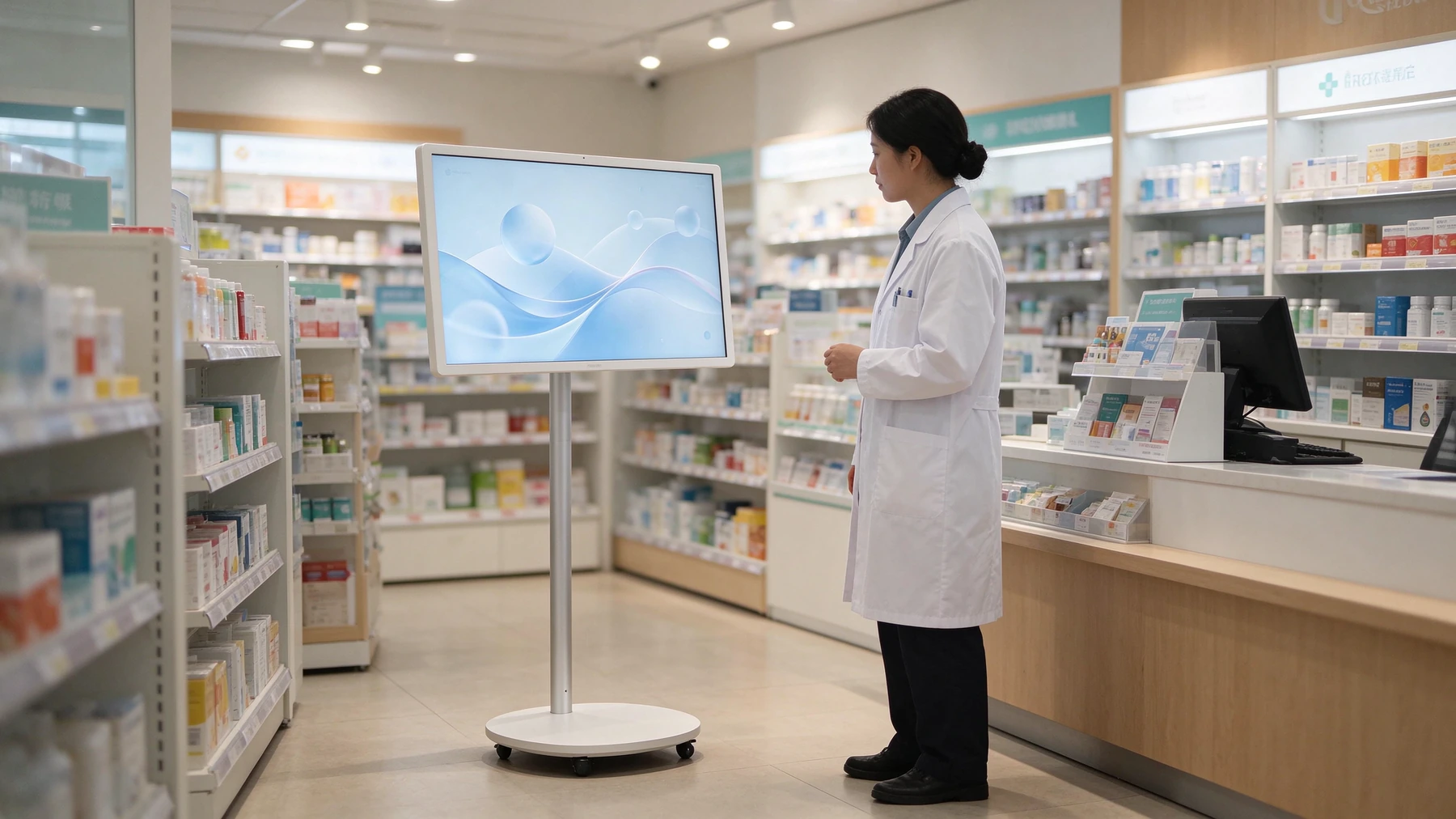
These are the objections we hear from chain operations directors, store managers and procurement teams in the first meeting. Each one has a specific answer — not a slogan.
A poster on the entrance glass cannot follow the customer. In a 400㎡ store the traffic path changes by hour: morning commuters, lunchtime OTC buyers, evening chronic-disease refills.
Forty stores, one monthly campaign, USB sticks and a regional manager on a train. By the time the material is live, the campaign is half over.
The pilot looks great for six weeks. Then the person who ran it changes role, and the screen becomes an expensive black rectangle in the corner.
A drugstore trades 12–14 hours. A mobile screen does not run that long at full brightness on one charge, and nobody wants a dead screen at 6pm.
Glass shopfronts and bright entrance zones wash out a 300–400 cd/m² indoor panel. The first photo the client sends you is "we can't see anything".
Pharmacy content is the most tightly regulated retail content there is. One prescription-medicine promotion on screen and the project is frozen by the client's legal team.
Procurement teams usually compare four device categories. They are not interchangeable, and the difference is not the screen — it is whether the asset can be re-deployed without a work order.
| Otsustamise tegur | Fixed TV | Wall / floor digital signage | Tablet | Qtenboard mobile smart screen |
|---|---|---|---|---|
| Can be re-positioned | Ei ole. | No — relocation means new install | Yes, but by hand and easily lost | Yes — silent castors, no cable, no work order |
| Screen size for 3–5 m viewing | Hea küll. | Hea küll. | Poor | Good — 21.5" to 43" available |
| Touch and customer interaction | Remote only | Mostly non-touch | Hea küll. | Multi-touch panel, direct interaction |
| Fleet management across stores | Puudub | Vendor CMS, often locked | MDM | L1 offline / L2 Qtenboard DMS / L3 API |
| Brand and software customisation | Puudub | Piiratud piiratud | Puudub | Open-mould branding, boot animation, pre-installed apps |
| Wiring and installation cost per position | Kõrge | Kõrge | Puudub | None — battery powered |
A pharmacy does not need one screen in one place. It needs the right screen in four places at four different times of day — and that is exactly what a movable unit changes about the economics.
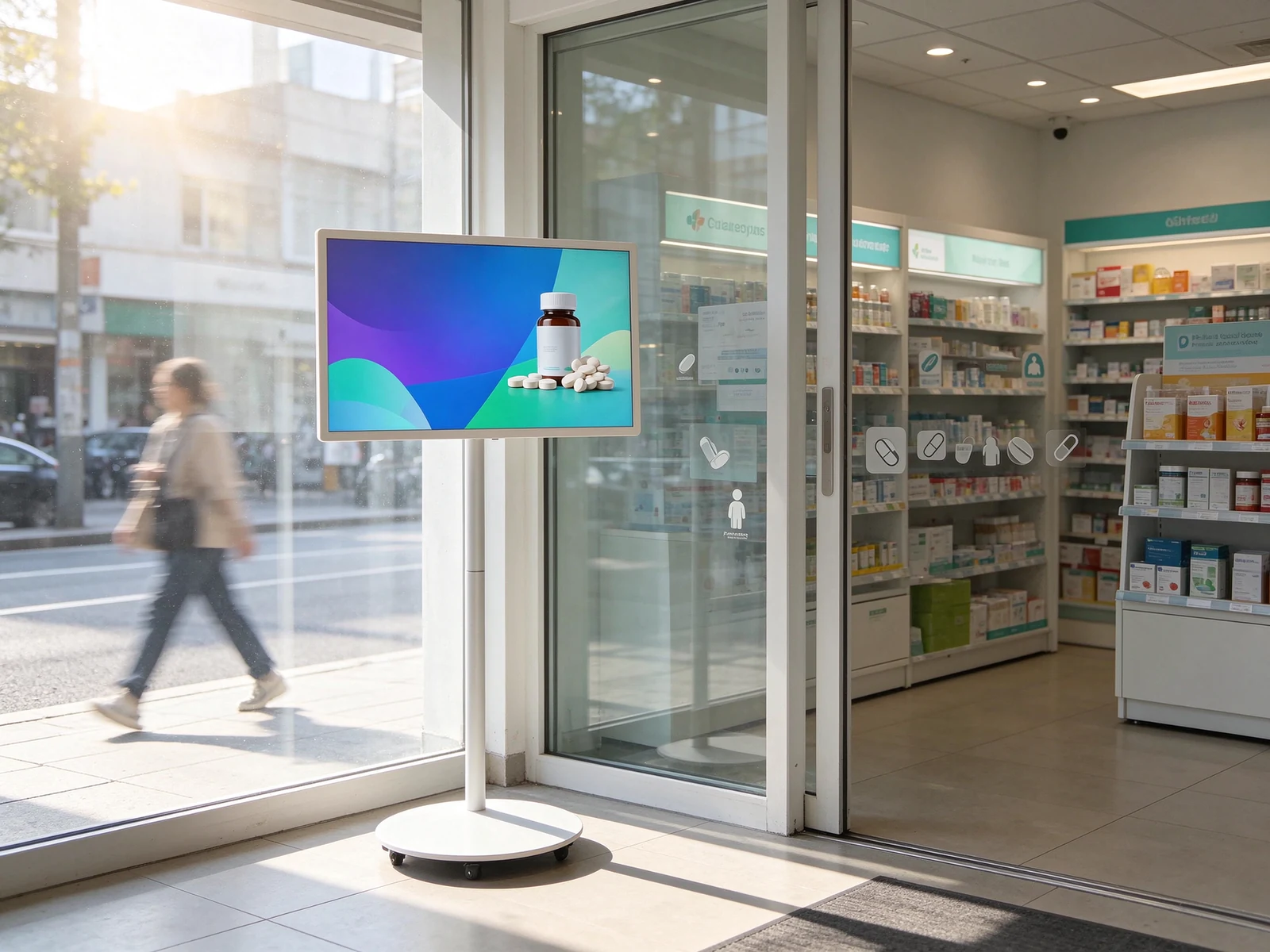
Traffic capture. Seasonal campaigns, health-day themes, new-category launches. This is the zone where brightness matters most: a glass frontage can push ambient light far above what an indoor panel handles comfortably.
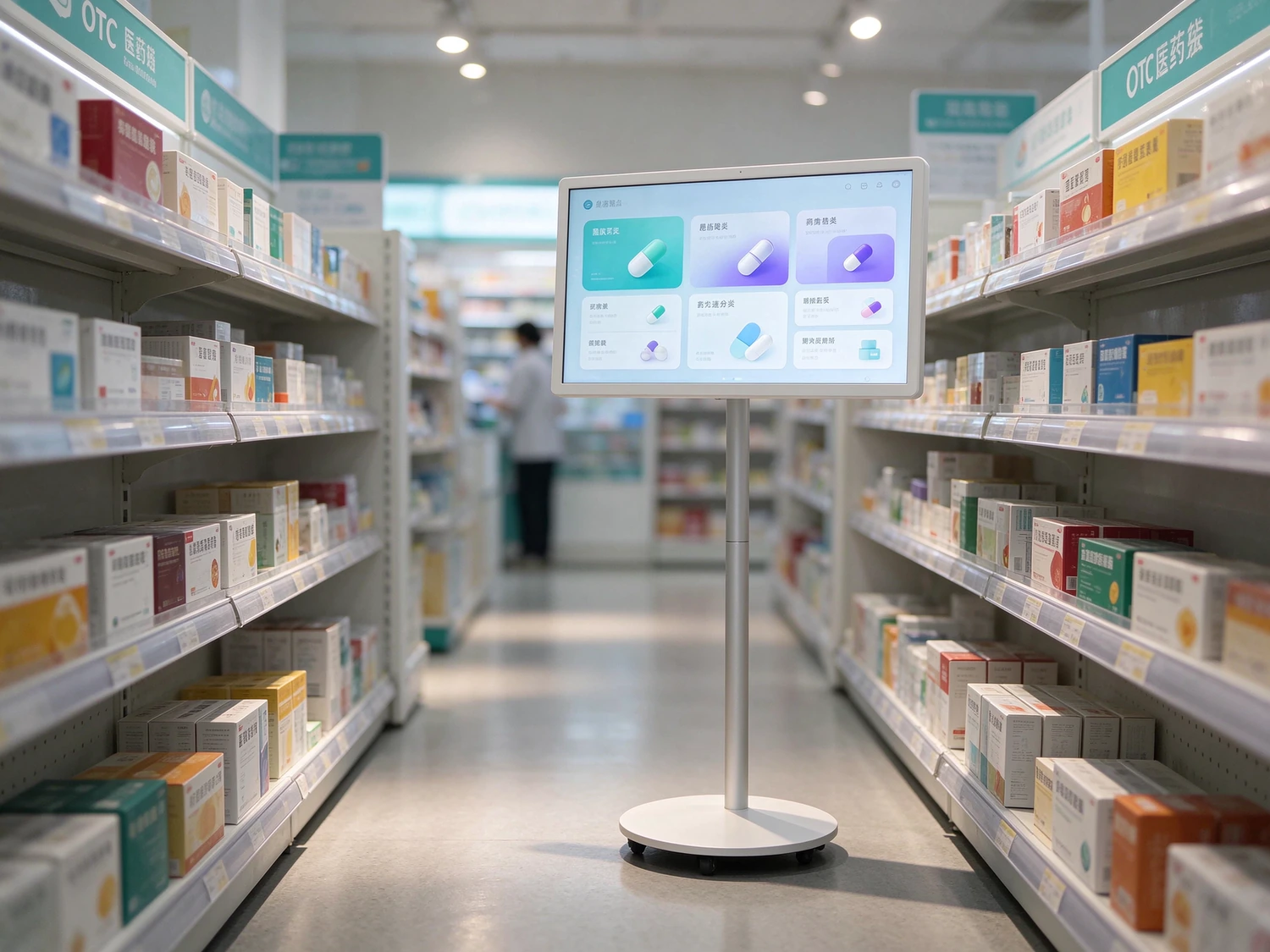
Category education at the point of hesitation. Where a shopper stops and reads a pack, a screen can answer the comparison question the pack cannot. A 27" unit keeps the aisle walkable; a 32" suits a wider category end.
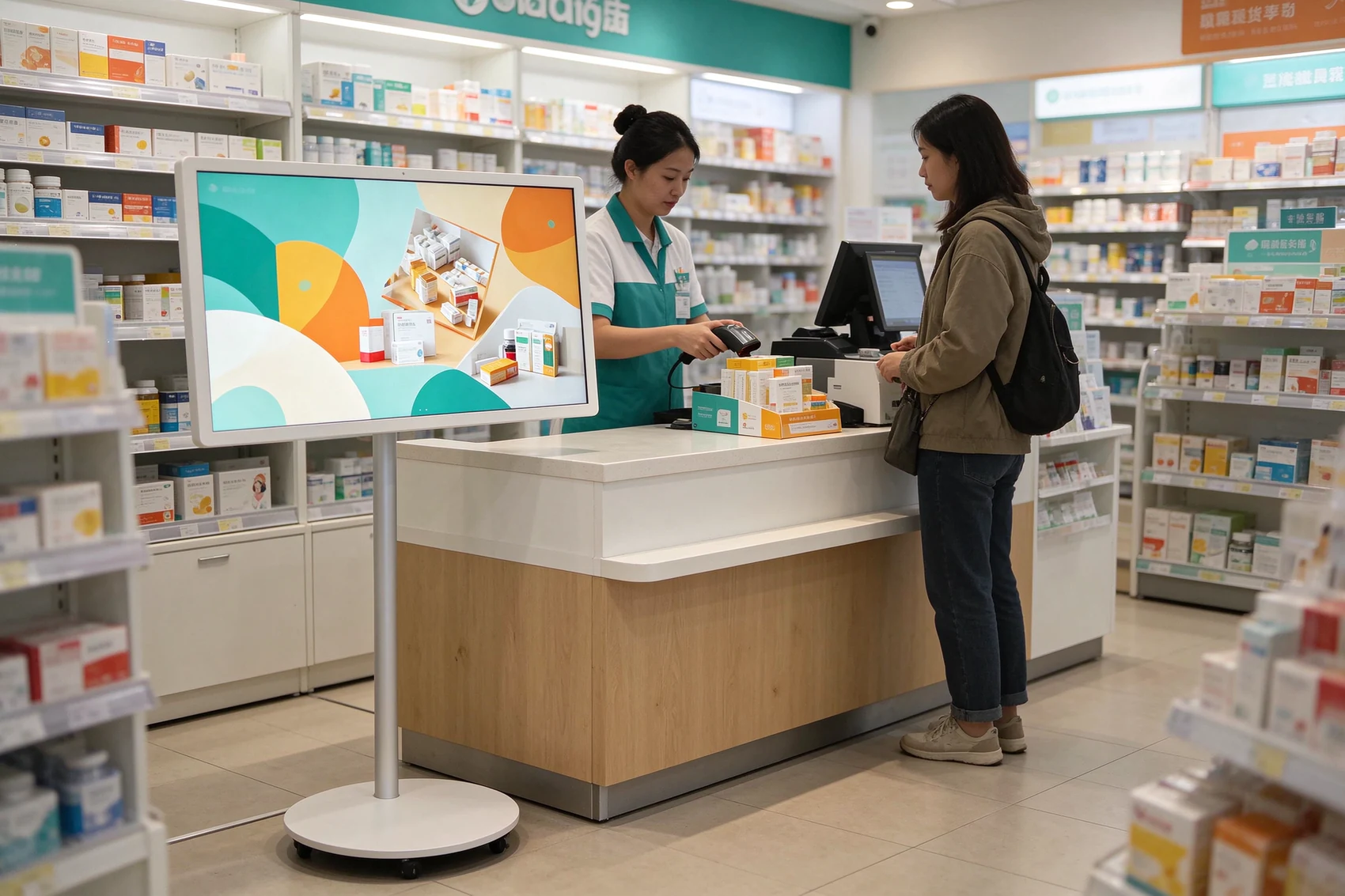
The highest-value 90 seconds in the store. Basket-building messages, member-programme sign-up, refill reminders and service announcements — placed where the customer is already standing still.
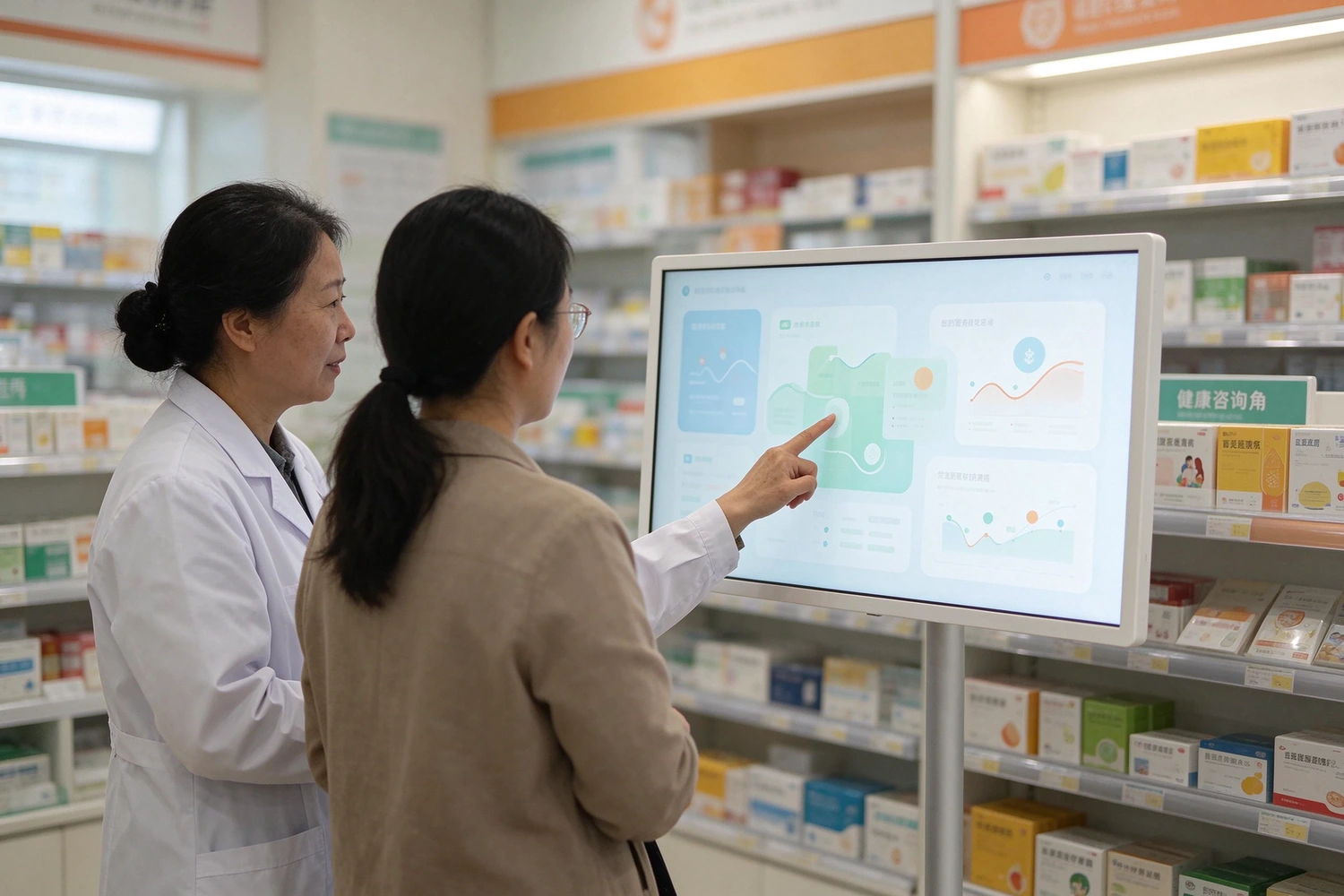
Touch-led explanation: how to take a product correctly, storage and handling, lifestyle context, service scope. Content is educational and non-diagnostic, and stays inside the client's approved library.
Retail is where the volume is, but the same wheeled, battery-powered unit is the answer to two other commercial briefs we get asked about constantly — a wedding that has to look right in a hotel ballroom, and a trade show stand that has to work on a concrete floor for three days with no power run.
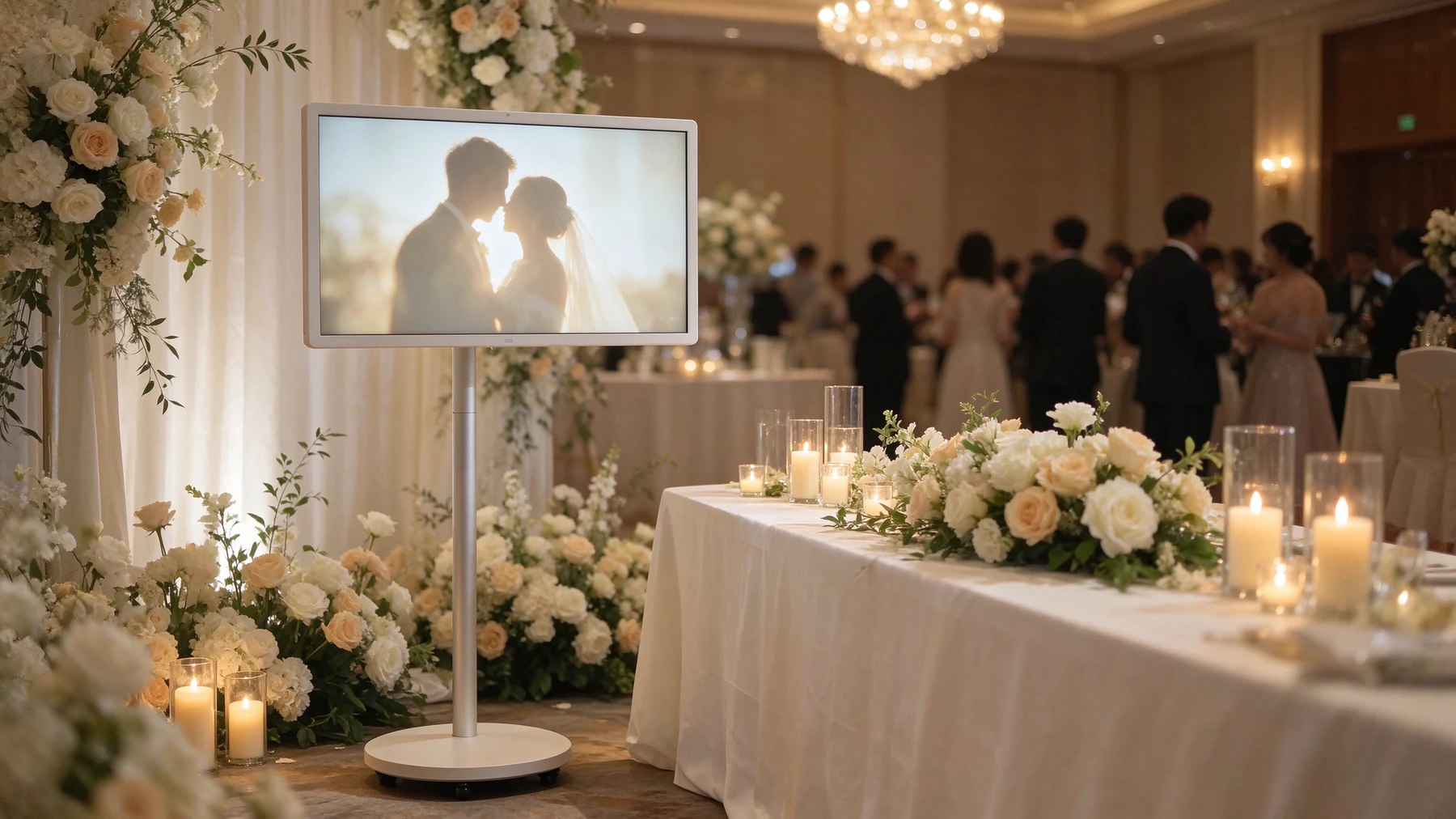
Where a hotel or a wedding planner currently rents a fixed LED wall, this unit does the job at a fraction of the setup: a photo and film loop at the welcome table, the couple's story before the entrance, table guidance during the banquet. It moves with the décor instead of being built into it.
A ballroom cannot be drilled, and the ceremony cannot be interrupted by a noisy castor. Specify quiet castors, a white or champagne finish that matches the styling, and a runtime that covers a four to six hour event on one charge — then it goes back in the van.
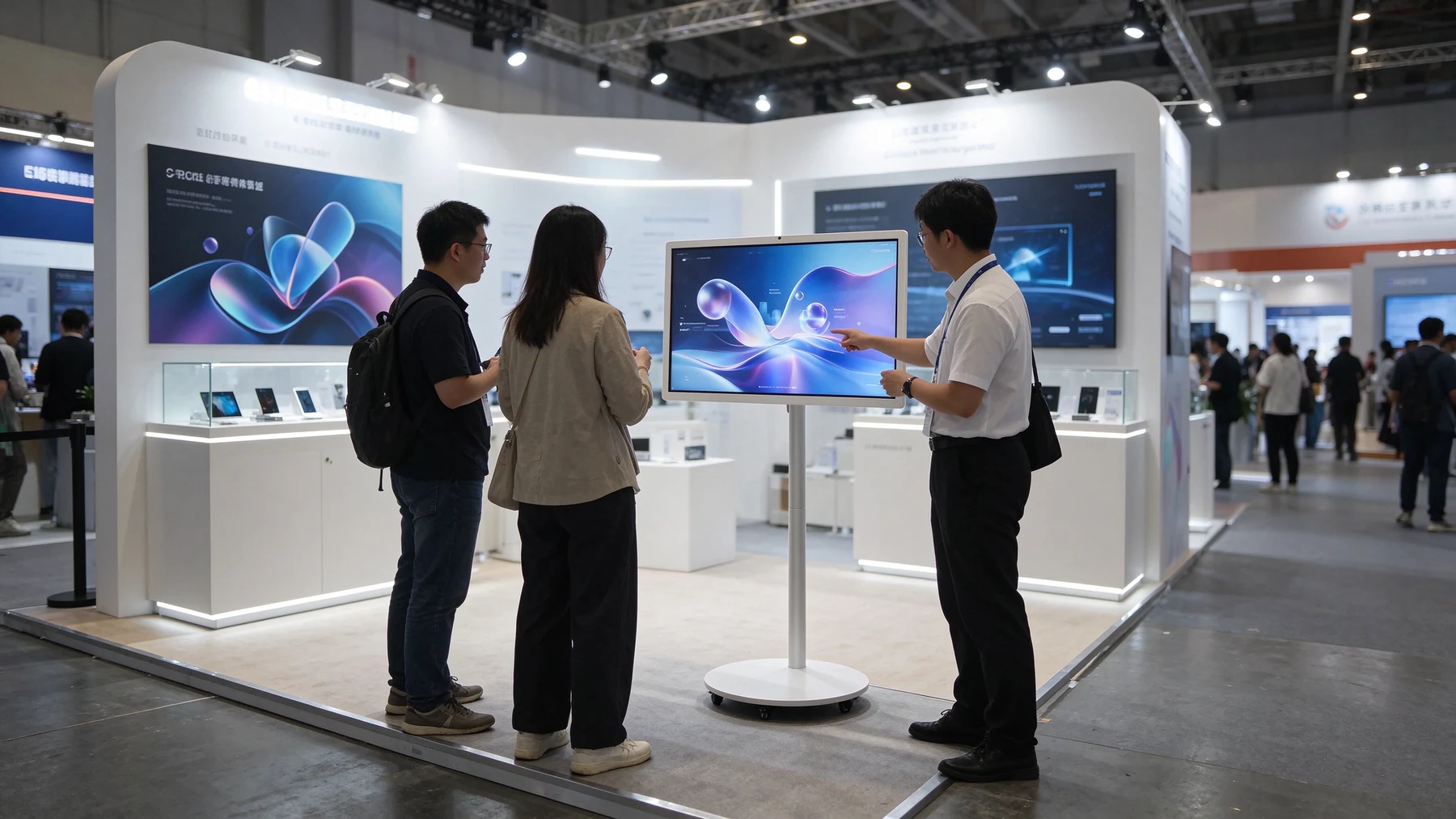
A three-day show on a concrete floor, hall lighting that is far brighter than a store, and a power outlet four stands away. That is the real brief — not "a screen on a stand". High brightness, a battery that survives a full show day, and a unit one person can wheel, load and re-position between halls.
The commercial value is the demo position itself: at the aisle edge rather than behind the counter, so a visitor can walk up and touch the product, and the stand staff can move it when the traffic shifts between halls.
The rental angle worth putting in front of a distributor. A single SKU that can run a pharmacy promo on Monday, a wedding on Saturday and a trade show the week after is a rental asset with three revenue streams and one spare-parts pool. That is why we quote event and exhibition deployments on the same platform rather than a separate product line — and why the rental and managed-position models in section 12 apply to event suppliers as well as to stores.
Five sizes are available on the same mobile platform. The rule we give procurement teams: match the diagonal to the viewing distance and the zone, then choose brightness and battery by the store's trading pattern.
| Suurused | Best-fit zone | Typical viewing distance | Brightness option | Battery / runtime | Notes for pharmacy use |
|---|---|---|---|---|---|
| 21.5" | Counter end cap, small-format store | 1.5 – 2.5 m | Indoor standard | Standard pack | Lowest footprint; best where floor space is the constraint |
| 23.8" | Counter, narrow aisle, back-office training | 2 – 3 m | Indoor standard | Standard pack | Good compromise between footprint and legibility |
| 27" | OTC aisle, consultation corner, small clinic counter | 2.5 – 3.5 m | Indoor standard / low-blue option | Standard or extended pack | Keeps the aisle walkable; ideal for touch interaction |
| 32" | Entrance, counter, chain standard model | 3 – 5 m | Indoor standard / high brightness | Extended pack | Recommended chain standard: one SKU, one spare-parts pool |
| 43" | Wide entrance, atrium event, in-store campaign stage | 4 – 7 m | High brightness recommended | Extended pack | Check aisle clearance before specifying; larger turning circle |
One-SKU discipline pays for itself. Chains that standardise on a single 32" model across all four zones get three things a mixed fleet never gets: one spare-parts pool, one firmware baseline, and one training script for store staff. If a zone genuinely cannot take 32", specify the exception once and record it in the store plan rather than letting each regional manager choose.
Need a private-label version for a distributor or a pharmacy brand's own identity? See the OEM/ODM customisation guide Ja 32" portable smart screen product page.
Most mobile-screen projects fail on physics, not on marketing. This table is the one we walk through with store engineering and facilities teams.
| Constraint | What usually goes wrong | How we specify around it |
|---|---|---|
| Trading hours vs runtime | 12–14 hour day, single charge, screen dies before the evening peak | Per-store charge-window map: charge during low-traffic windows, plus hot-swap packs for stores with two peaks. Runtime is configuration-dependent and confirmed against your brightness and content profile. |
| Välisvalgus | Entrance and window positions wash out at midday | High-brightness variant on entrance/window zones only; indoor standard elsewhere. Avoid paying for brightness you do not need in the aisle. |
| Castor grade | Consumer-grade silent wheels wear out on tiled retail floors within months | Commercial castor option with locking brakes; specify floor type (tile, polished concrete, ramp) at survey stage. |
| Cleaning and disinfection | Daily wiping with alcohol or chlorine-based disinfectant degrades consumer-grade coatings | Confirm the cleaning agent with our engineering team before order; specify a compatible surface treatment where daily disinfection is required. |
| Aisle clearance and egress | A parked unit blocks a walkway or, worse, an emergency route | Mark standing positions on the store plan during survey; keep egress routes clear at all times; define a "park here" sticker set for staff. |
| Stability and anti-theft | Tipping on uneven floors; unit walked out of the door | Weighted base, castor locks, optional floor-anchor or cable-lock kit, and serial-number asset tagging linked to the device list. |
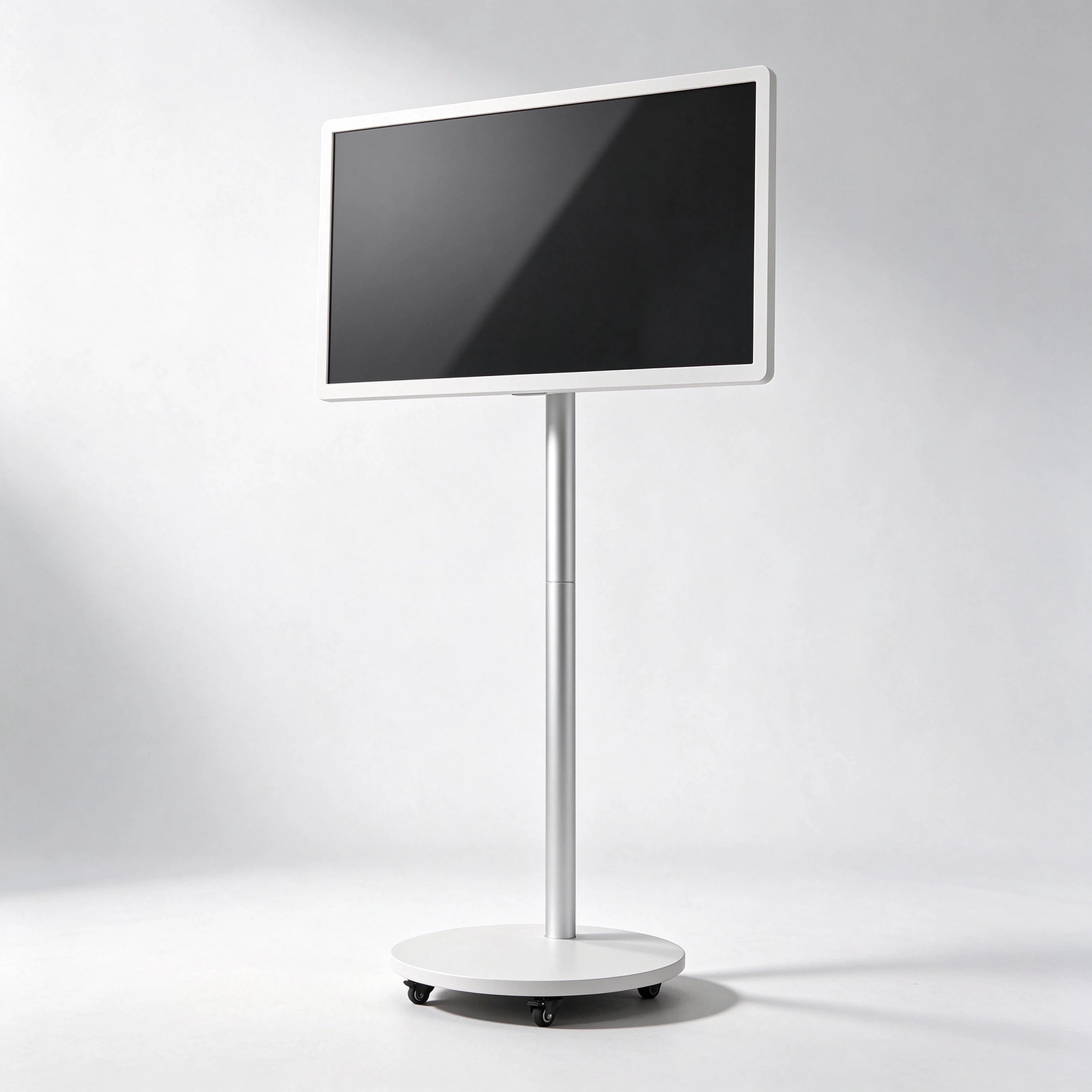
The question that decides the deal is rarely the panel. It is "how do I run this across every store without hiring someone". We answer it in three levels, and you can move up without changing the device.
| Level | Fleet size it suits | Mida see teeb | What the client needs to provide |
|---|---|---|---|
| L1 · Local, offline | 1 – 5 units, single store | USB content load, timed playback, auto-start on power, local app whitelist. Works with no network at all. | Nothing beyond a named store owner |
| L2 · Qtenboard DMS | 6 – 200 units, regional chains | Device groups by region and zone, playlist scheduling, remote power on/off, screenshots for proof-of-play, OTA firmware, offline caching, fault alerts. | Store list, zone map, one head-office operator |
| L3 · Open integration | Large chains with an existing CMS or middle platform | API access so the device is managed as an Android terminal inside the client's own system; SSO and permission inheritance. | Interface specification and a test environment |
If your chain already runs a CMS, you do not have to replace it. L3 exists precisely so the device becomes a managed endpoint inside your platform instead of a second system nobody owns.
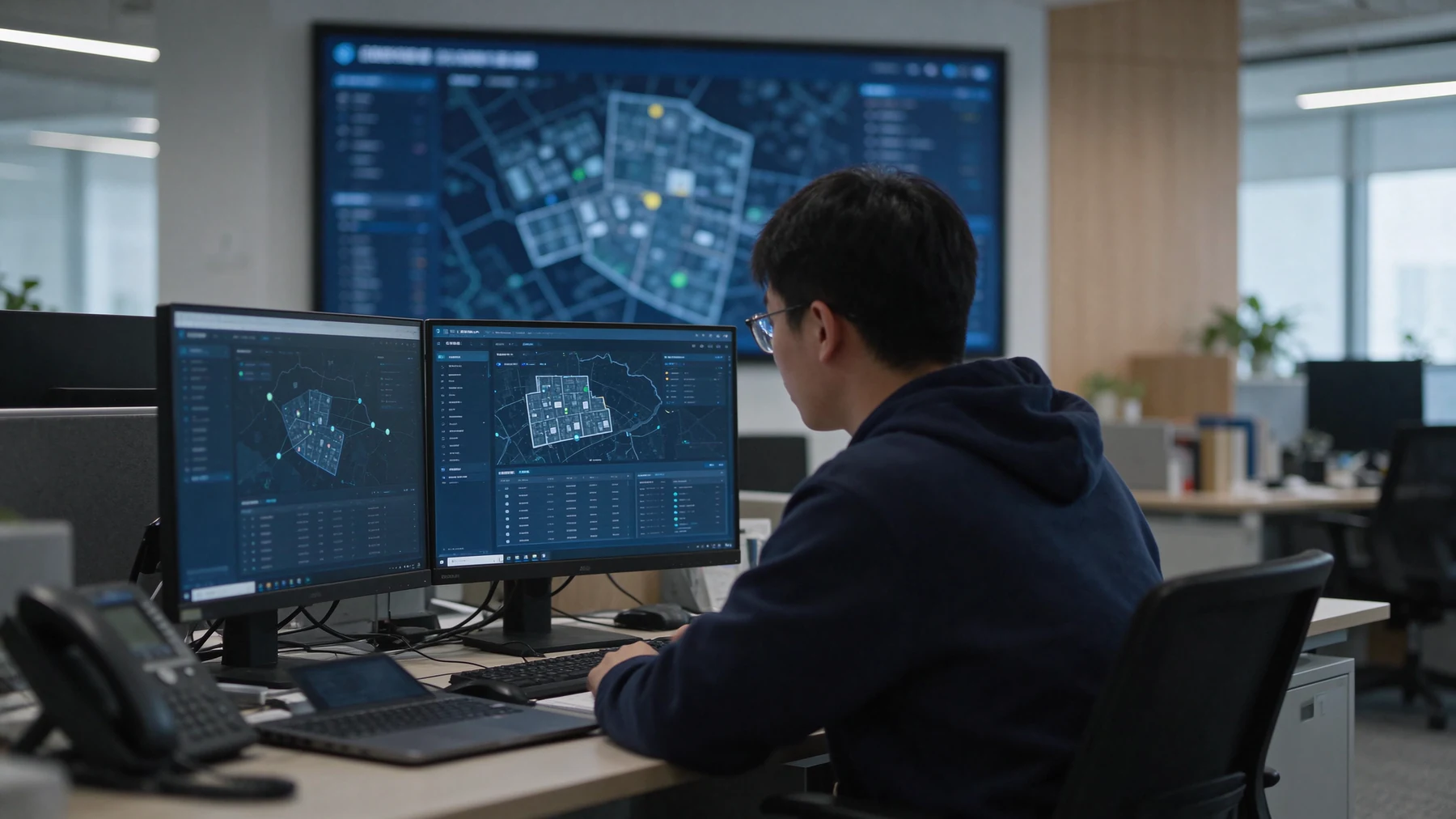
A screen in a pharmacy is a regulated communication channel. We build the guardrails into the deployment plan and hand them to your legal and quality teams with a named owner for each item.
Prescription medicines may not be advertised to the general public. In practice this means the screen's content library is a whitelist, not an open folder — and every asset carries an approver.
Original price, promotional price and campaign period have to be accurate and retained. A rolling loop that still shows last week's discount is a consumer-protection exposure.
A camera on a retail screen invites two questions: are you filming customers, and are you running facial analysis. Our default configuration is camera-disabled for audience measurement.
A movable unit is the easiest thing in the store to leave in the wrong place. Parking in a passage, or charging beside a wet dispensing area, is a finding waiting to happen.
Educational content is not the same as medical advice. Screens that drift into diagnosis or efficacy claims put the pharmacy's licence at risk, not the supplier's.
Customs and retail compliance teams ask for paperwork, not marketing copy. Certification scope has to be fixed before the purchase order, not after production.
A pharmacy team has no content producer. Buying the hardware without answering "who writes the loop" is how a screen project quietly dies in month three. We price that answer into the project instead of leaving it as homework.
Ready-made loop structures for seasonal campaigns, category education, member programme, service announcements and queue-side messaging — in the store's language, in the right aspect ratios.
A scheduled pack per month, mapped to the campaign calendar you already run, delivered as finished assets plus a playlist file that imports straight into DMS.
You send the promotion and the approved wording; we return the schedule, the assets and the compliance log. Optional, priced per store per month.
No serious chain signs for 200 units off a brochure. The pilot is designed to produce evidence on the three things a procurement committee actually argues about: does it stay online, does it get used, and did it move a number.
Store selection, floor plan, zone marking, floor type, network and power survey. Output: store plan and BOM.
2–4 units live in 2–3 stores, DMS accounts opened, staff trained on a one-page card, standing positions marked.
Live campaign cycle, weekly online-rate and playback review, one content refresh to test the workflow.
Evidence pack: uptime, refresh time, staff feedback, campaign result, incident log — and a decision, not a discussion.
| Acceptance metric | How it is measured | Pass condition agreed at kick-off |
|---|---|---|
| Kättesaadavus | Device online rate and playback completion from DMS logs | Agreed percentage of trading hours, excluding planned charging windows |
| Refresh effort | Time from approved asset to live on all pilot stores | Under the manual baseline the chain uses today, with a logged trail |
| Staff adoption | Store-manager log plus a short structured interview | Named owner per store and no unresolved complaints at review |
| Commercial result | One metric the client chooses — category lift, coupon redemption, member sign-up, queue-side conversion | Baseline and target fixed before launch, measured the same way after |
| Operations incidents | Incident log: tipping, blocking, damage, cleaning issues | Zero safety incidents; every issue closed with a corrective action |
Write the service boundary before the price, because the price is only defensible once the boundary is clear. These are the items we put on the table at quotation stage.
| Element | Asukoht | Why it matters in a pharmacy |
|---|---|---|
| Garantii | Up to 3 years, scoped by project and by component | A screen that is out of warranty in year two becomes an unbudgeted replacement |
| Battery as a wear part | Defined separately from the panel warranty, with a replacement interval and spares | Battery capacity is the first thing to degrade in daily-cycle use; pretending otherwise is how trust is lost |
| Spare units | Spare ratio agreed for batch projects, held at regional level | A dark store position is a lost campaign, not just a broken screen |
| Response tiers | Priority tiers by impact — device down, function fault, consultation — with remote-first diagnosis | Store staff need to know who to call and what happens next, not just that "support exists" |
| Remote operations | Log retrieval, remote configuration, OTA with staged rollout and rollback | Most faults are configuration, not hardware; a truck roll per issue destroys the service model |
| Elutsükkel | End-of-life notice period, spare-parts support window, replacement path | A 40-store fleet is a five-year asset decision, not a one-off purchase |
| Certificates and documentation | Certification pack, spec sheet, test summary supplied with shipment | Retail compliance audits ask for documents years after delivery |
Hardware is one line item. The commercial model is the part that decides whether the project starts this quarter or next year.
Client owns the asset outright. Cleanest for chains that already capitalise store equipment and want the depreciation on their own books.
Typical fit: regional chain, 10–100 stores
Bundled through a systems integrator or fit-out contractor who handles installation, network and on-site service. One contract for the client.
Typical fit: new store rollouts, refurbishment programmes
The distributor or pharmacy brand ships under its own name: logo, boot animation, UI, packaging, pre-installed apps, accessory bundle.
Typical fit: distributors, own-brand pharmacy groups
A monthly fee covering device, service and content pack, with a minimum term. Turns a capital request into an operating cost line.
Typical fit: single stores, small chains, seasonal campaigns
We own and operate the screen position; the store provides the space. Suited to high-traffic stores where the value is the position, not the panel.
Typical fit: flagship stores, mall-adjacent locations
Three anonymised project patterns, published with the client's permission to describe the configuration and the workflow. Numbers are client-reported and rounded; they are evidence of pattern, not audited guarantees.
Standardised on 32" for entrance, counter and aisle; two 43" units for atrium events. Content moved from printed posters and USB updates to scheduled playlists.
One unit at the counter, one at the consultation corner. The client chose coupon redemption as the acceptance metric and set the baseline before launch.
Own brand, own boot animation and packaging, with batch delivery aligned to the distributor's retail launch calendar. Mix of 27" and 32" for pharmacy and personal-care chains.
In a 40-store rollout the difference between a factory and a reseller shows up in three places: unit cost at volume, engineering changes mid-project, and who is accountable when something fails in year three.
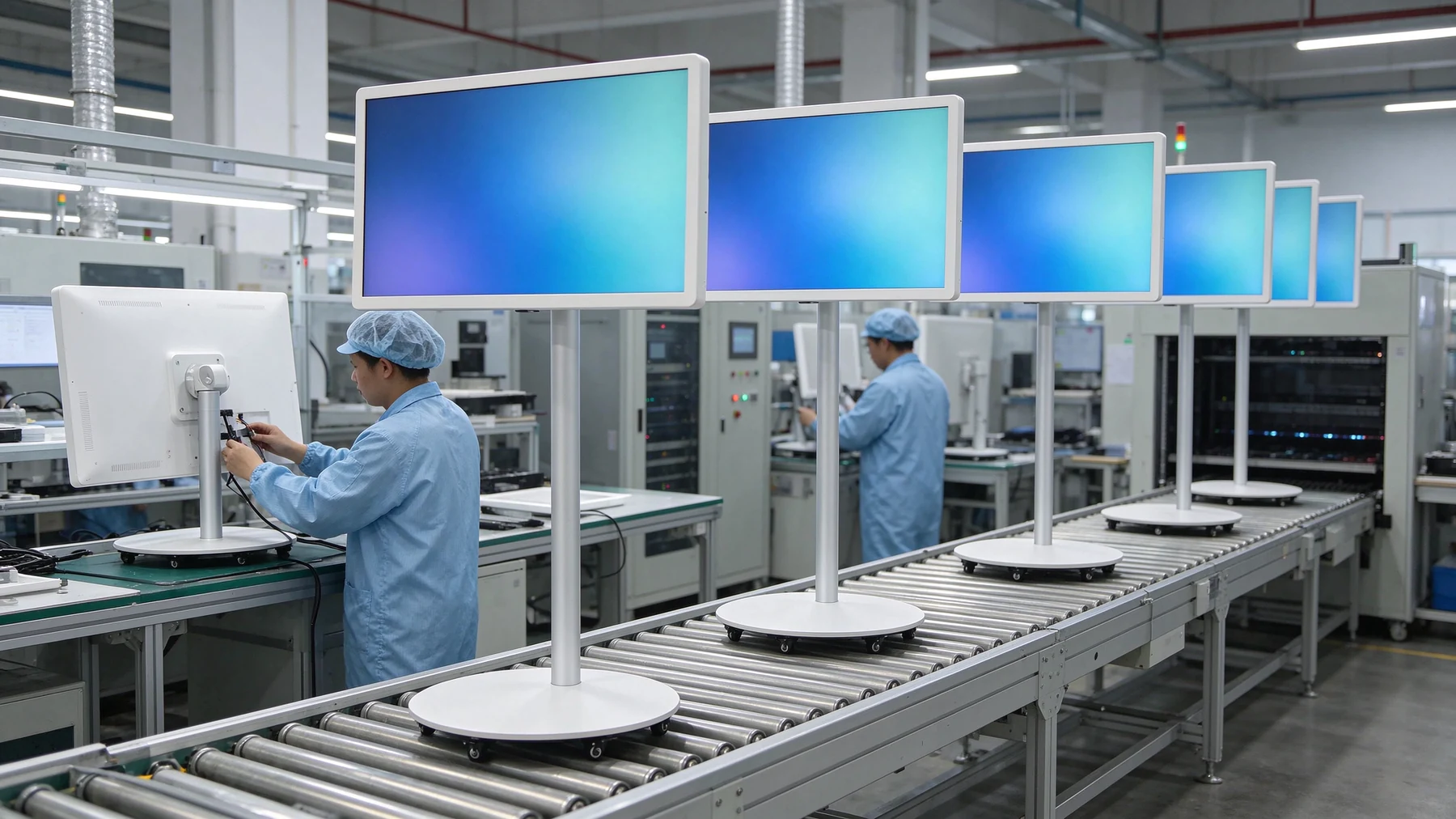
Panel sourcing, mainboard, bonding, structure and assembly sit inside the same organisation, so a specification change mid-project is an engineering decision rather than a supplier negotiation.
The portable smart screen range runs from 21.5" to 43" with independently configurable battery capacity, stand structure and castor grade — the three parts a pharmacy deployment actually stresses.
DMS is part of the offer, not a referral to a third-party MDM. That matters when a store calls at 9am and nobody can explain why the playlist did not update.
Equipment shipped to more than 100 countries, with documentation sets prepared for destination-market certification rather than retrofitted after a customs query.
Solution documents are judged on their sources. Here is ours, in full.
Prepared by: Qtenboard retail & commercial display solutions team, working with the portable smart screen product line.
Reviewed by: Qtenboard hardware engineering (structure and castor group) and the OEM/ODM project desk, for the engineering constraints in section 06.
Last updated: 19 November 2026. Published as a working solution outline for B2B enquiries; specifications are confirmed per project.
Engineering figures come from product configurations and factory test practice; where a figure depends on brightness or content load, this page says so instead of quoting a single number.
Case figures are client-reported, rounded, and published with permission under anonymity. They describe patterns, not audited guarantees.
Compliance statements describe controls we can build into a deployment. They are not legal advice and do not replace review by your qualified person or legal counsel.
Straight answers, including the ones where the honest answer is "it depends on your configuration".
Not on a single charge at full brightness, and any supplier who says otherwise is describing a demo rather than a store. A drugstore trades 12–14 hours with two traffic peaks. The workable pattern is one charge window in the low-traffic period plus a hot-swap pack where the second peak matters, with runtime confirmed against your brightness setting and content load. We map charge windows per store during the survey, so "when is it dark" is a scheduled fact rather than a surprise.
Usually not for the entrance zone at midday. Indoor retail brightness is comfortable inside the store, but a glazed frontage can push ambient light well beyond that. Specify the high-brightness variant for entrance and window-facing positions only, and keep the standard panel in the aisle and at the counter where you are paying for light you do not need. Mixing both in one order is normal; the zone plan tells you which is which.
Three things: a weighted base, locking castors, and an asset identity. For higher-risk locations we add a floor-anchor or cable-lock kit. Every unit carries a serial number that is registered in the device list, so a missing device is visible in the fleet view rather than discovered at stock-take. For stores with ramps or uneven tiles, we ask about floor type at survey stage because castor grade and brake type change with it.
Yes, that is what the DMS level is for: device groups by region and zone, scheduled playlists, remote power control, proof-of-play screenshots, OTA firmware with staged rollout, offline caching and fault alerts. One named operator at head office can run a regional fleet. If you already have a CMS, we can hand the device over as a managed Android endpoint through API access instead of asking you to run a second platform.
Content is cached locally, so a store keeps playing the current playlist through a network outage and syncs when the link returns — the screen does not go dark because the router did. For stores with persistent connectivity problems, a 4G module is available as a fallback path. Playback logs are buffered on-device and uploaded later, so reporting does not develop a permanent gap.
No, and this is the single most important line in a pharmacy deployment. Prescription medicines may not be advertised to the general public. Our provisioning assumes a whitelist-based content library with a named approver, an approval log, and a remote kill-switch for any asset. What the screen is genuinely good at is non-prescription category education, service announcements, member programme messaging and store information. The judgement on what is permissible stays with your qualified person; the controls are ours to supply.
Default is camera off for any audience-measurement purpose. The camera exists on some configurations for video calls, remote assistance or staff-facing use, and it can be disabled at provisioning. If a client wants visitor counting, we specify aggregate-only sensing with no facial identification, and the notice and consent position is documented with your team before anything is switched on.
A pilot typically starts at a handful of units across two or three stores — enough to test two zones and a full campaign cycle. Brand-level customisation (logo, boot animation, packaging, pre-installed apps) on existing tooling carries no new mould cost; structural or private-mould development requires engineering evaluation and a higher MOQ. Both are quoted per project rather than published as a single number, because the honest answer depends on how far the customisation goes.
Standard configurations ship faster than custom ones, and phased batches are normal for rollouts. The pattern that protects an opening date is: lock the specification and certification scope first, produce a sample batch for sign-off, then release the volume batch with a fixed firmware image. Tell us the opening date at enquiry stage and the production plan is built backwards from it, rather than promised after the order.
Three routes. The simplest is local playback with no integration at all. The middle route is our DMS, which handles scheduling and monitoring without touching your systems. The full route is API-level integration, where the device is managed inside your platform and campaign data can be linked to the systems you already run. Integration scope depends on your interface documentation, so we ask for it early rather than assuming it will work.
Daily alcohol or chlorine-based wiping is normal in pharmacy and clinical environments, and it is exactly the thing that degrades consumer-grade coatings. Before quoting, we confirm the cleaning agent your stores use and specify a compatible surface treatment where daily disinfection is required. This is a specification line, not an afterthought — it is cheaper to get right at order stage than to replace a panel in year one.
Yes. Private label is a standard route: your logo, boot animation, UI, packaging, app pre-load and accessory bundle, with documentation prepared for your destination market. Distributors typically start with a sample batch under their brand, validate it in two or three stores, then move to phased volume. The OEM/ODM guide sets out the customisation levels and where tooling cost begins.
Yes, and for a rental business this is the most interesting part of the platform. One unit can run a pharmacy promotion on Monday, a wedding reception on Saturday and a three-day exhibition the following week, because the physical requirements overlap: battery power, quiet castors and a white finish that does not look industrial. Specify quiet castors and the runtime that covers your longest event, add a transit case, and the same fleet serves retail, events and exhibitions with one spare-parts pool. Restyling is limited to finish, content and accessories — a hotel wedding and a drugstore counter do not want the same visual, so keep a separate content template set for each.
The white frame and champagne or white finish are chosen precisely because they disappear into banquet décor instead of reading as commercial hardware. Two things decide whether it works in a ceremony: castor noise and screen brightness. Specify the quiet castor option, test the unit on the venue's own floor rather than a showroom tile, and set brightness for the room's lighting — a screen tuned for a bright supermarket looks harsh in a dim ballroom. For the ceremony itself, position it for the welcome and banquet segments and keep it out of the aisle during the vows.
Quotations are built from the store, not from a price list. Three inputs are enough for us to return a configuration you can put in front of a procurement committee.
Direct enquiry
Retail, event & exhibition solutions desk
If your deployment is not a pharmacy, the same mobile platform is configured differently for other commercial spaces.
About this document. This page is a B2B solution outline prepared by Qtenboard for retail pharmacy and drugstore chain projects. Product availability, brightness options, battery configuration, castor grade, certification scope, warranty terms and MOQ are confirmed per project and per destination market. Figures described as typical are configuration-dependent; case figures are client-reported, rounded and anonymised. Compliance content describes deployment controls and is not legal advice. Qtenboard is a manufacturer of interactive flat panels, digital signage, kiosks, video walls and portable smart screens, with owned production in Shenzhen and Guangzhou. Last updated 19 November 2026.

Tegevjuht | Interaktiivne ekraani ja koostöö lahendusekspert
Olen Qtenboardi asutaja, tuues üle 17-aastase praktilise oskusteadmisega puute kuvatööstusesse. Võttes arvesse ülemaailmse juhtimise perspektiivi, mis on saavutatud minu EMBA uuringud ShenZheni ülikoolis, Ma juhin Tootmisvõime jääb tööstuse esirinnas.
Qtenboardi juhina olen spetsialiseerunud kohandatud OEM/ODM-lahenduste pakkumisele interaktiivsetele valgeplaatidele, LCD video seinad, digitaalsed signaalid ja tööstusliku kvaliteediga puuteterminalid. Toetas meie 330.000 m nüüdisaegse tööstuspargi Shenzhenis, säilitame täispuhastuse kontrolli tööstusdisaini, täpsuse tootmise, ja range jõudluse testimine.
Peaaegu kaks aastakümne pikkune projektikogemus kasutatakse Qtenboardi ekraani lahendusi nüüd rohkem kui 120 riigis ja piirkonnas, teenis usaldust üle 15000 ettevõtluskliendi üle maailma. Kui otsite tundlik partner sügava tootmise aluse oma kohandatud touch kuva projekte, Minu meeskonnaga oleme valmis toetama teie nägemust professionaalselt.

 est
 EN
 spa
 pt
 vie
 th
 lav
 aze
 ukr
 bel
 ru