Bussipeatuse digitaalne teavitustahvel reaalajas reisijateinfoks

2026-11-09
Välisnäidikute tootja · Shenzhen · OEM / ODM alates 2005. aastast

Bussi peatuse digitaalse signaali lahendusS reaalajas reisijate info ja välireklaum

Üks väljas kiosk platvorm otse bussi saabujatele, marsruudi muutused, hädaabiteated ja tasulised reklaamid - konfigureeritud kliima, teie transiidiandmeallikas ja varjupaiga struktuur. Saada kohapeale tingimused ja me tagastame joonis, arve materjale ja kindel tsitaat.

  • Ekraani suurus21,5 – 98 tollit
  • Heledus≥700 – 2000 cd/m²
  • KaitseIP65 korpuse valik
  • PlatvormAndroid 9–16 / Windows
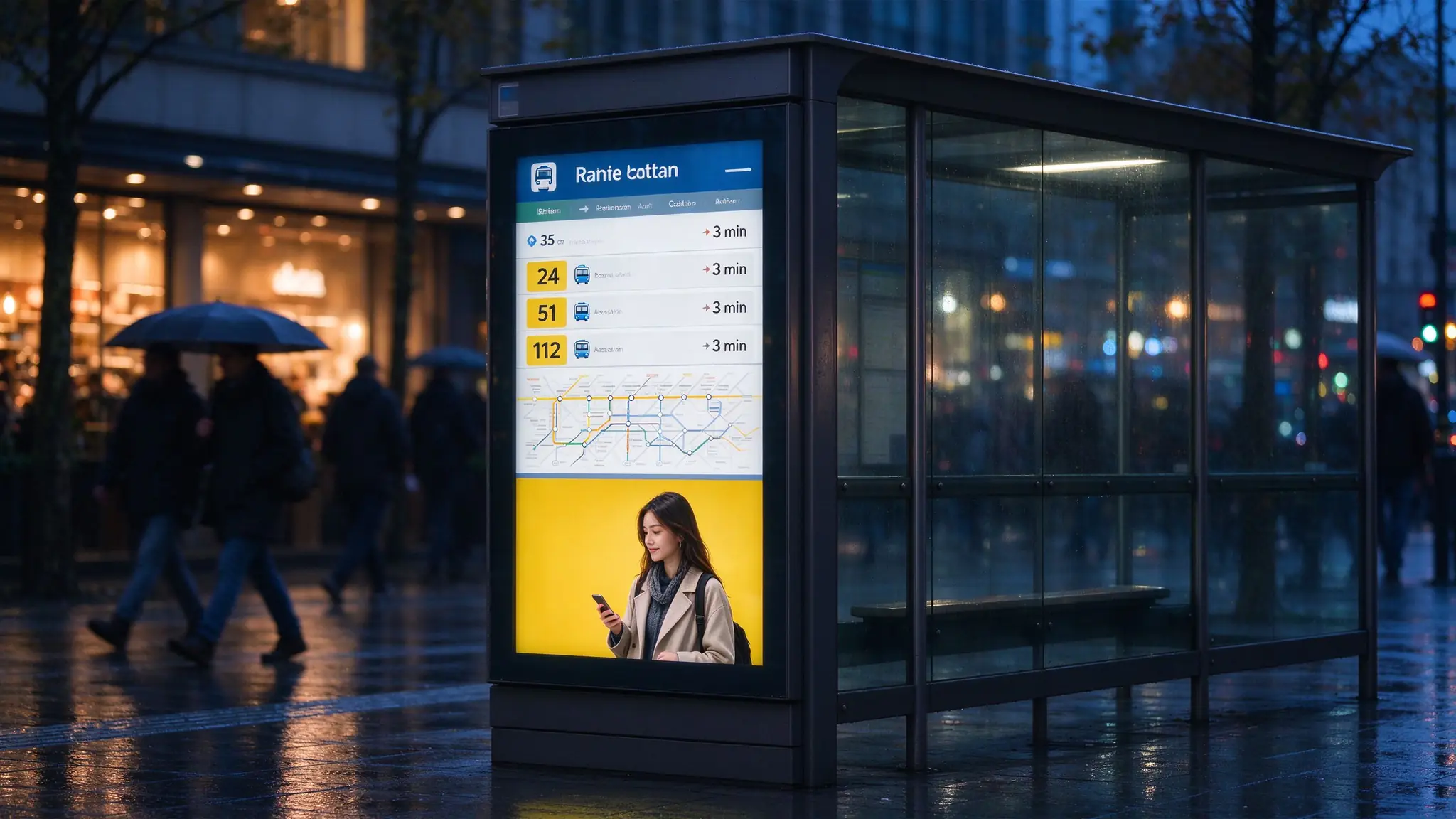
Outdoor bus stop digital signage displaying real time bus arrival information at dusk

Portree välisbussi peatus näitab avaldamine otse saabujate üle tasustatud reklaamipaneel samal ekraanil.

Lühike vastus

Bussipeatuse digiteerimise projekti õnnestub või ebaõnnestub kolm otsust, mida tehakse enne mis tahes riistvara tellimist - kui ereda ja kui hästi jahtuv piirkond on kõnealuse konkreetse koha kohta, kas tegelikult on olemas tegelik transiidiandmevood, et juhtida otse saabumise ekraani; Ja kas reisijate teavet ja reklaami hallatakse kahe süsteemi asemel ühest süsteemist. Qtenboard ehitab nende kolme otsuse ümber ühe seadistatava kioski platvormi.

Kus bussipeatus digitaalse signaali projektid tegelikult seisavad

Neli ebaõnnestumise kohta korduvad linnade, integraatorite ja meediaoperaatorite projektides. Iga probleemi on odavam lahendada spetsifikatsiooni etapis kui pärast esimese seadme paigaldamist objektile.

  1. Ajakava on endiselt paberil, nii et keegi ei usalda peatust.

    Trükis olevad ajakavad on paigas mitu kuud ette. Viivitus, ümber suunatud marsruut või suletud peatus jõuab reisijateni hilinenult või üldse mitte ning iga uuenduse jaoks on vaja kohapealset kontrolli. Reisijate kaebused jõuavad operaatorini, mitte printerisse.

    Kulu selle jätma jätmise eest: korduvad trüki- ja tööjõukulud, millele lisandub igapäevane usaldusväärsuse kahjustus teie kõige suurema liiklusega tänavavaralises objektil.

  2. Ekraan valitakse enne andmeallika kinnitamist.

    Kuvapind on vaid renderdamiseks mõeldud pind. Reaalajas hinnangulised saabumisajad pärinevad transiidiplatvormilt, kliendi API-st või GTFS / GTFS-Realtime voost. Ostke kõigepealt ekraan ja „reaalajas“ lubadus muutub staatiliseks JPEG-pildiesitluseks.

    Selle lahkumise kulud: terminal, mis ei saa näidata, mida pakkumus lubati, ja teine integratsioonieelarve, mida keegi ei plaaninud.

  3. Korpus on määratletud siseruumide andmelehe põhjal.

    Neli erinevat probleemi on päikesevalgus, kuumus, vihm, rannasool ja sisemine kondensatsioon. Hele paneel nõrga soojuse disainiga muutub pärastlõunal ja sureb teisel suvel; suletud karp ilma niiskuse käitlemise uduta seestpoolt.

    Selle lahkumise kulud: veoauto rullid, asenduspaneelid ja hoolduseelarve, mis ületab reklaamitulu.

  4. Teave ja reklaam pärinevad kahest tarnijast

    Reisijate teabekuvarid ja reklaamkuvarid on tavaliselt pärit erinevatest tarnijatelt ja töötavad erinevatel CMS-platvormidel. Kaks sisselogimist, kaks tugiakna, kaks varuosa basseini, ja argumendi selle kohta, milline süsteem saab ekraani, kui hädaolukord peab ennetama makstud reklaami.

    Selle lahkumise kulud: dubleeritud integratsioonitöö ja rahastamiskava, mis on blokeeritud teenuse taseme konflikti tõttu.

Üks kuvar, kolm töökohta: reisijate teave, reklaam, linnateenused

Nutikas bussipeatuse kuvari on üksainus väliterminal, mis kuvab korraga kolme sisukihti, mille prioriteedireegleid operaator kontrollib. Ekraan on jagatud kindlatesse tsoonidesse, nii et teenuseinfo ei kustutata kunagi ekraanilt kampaania tõttu.

  • Ülemine tsoon - peatuse nimi, liini tunnus, linna või operaatori logo.
  • Peatsoon - Reklaamiplakat või video, reklaamimis- ja linnaürituste sisu.
  • Põhjavöönd - hinnangulised saabumisajad, järgmised väljumised, teated teenuse kohta ja uudistebänner.
  • Küljepiirkond - Ilm, teeotsing, QR sisestus mobiilsideteenuse või sponsor märk.

Hädaolukordade ja hädavajalike transiidi sõnumid saab eelistada ärilise sisu ees vastavalt teie sisupoliitikale ja kohalikele avalikele teenustele. a konfiguratsiooniotsus, mitte tarkvara ümberkirjutamine.

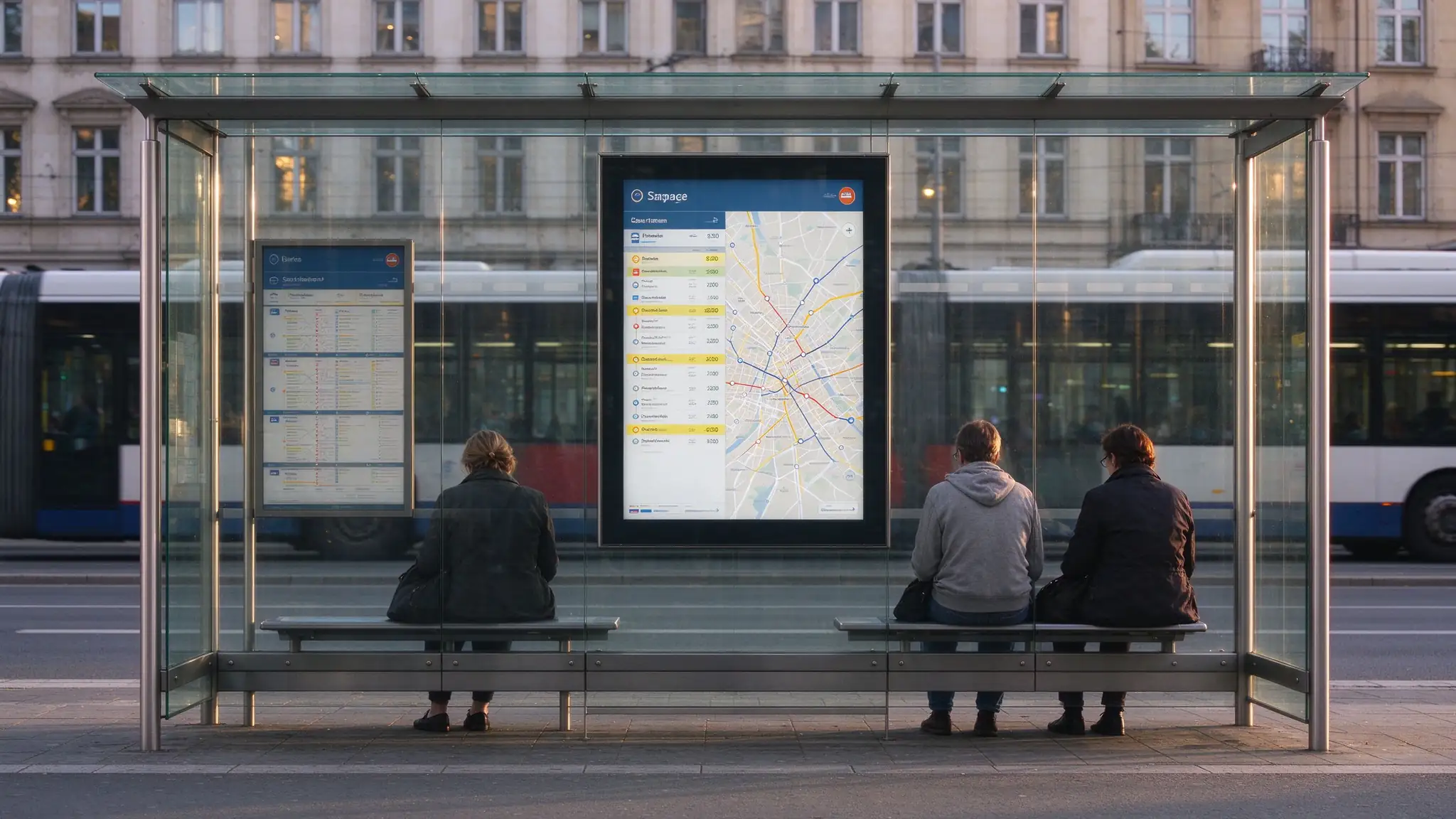
Bus shelter digital signage integrated into a glass shelter structure

Varjualusega integreeritud konfiguratsioon: ekraan muutub varjualuse konstruktsiooni osaks, mitte ei asu selle kõrval.

Five configurations, one cabinet platform

Most projects start from one of these five. They differ in data depth and interaction, not in build quality — the same outdoor enclosure, thermal design and QC process sit behind all of them.

SeadistamineParim.Data sourceConfirm before ordering
Eraldi ajakava vaade Sites with no live feed yet Local CMS or USB, fixed timetable Power, network, update frequency
CMS-i hallatav bussipeatuse kuvar Bus companies, campus and commercial shuttles Cloud CMS või keskserveri Stop count, user permissions, playback reports
API-ga integreeritud reisijate kuvara Transit operators, smart-city programs Transit platform, REST API, GTFS-Realtime Data format, interface documentation, refresh rate
Interaktiivne nutik bussipeatuskiosk City hubs, interchanges, tourist areas API plus touch software and peripherals Software scope, waterproof openings, privacy rules
Solar-powered bus stop display Saidid ilma stabiilse võrguvooluta Same as above, on a low-power profile Sunlight hours, power draw, battery life, 4G coverage

Specifications are finalized on the project drawing. Screen size, OS, top signage, audio, camera, solar and data integration are confirmed per project.

Outdoor engineering: the five variables that decide whether the screen survives

Every one of these is selected against a specific site condition. Nothing on a Qtenboard bus stop display is fixed by default — which is why the site survey matters more than the datasheet.

Brightness matched to the site

Options run from a semi-outdoor panel to sunlight-readable high-brightness glass, rated across the ≥700–2000 cd/m² band on the PIS series. Shelter advertising screens run higher, ≥2500 cd/m² with an automatic light sensor. Direct sun on a south-facing stop, a canopy, and a shaded shelter recess are three different specifications.

IP protection plus moisture control

An IP65 enclosure stops water entering from outside. It does not stop condensation forming inside when a cold night follows a humid day. High-humidity and coastal sites need a drainage and anti-condensation design, and often a heater, or the driver board corrodes behind a perfectly sealed door.

Thermal design sized to the climate

Fan cooling, an air-conditioning module for high-heat regions, a heater for cold regions, or an integrated controller with remote temperature monitoring and over-temperature protection. Heat soak at midday is the most common cause of a dim or failing outdoor panel.

Glass and vandal resistance

Tempered or laminated protective glass, anti-glare and anti-reflective options for readability, optional anti-vandal front protection, security screws, a lockable cabinet and remote door-status alerting. Public space means somebody will test it.

Power architecture

AC with surge protection, a solar array with battery backup, or a hybrid system where information must keep running through an outage. A solar site is a feasibility calculation — sunlight hours, brightness setting, operating hours and connectivity all move the battery size.

Structure and installation interface

Freestanding kiosk with base plate, anchor bolts and a top signage band, or a frame designed to integrate into a shelter. The second option changes the drawing: interface points, load bearing, cable route and maintenance access all have to be agreed with the shelter manufacturer.

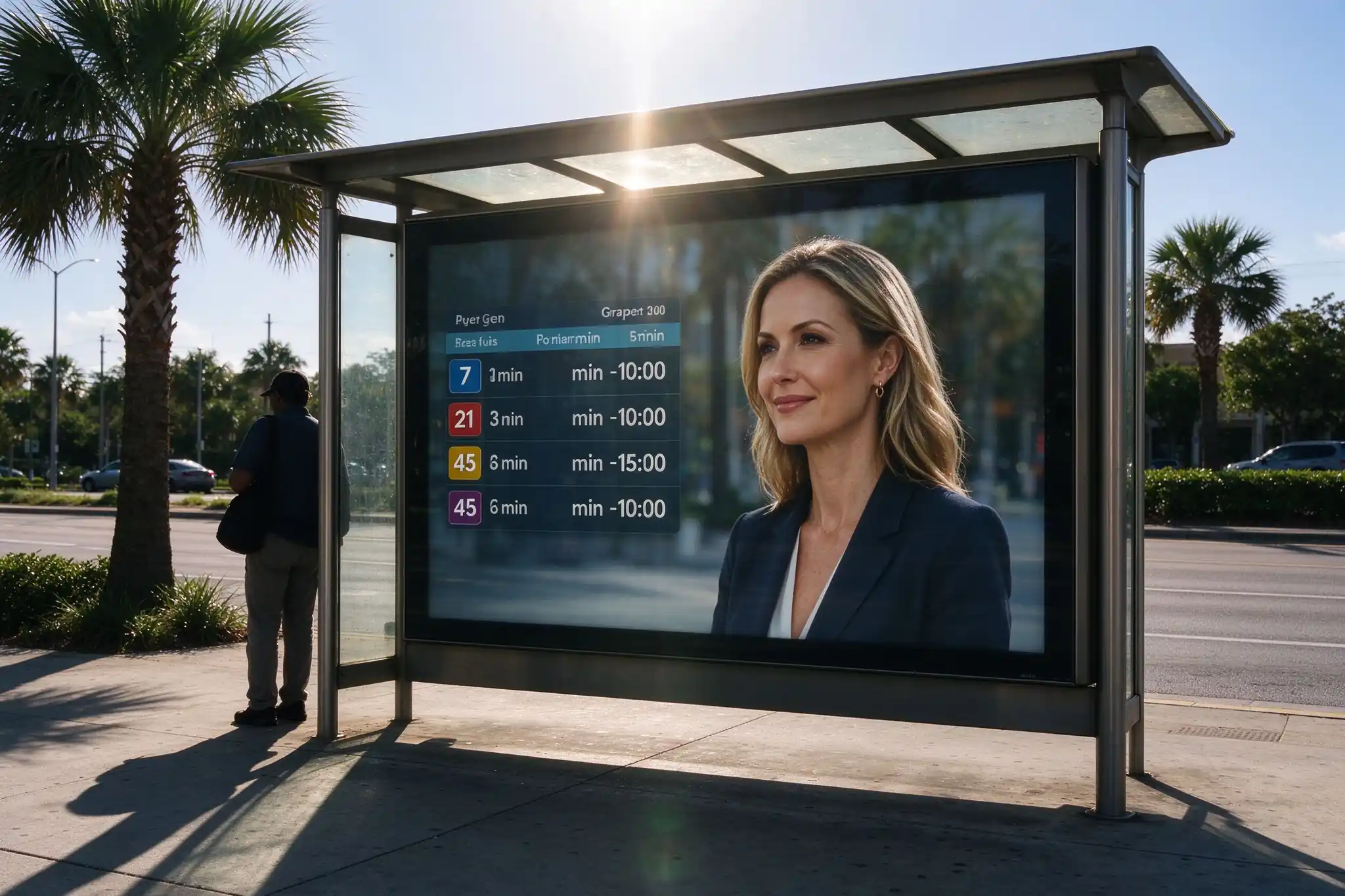
Sunlight readable bus stop screen showing passenger information in direct midday sun
Midday direct sun: the panel is specified for the site, not for a showroom.
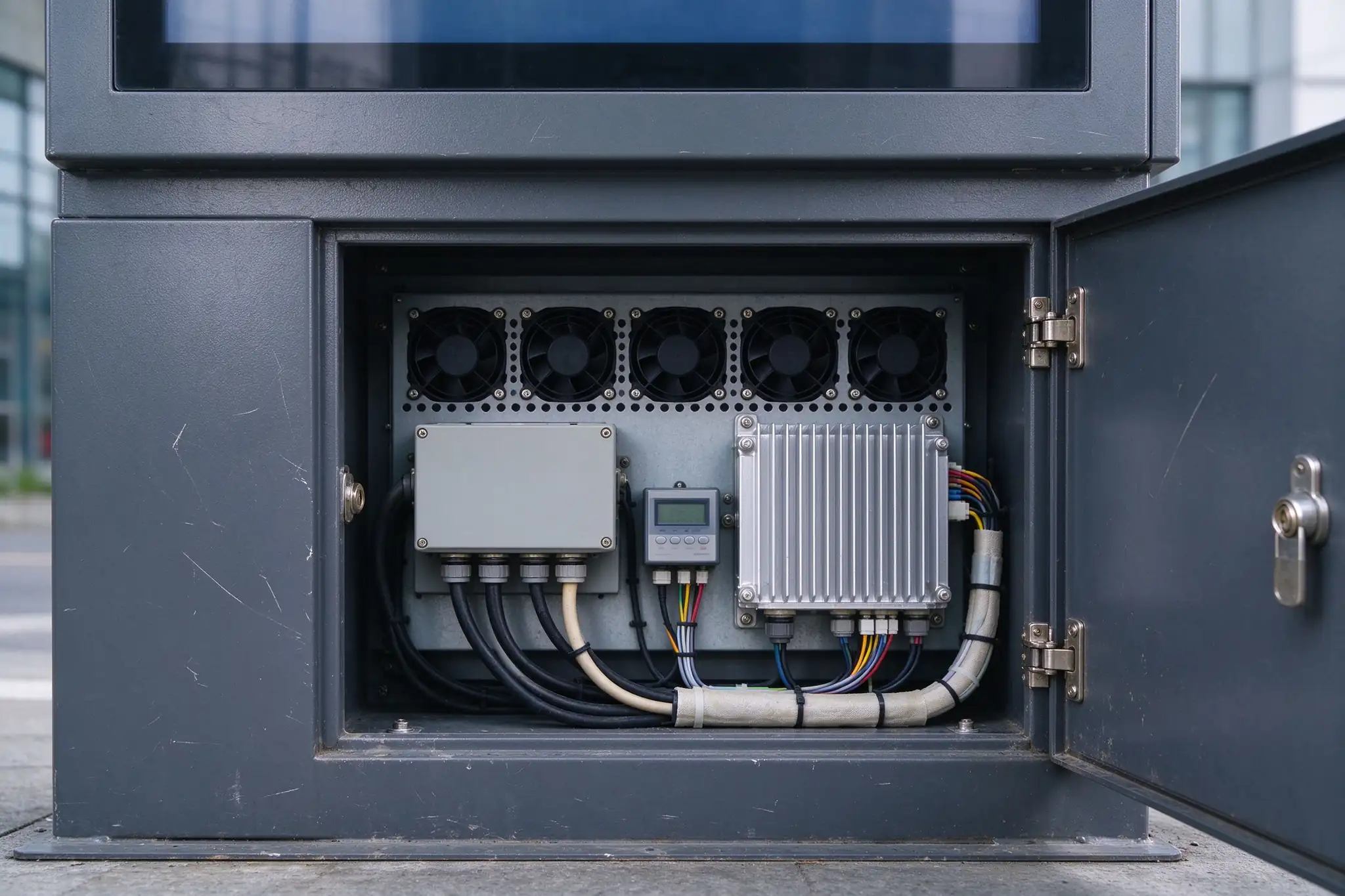
Outdoor bus stop display enclosure with fan cooling and rear maintenance access
Service bay: sealed cable glands, fan bank, heatsink and a lockable maintenance door.

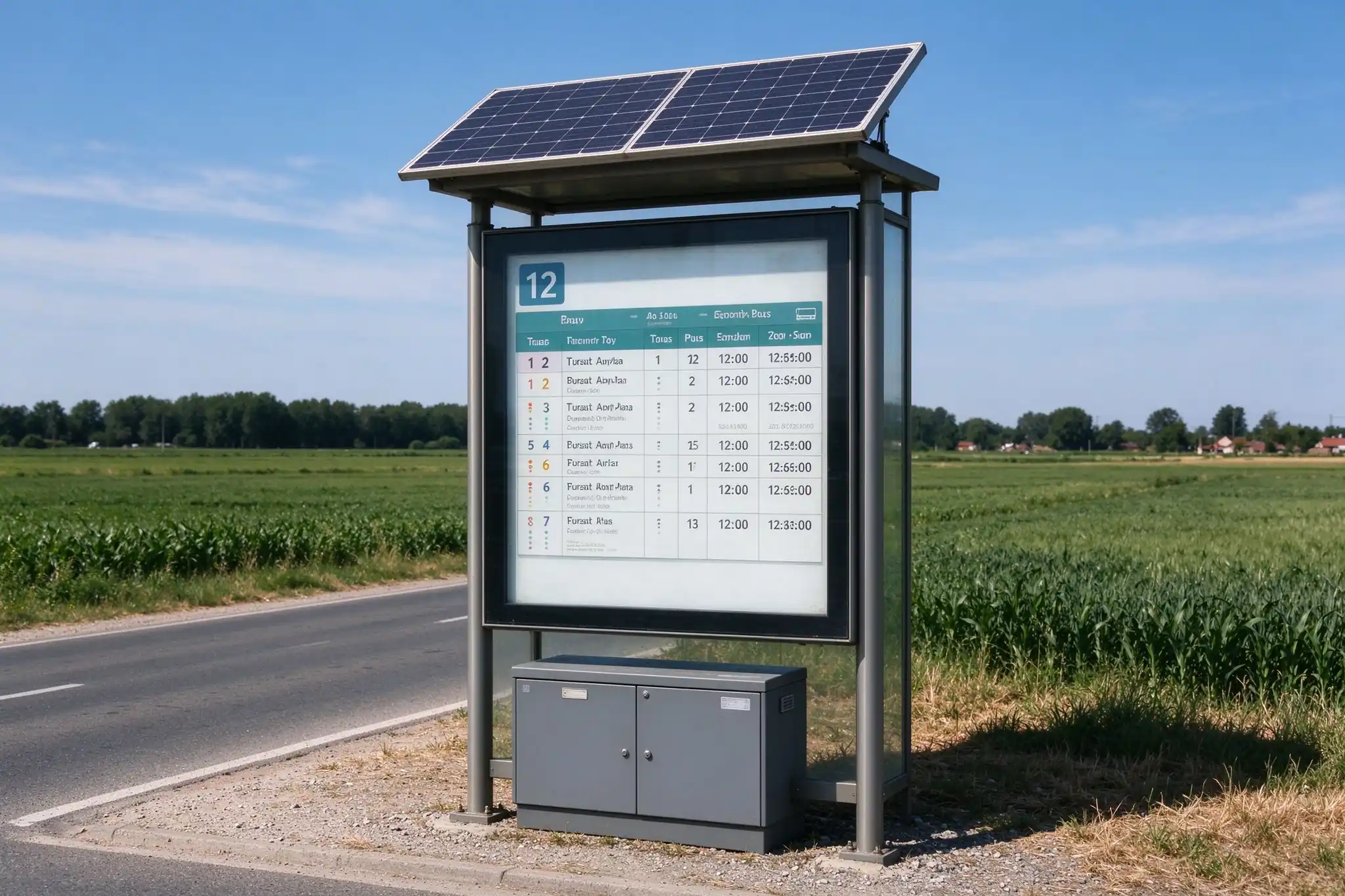
When there is no grid connection at the stop

Rural routes, temporary stops and roadside sites often have no reliable supply. A solar panel, battery cabinet and a low-power display profile let the same terminal run the timetable and the ad panel without trenching a cable. We run the feasibility check before the quote, not after the order: sunlight hours, brightness setting, operating window and 4G or 5G duty cycle.

Solar powered smart bus stop display for sites without grid power
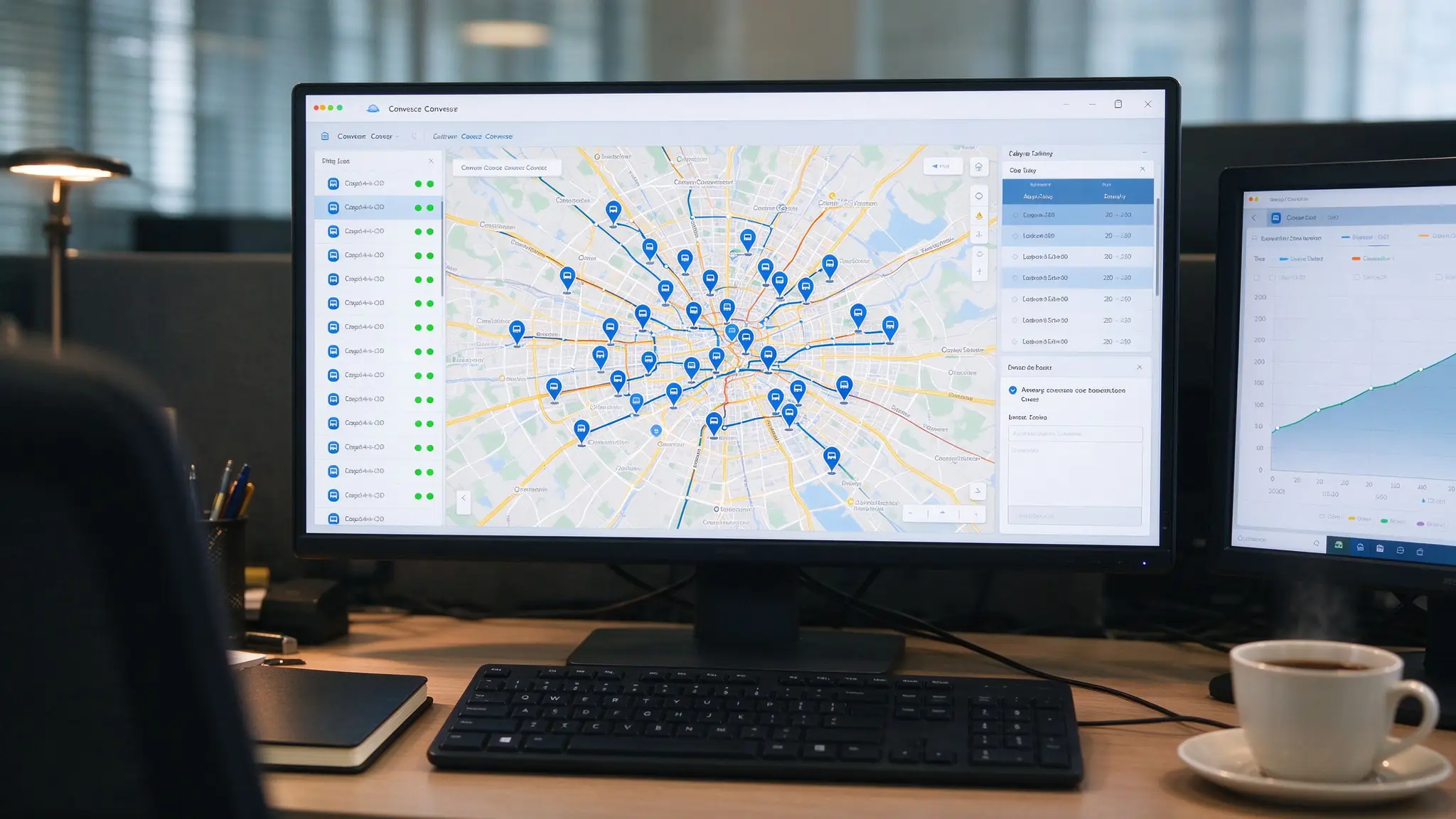
Cloud CMS dashboard managing multi stop bus stop digital signage network

One dashboard for the network: device status, playlists, emergency publishing and proof of play.

Transit data integration: what a display can and cannot do

A passenger information display renders data. It does not generate it. Live estimated arrival times require a compatible transit management platform, a customer-provided API, or a GTFS / GTFS-Realtime feed with the right permissions — and that source has to exist before the tender closes.

What the terminal can publish once connected: route number and route name, destination, next departure, estimated arrival, vehicle status, delay and diversion notices, temporary stop closure, transfer guidance, service alerts and emergency announcements.

What we assess before quoting

  • Which system owns the data, and who can authorise access
  • Format: REST API, GTFS, GTFS-Realtime or a third-party PIS platform
  • Refresh frequency, and how stale data should be displayed
  • Whether interface documentation exists, or an integration test is needed
  • Which zones of the screen the data drives, and the language set

Real-time data note. Real-time passenger information requires integration with a compatible transit platform, API, GTFS / GTFS-Realtime feed or customer-provided data source. The display hardware alone does not generate live bus data.

Remote content and scheduling

Multi-stop grouping, playlist scheduling, daypart control, timetable publishing, emergency message publishing, role-based access for the city, the operator and the advertiser, remote reboot and system updates.

Proof of play for ad revenue

Playback logs and screenshot capture give a media operator the evidence an advertiser asks for, so the shelter inventory can be sold on measured delivery rather than on a photo of a screen.

Device health without truck rolls

Online status, internal temperature, fan and thermal state, brightness, storage, signal strength, door-open and power status are visible per stop — the difference between a maintenance plan and a maintenance budget.

Deployment: from site survey to commissioning

A bus stop screen is a piece of street infrastructure. The sequence below is the one that keeps the civil work and the hardware from waiting on each other.

  1. 01

    Site survey

    Installation type, footprint, viewing direction and passenger flow, sunlight exposure, rain, wind, snow, dust and humidity, temperature range, coastal or corrosive conditions, ground material and the network available on site.

  2. 02

    Foundation and anchoring design

    Base plate, anchor bolts or an embedded frame, dimensioned against the unit weight, local wind load and the ground structure. Permanent outdoor units need a proper base — this line is often missing from a first quote and appears later as a change order.

  3. 03

    Power, earthing and cable route

    Confirm local voltage and capacity, reserve a protected cable route in the base or ground, specify earthing and surge protection, and decide the backup strategy where uninterrupted information matters.

  4. 04

    Drawing approval and production

    Cabinet drawing, top signage and branding approved before tooling starts. A sample or pre-production unit is available where the project needs one signed off.

  5. 05

    Testing, inspection and commissioning

    Function and burn-in testing, pre-shipment inspection, then packing list, drawings and installation guidance. Remote commissioning support covers the CMS, the data feed and the first live stop.

Plan the maintenance access before the concrete is poured

Front or rear service access has to be decided against the shelter layout and the pavement width, not after installation. Multi-stop projects also need an agreed split of responsibility for content, network, cleaning and hardware, plus a spare-parts list sized to the fleet.

OEM / ODM customization for transit and shelter projects

For distributors, integrators and shelter manufacturers, the value is in the parts that carry your name and your structure — not in a stock box with a sticker.

Appearance and structure

  • Cabinet dimensions and portrait screen size, 21.5 to 98 inch
  • Top signage band for the stop name, route mark, city logo or sponsor
  • Base plate and anchor-hole layout to your civil drawing
  • Shelter integration structure and interface points
  • Powder-coat colour, printed graphics, front or rear maintenance
  • Glass type, ventilation and cable-entry position

Hardware and software

  • High-brightness panel, Android or Windows platform, CPU / RAM / storage
  • 4G, 5G, Wi-Fi, LAN, GPS, IoT modules for device monitoring
  • PCAP touch, speaker and audio announcement, camera, QR, NFC, intercom, emergency button
  • CMS integration, transit API integration, GTFS assessment
  • Advertising playlist management and emergency-alert publishing
  • Multi-language UI, city map and wayfinding layout

Deployment profiles we build for

Three buyer types, three different definitions of success. The configuration changes; the cabinet platform, CMS logic and support window do not.

Transit operator

Live arrival information across a multi-stop network

Probleemid Printed timetables at dozens of stops, with delays and route changes reaching passengers late.

Seadistamine API-integrated portrait displays with ETA, vehicle status and alert zones, grouped and published from one CMS, advertising slots kept on the same screen.

Tulemus One publishing workflow for the network, delay notices pushed remotely, and a second revenue line on hardware already installed.

Municipality / smart city

A managed public-information network

Probleemid Scattered legacy signs with no remote management and no consistent city identity.

Seadistamine 4G-connected, CMS-managed bus stop displays with device monitoring, emergency and weather alert publishing, and unified city branding on the top band.

Tulemus One dashboard for the whole network, alerts published in minutes, and fewer field visits for routine checks.

Shelter and media operator

Advertising inventory without degrading passenger service

Probleemid Shelter space to monetize, but passenger guidance that cannot be interrupted by a campaign.

Seadistamine Split-screen displays with a fixed service zone and a scheduled advertising zone, optional touch, solar power and QR services, playback logs for advertisers.

Tulemus New DOOH inventory on the same asset that carries the timetable, sold on measured playback rather than on a photograph.

These are representative deployment scenarios built from project configurations. Named references, project photographs and certificates are shared under NDA once requirements are confirmed.

Factory proof: how a unit earns its shipping label

Qtenboard has manufactured outdoor displays and kiosks since 2005, exporting to more than 100 countries as an OEM / ODM partner for international brands. Three factories in China cover 33,000 m² with around 1,000 skilled workers, running automated SMT lines, metal fabrication, in-house test platforms and export packing under one roof.

Sixteen inspection points before packing

  • Panel and image-quality inspection, high-brightness readability test
  • Android or Windows boot test, CMS playback test, API data-display test where integration is in scope
  • LAN, Wi-Fi, 4G or 5G connectivity test and audio announcement test
  • Touch, QR, NFC and camera peripheral tests where selected
  • Cooling, heating and temperature-monitoring test, door-lock and access test
  • Cabinet sealing and cable-entry inspection, long-duration burn-in
  • Base, mounting point and mechanical-dimension check, packaging inspection

Test records are available for project review, alongside CE, FCC and RoHS options, IP-rated enclosure reports and IK or safety-glass certificates where they apply to the configuration.

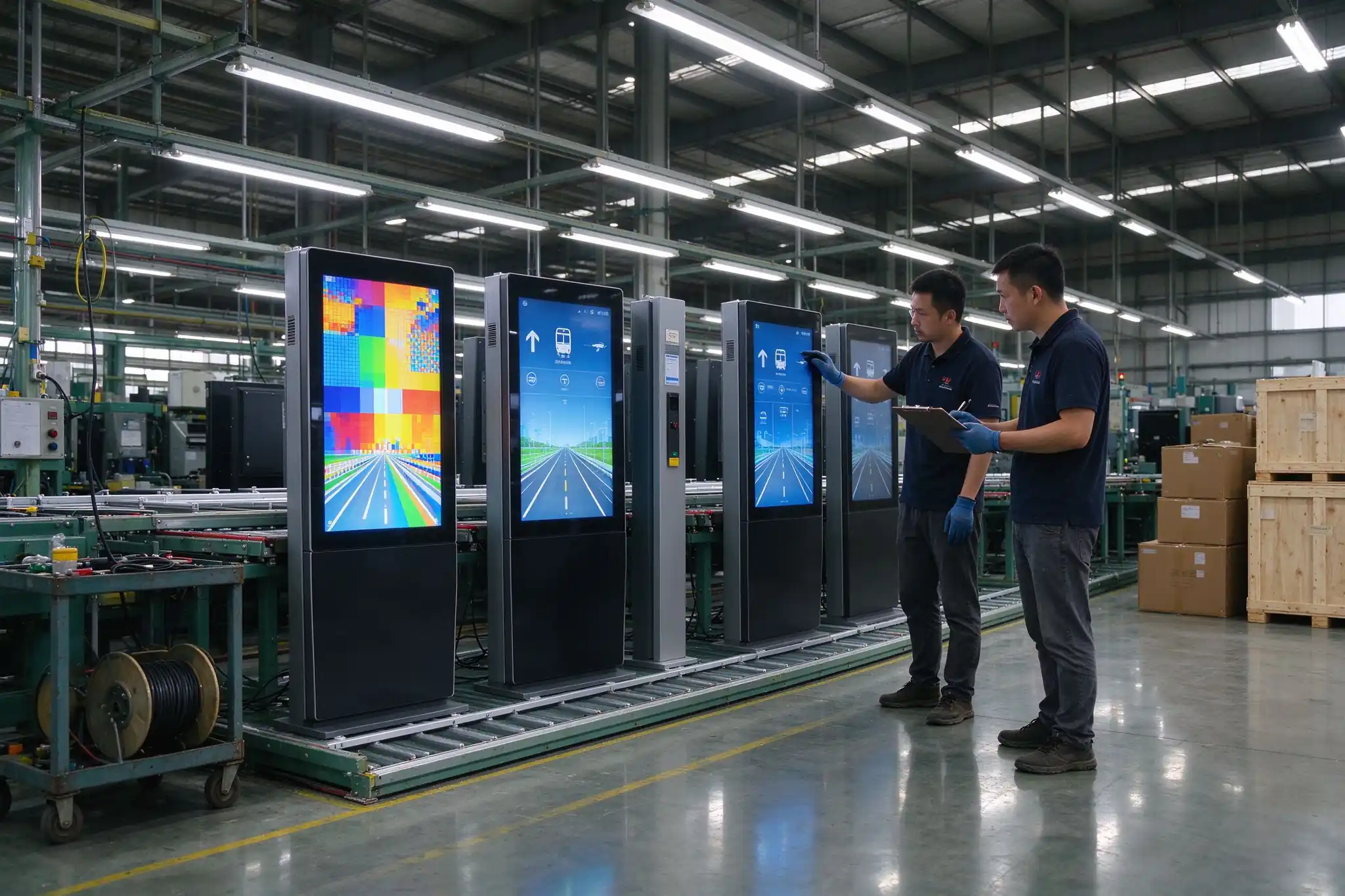
Qtenboard factory quality control testing outdoor bus stop displays before shipment

Burn-in line before pre-shipment inspection: units run under power, not just switched on for a photo.

Asutatud
2005
Factories
3 in China, 33,000 m²
Meeskond.
~1,000 skilled workers
Export markets
100 riigid

What we need to return a configuration and a price

Bus stop digital signage quotes vary by two to three times for the same nominal screen size, because brightness, thermal design, protection, data scope and quantity all move the bill of materials. Send these eight items and the reply is a defined configuration, not a range.

  1. Site type and quantity — bus stop, shelter, transit hub or plaza; how many units, and how many in phase one.
  2. Keskkond — direct sun exposure, temperature range, rainfall, humidity, coastal corrosion, cleaning practice.
  3. Ground and wind conditions — paving or soil, foundation depth, local wind load, anchoring requirement.
  4. Võimsus: — available AC supply, or a solar feasibility review; whether information must survive an outage.
  5. Transit data — data owner, format (REST API, GTFS, GTFS-Realtime), refresh rate, interface documentation.
  6. Display and interaction scope — size, portrait or landscape, touch, audio announcement, QR, NFC, camera, accessibility options.
  7. Content and operation model — who publishes, whether advertising is sold, permissions required, proof-of-play needed.
  8. Kohaletoimetamine — destination country, target date, incoterm, whether a sample unit is required first.

Talk to the project team directly

Info@qtenboard.com.

+86 181 2471 3748

Longhua piirkond, Shenzhen, Hiina,

Send the eight items

Sample and batch orders supported · T/T, LC or project terms · Lead time depends on configuration, quantity and customization · Standard and extended warranty options

Korduma kippuvad küsimused

What is bus stop digital signage?

An outdoor display terminal installed at a bus stop, shelter or transit area that publishes timetables, live arrival information, route changes, public announcements and paid advertising. In practice it replaces the printed timetable and the static advertising panel with one remotely managed screen.

Can the bus stop screen show real-time arrivals?

Yes, once it is connected to a compatible transit management platform, a cloud system or a customer-provided API. The accuracy of the arrival time is the accuracy of the data source — the display does not estimate a bus position by itself.

Does it support GTFS and GTFS-Realtime?

GTFS and GTFS-Realtime integration is assessed as part of the software scope. Send the feed or interface documentation, the update frequency and the display format you need, and the compatibility review comes back with the quote.

Can one screen carry both passenger information and advertising?

Yes. The layout is divided into zones — service information in a fixed area, advertising in the main area — and emergency or essential transit messages can pre-empt commercial content under the operator's content policy.

Is it suitable for direct sunlight and coastal humidity?

The terminal is built for outdoor and semi-outdoor deployment, but brightness, glass, thermal design, anti-condensation and corrosion treatment are selected per site. A coastal installation with high salt exposure is specified differently from a shaded inland shelter.

Can it run on solar power with no grid connection?

Solar panel and battery backup options are available for sites without stable supply, with a low-power display profile. Feasibility depends on sunlight hours, brightness setting, operating hours, power draw and the connectivity duty cycle, so it is reviewed before quoting.

Can it be integrated into an existing bus shelter?

Yes. The unit can be supplied freestanding or configured for integration into a shelter structure. Provide shelter dimensions, mounting position, available power, network condition and maintenance-access requirements, and the drawings are adapted accordingly.

How are multiple stops managed from one place?

A cloud CMS or local server groups the stops, publishes playlists and notices, and monitors device status — online state, temperature, signal, storage, door-open and power. Remote reboot and system updates avoid site visits for routine issues.

What certification and test evidence comes with a project?

CE, FCC and RoHS options, IP-rated enclosure test reports, and IK or safety-glass certificates where applicable to the configuration. Sixteen inspection points are recorded before packing and the test records can be supplied for project review.

What are the order terms for a first project?

Sample orders and batch orders are both supported. Payment terms are T/T, LC or project-specific; lead time depends on configuration, quantity and customization; export packing is a wooden case or project packaging, and spare-parts lists are recommended for long-term deployment.

Start with the site, not with the screen size

Send the site conditions, the data source and the quantity. You get back a configuration drawing, an integration assessment and a price that holds through production.

Technical review: Queenie Wang, founder of Qtenboard, 17 years in the interactive display industry. Figures and configuration options on this page reflect the current product specification sheet and factory QC records, reviewed 9 November 2026.

Reference note: screen images are for reference only. Final screen size, operating system, top signage, audio, camera, solar power and transit-data integration are confirmed per project drawing.


Qtenboard Queenie Wang

Queenie Wangi

Tegevjuht | Interaktiivne ekraani ja koostöö lahendusekspert

Olen Qtenboardi asutaja, tuues üle 17-aastase praktilise oskusteadmisega puute kuvatööstusesse. Võttes arvesse ülemaailmse juhtimise perspektiivi, mis on saavutatud minu EMBA uuringud ShenZheni ülikoolis, Ma juhin Tootmisvõime jääb tööstuse esirinnas.

Qtenboardi juhina olen spetsialiseerunud kohandatud OEM/ODM-lahenduste pakkumisele interaktiivsetele valgeplaatidele, LCD video seinad, digitaalsed signaalid ja tööstusliku kvaliteediga puuteterminalid. Toetas meie 330.000 m nüüdisaegse tööstuspargi Shenzhenis, säilitame täispuhastuse kontrolli tööstusdisaini, täpsuse tootmise, ja range jõudluse testimine.

Peaaegu kaks aastakümne pikkune projektikogemus kasutatakse Qtenboardi ekraani lahendusi nüüd rohkem kui 120 riigis ja piirkonnas, teenis usaldust üle 15000 ettevõtluskliendi üle maailma. Kui otsite tundlik partner sügava tootmise aluse oma kohandatud touch kuva projekte, Minu meeskonnaga oleme valmis toetama teie nägemust professionaalselt.