
 vie
 EN
 spa
 pt
 th
 est
 lav
 aze
 ukr
 bel
 ru
Planning an interactive flat panel school budget in Kazakhstan requires more than multiplying the unit price by the number of classrooms. Schools should account for equipment configuration, delivery, import-related costs, installation, training, warranty and currency fluctuations before approving a project budget.
A practical budget starts with the cost of one classroom and expands to the whole school, with separate calculations for different room types and shared project expenses. This approach helps school administrators compare supplier quotations, plan deployment and manage spending in tenge.
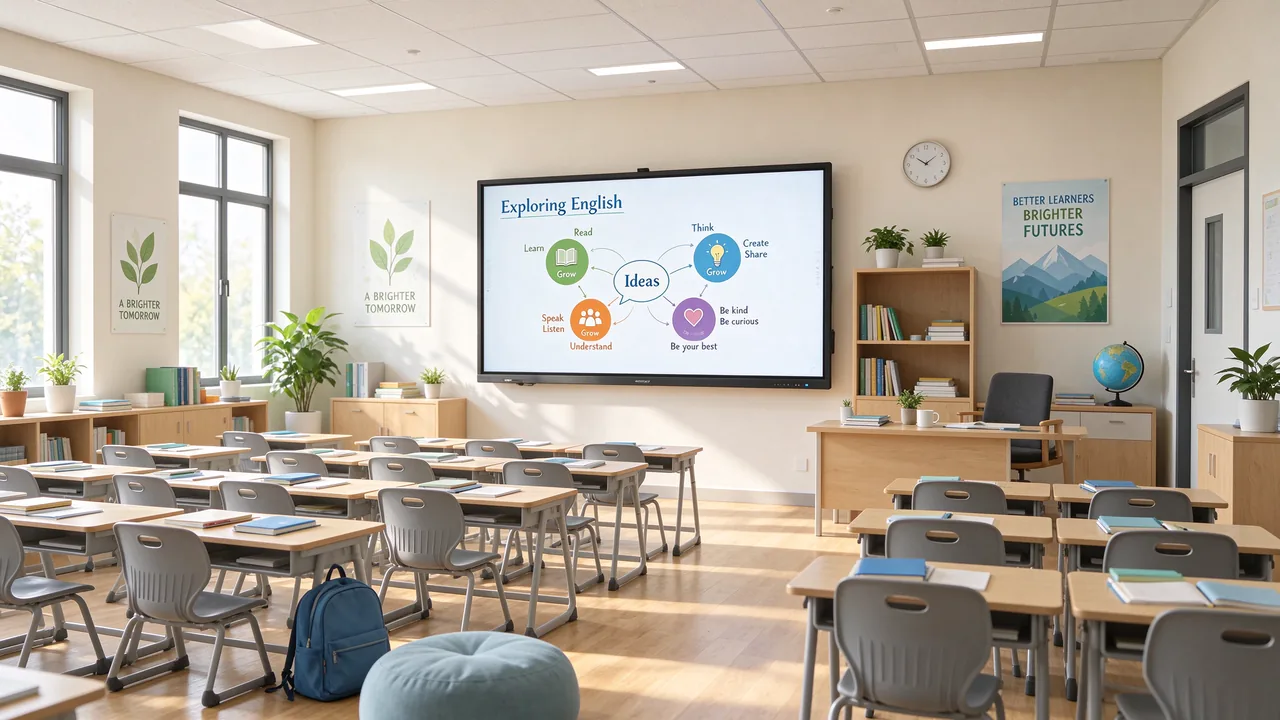
Interactive flat panel deployment for classroom and whole-school digital learning environments
What Should Be Included in a Classroom Equipment Budget?
An interactive whiteboard or smart board is only one part of a classroom equipment project. The complete budget should include the accessories, logistics, installation and support arrangements needed to make the equipment ready for teaching.
Before requesting quotations, schools should prepare a list of cost categories and confirm which items are included in each supplier's offer. The following table provides a practical starting point.
| Danh Mục chi phí | What to Include | Main Cost Factors |
|---|---|---|
| Bảng phẳng tương tác | Display size, resolution, brightness, touch functions and system configuration | Model selection, technical requirements and order quantity |
| Computer configuration | Built-in system, optional Windows OPS and required software | Teaching applications and project specifications |
| Mounting and accessories | Wall brackets, mobile stands, cables and connection accessories | Classroom layout and installation method |
| International logistics | Applicable export transportation and cargo insurance | Trade terms, shipping route and transport method |
| Import and customs | Applicable duties, import taxes, customs declaration and agency services | Product classification, importer and transaction arrangement |
| Local delivery | Transportation from the relevant entry point or warehouse to schools | Delivery distance, destination and shipment batches |
| Installation and testing | Mounting, connections, system setup and functional testing | Site conditions and installation requirements |
| Đào tạo | Teacher guidance, administrator training and operating instructions | Participant numbers and training arrangements |
| Warranty and spare parts | Warranty options, spare parts and repair logistics | Warranty coverage and project requirements |
| Project management | Documentation, coordination, inspection and phased delivery | Project size and implementation complexity |
| Budget contingency | Allowance for exchange-rate and site-related changes | Budget policy and project risk assessment |
One important step is to distinguish the supplier's equipment price from the total cost of deployment. A quotation may cover the interactive flat panel but exclude wall brackets, Windows OPS, local transportation, installation or teacher training.
Buyers should also check the agreed trade terms. EXW, FOB, CIF and other delivery arrangements assign different responsibilities to the seller and buyer. Do not assume that international freight, insurance, import clearance and delivery to the school are automatically included.
For schools comparing product configurations, the Qtenboard education interactive whiteboard range provides a starting point for reviewing available solutions. Schools planning a broader deployment can also explore Qtenboard education solutions.
How to Calculate a Classroom and Whole-School Budget
A useful budgeting method separates classroom-specific costs from expenses shared across the project. This is especially important when a school has different room types, display sizes or computer configurations.
Calculate the Budget for One Classroom
Schools can use the following formula to organize the estimated cost of one classroom:
| Symbol | Thành phần Ngân Sách |
|---|---|
| Er | Interactive flat panel and equipment procurement |
| Mộtr | Mounting accessories and installation materials |
| Lr | Transportation and logistics |
| Tôir | Installation, connection and testing |
| Tr | Training and operating guidance |
| Sr | Spare parts and warranty-related costs |
| Xr | Applicable taxes and customs-related costs |
| Br | Budget contingency |
Each component should be based on the actual supplier quotation, project requirements and agreed division of responsibilities. If a quotation already includes a particular service or accessory, do not add the same cost again.
Calculate the Budget for the Whole School
For a school-wide project, the budget should account for each classroom and then add shared expenses that are not tied to a single room.
In this formula, Cr represents the budget for each classroom, P covers shared training, spare parts and deployment expenses, and M represents project management and other shared costs.
The number of classrooms is not always enough to determine the final budget. A science room, a standard teaching room and a multipurpose classroom may require different display sizes, computer configurations or accessories.
Use Separate Configurations for Different Room Types
For example, a school may divide its rooms into standard classrooms and specialist classrooms. If the two groups use different equipment configurations, the calculation can be organized as follows:
Here, nMột và nB are the numbers of classrooms using configurations A and B. CMột và CB are their respective classroom budgets.
This model allows procurement teams to compare different configurations without assuming that every classroom has identical requirements. It also makes later changes easier to track when a project is expanded or divided into procurement batches.
For display selection, schools can use the Máy tính Kích thước màn hình phẳng tương tác as a reference when assessing screen size in relation to classroom layout and viewing distance.
City vs Village: What Changes in Deployment Costs?
The cost of deploying interactive flat panels can differ between urban and rural schools, but location alone does not determine which project will cost more. Transportation routes, delivery schedules, site readiness and access to installation resources all influence the final budget.
| Deployment Factor | Urban School Considerations | Rural School Considerations | Budget Planning Approach |
|---|---|---|---|
| Giao thông | Consolidated delivery may be easier to arrange in some locations | Delivery may involve longer routes or more dispersed destinations | Calculate costs by actual route and delivery batch |
| Installation resources | Local installation personnel may be easier to coordinate | Installation teams may need to be scheduled in advance | Confirm who is responsible for installation and testing |
| Electricity and network | Existing classroom infrastructure still needs inspection | Power supply and network coverage may require additional checks | Assess site readiness before finalizing the equipment plan |
| Teacher training | Group training may be easier to organize | Training may need to be arranged in separate sessions or remotely | Include the training method in the project plan |
| Phụ tùng thay thế | Replacement channels may be more accessible in some areas | Replenishment may require additional coordination and time | Plan stock according to equipment quantity and replenishment lead time |
| Project acceptance | Centralized inspection may be practical for some projects | Acceptance may need to be arranged across separate locations | Prepare a consistent inspection and documentation process |
For urban projects, schools may be able to coordinate several installations within a concentrated delivery schedule. However, older buildings, limited access, wall conditions or existing cable routes can still create additional work.
For rural projects, the main planning challenge may be the coordination of deliveries, installation visits and teacher training across multiple destinations. A school should confirm whether equipment can be delivered in consolidated batches and whether local personnel can handle installation under the agreed technical instructions.
Before confirming the budget, assess the classroom wall structure, available power outlets, network access, installation height and required cable routes. A site assessment helps prevent additional work from being discovered only after the equipment has arrived.
Therefore, rural deployment should not automatically be classified as more expensive. The actual difference depends on the school's location, delivery plan, site readiness and service arrangements.
How Exchange Rates and Taxes Affect a Budget in Tenge
Schools in Kazakhstan may receive supplier quotations in a foreign currency while preparing internal procurement budgets in tenge. The exchange-rate reference and the actual payment arrangement should therefore be documented separately.
Convert Supplier Quotes into Tenge
A basic currency conversion can be expressed as:
In this formula, EFX is the supplier quotation in a foreign currency, R is the exchange-rate reference used for budgeting, and EKZT is the converted amount in tenge.
This calculation is only a currency conversion. It does not represent the final cost of delivering and installing the equipment at a school.
What Should Buyers Verify?
- Confirm the quotation currency and the currency specified in the contract.
- Check the quotation validity period and planned payment dates.
- Record the date and source of the exchange-rate reference.
- Ask the paying bank about its actual conversion conditions.
- Confirm which party is responsible for applicable import taxes and customs procedures.
- Review the budget again before payment if the exchange rate or transaction conditions have changed.
The National Bank of Kazakhstan publishes official exchange-rate information that buyers can consult when preparing a budget reference. However, an official reference rate is not necessarily the rate applied to a company's actual currency conversion.
For current information, consult the National Bank of Kazakhstan. Import duties, taxes and customs procedures should be checked against the actual product classification, importer and transaction arrangement through the State Revenue Committee of Kazakhstan and other applicable official sources.
Budgeting reminder: Do not apply an assumed tax rate or exchange rate to every project. Confirm the applicable treatment and the responsible party before converting a supplier quotation into an approved tenge budget.
How to Compare Interactive Flat Panel Supplier Quotes
Comparing supplier quotations only by their final totals can lead to an inaccurate purchasing decision. Two offers may have different equipment configurations, delivery responsibilities, installation services or warranty coverage.
Before comparing prices, schools should make sure that each supplier is quoting against the same technical and commercial requirements.

Itemized quotations with matching configurations make supplier comparison fairer and easier to audit.
| Quotation Check | Questions for the Buyer |
|---|---|
| Display specifications | Are screen size, resolution, brightness and touch specifications aligned? |
| Cấu hình hệ thống | Does the Android configuration or optional Windows OPS meet the project requirements? |
| Phụ kiện | Are mounting brackets, mobile stands, cables and required accessories included? |
| Phần mềm | Are teaching applications, language requirements and software functions clearly specified? |
| Hậu cần | Who is responsible for transportation, insurance, customs clearance and local delivery? |
| Cài đặt | Does the quotation include on-site installation, setup and functional testing? |
| Đào tạo | Are teacher and administrator training arrangements included? |
| Bảo hành | Are the warranty period, coverage and exclusions clearly documented? |
| Phụ tùng thay thế | How are spare parts supplied, shipped and coordinated when required? |
| Acceptance documents | Will the supplier provide product specifications, test records and required delivery documents? |
Batch consistency is another important consideration for whole-school procurement. Buyers should confirm the product model, system version, accessory list, software configuration and documentation requirements before approving repeated orders.
For additional product-selection guidance, consult the Qtenboard interactive whiteboard buying guide. It can help procurement teams prepare technical questions before requesting comparable quotations from suppliers.
How to Plan a Phased School-Wide Rollout
A phased rollout can help schools validate equipment configurations and deployment procedures before extending the project to more classrooms. It also gives procurement teams a clearer way to organize budgets, delivery schedules and acceptance records.
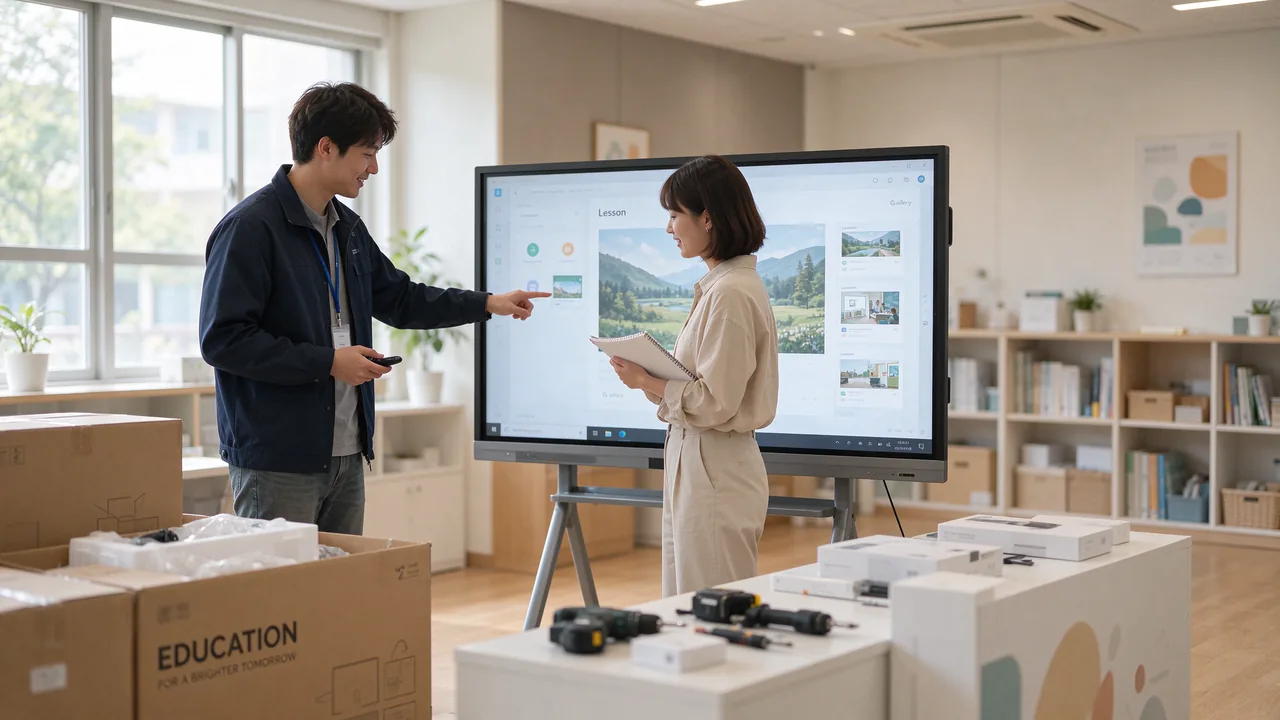
A pilot classroom validates the display configuration, installation process and teacher usage before broader batches.
-
Stage 1: Assess classroom requirements.
Record classroom quantities, room dimensions, layouts, existing power and network conditions, and the equipment already available. Group rooms by their actual teaching and technical requirements.
-
Stage 2: Run a pilot deployment.
Select representative classrooms to verify the chosen display configuration, installation process, software requirements and teacher usage. Document issues that may affect later batches.
-
Stage 3: Procure in planned batches.
Use the pilot results to finalize the equipment list and delivery plan. Coordinate product specifications, accessories, training and acceptance requirements across each batch.
-
Stage 4: Expand and manage the equipment.
Maintain consistent equipment records, training materials, warranty information and spare-parts arrangements as more classrooms are equipped.
Schools should also review the applicable equipment requirements before approving their technical specifications. The relevant rules and procurement conditions may differ according to the type of educational organization and the project.
For Kazakhstan school projects, buyers can review the applicable official requirements through the Adilet legal information system. The equipment specification and budget should be checked against the actual procurement documents rather than assuming that one configuration applies to every school.
Warranty, Spare Parts and Long-Term Budget Planning
The initial purchase price is only one part of the financial planning for an interactive flat panel project. Schools should also understand the warranty period, coverage, spare-parts arrangements and responsibilities for handling equipment issues after delivery.
Qtenboard supports 1–3-year warranty options, depending on the product model, project requirements and contractual agreement. If a school project requires a three-year warranty, the selected option should be clearly stated in the quotation and contract.
Before placing an order, buyers should confirm what the warranty covers, which conditions are excluded, how replacement parts are supplied and who is responsible for transportation and repair coordination. The warranty period alone does not describe every service responsibility.
Schools should estimate spare-parts needs according to the number of deployed units, model consistency, expected replenishment time and the agreed maintenance arrangement. A fixed spare-parts percentage should not be assumed without considering the project conditions.
For detailed warranty information, refer to the Qtenboard warranty policy and confirm the terms applicable to the specific quotation and contract.
Câu hỏi thường gặp
Should a School Prepare Its Equipment Budget in Tenge or Another Currency?
Schools can prepare internal budgets and approvals in tenge while retaining the supplier's original quotation currency. The budget should record the exchange-rate reference date, quotation validity period, payment currency and actual settlement conditions. Review the conversion before payment if the exchange rate or contract terms have changed.
How Should a School Estimate Its Spare-Parts Requirements?
Estimate spare-parts needs according to the number of installed panels, model consistency, replenishment lead time, usage environment and maintenance arrangements. Schools should also confirm which parts are covered by the warranty and which may need to be purchased separately. Avoid using an arbitrary fixed percentage without project-specific information.
Does Installation Cost Vary Between Classrooms?
Yes. Installation requirements can differ according to wall structure, mounting height, bracket type, power outlets, cable routes and room layout. A site assessment before bulk delivery helps identify additional work and makes installation planning more predictable.
What Costs May Be Excluded from an Interactive Flat Panel Supplier's Quotation?
Depending on the quotation and trade terms, excluded items may include international freight, insurance, customs clearance, local delivery, installation, extra cabling, training or additional accessories. Buyers should request an itemized quotation and confirm the responsibility for each cost before comparing suppliers.
Can Qtenboard Provide a Three-Year Warranty for School Projects?
Qtenboard supports warranty options of one to three years, depending on the product model and project requirements. For a school project that requires three years, the selected warranty option, coverage, exclusions and related responsibilities should be confirmed in writing in the quotation and contract.
Plan Your School's Interactive Flat Panel Budget
A reliable school equipment budget starts with accurate classroom information and a clearly defined quotation scope. To prepare a project proposal, buyers should share the number of classrooms, room dimensions, school locations, preferred display configurations, installation conditions and warranty requirements.
Qtenboard can review the project requirements and discuss suitable interactive flat panel configurations for education applications. The equipment list, delivery arrangement, warranty option and project responsibilities can then be clarified for quotation and procurement planning.
Explore Qtenboard education products and project solutions:
