A 110-inch smart board is not a bigger 86-inch panel. It is a 2.4-metre-wide commercial display that weighs around 158 kg, ships in a crate, needs a lift and a load-rated wall — and is usually built to order. This framework turns supplier selection into four checks, each with one document to request and one answer that disqualifies a bidder.

Verify a 110-inch smart board supplier in four passes: prove the factory, validate the exact 110-inch model, put commercial terms in writing, and close the deployment loop. A supplier who cannot produce all four is not yet a qualified bidder.
The 110-inch class sits at the top of the interactive flat panel ladder. Volumes are low, panels are custom-built, and the cost of a failed install is carried by the buyer, not the seller. That is why the first question is not “what is the price” but “what can you prove”.
A 110-inch interactive flat panel is a low-volume SKU. Most suppliers hold finished 55–86-inch stock and start a 110-inch build only after an order is confirmed, which means your deposit funds a production slot rather than a warehouse pick. Ask whether the quoted 110-inch model is a repeatable production model with an existing tooling set, or a one-off engineering build assembled around a purchased panel. The difference shows up in spare-parts continuity two years later.
A 110-inch smart board typically lands at 150–190 kg net depending on the touch technology and chassis. Qtenboard publishes 158 kg net weight for its AI-RK3588-110 model, with a 1195 × 220 mm VESA pattern. That weight decides your wall structure, the number of installers, the lift, the crate, and the freight class. None of it is visible on a quotation sheet, and all of it becomes cost if it is discovered on site.
Certificates are frequently issued for a product family, and a 110-inch model added two years later may not be listed on the original report. The gap is invisible until a tender reviewer or a customs officer opens the file. Treat a certificate without the 110-inch model number on it as no certificate at all.
| Prece | 86-inch | 98-inch | 105-inch | 110-inch |
|---|---|---|---|---|
| Active area (approx.) | 1.90 × 1.07 m | 2.17 × 1.22 m | 2.32 × 1.31 m | 2.44 × 1.37 m |
| Net weight (published) | 70 kg | 110 kg | 140 kg | 158 kg |
| Install crew | 2 people, wall or stand | 2–3 people, lift advised | 3 people, lift required | 3 people, lift and load-rated wall |
| Packing | Crate or double carton | Crate | Crate | Crate with corner protection and moisture barrier |
| Typical supply | Stock model | Stock or short build | Build to order | Build to order, project-specific |
| Documentation risk | Zems | Vidējs | Augsts | Highest — model-level certificate required |
Active areas are calculated from the diagonal at 16:9 and rounded; use the supplier's drawing for structural work.
Most “110-inch smart board manufacturers” in search results are trading companies with a product page. That is not automatically a problem — a good trader can manage a project — but the verification path changes. You need to know which entity holds the production line before you discuss price, because the entity that signs the PI is the entity that answers for the warranty.
Ask for a 3–5 minute unedited walk-through: the 110-inch assembly fixture, the aging rack loaded with large panels, the packing bench with corner foam, and the loading bay. A showroom photo proves nothing about capacity.
“200 units per day” is a plant total. Ask how many of those are 98-inch and above. Large-format output is constrained by fixtures and aging positions, not by assembly headcount.
An ISO 9001 certificate and a recent client or third-party factory audit carry more weight than a capability page. If no audit exists, ask for a video call with the production manager on the floor.
A hand-built sample can pass every test and still have nothing to do with the pallet you receive. Before approving a 110-inch sample, confirm three things in writing: the sample came off the same production line and fixture as the order, the batch will be aged under the same standard, and the acceptance criteria (dead pixels, brightness uniformity, touch linearity) are identical for sample and mass production. Then request the batch aging record with the shipment, not after the complaint.
A 110-inch interactive whiteboard is specified by numbers that a brochure tends to blur: native versus input resolution, real touch latency, heat load, and the exact certification list. Put the following four groups on your RFQ and require a written answer for each.
Native resolution. Confirm 3840 × 2160 at panel level, not “4K input supported”. Touch points and technology. 20 to 40–50 points is normal at this size; infrared frames tolerate gloves and pens but add a bezel step, capacitive gives a flush surface and better palm rejection. Bonding. Zero-air-gap bonding removes the parallax that makes large-format writing feel imprecise, and it keeps dust out of the gap. Latency. Ask for a measured figure with the pen you will actually use, on the firmware you will actually ship.
At 110 inches the panel is usually the cheapest problem to solve; the platform decision lasts longer. Confirm the Android version, the chipset and the RAM/ROM configuration, whether a Windows OPS module is supplied and at which i5/i7 tier, and how the dual-system switch behaves after a power cut. If your market expects Google services, ask for Google EDLA certification on the specific model rather than “EDLA-ready”. For fleet deployments, ask which device management system is supported and whether OTA updates can be staged by site.
A 110-inch interactive display can draw close to 500 W at maximum, and nearly all of that becomes heat inside a sealed chassis. Qtenboard publishes under 480 W maximum for its AI-RK3588-110 model. Ask for the thermal design (passive vents, fan strategy, temperature derating), the operating temperature range, and the VESA pattern with a load rating. Then have your structural engineer confirm the wall or stand against the real weight, not the shipping weight on the invoice.
Request the certificate, the test report, and a one-line statement that both cover the 110-inch model number you are buying. CE and FCC reports name the model and the internal components; if the mainboard or power board changes for your build, the report may no longer describe the unit you receive. For tenders, add the energy label, the RoHS test summary and — where the destination market asks for it — a photobiological safety report.
| Checkpoint | Ko lūgt | Reference value (Qtenboard AI-RK3588-110) |
|---|---|---|
| Izšķirtspēja | Panel spec sheet, not the input list | Native 3840 × 2160, 4K UHD, zero-bonding |
| Pieskāriens | Technology, point count, measured latency | Up to 40-point capacitive, pen and finger, palm rejection |
| Compute | Chipset, RAM/ROM, Android version, OPS tier | RK3588 octa-core 2.4 GHz, 6 TOPS NPU, 8+128 / 16+256 GB, Android 15 plus Windows OPS option |
| Kamera un audio | Resolution, field of view, mic array and pickup distance | 48 MP AI camera, 8-array microphone, 10 m pickup, AI noise reduction |
| Net weight | Net weight per model, not carton weight | 158 kg |
| Max power | Maximum and standby draw, with OPS included or not | Under 480 W maximum, under 75 W standby |
| Montāža | VESA pattern and rated load | 1195 × 220 mm |
| Brightness and glass | Nit value, anti-glare treatment, glass thickness | 500 cd/m² class, anti-glare tempered glass |
| Sertifikācija | Certificate and report naming the 110-inch model | CE / FCC / RoHS / CCC — confirm the batch-level list per order |
| Documentation set | Drawing, manual, spare-parts list, firmware version | Dimensioned drawing, English manual, spare-parts price list, locked firmware |
Reference values are published for one Qtenboard 110-inch model and are included as a benchmark for your RFQ. Confirm the current sheet for the exact model and batch you order.
At 110 inches, commercial terms carry more risk than the hardware sheet. A vague customization clause, an untested lead time or a warranty written for the wrong module will cost more than a specification difference. Four clauses decide the project.
Ask two separate questions: what is the minimum order for a standard 110-inch model, and what is the minimum for a customized one. Then define the customization boundary item by item — logo on the bezel, boot animation, launcher and UI skin, preinstalled applications, language pack, accessory set, retail packaging, and the model number printed on the label. For OEM/ODM programmes, also ask who owns the tooling and the artwork files, and whether a customized unit requires a supplementary certification or a new report.
For scale, Qtenboard's published customization guide lists software and firmware changes from a single unit with a 7–10 working-day sample cycle and 15–25 working days for mass production, while structural ODM and private-mould tooling are quoted per project. Treat those figures as reference values and re-confirm them per model before a schedule is committed.
Quoted lead time should be built from three numbers you can check: how many 110-inch units the plant can build per week, how many aging positions exist for that size, and where your order sits against confirmed bookings. Ask for the last two quarterly delivery records by model. A supplier who quotes four weeks without a fixture count is quoting hope.
“Two-year warranty” describes a period, not a remedy. Require the clause to split panel and backlight, mainboard, touch module, power board and accessories, each with its own coverage and its own replacement path. Ask for the RMA turnaround in working days, the address the unit returns to, and who pays freight. For a 158 kg panel, an advance-replacement agreement is worth more than an extra six months of coverage, because a swap by sea freight ends the project season.
If you are building a 110-inch line for one market, confirm whether the same custom build can be sold to another buyer in that market, and what exclusivity costs. Distributors should also ask how the factory handles direct enquiries from their region, and whether price lists and customer data are covered by a confidentiality clause in the agreement rather than a promise in email.
| Clause | Why it matters at 110 inches | Acceptable answer |
|---|---|---|
| MOQ, standard vs custom | Custom builds consume a full production slot | Two numbers stated separately, with sample and tooling cost called out |
| Customization scope | Unclear scope becomes an unpriced change order | A written list of modifiable items and the items that void certification |
| Lead time basis | Large panels are constrained by fixtures and aging positions | Weekly large-format capacity plus a scheduling commitment in the PI |
| Late-delivery remedy | A late 110-inch panel can miss a tender handover date | A stated remedy tied to the confirmed ship date, not to “force majeure” |
| Warranty by module | Panel, board and touch fail differently and are replaced differently | Module-level coverage, RMA turnaround in days, freight responsibility |
| Rezerves daļas | Spares for a low-volume size are not stocked locally | Recommended spares kit shipped with the order, plus a parts price list |
Most failed 110-inch projects fail on site, not in the factory: a crate that arrives with a cracked corner, a doorway that is 6 cm too narrow, a wall that was never load-checked. Verification has to reach the installation day.
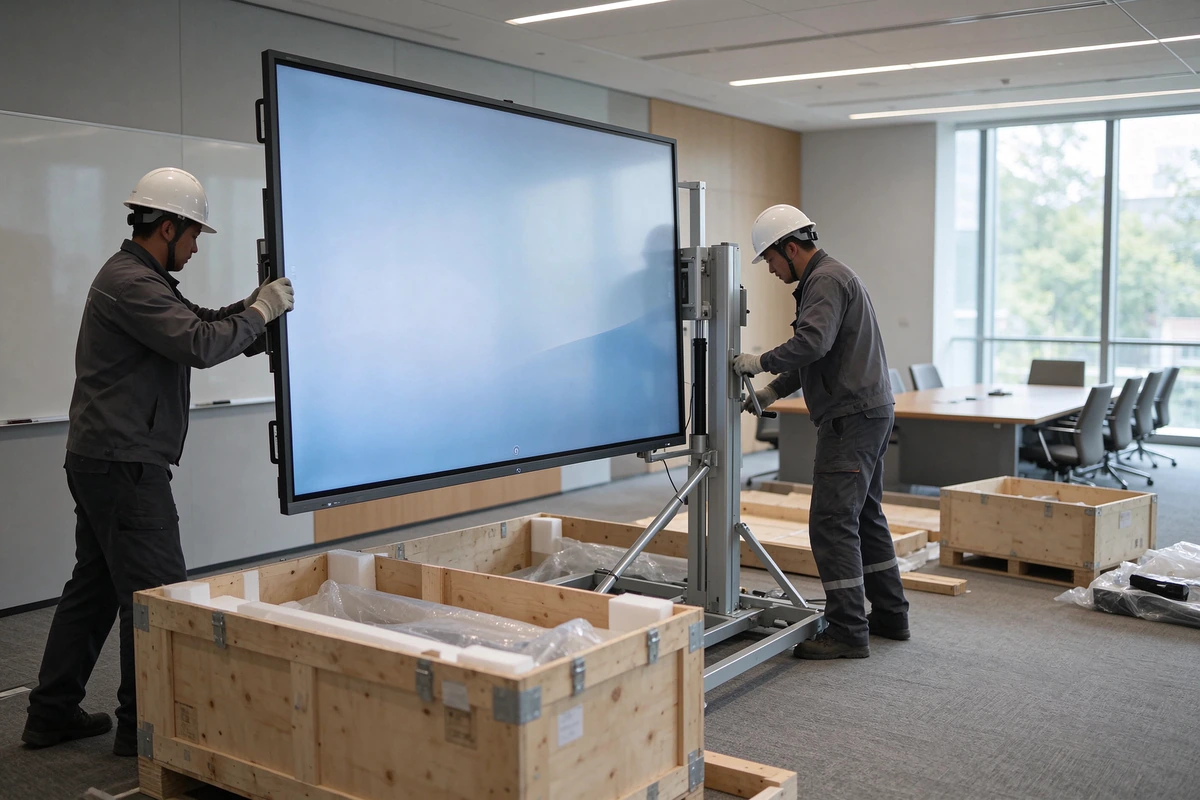
For a 158 kg panel, the packaging is part of the product. Ask for the crate drawing: plywood thickness, foam corners, an inner moisture barrier, base runners sized for a forklift, and a printed tilt or impact indicator. Confirm the drop-test standard the pack was validated against, and check that marine insurance covers the full value plus freight, not the invoice value alone. If the supplier ships 110-inch units in a single-wall carton, the conversation is over.
Write the acceptance criteria into the contract: dead-pixel allowance and its distribution, brightness uniformity across the 110-inch face, touch linearity at the four corners, colour consistency against a reference panel, and a list of meeting or classroom applications that must run before hand-over. Then have the site supervisor sign that sheet on the day. It is the only document that settles a dispute later without photographs and arguments.
A 110-inch sample is expensive to ship, so make the test count. Run it in this order and record each result — the same sheet becomes the acceptance standard for the order.
Score two to three candidates on the same sheet and the decision becomes comparable. Weight the dimensions by what actually hurts if they fail — not by brochure appeal.
| Dimensija | Svars | What a 5 looks like | What a 2 looks like |
|---|---|---|---|
| Factory identity | 25% | Licence with manufacturing scope, line video, 110-inch build records, audit report | Sales-only licence, stock photos, no model-level history |
| 110-inch capability | 25% | Repeatable build, large-format fixture and aging positions, batch QC records | One-off engineering build, sample-only evidence |
| Certification scope | 20% | Certificate and report naming the 110-inch model and the exact configuration | Family certificate covering 55–86 inches only |
| Komerciālie noteikumi | 15% | Written MOQ, customization boundary, capacity-based lead time, late-delivery remedy | Verbal MOQ, open-ended lead time, no remedy clause |
| After-sales and spares | 15% | Module-level warranty, stated RMA days, spares kit with the order | Single warranty period, no spares path, freight unclear |
Qtenboard is a Shenzhen interactive display manufacturer founded in 2005, with 21 years of LCD manufacturing behind it, three factories and a 330,000 m² industrial park. The 55–110-inch ladder is a standard production range rather than an exception, which is the practical difference when a 110-inch smart board has to be replaced or expanded two years later.
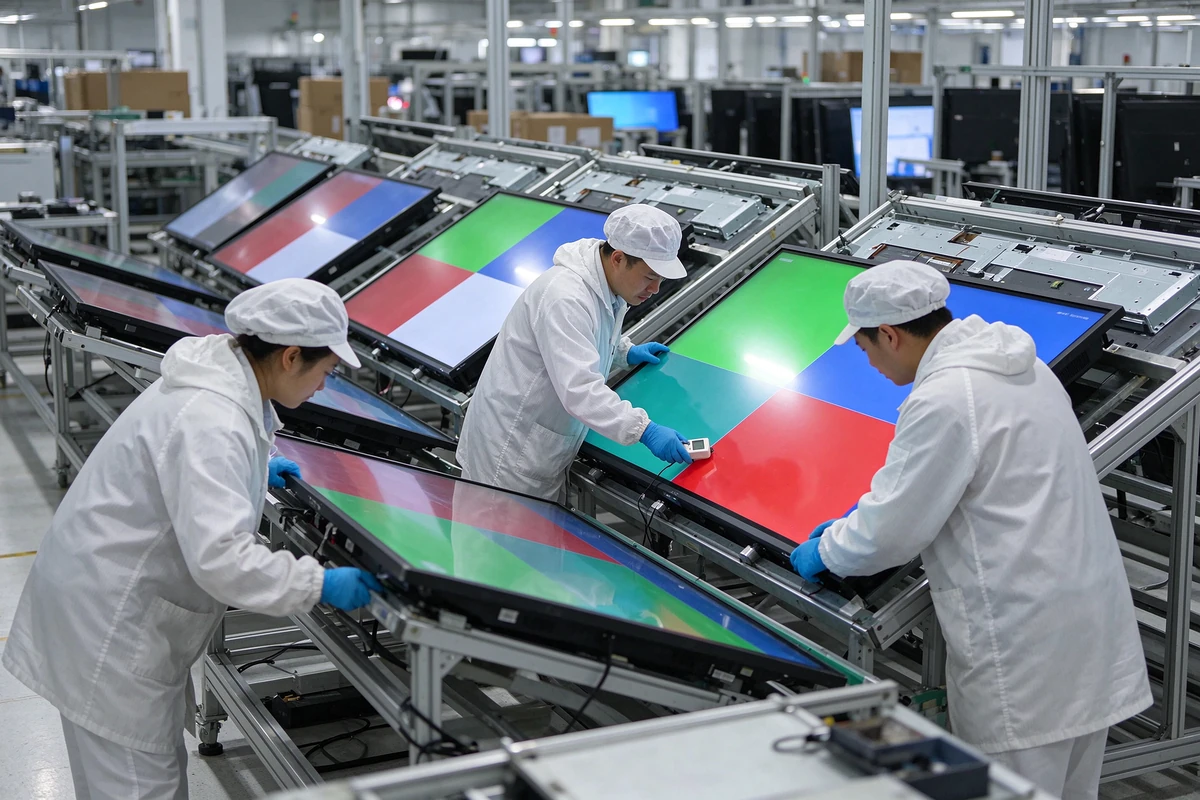
Business licence and manufacturing scope, the 110-inch model list with published specifications, the aging and outgoing-inspection standard, dimensioned drawings, and the batch-level certification list. Ask the sales team for the document pack by name and it is assembled for the project.
Qtenboard runs OEM/ODM programmes plus SKD/CKD local assembly. Logo, boot animation, launcher, language pack, preinstalled software, accessories and packaging are configurable, with the certification consequence of each change stated before the order rather than after.
An all-in-one commercial display with a 110-inch diagonal — roughly 2.44 × 1.37 m of active area — native 4K resolution, 20 to 50 touch points, built-in Android computing and an optional Windows OPS module. It is used in auditoriums, training halls, boardrooms and public venues where a 98-inch panel is too small for the back row.
No. Panel supply, assembly fixtures, aging racks, crate design and installation method all change at this size. Published Qtenboard figures show the jump clearly: 70 kg at 86 inches against 158 kg at 110 inches, with a different VESA pattern.
Ask for the certificate and the test report, then find the model number and the internal component list on both. If the 110-inch model is absent, or the report describes a different mainboard or power board, request an amendment or a model-specific report before the tender submission.
Native resolution, panel type and brightness, touch technology and point count, measured writing latency, chipset with RAM/ROM, Android version, OPS option, net weight, maximum and standby power, VESA pattern and rated load, operating temperature, plus a dimensioned drawing.
A three-person crew, a lift frame, a wall or stand rated for the real net weight, and a route measured against the crate rather than the panel. Doorway width, elevator capacity and wall structure should be confirmed before the unit ships, not on delivery day.
Yes, at manufacturer level the 110-inch class is commonly customized. Logo, boot animation, launcher, language pack, preinstalled applications and packaging are the usual scope; confirm which changes require a supplementary certification and who owns the tooling and artwork.
A module-level clause rather than one blanket period: panel and backlight, mainboard, touch module, power board and accessories each stated separately, with an RMA turnaround in working days and a clear statement of who pays return freight.
Confirm it came off the mass-production fixture, age it for 72 hours at maximum brightness, measure brightness at nine points, test touch linearity at the corners, run your own meeting or classroom software, and inspect the crate and spare-parts kit before approval.
Lead time depends on large-format fixture and aging capacity, not on assembly speed. Ask for the weekly 98-inch-and-above output, the last two quarterly delivery records, and a scheduling commitment written into the proforma invoice.
It depends on the platform you specify. Qtenboard offers Google native EDLA certification on qualifying models and Android plus Windows dual-system configurations with an OPS module; confirm the exact model, Android version and certification status on the quotation rather than on a marketing page.
Tell us the venue, the farthest viewing distance, the number of units and the target market. We will come back with the 110-inch configuration, the certification list for that model, the crate and freight plan, and the spare-parts kit we recommend holding.

Ceo | interaktīva displeja un sadarbības risinājumu eksperts
Esmu Qtenboard dibinātājs, un man ir vairāk nekā 17 gadu praktiskas pieredzes skārienjūtīgo ekrānu nozarē. Pamatojoties uz globālās vadības perspektīvu, kas iegūta, izmantojot emba studijas šengenas universitātē, es vadu savu komandu, optimizējot katru darbības posmu-no produktu definīcijas līdz augstas efektivitātes piegādes ķēdes pārvaldībai-nodrošinot, ka mūsu ražošanas spējas paliek nozares priekšgalā.
Kā qtenboard līderis, es specializējos, lai nodrošinātu pielāgotus oem/odm risinājumus interaktīvajām tāfelēm, lcd video sienām, ciparu apzīmēm un rūpnieciskās kvalitātes pieskāriena termināļiem. Atbalstīts mūsu 330,000 m² mūsdienu rūpniecības parks shenzhen, mēs uzturēt pilnu dzīves cikla kontroli pār rūpniecisko dizainu, precizitāti ražošanu un stingru veiktspējas testēšanu.
Ar gandrīz divus gadu desmitus ilgu projekta pieredzi, qtenboard displeja risinājumi tagad tiek izvietoti vairāk nekā 120 valstīs un reģionos, nopelnījis vairāk nekā 15,000 uzņēmumu klientu uzticību visā pasaulē. Ja jūs meklējat atsaucīgu partneri ar dziļu ražošanas pamatu jūsu pielāgotiem touch displeja projektiem, mans komanda un es esam gatavi atbalstīt jūsu vīziju ar profesionālu izcilību.

 lav
 EN
 spa
 pt
 vie
 th
 est
 aze
 ukr
 bel
 ru